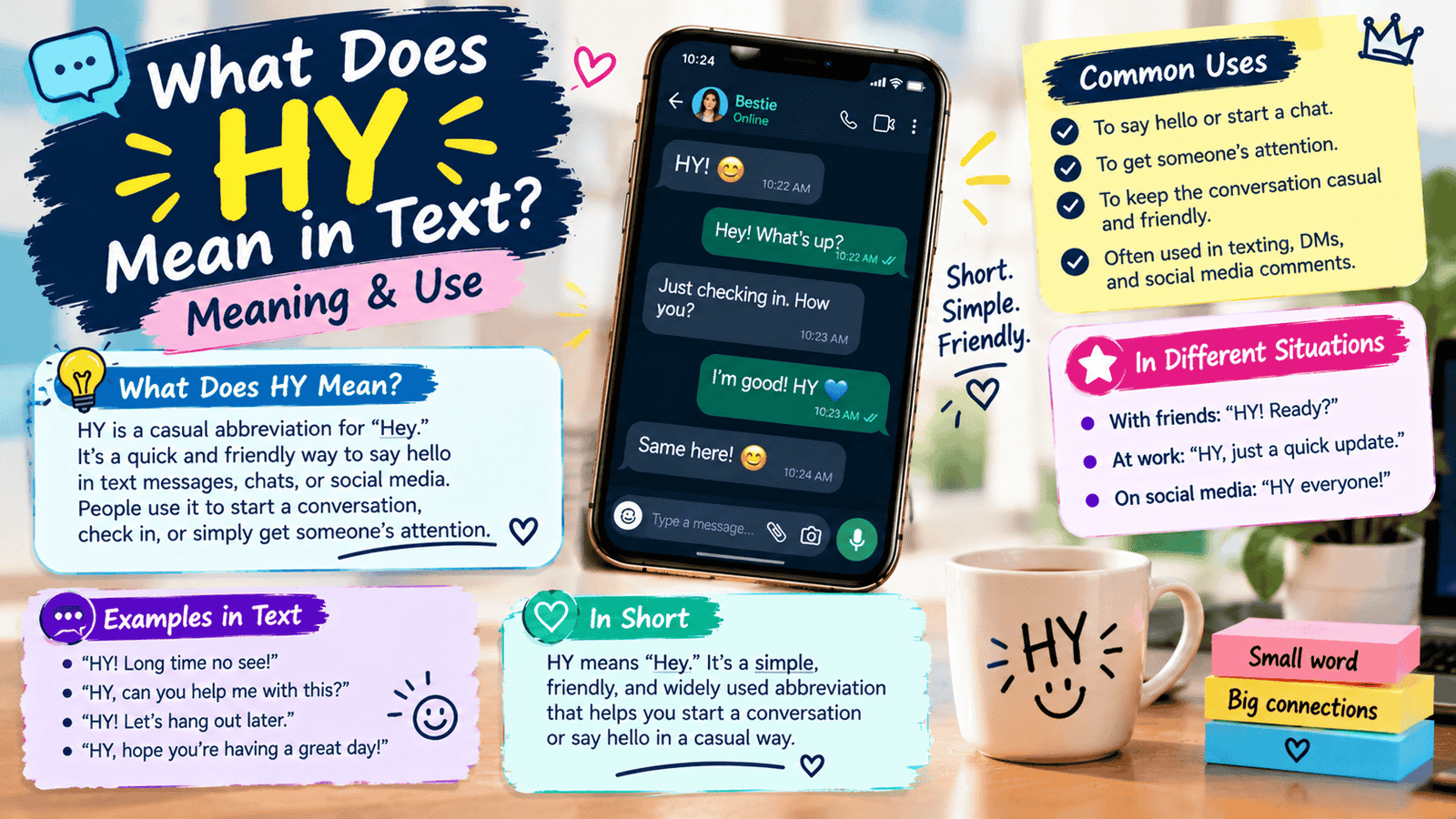
What Does HY Mean in Text? Meaning & Use
If someone sends you “HY” in a text, the meaning usually depends on the conversation and the person using it. In casual American texting, HY most commonly means “hell yeah,” an informal way to show strong agreement, excitement, or enthusiasm.
For example, if a friend texts, “Want to go to the concert tonight?” and you reply, “HY!”, you are essentially saying, “Hell yeah!” or “Absolutely!”
However, abbreviations can be ambiguous. In some conversations, HY may be intended to mean something else, such as “how you?”, especially when the surrounding message suggests a greeting or question. That is why the words around HY, the relationship between the people, and the overall tone of the conversation matter.
Quick Answer
HY most commonly means “hell yeah” in texting and online communication. It expresses strong agreement, excitement, approval, or enthusiasm.
Most common meaning: Hell yeah
Other possible meaning: “How you?” or another community-specific abbreviation, depending on context.
For example:
“Are you coming with us tonight?”
“HY!”
Here, HY means “Hell yeah!”
Because HY is very short, it should not automatically be interpreted one way in every conversation. If it appears after a question that expects a yes-or-no response, “hell yeah” is often the natural interpretation.
HY Meaning in Simple English
In everyday texting, HY is usually a shortened version of “hell yeah.” The phrase “hell yeah” is an informal expression of strong agreement. It is similar to saying “absolutely,” “definitely,” “for sure,” or “yes!”
The word “hell” makes the expression more emphatic than a simple “yeah.” It can communicate excitement or strong approval, especially between friends.
Example 1
Friend: “Do you want pizza tonight?”
You: “HY!”
In this situation, HY means “Hell yeah!” The response shows enthusiasm rather than a reluctant yes.
Example 2
Friend: “That movie was actually amazing.”
You: “HY, it was!”
Here, HY communicates strong agreement. The person is enthusiastically agreeing with the other person’s opinion.
Example 3
Friend: “You still down for the road trip?”
You: “HY!”
The abbreviation means “Hell yeah!” and suggests that the person is definitely interested in going.
HY is therefore much more energetic than simply replying “yes.” The exact emotional strength still depends on the conversation, punctuation, capitalization, and relationship between the people.
HY Meaning at a Glance
| Feature | Common meaning |
|---|---|
| Common meaning | Hell yeah |
| Tone | Enthusiastic, casual, strongly positive |
| Formality | Very informal |
| Typical use | Agreement, excitement, approval |
| Common platforms | Text messages, DMs, group chats, social media |
| Best used with | Friends and people you know casually |
| Avoid in | Formal emails, academic writing, professional messages |
Origin and Background of HY
HY belongs to the broader tradition of shortening words and phrases in digital communication. Text messaging encouraged people to communicate quickly, and online communities developed their own abbreviations for common expressions.
The phrase “hell yeah” itself predates modern texting. It has long been used in informal American English to express enthusiastic agreement or approval. HY is a compressed digital form that removes the words while keeping their recognizable initials.
There is not one universally established date when HY became a standard abbreviation. Like many internet expressions, its usage has developed gradually through texting, online communities, social media, gaming conversations, and private messaging.
Context is especially important because short abbreviations can develop different meanings in different communities. HY does not have one universally guaranteed interpretation in every message.
Real-Life Conversations
Text Message
Person A: You wanna grab burgers after work?
Person B: HY 😂
What HY communicates: Person B is enthusiastically agreeing. The laughing emoji makes the reply feel even more relaxed and playful.
Instagram DM
Person A: That new album is so good.
Person B: HY, I’ve had it on repeat.
What HY communicates: Here, HY means “hell yeah” and strongly agrees with the opinion.
TikTok Comment
Person A: We need more videos like this.
Person B: HY!!
What HY communicates: The capital letters and exclamation marks make the abbreviation look more energetic. The commenter is strongly agreeing.
Group Chat
Person A: Beach this Saturday?
Person B: HY
Person C: I’m in
Person A: Let’s do it.
What HY communicates: Person B is enthusiastically confirming that they want to participate.
Tone and Emotional Meaning of HY
The emotional meaning of HY usually comes from enthusiastic agreement. It can sound energetic, confident, playful, or excited depending on the conversation.
For example, “HY!” can feel much more enthusiastic than “yeah.” Adding an emoji can make the meaning more playful:
“HY 😂” can communicate excited agreement with humor.
Capitalization can also affect how the message feels. “hy” may appear more relaxed, while “HY!!!” can look much more energetic.
Context can change the emotional interpretation as well. If someone asks, “Are you seriously coming?” and the answer is “HY,” the response may communicate strong confirmation.
The relationship also matters. Between close friends, HY can feel completely natural. In a conversation with someone unfamiliar, the same abbreviation may feel overly casual or unclear.
How HY Is Used in Different Situations
Friends
Among friends, HY can be a natural way to express strong agreement.
“Movie tonight?”
“HY!”
It works particularly well when the conversation is relaxed and informal.
Dating and Relationships
HY can also appear in casual dating conversations.
“Want to see me tonight?”
“HY ❤️”
In this context, it may communicate enthusiasm about spending time together. However, the surrounding conversation determines whether it sounds romantic, playful, or simply friendly.
Family
Some people may use HY with siblings, cousins, or other family members, especially if the family regularly uses texting slang.
It is less likely to appear in more formal family communication, such as an important message to an older relative who may not recognize the abbreviation.
Social Media
HY can appear in comments, replies, captions, and direct messages when users want to show strong agreement or excitement.
For example:
“This is exactly what I needed today.”
“HY!”
The abbreviation keeps the response short while still showing enthusiasm.
Gaming
Gamers and online communities frequently use short expressions because conversations can move quickly.
A player might say:
“Ranked after this?”
“HY.”
Here, HY can mean an enthusiastic yes.
School
Students may use HY in private messages or group chats with friends. It is still casual slang, however, and should not normally be used in academic assignments.
Workplace
HY is generally too informal for professional communication. Even if coworkers understand it, a clearer phrase such as “Absolutely” or “Definitely” is usually better in work-related messages.
Social Media Usage
You may encounter HY in informal digital conversations on platforms such as TikTok, Instagram, Snapchat, Discord, Reddit, Facebook, WhatsApp, and ordinary text messages.
The important point is that these platforms do not necessarily give HY one official meaning. People use abbreviations according to their own communities, friend groups, and communication habits.
On social media, HY may appear as a quick reaction to something exciting:
“We finally got tickets!”
“HY!!!”
In this example, the abbreviation is functioning almost like an enthusiastic verbal reaction.
On platforms where comments are short and fast-moving, abbreviations can be especially convenient. Still, unfamiliar readers may interpret HY differently if there is not enough context.
When NOT to Use HY
HY is best reserved for casual communication.
Avoid relying on it when clarity and professionalism are important, especially in:
- Job applications
- Professional emails
- Academic assignments
- Formal requests
- Business correspondence
- Messages to unfamiliar professional contacts
- Official documents
Instead of:
“HY, I’d love to join.”
A professional version would be:
“Absolutely, I’d be happy to join.”
Or:
“Yes, definitely. I’d be glad to participate.”
The issue is not that HY is inherently wrong. It simply belongs to a much more informal communication style.
Common Misunderstandings
The biggest problem with HY is that short abbreviations can be ambiguous.
Someone unfamiliar with texting slang may not know whether HY means “hell yeah,” “how you?” or something specific to a particular online community.
Context Confusion
If someone sends only:
“HY”
there may not be enough information to know exactly what they mean.
If the previous message was:
“Are you coming?”
then “hell yeah” makes sense.
If the previous message was:
“Hey, haven’t talked to you in a while. HY?”
the sender may instead be using it as a shortened question such as “How you?”
Tone Confusion
“HY!” generally feels enthusiastic, but the same abbreviation can sound different depending on punctuation and context.
“HY!!” looks excited.
“hy” may feel more relaxed.
“HY 😂” can suggest playful enthusiasm.
Assuming Every Abbreviation Has One Meaning
Texting slang is highly contextual. An abbreviation that has one meaning in a particular friend group may mean something else somewhere else.
When the surrounding conversation does not make the meaning clear, asking for clarification is better than guessing.
Comparison With Similar Expressions
| Expression | Typical meaning | Tone |
|---|---|---|
| HY | Hell yeah | Very casual, enthusiastic |
| Yeah | Yes or agreement | Casual, neutral |
| Yup | Yes | Casual, relaxed |
| Yep | Yes | Casual, friendly |
| Absolutely | Strong agreement | Positive, clearer |
| Definitely | Strong confirmation | Confident, neutral |
| For sure | Agreement or confirmation | Casual, friendly |
Key Insight
The main difference is intensity and formality. HY is a highly casual abbreviation that can communicate strong enthusiasm, while expressions such as “absolutely” and “definitely” are clearer and more appropriate in professional or unfamiliar settings.
Variations and Related Forms
1. HY
Meaning: Usually “hell yeah”
Tone: Very casual and enthusiastic
Example: “Want to come with us?” “HY!”
2. Hell yeah
Meaning: Strong agreement or excitement
Tone: Very casual and emphatic
Example: “Hell yeah, I’m coming.”
3. Yeah
Meaning: Yes or agreement
Tone: Casual and neutral
Example: “Yeah, that sounds good.”
4. Yup
Meaning: Yes
Tone: Casual and relaxed
Example: “Yup, I’m ready.”
5. Yep
Meaning: Yes
Tone: Casual and friendly
Example: “Yep, I’ll be there.”
6. Absolutely
Meaning: Strong agreement
Tone: Positive and more polished
Example: “Absolutely, I’d love to go.”
7. Definitely
Meaning: Strong confirmation
Tone: Confident and neutral
Example: “Definitely. Count me in.”
8. For sure
Meaning: Definitely or certainly
Tone: Casual and friendly
Example: “For sure, I’ll text you later.”
Not all of these are direct abbreviations of HY. They are included because they can perform a similar conversational function when someone wants to express agreement or confirmation.
How to Respond to HY
Your response should match the situation and the tone of the conversation.
Casual Replies
- “Let’s go!”
- “Same!”
- “Absolutely!”
- “For sure!”
- “I knew you’d say yes 😂”
These work well with friends.
Friendly Replies
- “Awesome, see you then!”
- “Perfect!”
- “Sounds good!”
- “Haha, I’m glad you’re in.”
These are useful when you want to continue the conversation naturally.
Funny Replies
- “That was the energy I was looking for 😂”
- “I knew it!”
- “Say less!”
- “Now we’re talking 😂”
Use these when the conversation is already playful.
Short Replies
If you want to keep things brief, you can answer with:
- “Bet.”
- “Same.”
- “Yep!”
- “Absolutely.”
Mature Replies
For a more composed tone:
- “Definitely.”
- “Absolutely, I’m interested.”
- “Yes, that works for me.”
- “I’d be happy to.”
Respectful Replies
If you’re not sure how informal the conversation should be:
- “Absolutely.”
- “Yes, definitely.”
- “That sounds good to me.”
These responses communicate agreement without relying on slang.
Generational and Cultural Usage
HY is part of a broader digital communication style in which people shorten common phrases. However, not everyone uses or recognizes the same abbreviations.
Gen Z users may be especially comfortable with rapidly changing internet language, while Millennials and older internet users may recognize many abbreviations from years of texting and online communication. That does not mean every person in a generation uses HY or interprets it identically.
International English users may also encounter HY through American social media, gaming, entertainment, and online communities. Someone who learned English primarily through formal education may understand “hell yeah” more easily than the abbreviation itself.
The safest approach is to consider the specific community and conversation, rather than assuming someone’s age or background determines what HY means.
Is HY Appropriate for Kids and Teens?
HY is generally a casual slang abbreviation. Its most common interpretation, “hell yeah,” contains the word “hell,” which some families, schools, or communities may consider inappropriate or unsuitable in certain settings.
The expression is not automatically harmful, but context matters. Parents and educators who encounter HY should look at the surrounding conversation before deciding what it means.
For schoolwork, formal communication, or situations requiring standard English, a teen would generally be better off writing “yes,” “definitely,” or “absolutely.”
Casual vs. Formal English
| Casual Expression | More Formal Alternative |
|---|---|
| HY! | Absolutely! |
| HY, I’m in. | Yes, I’d be happy to participate. |
| HY, let’s do it. | Definitely, let’s proceed. |
| HY! That sounds fun. | Absolutely, that sounds great. |
The casual version works best when you’re talking with friends or people who regularly use texting slang. Standard alternatives are better when communicating with teachers, employers, clients, managers, or unfamiliar professional contacts.
FAQs About HY in Text
What does HY mean in text?
HY most commonly means “hell yeah.” It is an informal way to express strong agreement, excitement, or enthusiasm.
Is HY slang?
Yes. When HY is used to mean “hell yeah,” it is informal texting and internet slang. It is not appropriate for most formal or professional writing.
What does HY mean on social media?
On social media, HY commonly means “hell yeah” when someone wants to strongly agree with or enthusiastically support something. The exact meaning can still depend on the surrounding conversation.
Is HY the same as “hell yeah”?
Usually, yes. In casual texting, HY is commonly used as a shortened form of “hell yeah,” especially when responding enthusiastically to a question or statement.
Can HY mean “how you?”
It can, depending on the person and context. If HY appears as part of a greeting or a question about someone’s well-being, clarification may be necessary because abbreviations can have multiple interpretations.
How should I respond to HY?
If HY means “hell yeah,” you can respond naturally with phrases such as “Absolutely,” “Let’s go!” “For sure,” or “Awesome!” Choose your response based on how casual the conversation is.
Should I use HY at work?
Generally, it is better to avoid HY in professional communication. Use clearer expressions such as “Absolutely,” “Definitely,” “Yes,” or “That works for me” instead.
Conclusion
When someone uses HY in a text, the most common meaning is “hell yeah.” It is an informal, enthusiastic way to say yes, show strong agreement, or express excitement. The abbreviation is especially natural in conversations between friends and in casual online communication.
Still, HY is not guaranteed to have the same meaning in every message. Context, punctuation, the relationship between the speakers, and the surrounding words can all affect interpretation. If the message is unclear, checking the context or asking what the person means is better than assuming.
Digital language changes quickly, but the basic rule remains simple: understand the conversation before interpreting the abbreviation. Knowing both the slang meaning and the appropriate standard-English alternative makes it easier to communicate clearly across casual, social, academic, and professional settings.