Mushroom Symbolism and Spiritual Meaning in the USA
Quick Answer
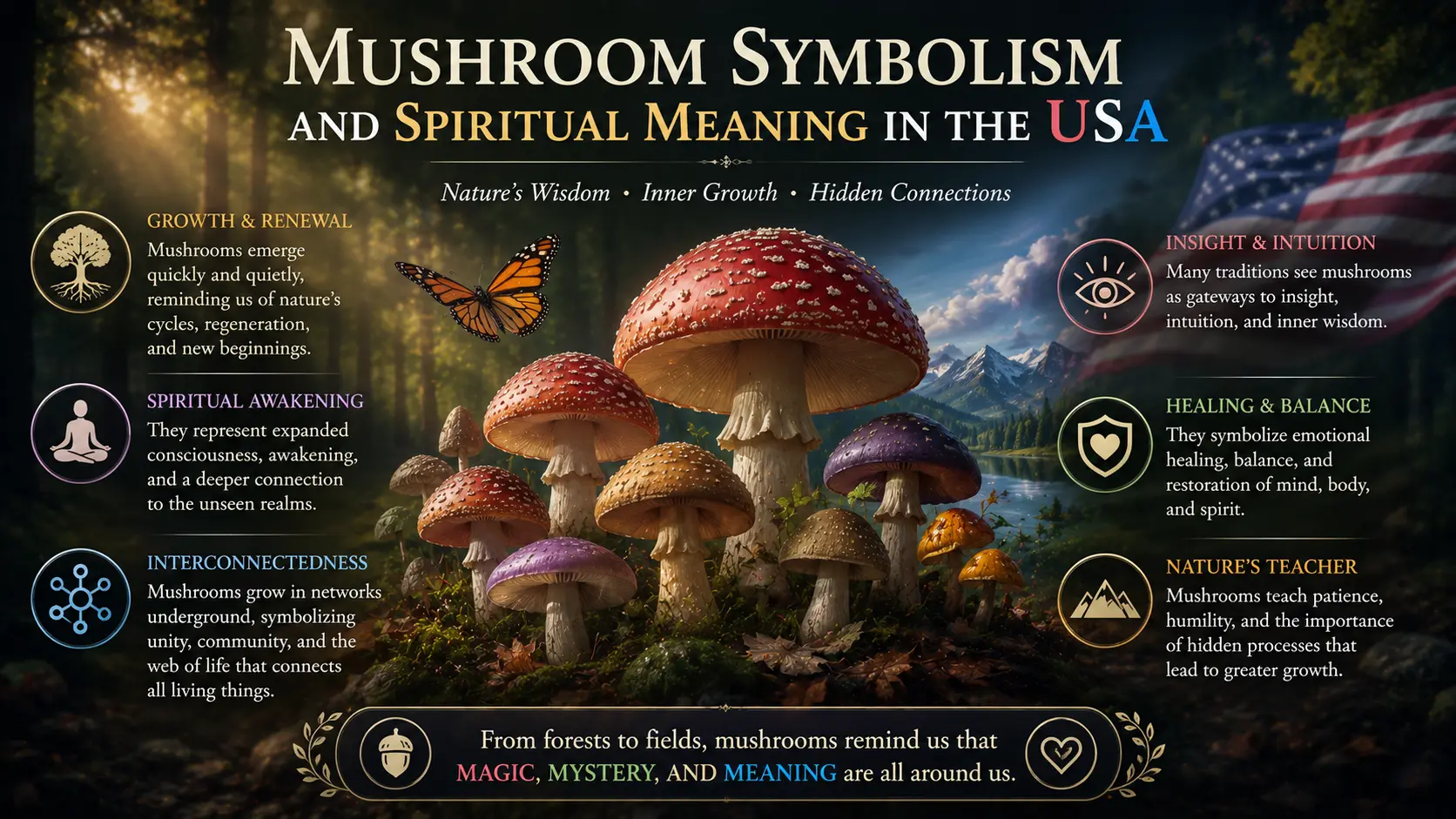
Mushroom symbolism is commonly associated with transformation, renewal, mystery, hidden knowledge, resilience, interconnectedness, and personal growth. Because mushrooms emerge from darkness, decay, and unseen underground networks, they can symbolize the idea that something meaningful may develop beyond ordinary perception.
In the United States, mushroom symbolism has many interpretations. Some are rooted in nature and folklore, while others appear in spirituality, art, tattoos, fashion, environmental movements, and popular media. Meanings can be positive, mysterious, playful, or cautionary depending on context.
TL;DR
Mushrooms often symbolize transformation, rebirth, mystery, resilience, connection with nature, and unseen growth. Their life cycle makes them powerful symbols of change because they emerge quickly from environments associated with decay and renewal.
In American culture, mushrooms can represent everything from woodland magic and ecological awareness to individuality and curiosity. Their symbolism is not universal, however, and interpretations vary by culture, personal experience, and the particular mushroom being represented.
What Is Mushroom Symbolism?
Mushroom symbolism is the practice of giving mushrooms metaphorical, spiritual, emotional, or cultural meanings based on their appearance, growth patterns, natural environment, and role in ecosystems.
Mushrooms are especially interesting symbols because much of their life exists beneath the surface. The visible mushroom may appear suddenly, while an extensive fungal network remains hidden underground. This contrast between what is visible and what is unseen has inspired associations with mystery, hidden potential, intuition, and transformation.
Visual and Natural Characteristics
Mushrooms have unusual shapes, textures, colors, and growth habits. Some appear delicate and fragile, while others thrive in forests, soil, fallen wood, and other environments where decomposition is taking place.
Their ability to participate in decomposition gives them a symbolic connection with cycles of death and renewal. Rather than representing an ending alone, mushrooms can suggest that one stage of life becomes the foundation for another.
Core Meanings at a Glance
Common symbolic interpretations of mushrooms include:
- Transformation — change and personal evolution.
- Renewal — new life emerging from old conditions.
- Mystery — hidden processes and unexplained experiences.
- Resilience — continuing to grow under challenging conditions.
- Connection — relationships between organisms and ecosystems.
- Grounding — association with soil, forests, and natural cycles.
- Hidden potential — unseen development before visible results.
- Curiosity — exploration of unfamiliar ideas or experiences.
These meanings are symbolic rather than fixed definitions. A mushroom image can communicate something very different depending on why a person chooses it.
Ancient and Pre-Christian Roots of Mushroom Meaning
Long before modern environmentalism and pop culture, fungi existed within human relationships with forests, food, medicine, folklore, and ritual practices. Because some mushrooms were familiar foods while others were poisonous or unusual, they naturally attracted attention.
Historical mushroom symbolism is therefore diverse. It is important not to assume that every ancient culture assigned the same spiritual meaning to fungi.
Early Ritual and Mythic Associations
Some cultures have associated particular fungi with altered states, ritual experiences, or sacred practices. In these contexts, mushrooms could become symbols of contact with the sacred, altered perception, mystery, or communication with a spiritual realm.
However, historical claims about mushroom rituals can sometimes be exaggerated online. Not every ancient mushroom image or reference proves that a culture used mushrooms for spiritual purposes. Responsible interpretation requires distinguishing documented traditions from modern speculation.
European Folk Traditions
European folklore contains numerous stories involving forests, fairies, elves, magical creatures, and unusual woodland growth. Mushrooms sometimes became part of this imaginative landscape because they could appear suddenly and form distinctive circles.
The famous fairy ring became particularly rich in folklore. Circular mushroom growth was sometimes interpreted as a supernatural gathering place. This helped connect mushrooms with enchanted forests, hidden worlds, magic, and otherworldly activity.
See Also: Glizzy Meaning in 2026: What It Stands For & Safer Alternatives
Mushroom Symbolism in the United States
Mushroom symbolism in the United States developed through a mixture of Indigenous traditions, European folklore, scientific understanding, environmental awareness, and popular culture.
There is no single American interpretation. Instead, mushrooms can carry different meanings depending on whether they appear in an ecological, artistic, spiritual, culinary, folkloric, or recreational context.
Nature and American Identity
The American relationship with forests and wilderness has helped make mushrooms symbols of exploration, biodiversity, and the natural world.
For hikers, gardeners, naturalists, and foragers, mushrooms may represent curiosity about ecosystems and appreciation for organisms that are often overlooked. Their presence can remind people that forests contain complex systems extending far beyond what humans can immediately see.
Mushrooms can therefore symbolize a more attentive relationship with nature: look beneath the surface, notice the small things, and recognize hidden connections.
Pop Culture and Media Influence
American movies, video games, books, illustrations, and children’s media have contributed significantly to mushroom imagery. Brightly colored mushrooms can suggest fantasy and playfulness, while darker mushroom imagery can evoke mystery, danger, or surrealism.
This cultural exposure means that a mushroom tattoo, illustration, or decorative object may communicate several layers simultaneously. For one person, it may mean woodland magic; for another, creativity or transformation.
Spiritual Meaning of Mushrooms Today
Modern spiritual interpretations frequently focus on what mushrooms can teach symbolically about change, impermanence, interconnectedness, and unseen development.
These interpretations do not require a person to believe that mushrooms possess supernatural powers. Symbolism can simply provide a framework for reflection.
Connection to the Unseen
A mushroom is only the visible portion of a much larger fungal organism. This makes it a compelling metaphor for the unseen dimensions of life.
Spiritually, the mushroom may represent hidden emotions, intuition, unconscious thoughts, relationships, or possibilities that are developing before they become obvious. Its message can be interpreted as an invitation to pay attention to what exists beneath the surface.
Personal Growth and Awakening
Because mushrooms can emerge rapidly under favorable conditions, they are sometimes viewed as symbols of awakening and sudden personal change.
A person experiencing a major transition might interpret mushroom imagery as a reminder that growth does not always happen visibly. Important changes can occur quietly before they become noticeable to others.
Psychological and Emotional Associations
Mushrooms can also function as psychological symbols. Their unusual appearance and connection with forests, darkness, decay, and renewal can trigger different emotional responses.
For some people, mushrooms feel comforting and earthy. For others, they may appear strange, unsettling, or mysterious.
Feelings Mushrooms Evoke
Common emotional associations include:
- Wonder
- Curiosity
- Peace
- Mystery
- Nostalgia
- Connection with nature
- Caution
- Imagination
The emotional meaning often depends on presentation. A colorful mushroom illustration may feel cheerful and whimsical, whereas a dark forest mushroom scene may feel mysterious or eerie.
Identity and Inner States
People sometimes use mushroom imagery to express an identity centered around individuality, natural living, creativity, curiosity, or unconventional thinking.
Symbolically, mushrooms can also represent a person who is comfortable with complexity. They remind us that something does not need to be immediately understood to be meaningful.
Cross-Cultural and Spiritual Perspectives
Mushroom symbolism becomes more nuanced when viewed across cultures. Different societies have developed their own relationships with fungi based on local environments, traditions, food systems, medicine, folklore, and spiritual practices.
Global Symbolic Themes
Although meanings differ, recurring themes include:
| Symbolic Theme | Why Mushrooms Fit |
|---|---|
| Transformation | They participate in decomposition and renewal |
| Mystery | Much of fungal life remains hidden |
| Resilience | Fungi can thrive in diverse environments |
| Connection | Fungal networks interact with plants and ecosystems |
| Renewal | New growth can emerge from decaying material |
| Nature | Mushrooms are closely associated with forests and soil |
| Curiosity | Their diversity encourages exploration |
These themes are broad symbolic patterns rather than universal cultural rules.
Respectful Modern Awareness
It is important to avoid treating spiritual interpretations from different cultures as interchangeable. A mushroom may have a specific cultural or ceremonial significance in one community that should not automatically be generalized to everyone.
Modern discussions should also distinguish symbolic meaning from scientific fact. A mushroom can inspire spiritual reflection without that symbolism proving a supernatural claim.
Modern Uses of Mushroom Symbolism
Today, mushroom imagery appears across creative and lifestyle spaces. Its versatility makes it useful for people who want to communicate ideas about nature, mystery, fantasy, individuality, or transformation.
Art, Tattoos, and Fashion
Mushroom tattoos often symbolize growth, change, connection with nature, mystery, or an appreciation for woodland imagery.
Artists may combine mushrooms with moons, stars, flowers, insects, forests, eyes, or other symbols to create a deeper narrative. The final meaning depends heavily on the surrounding imagery and the person’s intention.
Home Decor and Digital Spaces
Mushroom designs can create a cozy, earthy, whimsical, or mystical atmosphere. They appear in wall art, ceramics, textiles, illustrations, wallpapers, and digital graphics.
In online spaces, mushroom imagery can also communicate creativity, alternative aesthetics, fantasy, nature appreciation, or curiosity without having one universally accepted meaning.
Common Contexts and Meanings in the USA
The meaning of a mushroom can change significantly depending on where it appears.
In nature: mushrooms may symbolize biodiversity, ecological cycles, and hidden life.
In tattoos: they may represent transformation, resilience, individuality, mystery, or personal growth.
In fantasy art: mushrooms often suggest magic, enchanted forests, imagination, or hidden worlds.
In environmental discussions: they can represent decomposition, interconnected ecosystems, and natural sustainability.
In spiritual discussions: mushrooms may symbolize awakening, unseen knowledge, renewal, and inner transformation.
In food culture: mushrooms can represent nourishment, culinary exploration, and appreciation of the natural world.
In popular culture: they may carry playful, fantastical, mysterious, or nostalgic meanings.
Misunderstandings and Controversies
Because mushroom imagery appears in many different settings, it can sometimes be interpreted too narrowly.
A mushroom does not automatically represent one particular spiritual practice, recreational activity, or belief system. Context matters.
Association With Illicit Use
Some people strongly associate mushroom imagery with psychedelic mushrooms. That association exists in modern American culture, but it is only one possible interpretation.
Mushrooms encompass an enormous variety of species and uses. Symbolic mushroom imagery can refer to forests, ecology, food, folklore, fantasy, personal growth, or transformation without referring to psychoactive substances.
Over-Simplification Online
Internet posts sometimes claim that mushrooms universally mean a particular spiritual message. Such statements can make symbolism appear more definitive than it really is.
A more useful approach is to treat mushroom symbolism as interpretive rather than absolute. Your personal experience, cultural background, the type of mushroom, and the context in which it appears can all influence its meaning.
How Mushroom Symbolism Has Shifted Over Time
The symbolic image of mushrooms has changed considerably. What was once mysterious or frightening can now be viewed as beautiful, ecological, scientific, or fashionable.
From Fear to Fascination
Historically, unfamiliar mushrooms could inspire caution because some species are poisonous and their sudden appearance seemed mysterious.
As scientific knowledge expanded, mushrooms increasingly became objects of study and appreciation. Their role in decomposition, ecosystems, food systems, and biology helped replace some fear with curiosity and fascination.
Modern Reclamation
Contemporary artists and nature enthusiasts have embraced mushroom imagery as a symbol of ecological awareness, creativity, resilience, and interconnectedness.
This modern interpretation often moves beyond the idea of mushrooms as strange forest objects. Instead, fungi can represent a deeper understanding of how life operates through cooperation, decomposition, adaptation, and renewal.
FAQs
What do mushrooms symbolize spiritually?
Mushrooms can spiritually symbolize transformation, renewal, mystery, hidden knowledge, resilience, and interconnectedness. Their underground growth makes them especially suited to representing unseen aspects of life.
Are mushrooms a symbol of transformation?
Yes. Mushrooms can represent transformation because they participate in natural cycles of decomposition and renewal. Their appearance can metaphorically suggest new growth emerging from changing circumstances.
Why are mushrooms linked to mystery?
Mushrooms are linked with mystery because their visible fruiting bodies can appear suddenly while much of the organism exists beneath the surface. Their unusual forms and forest associations have also contributed to their mysterious reputation.
Do mushrooms have negative symbolism?
They can. Depending on cultural or personal context, mushrooms may symbolize danger, uncertainty, decay, toxicity, or the unknown. Negative interpretations are not universal, however.
Are mushrooms important in American culture?
Yes. Mushrooms appear in American food culture, science, environmentalism, folklore, art, fashion, fantasy, and popular media. Their meanings vary considerably across these settings.
Conclusion
Mushroom symbolism and spiritual meaning in the USA reflect a fascinating combination of nature, folklore, psychology, creativity, and modern culture. Mushrooms can represent transformation because they participate in cycles of decomposition and renewal, while their hidden underground networks make them powerful symbols of mystery and unseen connections.
Today, mushroom imagery can communicate growth, resilience, curiosity, ecological awareness, individuality, or spiritual reflection. Its meaning is ultimately shaped by context and personal interpretation rather than a single universal definition.
Whether encountered in a forest, tattoo, artwork, dream, home decoration, or spiritual reflection, the mushroom can serve as a reminder that life often contains more beneath the surface than we can immediately see.