What Does SME Mean? Meaning, Uses & Examples
If you have seen SME in a text, social media post, workplace message, or online discussion, you may wonder what it means. The important thing to know is that SME can have more than one meaning, and the correct definition depends heavily on context.
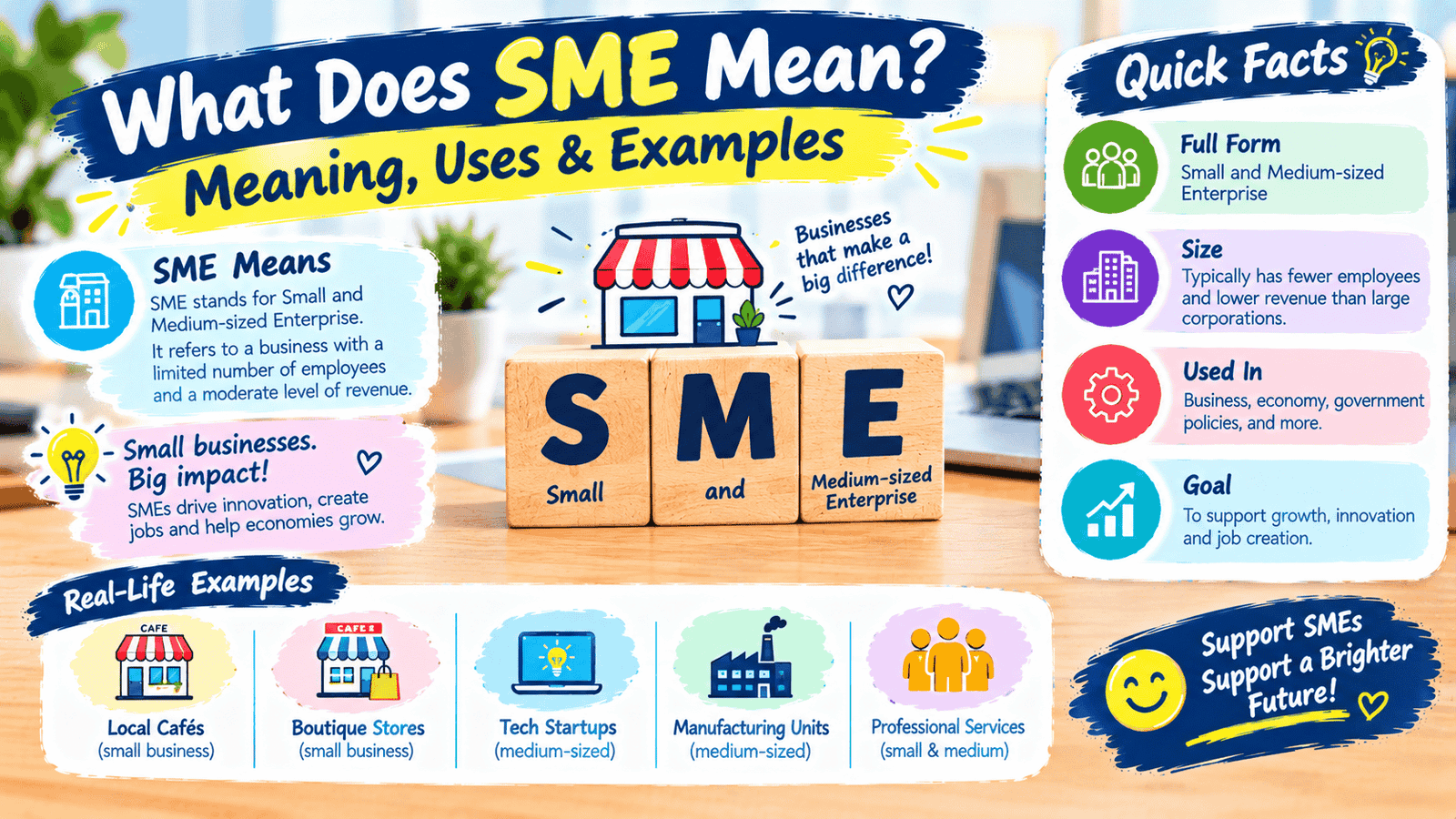
The most common professional meaning of SME is Subject Matter Expert, referring to someone with specialized knowledge or experience in a particular topic. In business and economics, SME can also mean Small and Medium-sized Enterprise, referring to a smaller business or company.
Unlike many texting abbreviations, SME is not usually a casual slang expression with one fixed definition. Its meaning changes according to the conversation, platform, and subject being discussed.
Quick Answer: What Does SME Mean?
SME most commonly means “Subject Matter Expert.” It describes a person who has detailed knowledge, skills, or experience in a specific field.
For example:
“Let’s ask Sarah. She’s the SME on this project.”
Here, SME means Subject Matter Expert.
In business contexts, SME can also mean “Small and Medium-sized Enterprise.” For example:
“The program provides funding for SMEs.”
Here, SMEs refers to smaller and medium-sized businesses.
So, if someone uses SME in a work chat, “Subject Matter Expert” is often the intended meaning. If the conversation is about businesses, financing, employment, or economic policy, “Small and Medium-sized Enterprise” may be more likely.
SME Meaning at a Glance
| Term | Meaning | Typical Context | Tone |
|---|---|---|---|
| SME | Subject Matter Expert | Work, education, projects | Professional |
| SME | Small and Medium-sized Enterprise | Business, economics | Formal |
| SMEs | Subject Matter Experts | Teams and organizations | Professional |
| SMEs | Small and Medium-sized Enterprises | Business discussions | Formal |
| SME role | Subject Matter Expert role | Projects, training, consulting | Professional |
| SME knowledge | Specialized expertise | Work and education | Professional |
What Does SME Stand For?
The full form of SME depends on context.
The two major meanings are:
- Subject Matter Expert
- Small and Medium-sized Enterprise
A Subject Matter Expert is an individual. This person understands a particular subject deeply and may advise others, review information, train employees, or help make decisions related to that subject.
A Small and Medium-sized Enterprise is a business category. The exact definition of what qualifies as an SME can differ between countries and organizations because business-size classifications may use factors such as employees, revenue, or other criteria.
This distinction is important because the same three letters can refer to either a knowledgeable person or a type of business.
SME as “Subject Matter Expert”
When SME means Subject Matter Expert, it generally describes someone who has specialized knowledge in a particular area.
For example, a software company might have an SME who understands cybersecurity. A hospital might have an SME specializing in a particular medical process. A school might have an SME who specializes in curriculum development.
You may see phrases such as:
- “Talk to the SME.”
- “We need an SME for this project.”
- “She’s our marketing SME.”
- “The SME reviewed the document.”
- “Ask the technical SME.”
- “We need subject-matter expertise.”
The person does not necessarily have to hold a particular job title. SME describes their knowledge or expertise in a specific subject.
Example 1
“Can you send this to the finance SME before we publish it?”
This means the sender wants someone with specialized financial knowledge to review the material.
Example 2
“Mike is the SME for our customer-support system.”
This means Mike is the person on the team who has particularly strong knowledge of that system.
Example 3
“We need an SME to explain the new process.”
Here, SME refers to someone qualified to explain the subject accurately.
SME as “Small and Medium-sized Enterprise”
In business and economic discussions, SME can mean Small and Medium-sized Enterprise.
The term describes businesses that fall within a particular size category. However, there is no single worldwide definition that applies identically everywhere.
For example, one organization or country may classify businesses according to employee count, while another may use revenue or another measurement.
You might see sentences like:
“SMEs play an important role in the economy.”
Or:
“The bank offers financing options for SMEs.”
In these examples, SME refers to businesses, not experts.
The plural form is usually SMEs.
How Is SME Used in Texting and Online Communication?
SME is different from abbreviations such as “LOL,” “BRB,” or “IDK.” It is not primarily a casual texting expression.
You can encounter SME in:
- Work chats
- LinkedIn posts
- Group messages
- Discord communities
- Educational discussions
- Business articles
- Online forums
- Project-management conversations
- Professional social media posts
On platforms such as TikTok, Instagram, Snapchat, WhatsApp, Discord, and Facebook, its meaning still depends on context.
For example, someone discussing a business might use “SME” to describe a company. Someone discussing a video game development project might use “SME” to describe a person who knows the game mechanics deeply.
Four Realistic Conversations Using SME
1. Text Message
Alex: “Who can explain the new software update?”
Jordan: “Ask Maya. She’s the SME for that system.”
Meaning and tone:
Here, SME means Subject Matter Expert. The tone is casual but professional. Jordan is identifying Maya as the person with specialized knowledge.
2. Instagram
Post: “Our team finally launched the new training program!”
Comment: “Shoutout to the SMEs who helped build it.”
Meaning and tone:
SMEs means Subject Matter Experts. The comment credits knowledgeable contributors. The tone is positive and appreciative.
3. TikTok
Creator: “I asked an SME to fact-check this before posting.”
Meaning and tone:
The creator is using SME to mean Subject Matter Expert. The wording emphasizes that someone with relevant expertise reviewed the information.
4. Group Chat
Sam: “Does anyone know why our small-business application was rejected?”
Taylor: “Our accountant might know. This program is designed for SMEs.”
Meaning and tone:
Here, SMEs means Small and Medium-sized Enterprises. The conversation is about businesses rather than an expert.
How Tone Changes the Meaning of SME
Because SME is an abbreviation rather than an emotional slang term, its tone usually comes from the surrounding message.
Compare:
“She’s the SME on this.”
This sounds straightforward and professional.
“Ask the SME 😂”
The laughing emoji makes the message more playful, although SME still has the same basic meaning.
“Please have the SME review the proposal.”
This sounds formal and workplace-oriented.
Punctuation can also influence the feeling of a message. A period can make a short statement sound more direct, while an emoji can make it feel warmer or more casual.
The relationship between the people also matters. Coworkers may use SME naturally, while a casual conversation between friends might avoid the abbreviation entirely unless the topic involves work or a shared technical subject.
Where You Might See SME
Among Friends
Friends may use SME when discussing a subject where one person has unusually strong knowledge.
For example:
“Ask Chris. He’s basically the sneaker SME.”
This can be serious or playful.
In Relationships
SME is uncommon in romantic conversations unless the couple is discussing work, school, business, or a specialized interest.
In Family Conversations
Family members might use SME when talking about someone’s expertise:
“Your sister is the SME on taxes in this family.”
This could be partly humorous rather than an official professional designation.
At School
Teachers, students, and academic teams may use SME to identify someone with specialized knowledge.
For example:
“We need an SME to review the science section.”
In Gaming
Gaming communities can use SME to describe someone who knows a game, system, character, or technical feature extremely well.
For example:
“Ask Leo. He’s our RPG mechanics SME.”
At Work
This is one of the most common settings for SME meaning Subject Matter Expert.
You might hear it in meetings, emails, project documents, training materials, and workplace chats.
SME on Social Media Platforms
The abbreviation can appear differently depending on the community.
TikTok: Creators may mention an SME when discussing expertise, fact-checking, education, or specialized subjects.
Instagram: SME can appear in captions, professional posts, comments, or discussions about businesses.
Snapchat: It is less likely to be used as casual slang, but it can appear in conversations involving school or work.
WhatsApp: SME may occur in professional group chats or conversations about businesses and projects.
Discord: Technical, gaming, educational, and professional communities may use SME frequently when identifying someone with specialized knowledge.
Facebook: SME may refer either to an expert or to a small or medium-sized business, depending on the group or discussion.
When You Should Not Use SME
Although SME is widely understood in professional settings, it is not always the clearest choice.
Avoid using it when your audience may not know the abbreviation.
For example, instead of writing:
“Contact the SME.”
A clearer version for a general audience might be:
“Contact the subject matter expert.”
This is especially useful in customer-facing communication, public documents, beginner-oriented materials, and formal writing where clarity matters more than brevity.
If you mean Small and Medium-sized Enterprise, spelling out the phrase the first time can also prevent confusion.
Common Misunderstandings About SME
One common misunderstanding is assuming that SME always means Subject Matter Expert.
That is not necessarily true.
If you read:
“The government introduced a new program for SMEs.”
The subject is probably businesses.
If you read:
“We need an SME to review the training material.”
The subject is probably an expert.
Another misunderstanding is treating SME as inherently informal. It is generally a professional abbreviation, not typical internet slang.
Context is the key.
SME Compared With Similar Expressions
| Expression | Meaning | Typical Tone | Main Difference |
|---|---|---|---|
| SME | Subject Matter Expert | Professional | Specialized expertise |
| Expert | Person with advanced knowledge | Neutral | More general |
| Specialist | Person focused on a specific field | Professional | Emphasizes specialization |
| Consultant | Person who provides professional advice | Professional | Often hired to advise |
| Professional | Person working in a field | Neutral | Does not necessarily imply expert-level knowledge |
| Guru | Highly knowledgeable person | Informal | Often more casual or exaggerated |
| Authority | Recognized source of expertise | Formal | Can imply recognized standing |
Key Insight: An SME is usually identified because of their specialized knowledge in a particular subject, while terms such as “professional” or “consultant” describe broader roles.
SME Variations and Related Forms
1. Subject Matter Expert
Meaning: A person with specialized knowledge of a particular topic.
Tone: Professional.
Example: “We’ll ask the subject matter expert to review the proposal.”
2. SMEs
Meaning: Plural form of SME when referring to multiple experts or businesses.
Tone: Professional.
Example: “Several SMEs reviewed the training materials.”
3. SME Role
Meaning: A position or responsibility involving specialized subject knowledge.
Tone: Professional.
Example: “She’s taking on an SME role for the new project.”
4. SME Knowledge
Meaning: Specialized knowledge provided by an expert.
Tone: Professional.
Example: “The project depends on strong SME knowledge.”
5. SME Review
Meaning: A review performed by a subject matter expert.
Tone: Professional.
Example: “The article needs an SME review before publication.”
6. SME Input
Meaning: Advice, information, or feedback from a subject matter expert.
Tone: Professional.
Example: “We need SME input before changing the process.”
7. SME Consultant
Meaning: A consultant who provides specialized expertise.
Tone: Professional.
Example: “The company hired an SME consultant for the project.”
8. Small and Medium-sized Enterprise
Meaning: A business that falls within a defined small or medium-sized category.
Tone: Formal.
Example: “The program supports small and medium-sized enterprises.”
9. SME Business
Meaning: A business described as a small or medium-sized enterprise.
Tone: Business-oriented.
Example: “The bank created services for SME businesses.”
How to Respond When Someone Says SME
Your response depends on what they mean.
Casual Reply
“Got it. Who’s the SME for this?”
Friendly Reply
“Good call. I’ll check with them.”
Funny Reply
“Sounds like we need to summon the SME.”
Mature Reply
“Let’s get input from the person with the most relevant expertise.”
Respectful Reply
“Sure. I’ll reach out to the subject matter expert.”
If you are unsure what SME means, the simplest response is:
“When you say SME, do you mean subject matter expert?”
That removes ambiguity without making assumptions.
SME and Generational Differences
SME is not strongly associated with one particular generation.
Gen Z may encounter it through workplace communication, online communities, education, gaming, and social media.
Millennials may be familiar with SME through professional environments, business communication, technology, and project work.
Older internet users may also recognize SME, particularly in professional, business, technical, or academic contexts.
The bigger difference is usually context and familiarity, not age. Someone who works in a specialized industry may use SME frequently, while someone outside that field may rarely encounter it.
Cultural and Global Usage
SME is used internationally, particularly in professional and business communication, but the exact meaning and business classification can vary by country or organization.
The phrase Small and Medium-sized Enterprise is especially common in international business and economic discussions. However, the criteria used to classify a business as an SME are not necessarily identical everywhere.
The Subject Matter Expert meaning is also broadly understandable in professional environments, particularly in fields involving training, technology, consulting, education, and project management.
It is better to rely on the surrounding context than to assume that everyone uses SME in exactly the same way.
Is SME Appropriate for Kids and Teenagers?
SME is generally not offensive or inappropriate for kids and teenagers.
However, younger users may not encounter it often in casual texting. It is more likely to appear in school projects, gaming communities, educational discussions, or conversations involving specialized knowledge.
For a younger audience, spelling out Subject Matter Expert may be clearer than simply using SME.
Casual vs. Standard or Formal English
| Casual Usage | Standard or Formal Alternative |
|---|---|
| “Ask the SME.” | “Ask the subject matter expert.” |
| “She’s our SME.” | “She is our subject matter expert.” |
| “Need SME input.” | “We need input from a subject matter expert.” |
| “SMEs reviewed it.” | “Subject matter experts reviewed it.” |
| “SME for the project” | “Subject matter expert for the project” |
In internal workplace communication, SME can save space and is often perfectly natural. In public-facing writing, spelling it out can improve clarity for readers who may not recognize the abbreviation.
Frequently Asked Questions
1. What does SME mean in texting?
SME usually means Subject Matter Expert when it appears in a conversation about work, school, technology, or specialized knowledge. It can also mean Small and Medium-sized Enterprise in business discussions.
2. What does SME stand for?
SME commonly stands for Subject Matter Expert or Small and Medium-sized Enterprise. The surrounding context determines which meaning applies.
3. What does SME mean at work?
At work, SME most commonly means Subject Matter Expert. It refers to someone with specialized knowledge about a particular process, product, system, or subject.
4. What does SME mean in business?
In business, SME can mean Small and Medium-sized Enterprise. It can also mean Subject Matter Expert when a company is discussing an employee or consultant with specialized knowledge.
5. Is SME slang?
SME is better described as an abbreviation or professional acronym than ordinary texting slang. It can appear online, but its main uses are professional and business-related.
6. What is the plural of SME?
The plural is usually SMEs. Depending on context, it can mean multiple Subject Matter Experts or multiple Small and Medium-sized Enterprises.
7. How do I know which meaning of SME someone intends?
Look at the surrounding topic. If the conversation concerns a knowledgeable person, SME probably means Subject Matter Expert. If it concerns companies, business funding, or economic activity, it may mean Small and Medium-sized Enterprise.
The Bottom Line
SME most commonly means Subject Matter Expert, especially in workplace, educational, technical, and project-related conversations. It identifies someone with specialized knowledge in a particular subject.
The other major meaning is Small and Medium-sized Enterprise, which refers to a category of business.
If you see SME in a text or online conversation, don’t automatically assume it has only one definition. Look at what the conversation is about, who is being discussed, and whether the subject involves a person with expertise or a type of business. That context usually makes the intended meaning clear.