What Insect Symbolizes Death? Meanings Explained
Quick Answer
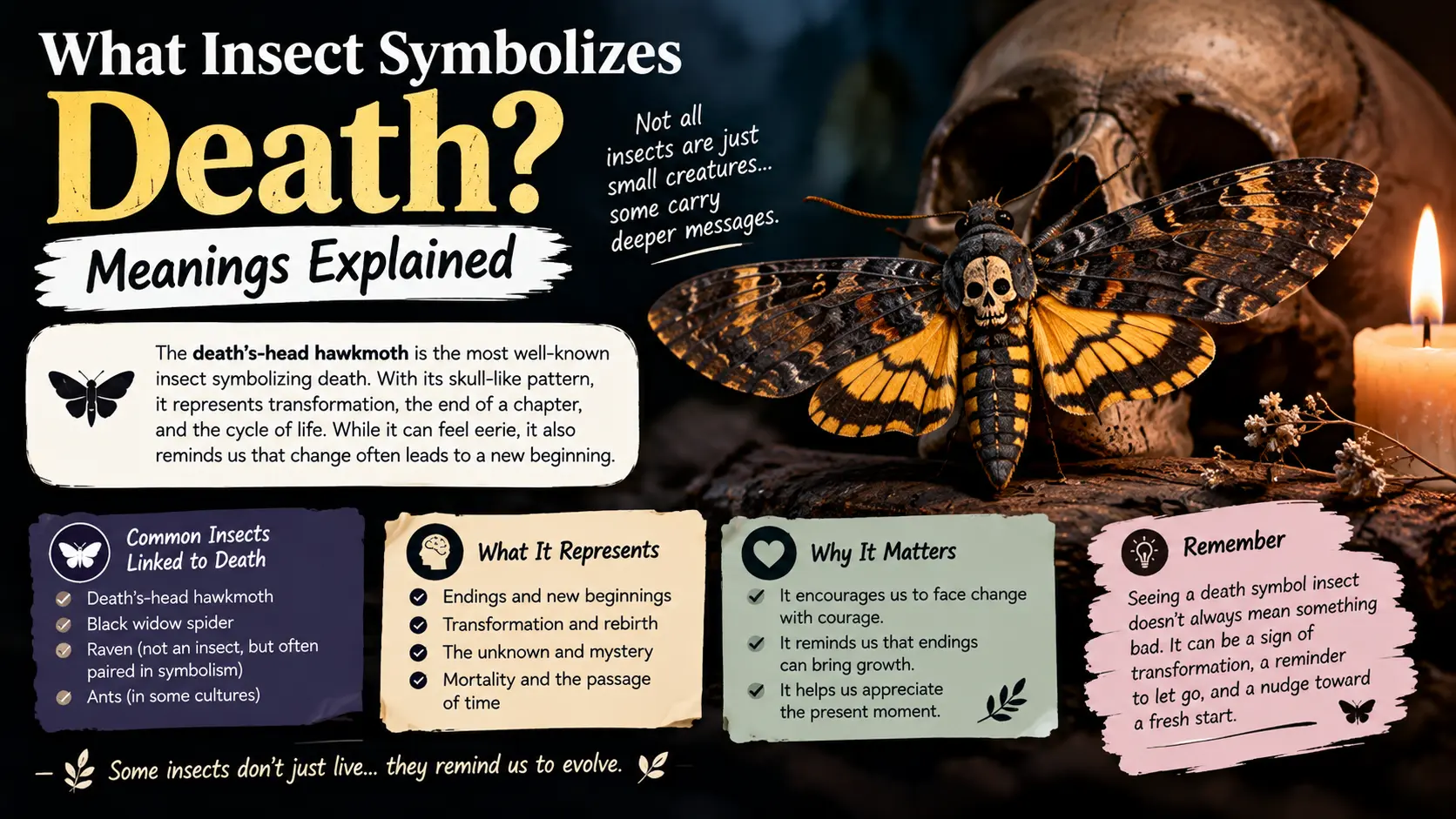
Several insects are associated with death, mortality, endings, transformation, and spiritual transition, but no single insect universally symbolizes death. Moths, flies, beetles, butterflies, and cicadas are among the insects most often connected with death-related symbolism.
The meaning depends heavily on culture and context. A fly may be associated with decay and decomposition, while a moth may represent darkness, mystery, or an ending. A beetle can symbolize regeneration and renewal, and a butterfly may represent the transformation that follows an ending.
It is also important to distinguish symbolism from prediction. Seeing an insect does not mean that death is approaching or that someone will die. These associations come from cultural traditions, observations of nature, religious imagery, folklore, literature, and personal interpretation.
TL;DR
- Moths can symbolize darkness, mystery, endings, and transformation.
- Flies are commonly connected with decay, decomposition, and mortality.
- Beetles can represent death, regeneration, protection, and renewal.
- Butterflies often symbolize transformation, rebirth, and spiritual transition.
- Cicadas can symbolize emergence, renewal, and the ending of one life phase.
- Black insects may acquire death symbolism because black is culturally associated with mourning and the unknown.
- Insect symbolism varies significantly between cultures.
- An insect appearing near you is not scientific evidence or a reliable prediction of death.
- Death symbolism can also have a positive meaning, representing closure, transformation, remembrance, or a new beginning.
Why Do Insects Symbolize Death?
Insects have fascinated human beings for thousands of years because they are closely connected to some of nature’s most visible cycles. They emerge, disappear, reproduce, transform, feed on decaying material, and sometimes remain hidden for long periods before suddenly appearing.
These behaviors naturally lend themselves to symbolic interpretations. An insect that appears around decaying organic matter, for example, may become associated with death and decomposition. An insect that transforms dramatically may instead become a symbol of death followed by renewal.
Another reason insects become death symbols is their relationship with impermanence. Many insects have relatively short adult lifespans, making them useful metaphors for the temporary nature of existence. Their small size and unusual behaviors can also make them seem mysterious or otherworldly.
However, symbolism should not be confused with biology. A fly visiting a particular place has a biological reason for doing so, while a person may give that encounter a personal symbolic meaning. The first is an observable natural event; the second is an interpretation.
Which Insect Most Commonly Symbolizes Death?
There is no universally accepted “death insect.” Different traditions emphasize different species and different aspects of mortality.
Moths and Their Connection to Death
Moths are among the insects most frequently given death-related and spiritual symbolism. Their nighttime activity, attraction to light, muted colors, and association with darkness have contributed to their mysterious image.
In modern symbolic interpretations, a moth may represent an ending, hidden knowledge, the unknown, or movement through a difficult transition. Its attraction to light can also be interpreted as a metaphor for seeking guidance during darkness.
At the same time, moth symbolism is not inherently negative. A moth’s life cycle includes profound transformation, so it can also symbolize change, adaptation, spiritual growth, and renewal.
Flies as Symbols of Decay and Mortality
Flies have a particularly strong association with death because many species are attracted to decaying organic material. This ecological relationship has influenced their symbolic meaning throughout human history.
In symbolic language, flies may represent decay, mortality, corruption, cleansing, persistence, or the unavoidable return of life to nature.
Yet flies also play an important ecological role. They contribute to decomposition and nutrient cycling. From this perspective, their symbolism can be understood as part of the larger natural cycle rather than simply as something frightening or negative.
Beetles and the Cycle of Death and Renewal
Beetles have some of the most complicated symbolism of any insect. Their associations can include death, protection, regeneration, strength, persistence, and renewal.
The scarab is particularly significant in ancient Egyptian symbolism. Rather than representing death as final destruction, the scarab became associated with renewal, regeneration, and the continuing cycle of existence.
This makes beetle symbolism especially interesting. An insect connected with death-related imagery can simultaneously represent the continuation of life.
Butterflies and Death as Transformation
Butterflies are usually associated with transformation, beauty, freedom, rebirth, and new beginnings, but they can also appear in symbolism related to death.
The reason is their metamorphosis. The caterpillar’s transformation into a butterfly creates an obvious metaphor for leaving one state of existence and entering another.
For this reason, butterflies can be used to symbolize the death of an old identity, the closing of one chapter, or the spiritual transformation associated with major life changes.
Insects Associated With Death in Different Cultures
Insect symbolism is never completely universal. The same creature can carry different meanings depending on historical period, geographic location, religious tradition, and cultural context.
Ancient Egyptian Insect Symbolism
The scarab beetle holds a particularly important place in ancient Egyptian symbolism. The scarab was associated with ideas of renewal, regeneration, and the movement of the sun.
Its symbolism demonstrates why it is misleading to describe the beetle simply as a “death symbol.” Ancient Egyptian interpretations connected death with a larger cycle of transition and renewal.
The scarab therefore provides an important example of how death symbolism can actually focus on continuity rather than finality.
European Folklore and Moths
European folklore contains many stories and beliefs involving nocturnal insects. Moths have sometimes been interpreted through associations with darkness, spirits, mystery, and the boundary between life and death.
These beliefs varied considerably between regions and historical periods. Modern internet discussions sometimes combine unrelated traditions, so individual claims about a moth representing death should be treated cautiously.
A more reliable general observation is that moths have long attracted symbolic attention because of their nighttime activity and unusual relationship with light.
Indigenous and Native American Perspectives
There is no single Indigenous or Native American interpretation of insect symbolism. Indigenous nations have distinct languages, histories, spiritual traditions, and relationships with the natural world.
Some traditions may give insects important roles in stories, teachings, ceremonies, or understandings of nature, but these meanings should not be generalized across all Indigenous peoples.
When discussing Indigenous symbolism, it is more respectful to identify the specific nation or tradition involved rather than claiming that “Native Americans believe” one universal interpretation.
Asian Cultural Interpretations
Across Asia, insects such as butterflies, beetles, cicadas, and moths have appeared in art, literature, folklore, and spiritual symbolism.
Butterflies can represent transformation, while cicadas may be associated with renewal, longevity, emergence, and the continuation of life. Beetles may carry meanings connected with resilience or regeneration.
These examples show that an insect associated with death in one symbolic framework may represent rebirth or continuity in another.
What Does a Black Insect Symbolize?
Black insects can easily acquire death symbolism because the color black has been associated in many cultures with mourning, darkness, mystery, solemnity, and the unknown.
When a naturally dark insect appears at night or in an unexpected setting, its visual appearance can strengthen these associations. This is particularly true of black moths and other nocturnal insects.
However, black does not automatically mean death. Depending on the context, it can also symbolize protection, mystery, elegance, strength, introspection, or hidden potential.
The species, behavior, cultural context, and personal circumstances all matter when interpreting a black insect symbolically.
What Does a Moth Symbolize Spiritually?
Spiritually, moths are often interpreted as symbols of transition, mystery, intuition, hidden knowledge, and transformation.
Their nighttime behavior can make them seem connected with unseen or less understood aspects of life. Their attraction to light has also inspired symbolic interpretations involving the search for truth, guidance, hope, or understanding.
Some people interpret a moth appearing during a period of grief as a meaningful reminder of someone who has died. That interpretation can be emotionally significant without being treated as proof of supernatural communication.
The broader symbolism of the moth is therefore more nuanced than simply “death.” It can represent the movement from darkness toward understanding or from one stage of life into another.
See Also: Snapdragon Symbolism: Spiritual Meaning, History & Culture
What Does a Fly Symbolize Spiritually?
Flies can symbolize decay, mortality, cleansing, persistence, and transformation. Their connection to decomposition makes them especially easy to associate with death.
At a deeper symbolic level, however, the fly can represent the natural process by which organic material returns to the environment. What looks like an unpleasant part of nature is also part of an essential ecological process.
Spiritually, some people may interpret repeated encounters with flies as a reminder to address something they consider stagnant or unhealthy in their lives. This is a personal symbolic interpretation rather than a universal spiritual rule.
What Does a Beetle Symbolize Spiritually?
Beetles can symbolize resilience, regeneration, protection, transformation, and renewal.
Their hard outer bodies may contribute to associations with strength and protection, while their life cycles and ecological roles provide metaphors for change and continuation.
The scarab provides one of the clearest examples of beetle symbolism connected to renewal. This makes beetles particularly appropriate when discussing the relationship between death and rebirth.
Rather than viewing death only as an ending, beetle symbolism can encourage a broader understanding of cycles, regeneration, and the continuation of life.
Insects That Symbolize Death vs. Insects That Symbolize Rebirth
| Insect | Common Symbolic Associations |
|---|---|
| Moth | Mystery, darkness, endings, transformation |
| Fly | Decay, mortality, cleansing, persistence |
| Beetle | Renewal, regeneration, protection, transformation |
| Butterfly | Metamorphosis, rebirth, spiritual transition |
| Cicada | Emergence, renewal, transformation |
| Dragonfly | Change, transition, adaptability |
| Ant | Community, persistence, mortality, life’s cycles |
This comparison shows that death and rebirth symbolism frequently overlap.
An insect may symbolize death because it is associated with decomposition, while another may symbolize death metaphorically because it leaves one stage of existence behind. In both cases, the symbolic meaning can lead toward transformation.
For this reason, it is useful to ask what kind of “death” a symbol represents. It could mean physical mortality, the ending of a relationship, the closing of a chapter, the abandonment of an old identity, or the beginning of a new phase.
Is Seeing an Insect a Sign of Death?
Seeing an insect is not reliable evidence that someone will die.
Insects appear because of ordinary biological and environmental factors such as temperature, food sources, moisture, light, vegetation, reproduction, shelter, and seasonal changes.
Nevertheless, people sometimes assign symbolic meaning to unusual encounters. A moth appearing during grief, for example, may remind someone of a deceased loved one. The emotional significance can be genuine even though the encounter does not establish a supernatural prediction.
The healthiest way to approach such experiences is to distinguish between personal meaning and factual evidence.
What Does It Mean When an Insect Appears After Someone Dies?
After losing someone, ordinary events can become emotionally meaningful. An insect appearing shortly after a person’s death may remind someone of memories, conversations, places, or beliefs connected with that person.
Some people interpret butterflies, moths, dragonflies, or other insects as symbolic visits from deceased loved ones. Others view the same experience as a comforting coincidence or a natural event that became meaningful because of the circumstances.
There is no scientifically established rule saying that a particular insect represents a deceased person. The interpretation belongs to the individual’s personal or cultural framework.
What matters emotionally is often the memory the encounter evokes, rather than proving exactly why the insect appeared.
Insect Symbolism in Dreams About Death
Dreams involving insects and death can have many interpretations. There is no universal dream dictionary that can determine exactly what an insect means for every person.
Dreaming About a Moth
A moth in a dream may be associated with change, uncertainty, hidden emotions, transition, or attraction toward something difficult to understand.
If the dream occurs during grief, the moth might simply reflect thoughts about loss and mortality.
Dreaming About Flies
Flies may symbolize something the dreamer experiences as unpleasant, unresolved, stagnant, or difficult to ignore.
Because flies are associated with decomposition, they may also appear in dreams when someone is thinking about mortality, endings, or significant change.
Dreaming About Beetles
A beetle can represent persistence, protection, resilience, or transformation. Its meaning may depend strongly on whether the dream felt threatening, peaceful, fascinating, or empowering.
Dreaming About Butterflies
Butterflies commonly symbolize transformation. In a dream involving death, they may represent moving beyond an old stage of life, emotional healing, or the transformation of identity.
Dream symbolism becomes more useful when the dreamer’s emotions and circumstances are considered rather than relying on one fixed interpretation.
Insect Symbolism in Funerals, Memorials, and Grief
Insects can become meaningful symbols in memorial art, jewelry, tattoos, paintings, literature, and personal keepsakes.
Butterflies are often selected to express transformation and remembrance, while moths may communicate mystery, darkness, or movement through grief. Beetles can symbolize regeneration or endurance.
These symbols can help people express feelings that are difficult to describe directly. An insect may become a visual representation of someone remembered, a life transition, or the idea that relationships continue through memory.
The meaning is often deeply personal. A butterfly that represents one person’s loved one may have an entirely different significance for another person.
Death Symbolism in Tattoos Featuring Insects
Insect tattoos can communicate complicated ideas about mortality without necessarily expressing something negative.
Moth Death Symbolism Tattoo
A moth tattoo may represent mystery, darkness, transformation, grief, or an attraction toward light during difficult circumstances.
Beetle Death Symbolism Tattoo
A beetle tattoo may emphasize regeneration, strength, protection, or the continuing cycle of life.
Butterfly Death and Rebirth Tattoo
A butterfly can represent the transformation that follows loss. It is often used as a memorial symbol for change, remembrance, freedom, and renewal.
Fly Tattoo Symbolism
A fly tattoo can have darker or more unconventional meanings, including mortality, decay, impermanence, persistence, or acceptance of life’s natural cycles.
Because tattoos remain highly personal, the creator’s intended meaning matters more than any universal symbolic dictionary.
The Psychological Meaning Behind Death-Related Insect Symbolism
Humans naturally search for meaning in unusual events, especially during emotionally significant periods.
Insects are particularly effective symbols because they can represent several visible processes at once. Their movement, disappearance, reproduction, metamorphosis, and relationship with decomposition provide natural metaphors for change and impermanence.
Color also influences perception. Dark insects may feel more mysterious, while brightly colored butterflies may feel more hopeful. These emotional reactions can shape the symbolic meanings people assign to different species.
Personal experience matters too. Someone who encountered a butterfly during an important life event may associate butterflies with that experience for years.
What Insects Symbolize Death in Modern American Culture?
In the United States, insect death symbolism appears in tattoos, gothic artwork, Halloween decorations, literature, jewelry, films, memorial designs, and social media imagery.
Moths and beetles are frequently used in darker visual aesthetics, while butterflies are more commonly associated with remembrance and transformation. Flies often carry associations with decay because of their ecological relationship with decomposing material.
Modern American symbolism also combines older traditions with contemporary personal expression. A person may choose an insect because it represents grief, a difficult transition, an old identity, or acceptance of mortality.
Consequently, modern symbolism is often less about following one traditional meaning and more about creating a personal visual language.
Positive Meanings Behind Death-Associated Insects
Death-related symbolism does not always have to be frightening or negative.
An insect connected with death can represent:
- Transformation
- Closure
- Renewal
- Acceptance
- Letting go
- New beginnings
- Remembrance
- The temporary nature of life
- Resilience
- Spiritual transition
This is especially important with butterflies and beetles. Their symbolic connection with transformation allows death to be understood as part of a larger cycle.
Even a fly, which is often perceived negatively, can symbolize the ecological process through which dead material becomes part of another cycle of life.
How to Interpret an Insect as a Personal Symbol
Consider the Insect Species
Start with the actual species rather than assuming every insect has the same meaning. A moth, butterfly, fly, and beetle have very different behaviors and cultural associations.
Consider Its Color
Color can influence symbolism. Black may suggest mystery or mourning, while bright colors may suggest life, hope, or transformation.
Consider Where You Saw It
An insect appearing in a home, garden, cemetery, forest, workplace, or dream can create different symbolic associations.
Consider What You Were Feeling
Your emotional state can be one of the strongest clues to personal symbolism. An insect seen during grief may feel very different from the same insect encountered during a celebration.
Consider Your Cultural Background
Cultural traditions can dramatically change an insect’s meaning. A symbol associated with death in one tradition may represent prosperity, protection, renewal, or good fortune elsewhere.
Common Misunderstandings About Insects and Death
One common misunderstanding is that one specific insect universally represents death. In reality, symbolism varies across cultures and historical periods.
Another misconception is that seeing an insect predicts someone’s death. There is no reliable scientific basis for using insect sightings to predict mortality.
It is also important to distinguish folklore from documented tradition. Internet posts frequently present spiritual interpretations as if they were universal cultural facts, even when those meanings are relatively modern or highly personal.
Finally, death symbolism does not necessarily mean something negative. Many traditions use mortality-related imagery to discuss renewal, transformation, remembrance, and the continuing cycle of life.
Frequently Asked Questions About What Insect Symbolizes Death?
What insect is most associated with death?
There is no universally recognized death insect. Moths and flies are often strongly associated with death-related ideas because of their connections with darkness, decomposition, and mortality, while beetles can symbolize death alongside renewal.
Do moths symbolize death?
Moths can symbolize death, mystery, darkness, endings, and transformation in some cultural and modern symbolic interpretations. They can also represent spiritual growth and movement toward light, so their meaning is not exclusively negative.
Do flies symbolize death?
Flies are commonly connected with death because many species participate in decomposition. Symbolically, they may represent mortality, decay, cleansing, persistence, and the natural return of organic material to the environment.
What beetle symbolizes death and rebirth?
The scarab beetle is particularly important in ancient Egyptian symbolism involving renewal and regeneration. Its symbolism demonstrates how death and rebirth can be understood as parts of one continuing cycle.
What insect symbolizes death and transformation?
Moths, beetles, butterflies, and cicadas can all symbolize death and transformation in different contexts. Moths emphasize mystery and transition, beetles regeneration, butterflies metamorphosis, and cicadas emergence and renewal.
Is seeing a moth a sign of death?
No. Seeing a moth is not reliable evidence or a scientific sign that death will occur. Some people may interpret a moth symbolically during periods of grief or transition, but that interpretation is personal or cultural.
What does a black insect symbolize spiritually?
A black insect may symbolize mystery, darkness, mourning, protection, transformation, or the unknown, depending on the insect and cultural context. Black coloration alone does not establish a specific spiritual meaning.
What insect represents the cycle of life and death?
Several insects can represent the life-and-death cycle. Beetles, butterflies, cicadas, and flies are especially useful examples because their life cycles or ecological roles illustrate transformation, decomposition, renewal, or emergence.
Do insects symbolize deceased loved ones?
Some people interpret butterflies, moths, dragonflies, and other insects as reminders of deceased loved ones. This can be a meaningful personal belief, but there is no universal scientific rule establishing that insects are messages from people who have died.
What insect symbolizes rebirth after death?
The butterfly and scarab beetle are strong examples of symbolism involving transformation and renewal. The butterfly represents metamorphosis, while the scarab has important historical associations with regeneration and renewal.
Final Thoughts on What Insect Symbolizes Death
The question “What insect symbolizes death?” does not have one universal answer. Different insects represent different aspects of mortality and transformation.
Moths can symbolize darkness, mystery, endings, and transition. Flies are closely associated with decay and decomposition. Beetles can represent regeneration and the continuation of life, while butterflies often turn the idea of death into a metaphor for transformation and rebirth.
The most important distinction is between symbolism and prediction. An insect appearing in your home, garden, dream, or during a period of grief does not provide evidence that death is coming. Instead, the encounter may become meaningful because of your memories, emotions, cultural beliefs, or the natural symbolism associated with that insect.
Ultimately, insects offer a powerful reminder that nature is built around cycles. Endings can lead to transformation, decay can contribute to renewal, and mortality can inspire remembrance and appreciation for life.