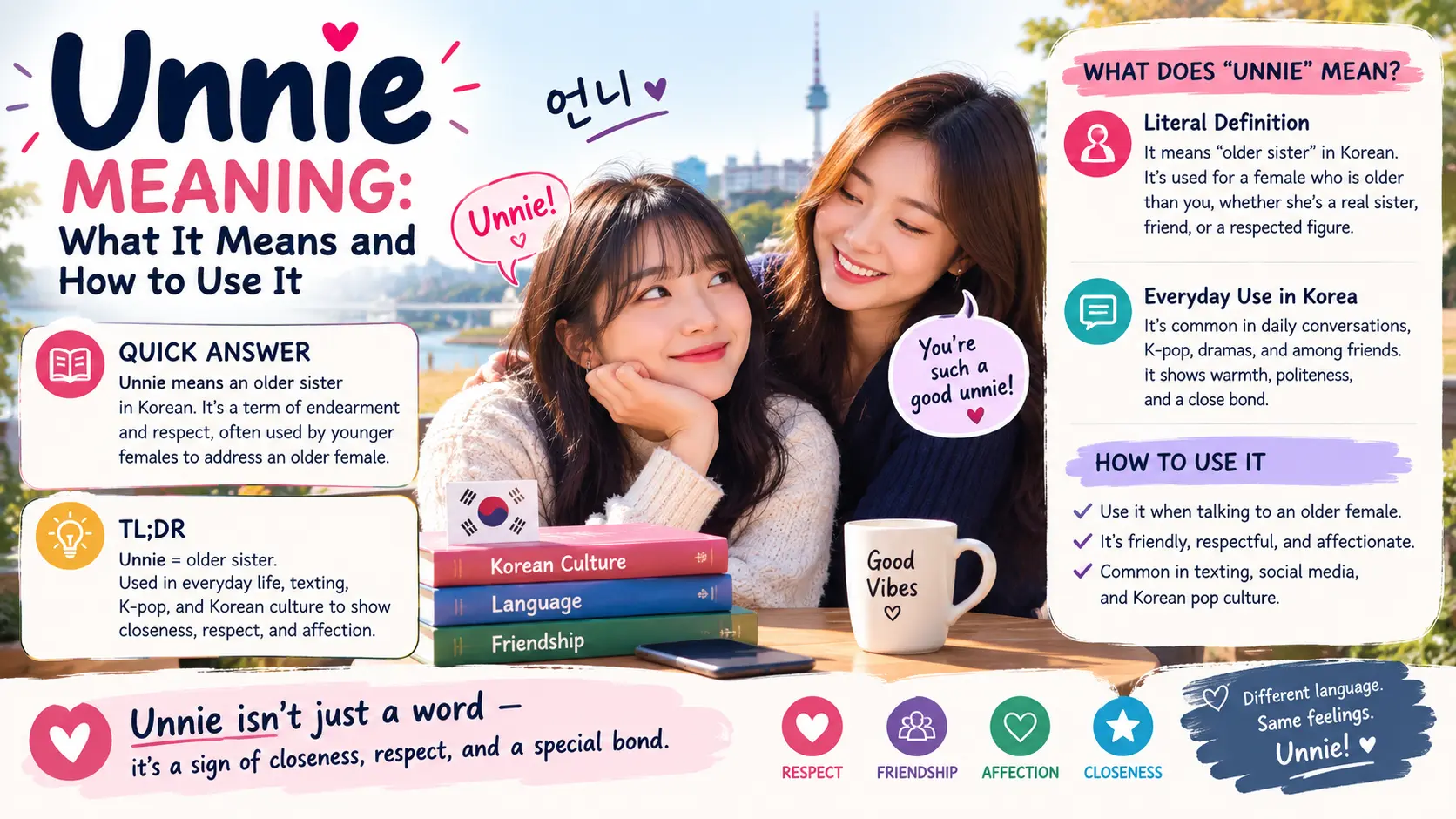
Unnie Meaning: What It Means and How to Use It
Quick Answer
“Unnie” (언니) is a Korean term used by a female to address or refer to an older female, especially an older sister, close female friend, or someone with a sister-like relationship. It can express familiarity, affection, respect, or closeness.
Although its original meaning comes from Korean language and culture, “unnie” has become familiar to many people in the United States through K-pop, K-dramas, Korean entertainment, and online fandoms.
TL;DR
- Unnie is a Korean relationship term meaning an older female addressed by a younger female.
- It can refer to a biological older sister or a close older female friend.
- The term carries ideas of closeness, affection, familiarity, and age-based social relationships.
- It is commonly encountered internationally through K-pop, K-dramas, and social media.
- A male generally does not use unnie; the corresponding term for an older female is noona.
- English-speaking fans sometimes use unnie casually, but its original Korean usage has specific social and gender rules.
What Does “Unnie” Mean?
Basic Definition
Unnie is the common English-style romanization of the Korean word 언니. A younger female uses it when addressing an older female.
The simplest translation is “older sister,” but translating it only as “sister” misses some of its cultural meaning. The person does not necessarily have to be a biological sister.
For example, a Korean woman might call her older biological sister unnie. She could also use the term for an older female friend with whom she has developed a close, sister-like relationship.
Who Uses the Term?
Traditionally, a female speaker uses unnie when referring to or addressing an older female.
This distinction is important because Korean relationship terms often communicate information about the speaker’s age, the other person’s age, gender, and level of familiarity.
A younger woman might therefore use unnie naturally with an older female friend, while a younger man would normally use a different Korean term rather than unnie.
What “Unnie” Implies in Conversation
The word can communicate more than age. Depending on the relationship and situation, it may suggest warmth, familiarity, affection, admiration, or sisterhood.
The emotional tone depends heavily on context. Between close friends, unnie can sound warm and playful. In a more distant relationship, another form of address may be more appropriate.
How Do You Pronounce “Unnie”?
Korean Pronunciation
The Korean spelling is 언니. The pronunciation is different from simply reading the English spelling letter by letter.
In Korean, the word contains two syllables and has a soft, natural rhythm when spoken. The Korean pronunciation is the best model to follow rather than an English pronunciation based on the spelling “unnie.”
Stress is also different from typical English word stress. Korean pronunciation generally uses a more even syllable rhythm.
Common English Pronunciation Mistakes
English speakers sometimes pronounce unnie as though it were an English nickname. This can make the word sound noticeably different from its Korean pronunciation.
Another common mistake is treating the spelling as if the double n creates a long English consonant. In Korean, the pronunciation should be learned from 언니, not from the English spelling alone.
What Does “Unnie” Mean in Korean Culture?
Family and Sister-Like Relationships
The most straightforward use of unnie is within families. A younger sister can use it when addressing her older sister.
However, Korean social language extends family terminology beyond biological relationships. Close female friendships can develop a sister-like quality, making unnie appropriate in situations where the two people are not related.
This gives the word a broader emotional meaning than the English word “sister.”
Respect, Age, and Social Hierarchy
Korean language has traditionally placed considerable importance on age and social relationships. Terms such as unnie, oppa, noona, and hyung help speakers communicate those relationships directly.
Calling someone unnie therefore provides social information. It identifies the person being addressed as an older female relative or relationship figure from the perspective of a younger female speaker.
That does not necessarily mean the relationship is formal. In fact, unnie is often associated with familiarity.
Affection and Familiarity
One of the most recognizable qualities of unnie is its ability to express closeness.
When used between friends, it can communicate something like “older sister” emotionally rather than literally. An older woman may be someone a younger woman looks up to, trusts, admires, or relies upon.
Where Does the Word “Unnie” Come From?
Korean Language Roots
Unnie comes from the Korean word 언니. It belongs to a group of Korean kinship and relationship terms that can also be used outside biological families.
Korean has several words that distinguish relationships based on the speaker’s gender and the other person’s gender and relative age.
This is one reason direct one-word English translations can be misleading.
How the Term Developed
The use of family terminology in Korean social relationships reflects the importance historically placed on age, familiarity, hierarchy, and interpersonal roles.
Over time, words such as unnie became natural ways to address people in relationships that resemble family connections.
Today, its usage can range from traditional family relationships to close friendships and highly visible entertainment contexts.
Romanization and Spelling Variations
Because Korean uses its own writing system, Hangul, the word 언니 can appear in several romanized forms.
“Unnie” is especially common online because it helps English-speaking audiences approximate the Korean pronunciation. You may also encounter alternative romanizations based on different romanization systems.
The spelling can vary, but the Korean source word remains 언니.
Unnie vs. Noona, Oppa, and Hyung
Unnie vs. Noona
Both unnie and noona can refer to an older female, but the speaker’s gender differs.
A younger female uses unnie for an older female. A younger male traditionally uses noona for an older female.
This is one of the most important distinctions for English speakers learning Korean relationship terms.
Unnie vs. Oppa
Oppa is traditionally used by a younger female when addressing an older male. It can mean an older brother, but it can also be used for an older male friend or someone with a close relationship.
In popular culture, oppa has developed additional associations because of K-pop and K-dramas.
Unnie vs. Hyung
Hyung is traditionally used by a younger male when addressing an older male.
Therefore, these terms form a useful basic pattern:
- Female → older female: Unnie
- Male → older female: Noona
- Female → older male: Oppa
- Male → older male: Hyung
Simple Gender and Age Guide
The terms are not simply four different words for “older person.” They depend on both the speaker’s gender and the other person’s gender.
Understanding that distinction prevents one of the most common mistakes made by people encountering Korean terms through entertainment.
How “Unnie” Became Popular in the United States
K-Pop and Global Fandoms
K-pop played a major role in introducing Korean relationship terminology to international audiences.
Fans frequently hear performers use words such as unnie, oppa, and hyung when interacting with other members, especially when discussing age or group dynamics.
As fans become familiar with Korean entertainment, these terms can become part of their online vocabulary.
K-Dramas and Streaming Platforms
K-dramas have also helped make unnie recognizable outside Korea.
Viewers encounter the word in family conversations, friendships, workplaces, schools, and romantic or dramatic storylines. Subtitles sometimes retain the original Korean term rather than translating it completely.
Repeated exposure makes the word familiar even to viewers who do not speak Korean.
Korean Culture on Social Media
TikTok, Instagram, YouTube, Reddit, and other online communities have further spread Korean vocabulary.
International fans may use unnie while discussing female K-pop idols, Korean actresses, fictional characters, or older members of a fandom community.
However, online usage can sometimes simplify or alter the original cultural meaning.
What Does “Unnie” Mean in American Slang?
How Americans Use the Term
In the United States, unnie is usually not an ordinary mainstream English slang word. Instead, it is a Korean cultural term adopted by certain communities.
K-pop fans, K-drama viewers, Korean culture enthusiasts, and people involved in Korean-language communities are more likely to recognize or use it.
Playful and Affectionate Usage
American fans may use unnie affectionately when talking to or about an older female person they admire.
For example, a fan might describe an older female idol as an “unnie” because she feels like a supportive older-sister figure.
This is generally an informal, community-based use, rather than a standard English definition.
When It May Sound Unnatural
Using unnie with someone who does not understand Korean culture may cause confusion.
It can also feel forced if someone uses Korean relationship terms simply as decorative slang without understanding their meaning.
A good rule is to consider the relationship and context rather than treating the word as a universal nickname for women.
“Unnie” in Texting and Social Media
Common Texting Examples
Online, people may use unnie when talking about an older female friend or an admired female celebrity.
Examples might include:
“My unnie always gives me the best advice.”
or:
“She is basically my unnie.”
These examples show how English-speaking communities may use the term to communicate a sister-like relationship.
Comments, Captions, and DMs
On social media, unnie may appear in comments directed toward older female creators, idols, or friends.
The tone is usually informal and affectionate, particularly within communities that already understand Korean terminology.
However, using the word does not automatically establish a genuine Korean-style relationship. Context still matters.
Online Fandom Language
Fandom communities often adapt words from the cultures associated with the entertainment they follow.
Consequently, unnie may become part of a fan’s vocabulary even when the person is not Korean.
This is an example of how entertainment and social media can move language across cultural boundaries.
The Emotional Meaning of “Unnie”
Sisterhood and Connection
Beyond its dictionary definition, unnie can represent sisterhood and emotional connection.
An older female may provide encouragement, advice, companionship, or protection in a way that resembles the role of an older sister.
This emotional association helps explain why the term can feel warmer than a simple age label.
Mentorship and Support
In some relationships, an older female may act as a mentor. She may offer guidance to someone younger or less experienced.
Calling her unnie can reflect that relationship, especially when friendship and mentorship overlap.
However, the word itself does not automatically mean “mentor.” That meaning comes from the relationship and context.
Admiration and Affection
The term can also communicate admiration. A younger female may look up to an older woman because of her personality, experience, talent, or confidence.
This is especially visible in entertainment fandoms, where fans may use unnie to describe older female idols they admire.
How “Unnie” Can Be Used in Different Relationships
Biological Sisters
The traditional family context is straightforward: a younger female can call her older sister unnie.
This is one of the clearest and most literal uses of the word.
Close Friends
Close female friends can also use unnie when there is an age difference and the relationship has enough familiarity.
It can make the interaction feel more personal than simply using the person’s name.
Older Female Mentors
In some settings, an older female who provides guidance or support may be viewed in an unnie-like role.
Still, whether the actual term is appropriate depends on the relationship, cultural setting, and individual preference.
Fandom and Community Relationships
International fandoms sometimes extend unnie to older female community members or celebrities.
This usage is more culturally adapted than traditional Korean usage and should not automatically be assumed to follow every Korean linguistic rule.
Common Misunderstandings About “Unnie”
It Does Not Simply Mean “Girl”
One common mistake is treating unnie as a generic Korean word for “girl” or “woman.”
It is not.
The word specifically reflects a relationship involving an older female from the perspective of a younger female speaker.
It Is Not Used by Everyone
Not everyone can use unnie in the same way.
Speaker gender and relative age are important in traditional usage. A male speaker generally uses noona rather than unnie when addressing an older female.
Age and Gender Still Matter
International entertainment sometimes makes Korean relationship terms appear interchangeable.
They are not.
Age and gender relationships are central to understanding the traditional distinctions among unnie, noona, oppa, and hyung.
Is “Unnie” a Slang Word?
Slang vs. Korean Honorific Language
Calling unnie simply “slang” is somewhat misleading.
It is better understood as a Korean kinship or relationship term that can function as a form of address.
Its informal nature does not automatically make it slang.
Why English Speakers May Call It Slang
English-language websites sometimes categorize Korean words adopted online as slang because they appear frequently in social media and fandom conversations.
In Korean, however, unnie has a more established linguistic and social role.
Formal and Informal Contexts
Unnie is associated with personal relationships rather than highly formal professional address.
That does not mean it is rude. Instead, it communicates a particular kind of familiarity.
“Unnie” in American Fashion and Pop Culture
Tattoos and Jewelry
Some people choose Korean words such as unnie for tattoos or jewelry because they associate them with sisterhood, friendship, or Korean culture.
The symbolic meaning can be personal, especially when the word represents a specific relationship.
Anyone considering the word as a permanent design should understand its actual Korean meaning rather than choosing it only because it looks appealing.
Clothing and Accessories
Korean words sometimes appear in fashion and pop-culture merchandise influenced by K-pop.
In these contexts, unnie may symbolize friendship, fandom, or an appreciation for Korean entertainment.
K-Pop-Inspired Identity
For international fans, using Korean relationship terms can become part of their fandom identity.
The practice can create a sense of belonging, although respectful cultural understanding is important when adopting terminology from another language.
Does “Unnie” Have a Spiritual Meaning?
Sisterhood and Guidance
Unnie does not have an inherent spiritual meaning in Korean. Its primary meaning is linguistic and relational.
However, people may give the word personal symbolic meaning based on their experiences with sisterhood, friendship, guidance, or emotional support.
Protection and Emotional Support
Because older-sister relationships can be associated with advice and support, some people may interpret unnie symbolically as representing protection or encouragement.
That is a personal interpretation rather than the literal Korean definition.
Symbolic Meaning in Modern Interpretations
In modern inspirational or spiritual writing, unnie may be used as a symbol of female connection, wisdom, mentorship, and sisterhood.
These interpretations can be meaningful, but they should be distinguished from the word’s actual linguistic meaning.
How the Meaning of “Unnie” Is Changing
Traditional Korean Usage
Traditional usage remains connected to age, gender, familiarity, and relationship.
The basic distinction between a younger female speaker and an older female remains fundamental.
Globalized Usage
Outside Korea, the term has taken on broader meanings.
International fans may use unnie to express admiration or describe someone who feels like an older sister, even when the relationship does not perfectly match traditional Korean usage.
Younger Generations and Online Communities
Digital communication allows words to travel rapidly between languages.
As Korean entertainment continues to reach international audiences, unnie may continue appearing in English-language conversations, especially among younger online communities.
Its international use may therefore remain more flexible than its traditional Korean meaning.
Unnie Meaning at a Glance
Definition
Unnie (언니) is traditionally used by a younger female when addressing or referring to an older female.
Who Can Say It?
Traditionally, younger females use unnie for older females. A younger male would normally use noona instead.
When to Use It
It is appropriate in relationships involving familiarity, such as older sisters and certain close female relationships.
When to Avoid It
Avoid treating unnie as a generic term for any woman. It can also be inappropriate when the relationship, age difference, or cultural context does not support its use.
FAQs About “Unnie”
What does unnie mean in Korean?
Unnie (언니) means “older sister” when used by a female speaker. It can also refer to an older female friend or another close older female relationship.
Is unnie only used for biological sisters?
No. Although it can refer to a biological older sister, it is also used for certain older female friends and sister-like relationships.
Can a man call someone unnie?
Traditionally, no. A younger male addressing an older female would normally use noona, not unnie.
Can foreigners use the word unnie?
Yes, foreigners can encounter and use the term, especially when learning Korean or participating in Korean-related communities. However, it is best to understand the cultural context rather than using it as random slang.
Is unnie a respectful word?
It can be respectful, but it is primarily a relationship-based form of address. It combines age awareness with familiarity rather than functioning like a highly formal title.
Is unnie considered slang?
Not in the simplest sense. Unnie is a Korean relationship or kinship term. English-speaking internet communities may sometimes label it slang because of its popularity in fandom culture.
What is the difference between unnie and noona?
Both can refer to an older female. Unnie is traditionally used by a younger female, while noona is traditionally used by a younger male.
How do you pronounce unnie?
The word comes from the Korean 언니, and its pronunciation should be learned from the Korean form rather than by reading the English spelling literally.
Why do K-Dramas leave unnie untranslated?
Subtitles may retain unnie because the Korean term communicates relationship, age, familiarity, and cultural context that a simple English word such as “sister” may not fully convey.
Can I use unnie when texting?
You can see unnie used in texting, especially among Korean speakers and international K-pop or K-drama communities. Its appropriateness depends on the relationship and context.
Conclusion
Unnie is much more than a simple Korean translation of “older sister.” The word reflects a relationship between a younger female and an older female and can communicate familiarity, affection, closeness, and sister-like connection.
Its popularity outside Korea has grown significantly through K-pop, K-dramas, streaming, and social media. International audiences may use the term more broadly, but understanding its original Korean context helps prevent common mistakes.
The most important distinction to remember is simple: a younger female traditionally uses unnie for an older female, while a younger male generally uses noona. Once that distinction is understood, the meaning and cultural significance of unnie become much clearer.