Crow Tapping on Window: Spiritual Meaning & Symbolism
A crow tapping on a window can be an unusual and memorable experience. Because crows have long been associated with intelligence, mystery, transformation, and spiritual symbolism, many people naturally wonder whether the behavior carries a deeper meaning. The spiritual interpretation depends on your beliefs, emotions, cultural background, and the circumstances surrounding the encounter.
At the same time, a crow tapping on glass can have a completely natural explanation. Reflections, territorial behavior, curiosity, and confusion about transparent surfaces can all cause a crow to approach a window. Understanding both the physical behavior and the symbolic interpretations allows you to appreciate the experience without immediately assuming that it is either a good omen or a bad one.
What Does It Mean When a Crow Taps on a Window?
A crow tapping on a window usually means that the bird has noticed something interesting in or around the glass. It may see its own reflection and interpret it as another crow, become curious about movement indoors, or respond to its surroundings. Repeated tapping can therefore be explained by ordinary bird behavior rather than anything supernatural.
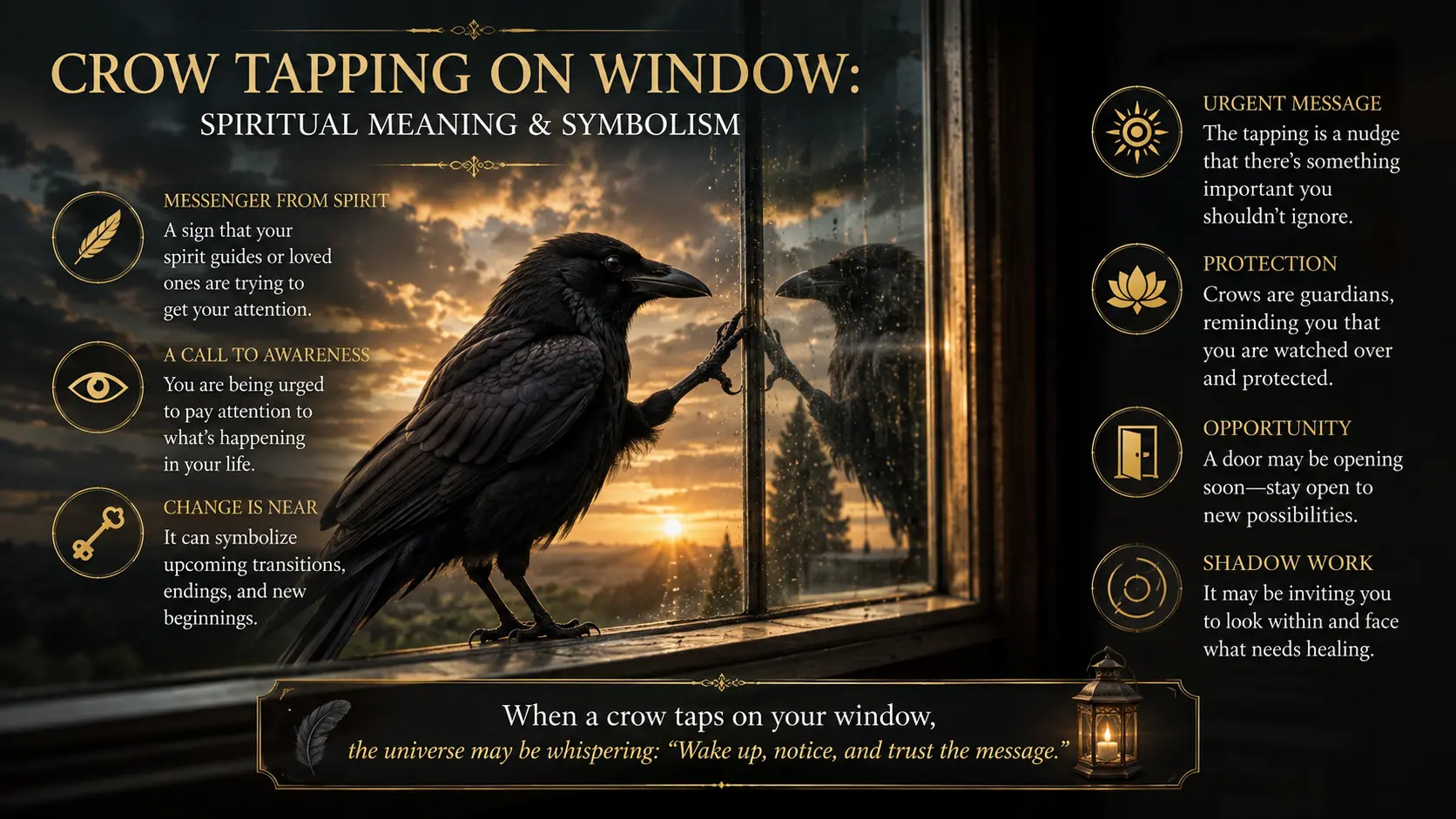
From a spiritual perspective, however, some people see the event as a symbolic invitation to pay attention. A window represents a boundary between the inner and outer world, while the crow is often associated with awareness, change, mystery, and intelligence. Together, these symbols can encourage personal reflection.
What the Behavior Looks Like
A crow may land on a windowsill, look through the glass, peck at the window, fly away, and return several times. It may also move from one side of the window to another while repeatedly examining the surface.
The behavior can seem especially meaningful when it happens unexpectedly or repeatedly. The emotional impact of the experience often influences the meaning a person gives to it.
Why a Crow May Approach Glass
Birds sometimes respond to reflections because they cannot understand that the reflected image is not another bird. A crow may also notice insects, indoor movement, food, plants, or other objects near the window.
In some situations, territorial instincts can encourage repeated interaction with a reflection. This is why understanding the physical explanation is important before assigning a spiritual interpretation.
Crow Symbolism and Spiritual Significance
Crows have occupied a special place in folklore and mythology for centuries. Their intelligence, adaptability, dark plumage, social behavior, and ability to thrive in different environments have contributed to their mysterious reputation.
Spiritually, the crow is often interpreted as a symbol of awareness, transformation, wisdom, mystery, and the ability to recognize what exists beneath the surface. These meanings are symbolic rather than universal rules.
Intelligence and Awareness
Crows are known for their remarkable problem-solving abilities, which makes intelligence one of their strongest symbolic associations. Seeing a crow may therefore inspire you to think more carefully about a situation.
A tapping crow can symbolically represent a wake-up call to become more observant. It may encourage you to notice something that you have previously overlooked.
Transformation and Change
Crows are frequently connected with transformation because they appear in many stories involving endings, beginnings, mystery, and transitions.
If you encounter a crow tapping on your window during a major life change, you may interpret the moment as a reminder to accept change rather than resist it. The symbolism can be personally meaningful even when the bird’s behavior has a natural explanation.
Mystery and the Unknown
The crow’s dark appearance and presence in folklore have given it strong associations with mystery. It can symbolize questions that do not yet have clear answers.
A crow at your window may therefore represent a period when you are being encouraged to remain curious. Not every meaningful experience needs to provide an immediate answer.
Protection and Guidance
Some spiritual traditions interpret birds as messengers or signs of guidance. Within that framework, a crow may represent a reminder to remain alert and trust your ability to navigate uncertain situations.
This does not necessarily mean that the bird is literally carrying a supernatural message. Instead, the encounter can become a meaningful symbol of awareness, resilience, and inner guidance.
Historical Roots of Crow Symbolism
Crow symbolism developed across many different cultures, and its meanings have never been identical everywhere. In some traditions, crows have been associated with wisdom and spiritual knowledge, while in others they have been connected with death, mystery, or supernatural forces.
These contrasting meanings explain why people can experience very different emotions when they see a crow. The same bird can symbolize wisdom in one cultural setting and uncertainty in another.
Ancient European Beliefs
European folklore contains numerous stories involving crows and ravens. These birds were sometimes associated with battlefields, prophecy, supernatural knowledge, and powerful figures from mythology.
Because crows are intelligent and adaptable, they became natural symbols of mystery and observation. Their presence around places associated with death also contributed to darker interpretations.
Indigenous Cultural Perspectives
Indigenous cultures across North America have diverse traditions involving ravens and crows. It is important not to treat all Indigenous beliefs as one single tradition because different nations and communities have their own teachings.
In some stories, corvids can be connected with intelligence, creation, transformation, trickery, or communication. The meaning depends strongly on the specific cultural tradition rather than a universal Indigenous interpretation.
Early Spiritual Archetypes
Birds have commonly been used as symbolic bridges between the physical and spiritual worlds. Their ability to fly made them natural representations of freedom, movement, perspective, and communication.
The crow’s intelligence and unusual behavior added another layer of symbolism. As a result, crows became powerful archetypes for seeing beyond appearances and confronting the unknown.
Crow Symbolism in American History
In the United States, attitudes toward crows have been shaped by folklore, agriculture, literature, popular culture, and practical experiences with wildlife.
Farmers historically noticed crows because they could gather in fields and interact with crops. These everyday encounters sometimes created negative associations, while folklore and literature preserved more mysterious interpretations.
Colonial-Era Interpretations
European settlers brought many existing beliefs about black birds and omens with them. As these ideas mixed with American experiences, crows could become associated with death, misfortune, wilderness, or mystery.
However, these associations should not be treated as evidence that a crow predicts a negative event. Folklore reflects cultural fears and beliefs, not guaranteed predictions about the future.
Rural and Agricultural Beliefs
Crows are highly adaptable and commonly appear in agricultural landscapes. Their presence around fields made them familiar to rural communities.
Because crows could sometimes affect crops, people developed practical opinions about them alongside symbolic ones. This combination helped create the complex image of the crow as both a clever animal and a mysterious figure.
Spiritual Meaning of a Crow Tapping on Your Window
When a crow taps on your window, the most useful spiritual interpretation may be to consider what was happening in your life at that moment.
If you were thinking about a major decision, experiencing uncertainty, or beginning a new chapter, the encounter may feel like a meaningful reminder to slow down and pay attention. The meaning comes from the relationship between the event and your personal experience.
A Call to Pay Attention
One common interpretation is that the crow represents awareness. The tapping itself can metaphorically feel like someone knocking on a door and asking you to notice something.
This symbolism can encourage you to examine your surroundings, relationships, choices, and emotions. The message may simply be: pay attention.
A Sign of Transition
Crows can symbolize transformation because they are often connected with endings and new beginnings in folklore.
If your life is changing, the crow may become a personal symbol for adapting to uncertainty. Rather than predicting what will happen, it can remind you that change is a normal part of growth.
A Moment for Self-Reflection
A surprising encounter often causes people to stop what they are doing. That pause itself can be valuable.
You might ask yourself what you were thinking about immediately before seeing the crow. Your answer may reveal why the event felt significant to you.
A Reminder to Trust Your Intuition
Crows are often associated with intelligence and observation. Symbolically, this can connect with the idea of trusting your own judgment.
If something in your life feels uncertain, the experience may encourage you to gather information, remain observant, and listen to your instincts without allowing fear to control your decisions.
Emotional and Psychological Meaning
A crow tapping against glass can create a strong emotional reaction because it is unexpected and visually striking. Some people feel curiosity, while others immediately think about spiritual signs or omens.
Psychologically, humans naturally search for patterns and meaning. When an unusual event occurs at an emotionally important time, the mind may connect the two experiences. This does not make the experience meaningless; it simply means that personal meaning and supernatural certainty are not the same thing.
Common Emotional Reactions
People may experience curiosity, surprise, excitement, fear, comfort, or even sadness when a crow repeatedly approaches a window.
Your first emotional response can provide useful information about your personal associations with crows. If you feel calm, you may view the event as reassuring. If you feel frightened, exploring the source of that fear may be more useful than assuming the crow predicts danger.
Personal Associations and Memories
A crow may remind someone of a loved one, childhood experience, story, movie, or spiritual belief. Those associations can make the encounter feel especially powerful.
In this sense, the symbolism is partly personal. An animal encounter can become meaningful because of what it awakens inside you.
The Psychology of Finding Meaning
Humans have always used symbols to understand uncertain experiences. Finding meaning in an unusual encounter can support reflection and emotional processing.
However, symbolic thinking is healthiest when it does not replace practical judgment. You can appreciate the spiritual symbolism while still recognizing that the crow may simply be responding to its reflection.
Crow Tapping on Window: Spiritual Meanings by Context
The circumstances surrounding the encounter can influence how people interpret it. A single tap may feel different from repeated tapping, and an encounter during an emotional period may feel more significant than an ordinary afternoon.
There is no universally accepted spiritual dictionary that assigns one fixed meaning to every crow encounter. Context is more important than rigid interpretations.
Tapping Once or Repeatedly
One brief tap may simply be an accidental interaction with the glass. Repeated tapping may suggest that the bird is responding to its reflection or another visual stimulus.
Symbolically, repeated tapping can be interpreted as persistence or a stronger reminder to pay attention. This is a personal interpretation rather than a prediction.
Tapping in the Morning
Morning is often symbolically associated with beginnings, renewal, and fresh opportunities.
A crow appearing at your window in the morning may therefore inspire interpretations connected with new awareness, a fresh perspective, or the beginning of a new chapter.
Tapping at Night
A nighttime encounter can feel more mysterious because darkness naturally changes the emotional atmosphere.
Symbolically, some people associate nighttime crows with introspection, hidden emotions, uncertainty, or the unknown. However, the bird may simply have been attracted to light or reflections.
A Crow Returning Every Day
If the same crow appears repeatedly, there may be a consistent physical reason. The window could be reflecting another bird, a tree, the sky, or something else the crow finds interesting.
Spiritually, repeated encounters can be viewed as a reminder to examine recurring patterns in your own life. The repetition can inspire reflection without proving that a supernatural message is present.
Seeing One Crow Versus Several
A single crow may be interpreted symbolically as individuality, observation, or personal awareness.
Several crows can represent community, social connection, collective intelligence, or shared experiences. These meanings vary across traditions and should not be treated as fixed spiritual laws.
Crow Tapping on Window: Good or Bad Omen?
A crow tapping on a window is not inherently a bad omen. The idea that every crow encounter predicts death or misfortune comes largely from specific folklore traditions and cultural associations.
Modern interpretations are often more balanced. Crows can symbolize intelligence, adaptability, transformation, observation, and mystery as easily as they can symbolize darker themes.
Why It Is Not Automatically Negative
Crows are intelligent wild animals with complex behaviors. Their presence does not provide reliable evidence that something bad is going to happen.
If you find the encounter meaningful, you can interpret it as a reminder to become more attentive, thoughtful, or adaptable rather than automatically expecting misfortune.
Why Context Shapes Interpretation
The same event can mean different things to different people. Someone beginning a new career might interpret the crow as a symbol of change, while someone grieving may connect it with memories of a loved one.
Personal context gives symbolism its emotional meaning.
Positive and Neutral Symbolism
Positive interpretations can include wisdom, awareness, resilience, transformation, protection, curiosity, and adaptability.
Neutral interpretations are equally reasonable: the crow may simply have noticed its reflection. You do not have to choose between appreciating symbolism and accepting a natural explanation.
Cultural Interpretations Around the World
Crow symbolism varies widely across cultures. Some traditions emphasize wisdom and intelligence, while others focus on mystery, death, prophecy, trickery, or transformation.
It is therefore important to avoid statements such as “crows always mean death” or “crows always bring good luck.” Symbolism changes across cultures, historical periods, and individual beliefs.
Asian Traditions
Across parts of Asia, crows and related corvids have appeared in folklore and mythology with meanings that can include family relationships, omens, intelligence, or spiritual significance.
Different countries and traditions interpret these birds differently. A respectful interpretation should recognize this diversity instead of combining unrelated beliefs into one universal meaning.
African and Global Folklore
African and other global traditions contain many stories involving birds as symbols of communication, wisdom, warning, or spiritual connection.
Crow and raven symbolism is particularly diverse because local ecosystems and cultural histories influence how people perceive these birds.
Western Spiritual Traditions
Western folklore has often given black birds complicated symbolic roles. They can represent death and mystery while also representing intelligence and prophecy.
Modern spiritual interpretations increasingly focus on transformation, awareness, intuition, and personal growth rather than assuming a negative prediction.
Modern Spirituality and Crow Symbolism
Contemporary spirituality often treats animal encounters as opportunities for reflection. Instead of asking only, “What does this bird predict?” people may ask, “What does this experience make me notice?”
This approach gives the encounter personal significance without requiring a literal supernatural explanation.
New-Age Interpretations
Some New-Age traditions describe crows as spirit animals, guides, or symbolic messengers. These interpretations commonly emphasize intuition, transformation, intelligence, and awareness.
Such beliefs are matters of personal spirituality rather than scientifically established facts. They can still serve as meaningful frameworks for reflection when approached thoughtfully.
Social Media and Online Spiritual Communities
Social media has made spiritual interpretations of animal encounters more visible. A short video of a crow tapping on a window can quickly receive hundreds of comments offering different interpretations.
This can be comforting or interesting, but online claims should be approached critically. A viral interpretation does not automatically represent an ancient or universal belief.
Personal Spiritual Practices
If the encounter feels meaningful, you might write down what happened, record your emotions, meditate, pray according to your own beliefs, or simply spend a few quiet minutes reflecting.
The purpose is not to force an answer. Instead, it is to use the experience as a prompt for greater self-awareness.
Why Crows Tap on Windows Physically
Before assuming spiritual significance, it is useful to understand why crows interact with windows. Glass is difficult for birds to perceive because it can reflect the surrounding environment.
A crow may see another crow in the reflection and respond defensively. It may also investigate movement, objects, food, or insects near the window.
Reflection and Territorial Behavior
A reflective window can look like a second bird. A territorial crow may repeatedly approach or peck at what it believes is a rival.
This is one of the most common practical explanations for repeated window tapping. Reducing reflections can sometimes help discourage the behavior.
Curiosity and Visual Confusion
Crows are highly curious animals. They investigate unusual objects and can learn from repeated experiences.
A transparent surface can create visual confusion because the bird may not understand the boundary between its reflection and the actual environment.
Seasonal and Environmental Factors
Window interactions can increase during certain periods when birds are more territorial or active.
Changes in light, weather, nearby nesting areas, vegetation, and outdoor activity can also influence how frequently a crow approaches a particular window.
Myths, Fear, and Common Misunderstandings
The most common misconception is that a crow at a window automatically predicts death. While some folklore connects crows and ravens with death or the spirit world, there is no reliable evidence that a crow tapping on glass predicts someone’s death.
Fear can become stronger when people encounter dramatic interpretations online. A more balanced approach considers cultural symbolism, personal meaning, and ordinary animal behavior together.
Death and Bad-Omen Beliefs
Crows have sometimes been associated with death because they are scavengers and historically appeared around battlefields or places where animals had died.
This association helped create folklore about crows as death omens. However, a cultural association is not the same as a prediction.
Horror Stories and Media Influence
Movies, television, books, and online stories often portray crows in dark or supernatural settings. These images can strongly influence modern perceptions.
As a result, people may interpret an ordinary crow encounter through a dramatic cultural lens. Recognizing this influence can help separate fear from personal spirituality.
Changing Modern Interpretations
Modern interpretations increasingly recognize the crow’s intelligence, adaptability, and social complexity.
Instead of seeing the bird only as a symbol of darkness, many people now associate it with wisdom, transformation, resilience, curiosity, and awareness.
What Should You Do When a Crow Taps on Your Window?
The best response is to remain calm and observe what is happening. Look for reflections, nearby nesting areas, food sources, or other environmental factors that could explain the behavior.
If the event feels spiritually meaningful, take a moment to reflect rather than immediately assuming that it predicts something. You can allow the experience to inspire awareness without becoming fearful.
Observe the Situation Calmly
Watch the crow from a safe distance and notice whether it is repeatedly responding to its reflection.
Avoid chasing or frightening the bird. Wild animals are best observed without unnecessary interference.
Reflect on What Is Happening in Your Life
Ask yourself what you were thinking or feeling when the crow appeared. Were you considering a major decision? Starting something new? Feeling uncertain?
These questions can help turn the encounter into a useful moment of self-reflection.
Avoid Fear-Based Interpretations
A spiritual interpretation should not make you feel trapped by fear. If an interpretation causes anxiety, step back and consider the ordinary explanation first.
A crow tapping on your window does not give you a fixed prediction about your future.
Protect the Bird if Necessary
If a bird repeatedly strikes or pecks at a window, reducing reflections may help. Window decals, exterior coverings, or other bird-safe visual barriers can make the glass easier for birds to recognize.
If the bird appears injured, contact an appropriate local wildlife rescue or rehabilitation service rather than attempting unnecessary handling.
Crow Symbolism in Art and Personal Expression
The crow’s distinctive appearance has made it a popular subject in art, photography, tattoos, literature, and home decoration.
People may choose crow imagery because it represents qualities they identify with, such as independence, intelligence, mystery, transformation, or resilience.
Tattoos and Personal Identity
A crow tattoo can represent different things depending on the individual. Common themes include wisdom, independence, transformation, mystery, and overcoming difficult experiences.
Because tattoo symbolism is personal, the most meaningful interpretation is often the one connected to the person’s own story.
Home Decor and Spiritual Art
Crow artwork can create an atmosphere of mystery and natural symbolism. Some people use it as a reminder of intuition, observation, or personal transformation.
The image can be decorative while also carrying a private emotional meaning.
Photography and Creative Expression
Photographers often find crows compelling because their silhouettes, movements, and social behavior create dramatic visual compositions.
A crow at a window can also become a metaphor for the relationship between the outside world and the private inner world.
Common Crow-Tapping Situations and Their Meanings
Different situations can inspire different symbolic interpretations, but none should be treated as universal predictions.
The most useful approach is to combine observation, personal context, cultural awareness, and practical reasoning.
One-Time Window Tapping
A single tap is most likely an ordinary interaction with the glass.
Symbolically, you might treat it as a brief reminder to become present and notice your surroundings.
Repeated Daily Tapping
Repeated tapping often has a physical explanation involving reflections or territorial behavior.
If you personally find the pattern meaningful, you might interpret it as a reminder to examine recurring patterns in your own life.
Crow Tapping During a Major Life Change
When an unusual encounter occurs during a major transition, it can feel especially significant.
The crow may become a personal symbol of adaptability, courage, and moving through uncertainty.
Crow Appearing Near a Bedroom Window
A bedroom is associated with rest, dreams, privacy, and the subconscious. A crow appearing there may therefore feel particularly intimate or mysterious.
Symbolically, some people connect this situation with reflection, dreams, hidden thoughts, or emotional awareness.
Crow Tapping During an Emotional Moment
If you notice a crow while thinking about someone or processing a difficult emotion, the encounter may become deeply meaningful.
Rather than assuming the crow is literally delivering a message, you can treat the moment as a symbolic reminder of the thoughts and feelings already present within you.
Crow Tapping on Window Meaning: Quick Reference Table
| Situation | Possible Symbolic Meaning | Practical Explanation |
|---|---|---|
| One tap | Awareness or curiosity | Accidental contact or investigation |
| Repeated tapping | Persistence or repeated reflection | Reflection or territorial behavior |
| Morning encounter | New beginning or fresh perspective | Normal daytime activity |
| Night encounter | Mystery or introspection | Attraction to light or reflections |
| Crow returns daily | Recurring theme or reminder | Familiar reflection or territory |
| During life changes | Transformation and adaptability | Coincidental timing |
| During grief | Memory and reflection | Emotional association |
| Multiple crows | Community or shared awareness | Normal social behavior |
FAQs
Is a Crow Tapping on a Window a Bad Omen?
No, a crow tapping on a window is not automatically a bad omen. It can have ordinary explanations such as reflection, curiosity, or territorial behavior. Spiritually, some people interpret it as a reminder of awareness or change.
Does a Crow Tapping on Glass Mean Someone Will Die?
There is no reliable evidence that a crow tapping on glass predicts someone’s death. Some folklore connects crows with death and mystery, but these are cultural beliefs rather than proven predictions.
Why Do Crows Physically Tap on Windows?
Crows may tap windows because they see their reflection and mistake it for another bird. They may also investigate movement, objects, insects, or other visual stimuli around the glass.
Could a Crow Be a Spiritual Messenger?
Some spiritual traditions interpret birds as messengers or symbolic guides. If you hold this belief, the crow may represent awareness, transformation, intuition, or reflection. However, this is a spiritual interpretation rather than something that can be scientifically confirmed.
Does the Time of Day Change the Meaning?
There is no universal spiritual rule connecting a particular time with a specific crow meaning. Morning may symbolically suggest beginnings, while nighttime may inspire associations with mystery or introspection.
What Does It Mean if the Crow Returns Every Day?
Repeated visits can have a practical explanation, especially if the crow is responding to a reflection. Symbolically, you might view the repetition as an invitation to examine recurring patterns or themes in your own life.
Should I Do Something After a Crow Taps on My Window?
You do not need to perform a special ritual. Observe the bird, consider practical causes, and reflect on why the encounter feels meaningful to you. If the bird repeatedly strikes the glass, consider using bird-safe measures to reduce reflection.
Conclusion
The spiritual meaning of a crow tapping on a window can be understood through several layers. Crows often symbolize intelligence, awareness, transformation, mystery, adaptability, and intuition, while the window can represent a boundary between the inner and outer worlds.
At the same time, the behavior usually has a practical explanation. Reflections, territorial instincts, curiosity, and visual confusion can all cause crows to interact with glass. Recognizing these natural causes does not prevent you from finding personal meaning in the experience.
Ultimately, a crow tapping on your window does not have to be interpreted as a warning or prediction. It can simply become a memorable reminder to pause, observe, trust your judgment, and pay attention to the changes taking place in your life.
Finding Meaning Without Fear
The healthiest interpretation is one that encourages curiosity rather than fear. Let the encounter inspire reflection while keeping your understanding grounded in reality.
A crow at your window may be a fascinating moment of nature, a personal symbol, or both. The meaning you take from it is ultimately shaped by your own experience, beliefs, and circumstances.