OMY Meaning in Text: What Does OMY Mean?
Quick Answer
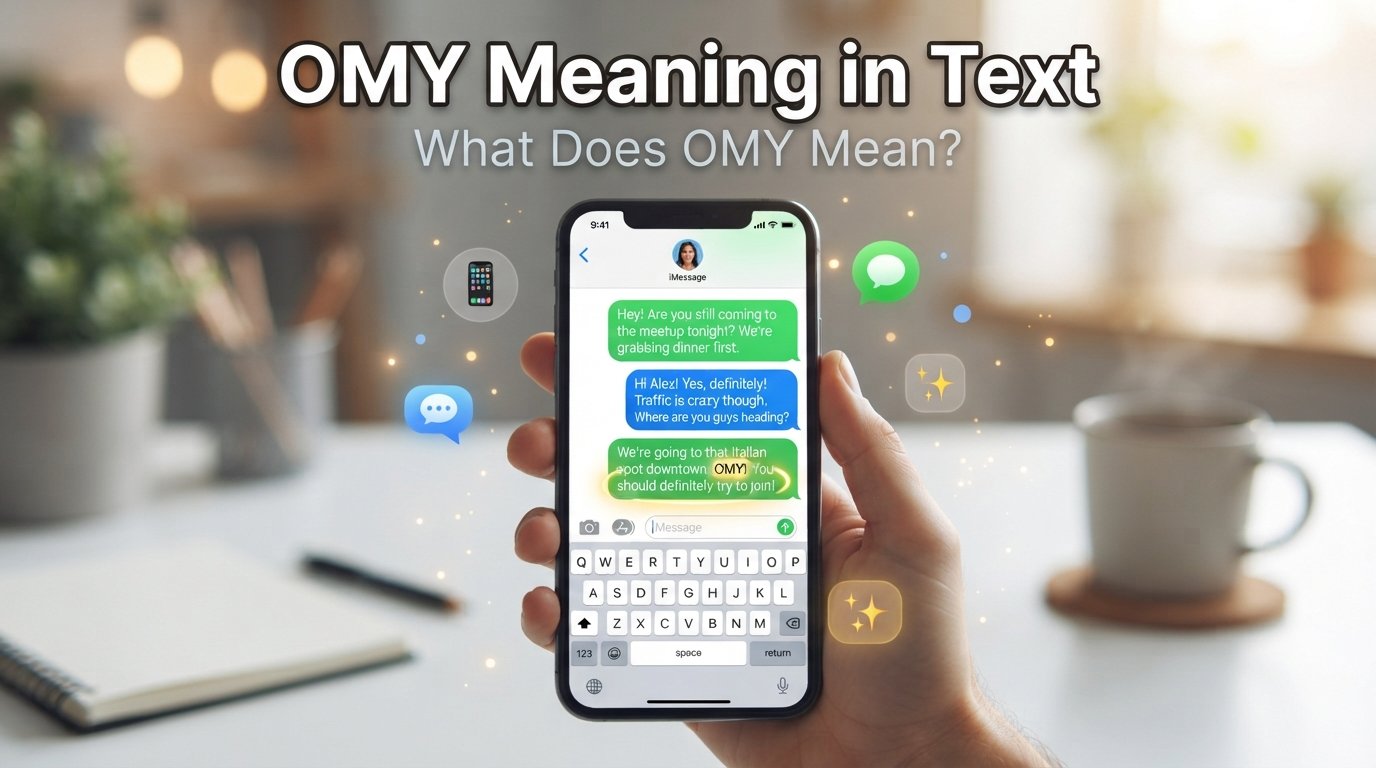
OMY usually means “Oh My” in text messages and online conversations. It is a short, casual expression used to show surprise, excitement, disbelief, amazement, or sometimes frustration. The exact emotion depends on the surrounding conversation, punctuation, and context.
For example, someone might text, “OMY, that was incredible!” to express excitement or amazement. Because OMY is informal, it is generally more appropriate for friends, social media, and casual chats than for professional communication.
TL;DR
OMY = “Oh My.” It is a casual texting abbreviation that communicates an emotional reaction. Depending on context, it can express surprise, shock, excitement, disbelief, amusement, or frustration. It can overlap with OMG (“Oh My God”), but OMY is usually less intense and avoids the religious reference found in the longer expression.
What Does OMY Mean in Texting?
OMY Definition
In texting, OMY most commonly stands for “Oh My.” It compresses a familiar spoken expression into three letters, making it quick to type while preserving the emotional reaction.
People may use OMY when something catches them off guard or produces a strong reaction. The abbreviation is flexible, so its meaning can range from genuine amazement to playful exaggeration.
What “Oh My” Expresses
The phrase “Oh my” has long been used as an emotional reaction in English. It can signal that someone is surprised, impressed, confused, amused, or overwhelmed.
The emotion is not fixed. “OMY, look at that!” might communicate excitement, while “OMY, what happened?” could express shock or concern.
How OMY Is Used in Messages
OMY normally appears as a standalone reaction or at the beginning of a sentence.
Examples include:
- “OMY, you actually did it!”
- “OMY, that is beautiful.”
- “OMY, what just happened?”
- “OMY 😂 I can’t believe that.”
- “OMY, this is getting crazy.”
Its meaning becomes clearer when you consider the words, emojis, punctuation, and conversation surrounding it.
How OMY Is Used in American Texting Culture
Everyday Conversations
In American digital communication, short expressions are common because texting encourages quick, conversational responses. OMY fits this style by turning a familiar spoken reaction into a compact written form.
A person may use it with friends when reacting to news, photos, stories, jokes, unexpected events, or dramatic situations. It often makes a message feel spontaneous rather than carefully composed.
Social Media and Online Chats
OMY can also appear in comments, captions, group conversations, and other informal online spaces. Users may write it when reacting to a surprising photo, funny video, impressive achievement, or unexpected update.
However, OMY is not necessarily as universally recognizable as abbreviations such as OMG, LOL, or BTW. Some readers may understand it immediately, while others may need the surrounding context.
When People Typically Use OMY
OMY is most useful when the writer wants to communicate an emotional reaction quickly.
Common situations include:
- Seeing something surprising
- Reacting to exciting news
- Expressing amazement
- Responding to something funny
- Showing disbelief
- Reacting dramatically for humor
- Expressing mild frustration
The abbreviation works best when the conversation is already informal.
What Does OMY Mean Emotionally?
Surprise and Shock
One of the clearest uses of OMY is surprise. Someone may type it after hearing unexpected information or seeing something they did not anticipate.
For example, “OMY, I didn’t know that!” communicates immediate surprise without requiring a longer explanation.
Excitement and Amazement
OMY can also express positive excitement. Someone who sees an amazing performance, beautiful image, or impressive accomplishment may use it as an enthusiastic reaction.
In this context, the abbreviation functions almost like an emotional exclamation rather than a literal statement.
Frustration or Disbelief
Depending on context, OMY can carry a completely different feeling. A person dealing with an irritating or unbelievable situation might write “OMY, not again.”
Here, the abbreviation communicates exasperation or disbelief rather than excitement. This demonstrates why the surrounding words are important when interpreting texting slang.
How to Understand the Tone of OMY
Context Changes the Meaning
The same abbreviation can communicate different emotions in different conversations.
Compare:
- “OMY, you look amazing!” — admiration
- “OMY, what happened?” — shock
- “OMY, not this again.” — frustration
- “OMY 😂” — amusement or playful surprise
The words that follow OMY often provide the strongest clue about the sender’s intended tone.
Punctuation and Capitalization
Punctuation can make a noticeable difference.
“OMY.” may appear calm, serious, or restrained, while “OMY!!!” feels much more dramatic. Lowercase “omy” may feel more casual, relaxed, or conversational.
Capitalization is not a strict rule in texting, though. People often type abbreviations in whatever format feels natural to them.
OMY With Emojis and Other Words
Emojis can make the intended emotion easier to recognize.
For example, a laughing emoji can make OMY feel playful, while a shocked-face emoji can reinforce surprise. Words such as “wow,” “no way,” or “seriously” can similarly strengthen the emotional meaning.
Where Did OMY Come From?
Origins of “Oh My”
The expression “oh my” comes from ordinary English speech and has been used as an exclamation for a long time. It can function as a mild emotional reaction without specifying exactly what the speaker feels.
Unlike a highly specialized slang term, “oh my” is simply a compact expression of emotion. Its meaning has always depended heavily on context and delivery.
From Spoken Expression to Text
As communication moved from face-to-face conversation to SMS, instant messaging, and social media, people began shortening many familiar expressions.
OMY follows this broader pattern. Instead of typing the complete phrase, a person can use three letters to recreate the same basic reaction in written form.
The Rise of Internet Abbreviations
Digital communication popularized many abbreviations because users wanted to communicate quickly while maintaining a conversational tone.
Terms such as LOL, BRB, IDK, OMG, and BTW became widely recognizable. OMY belongs to the broader world of abbreviated online language, although its recognition and frequency can vary considerably between communities.
See Also: What Is the White Cat Spiritual Meaning and Its Significance?
Why Do People Shorten “Oh My” to OMY?
Faster Digital Communication
One reason for abbreviations is simple efficiency. Typing three letters is faster than writing a complete phrase, particularly during rapid conversations.
OMY also communicates emotion without requiring a full sentence. That makes it useful as an immediate reaction.
Casual and Conversational Style
Texting is often designed to resemble speech. People use abbreviations, emojis, punctuation, and informal expressions to make messages feel natural.
OMY contributes to that conversational quality. It can make a reaction seem spontaneous rather than formal or carefully edited.
Internet Slang and Group Identity
Online communities often develop shared vocabulary. Using familiar abbreviations can help people communicate in a way that feels natural within a particular social group.
At the same time, slang is constantly changing. A term that is familiar to one group may be unfamiliar to another, which is why context remains important.
OMY vs OMG and Similar Abbreviations
OMY vs OMG
OMY means “Oh My,” while OMG usually means “Oh My God.”
Both can communicate surprise, excitement, shock, or disbelief. However, OMG is generally more established and widely recognized in English-language internet communication.
OMY can feel milder or less intense, depending on the context. It also avoids explicitly including “God” in the expression.
OMY vs OMW
These two abbreviations have very different meanings.
OMY generally means “Oh My.”
OMW usually means “On My Way.”
Because the letters are similar, confusing them can change the meaning of an entire message.
For example, “OMW” in “OMW to your house” means the person is traveling there, not reacting emotionally.
OMY vs OMFG
OMFG is a much stronger and more profane abbreviation generally derived from “Oh My F***ing God.”
OMY is considerably more neutral. If someone wants to express surprise without profanity, OMY can be a softer option.
Which Abbreviation Fits Best?
Choose the abbreviation according to the tone of the conversation.
- OMY: mild emotional reaction
- OMG: stronger, highly familiar emotional reaction
- OMW: indicates that someone is on the way
- OMFG: highly emphatic and profane reaction
Knowing the audience is just as important as knowing the abbreviation.
Is OMY Used Differently Across Platforms?
OMY in Text Messages
In private messages, OMY can function as a quick emotional response. Friends may use it naturally when discussing personal experiences, entertainment, relationships, jokes, or unexpected events.
Because texting is informal, there is considerable freedom in capitalization and punctuation.
OMY on TikTok and Instagram
On visual-first platforms, abbreviations often appear alongside images, videos, memes, and emojis. OMY can therefore work as a reaction to something visually surprising or impressive.
Its exact popularity can vary by platform, community, age group, and current slang trends.
OMY in Comments and Group Chats
Group chats can encourage abbreviated expressions because conversations move quickly. A short reaction such as OMY can communicate an immediate response without interrupting the flow of discussion.
In public comments, however, readers may have less context. If OMY is unfamiliar to the audience, its meaning may not be immediately obvious.
Can OMY Be Used Sarcastically?
Playful Sarcasm
Yes. OMY can be used sarcastically, especially when someone intentionally exaggerates a reaction.
For example, if a friend says they spent five minutes choosing a snack, another person might jokingly respond, “OMY, what a difficult decision!”
The phrase does not necessarily indicate genuine shock. Instead, it can amplify a humorous situation.
Dramatic Reactions
Digital communication frequently uses exaggerated reactions for comedic effect. OMY can participate in this style by making an ordinary situation sound dramatically important.
This is especially common when friends already understand each other’s humor.
How Context Reveals Sarcasm
Sarcasm is difficult to identify from words alone because texting does not include facial expressions or vocal tone.
Look for clues such as exaggerated wording, laughing emojis, previous conversation, or an obviously unrealistic reaction. These details can reveal whether OMY is sincere or playful.
Common Misunderstandings About OMY
Why People Misread It
The biggest issue with OMY is that its emotional meaning is not fixed. A reader may interpret it as excitement while the sender intended frustration.
Another problem is familiarity. Someone who has never encountered OMY may not immediately know what the letters represent.
When OMY Sounds Unnatural
OMY can feel unnatural when used in situations requiring formal or precise communication.
For example, a business email explaining a serious issue would usually benefit from direct language rather than casual texting abbreviations.
How to Use OMY Correctly
Use OMY when the conversation is informal and the emotional reaction is clear.
If the audience may not recognize the abbreviation, writing “oh my” or using a clearer phrase can prevent confusion. Good digital communication is not simply about shortening words—it is about making the intended meaning easy to understand.
Is OMY Rude or Inappropriate?
Casual vs Formal Communication
OMY is generally not rude by itself. Its tone depends on how and where it is used.
It is much more natural in casual conversations than in professional documents, academic writing, customer-service communication, or formal correspondence.
When OMY Is Safe to Use
OMY is generally suitable for:
- Friends
- Family conversations
- Informal group chats
- Casual social-media comments
- Memes and humorous conversations
- Informal online communities
Situations to Avoid It
Avoid relying on OMY when clarity and professionalism are especially important.
In a formal setting, writing the complete thought is usually better. A professional message should make the intended emotion or information unmistakable.
OMY Meaning Across Different Cultures
Similar Expressions Worldwide
Many languages have their own short expressions for surprise, amazement, disbelief, or frustration. Although the words differ, the underlying communicative purpose is often similar.
This is one reason emotional expressions can sometimes be understood even when the exact abbreviation is unfamiliar.
Translation and Cultural Differences
OMY does not always translate neatly into another language because “oh my” carries cultural and conversational associations from English.
A literal translation may not produce the same emotional effect. Translators and language learners therefore need to consider the situation rather than simply replacing each word.
Why Context Still Matters
Digital slang is highly dependent on community and culture. A term that seems obvious in one English-speaking online group may be unfamiliar elsewhere.
The safest approach is to interpret OMY alongside the entire message rather than treating it as a universal code with one emotional meaning.
Modern OMY Usage and Changing Slang
OMY Trends in 2025–2026
Digital slang continues to change quickly. Users increasingly combine abbreviations with emojis, reaction images, memes, GIFs, and intentionally exaggerated punctuation.
OMY therefore works less like a formal vocabulary item and more like a flexible digital reaction marker. Its frequency can vary considerably among different online communities.
How Younger Users Use OMY
Younger internet users often adapt abbreviations creatively. They may combine short expressions with lowercase text, repeated letters, emojis, or ironic language.
That means OMY can sometimes communicate more than its literal expansion. The emotional effect may depend on the surrounding digital style.
What Could Influence Its Future Meaning
The future of OMY will likely depend on whether online communities continue using it and whether another abbreviation becomes more popular.
Digital slang has a short life cycle. Some abbreviations become mainstream, while others remain limited to particular communities. OMY’s meaning is relatively stable, but its popularity and tone can continue to evolve.
Frequently Asked Questions About OMY
What does OMY stand for in texting?
OMY usually stands for “Oh My.” It is used as a casual emotional reaction to express surprise, excitement, amazement, disbelief, or frustration.
Is OMY the same as OMG?
Not exactly. OMY means “Oh My,” while OMG usually means “Oh My God.” They can express similar emotions, but OMG is more widely recognized and can sound more emphatic.
Is OMY rude or inappropriate?
Generally, OMY is not rude or offensive. However, it is informal and may not be appropriate for professional or highly formal communication.
Can OMY be used sarcastically?
Yes. OMY can be sarcastic or playful when someone intentionally exaggerates their reaction. The surrounding words, emojis, and conversation usually reveal whether the reaction is genuine.
Is OMY commonly used in America?
OMY can be understood in American digital communication, but it is less universally established than abbreviations such as OMG. Usage varies by individual, age group, platform, and online community.
Can OMY be used in professional messages?
It is usually better to avoid OMY in professional messages. Writing the complete expression or using direct language makes the communication clearer and more appropriate for formal settings.
Conclusion: Understanding OMY in Texting
Final Takeaway
OMY means “Oh My” in most texting and online contexts. It is a short, informal expression that can communicate surprise, excitement, amazement, disbelief, amusement, or frustration.
Its exact tone depends on context, punctuation, emojis, and the relationship between the people communicating. While OMY can overlap with OMG, it is generally a milder and more neutral expression. Understanding these differences makes it easier to interpret texting slang accurately and use it naturally in casual conversations.