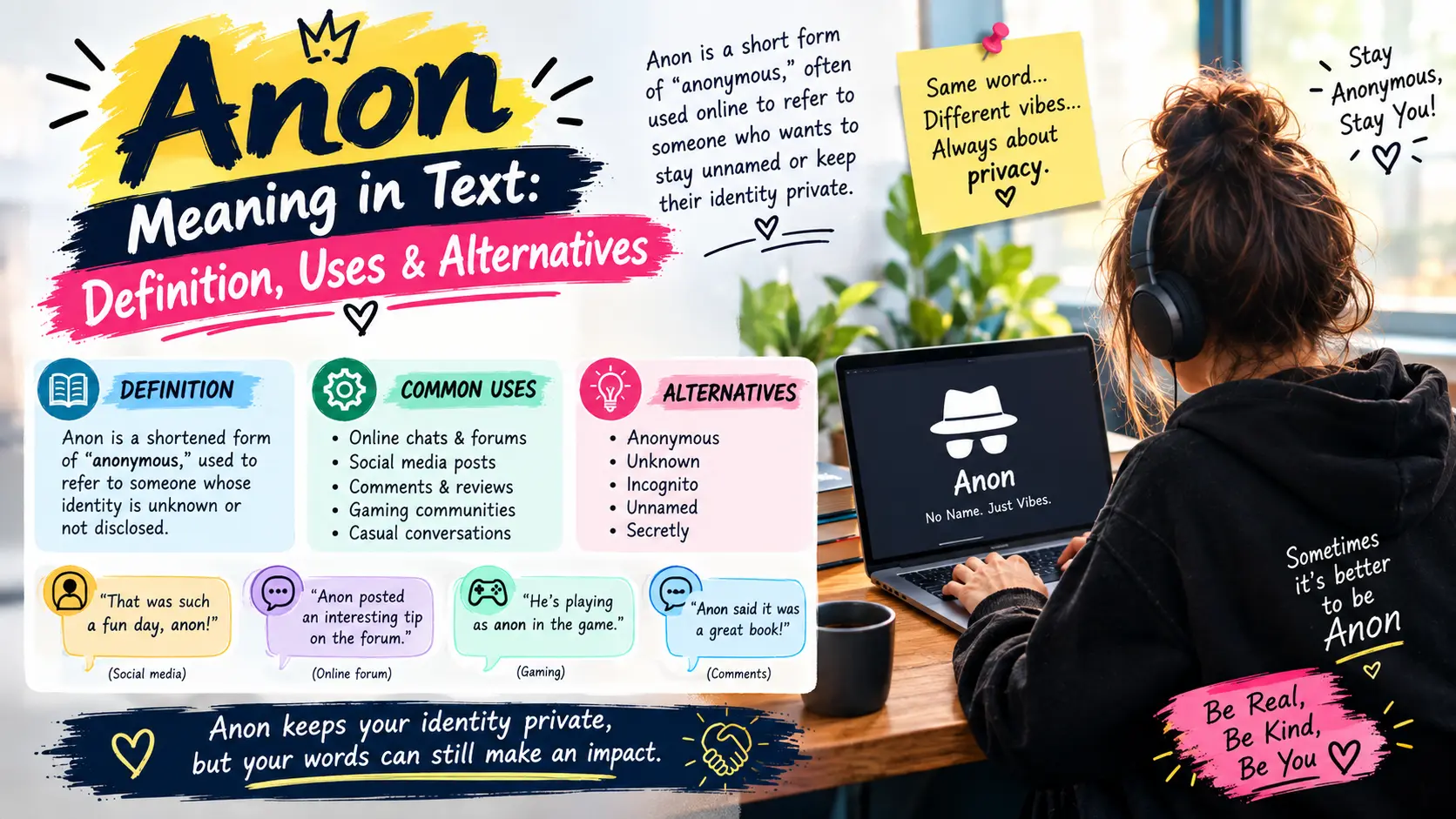
Anon Meaning in Text: Definition, Uses & Alternatives
Quick Answer
“Anon” usually means “anonymous” or “an anonymous person” in modern text and online communication. It is commonly used when someone’s identity is unknown, intentionally hidden, or not important to the discussion. For example, “An anon sent me a message” means that an unidentified person sent the message.
The word can also have an older meaning in English. Historically, “anon” meant “soon,” “shortly,” or “immediately.” However, when people use “anon” in contemporary texting, forums, or social media, they generally mean anonymous.
TL;DR
- Anon usually means anonymous in modern online communication.
- It can refer to an unidentified or unnamed person.
- It is common on forums, social media, websites, and messaging platforms.
- “Anon” is shorter and more casual than “anonymous.”
- Historically, “anon” also meant soon or shortly, especially in older English.
- The correct meaning depends on the context.
- In formal writing, anonymous is usually clearer than “anon.”
What Does “Anon” Mean in Text?
Simple Definition of Anon
In modern texting and internet language, anon is commonly a shortened form of anonymous. It describes someone whose identity is unknown, undisclosed, or deliberately concealed.
For example, someone might write, “An anon gave me some advice.” Here, “anon” refers to an anonymous person. The speaker either does not know who the person is or chooses not to identify them.
The term is especially useful online because digital communication often allows people to participate without publicly revealing their real names. Instead of repeatedly saying “anonymous user” or “anonymous person,” internet users often shorten the expression to anon.
What Anon Means in Different Contexts
The meaning of “anon” can change slightly depending on where it appears. On a discussion board, an anon may mean an unidentified user who posted a comment. On social media, it might describe someone using an anonymous account.
In a text conversation, “anon” could simply mean an unknown person. For example, “I received a tip from an anon” suggests that the source did not reveal their identity.
There is also an older English meaning of “anon.” In historical or literary writing, anon can mean “soon” or “shortly.” Therefore, context is important when determining what the word means.
Examples of Anon in a Sentence
Here are some examples of the modern meaning:
- “An anon sent me a message.”
- “Someone posted the information as an anon.”
- “An anon user left a comment.”
- “The story originally came from an anon source.”
- “I don’t know who submitted it; it was from an anon.”
In these examples, “anon” refers to someone whose identity is unknown or undisclosed.
What Does Anon Mean Online?
Anon on Social Media
On social media, anon commonly describes an anonymous person or account. A user might have an account that does not reveal their real name, or they might submit information without identifying themselves.
The word is particularly useful when discussing comments, tips, submissions, or messages where the identity of the contributor is unavailable.
For example, “An anon account posted the claim” means that the account owner is not publicly identified. The term itself does not necessarily suggest anything negative about the person.
See Also: Steadfast Definition, Meaning, Usage, and Symbolism
Anon in Forums and Online Communities
Forums and online communities frequently use “anon” to describe unidentified participants. A discussion may include several registered users alongside people who post without recognizable identities.
You may see phrases such as “anon poster,” “anon user,” or simply “an anon.”
In these settings, “anon” is usually informal internet shorthand. Its meaning is generally easy for experienced internet users to understand from context.
Anon in Text Messages and Chats
In texting, “anon” is less common than “anonymous,” but it can still appear in casual conversations. Someone might say, “I got this from an anon,” when explaining that an unidentified person provided information.
Because texting favors short expressions, “anon” can be convenient when both people already understand the context.
However, if the recipient may not recognize the abbreviation, using anonymous can prevent confusion.
Where Does the Word “Anon” Come From?
Historical Meaning of Anon
The word anon has a much older history than modern internet slang. In older English, “anon” was used to mean “soon,” “shortly,” or “right away.”
Historical and literary texts sometimes use expressions such as “I will come anon,” meaning “I will come soon.”
This older meaning is separate from the modern internet use meaning anonymous. The similarity in spelling can sometimes create confusion, but the two uses developed in different contexts.
How Anon Became Linked to Anonymity
The modern connection between “anon” and anonymity comes from its use as a shortened form of anonymous. As writing became increasingly informal and digital communication developed, shortened expressions became more common.
Internet communities especially favor compact language. “Anonymous” can therefore become “anon” when users want a quick way to identify someone whose name is hidden.
Over time, “anon” became recognizable as internet shorthand for an unidentified person.
Anon in Modern English
Today, “anon” has two important meanings depending on context.
In contemporary digital communication, it generally refers to an anonymous person or identity. In older literary or historical English, it can mean soon or shortly.
Modern readers encountering “anon” on a forum, social platform, or in a text message will usually interpret it as anonymous.
How Americans Use “Anon” Today
Casual Digital Communication
American internet users may use “anon” as a convenient shorthand when discussing unidentified people online. It can appear in comments, forums, social platforms, group discussions, and private messages.
Its tone is generally casual and internet-oriented rather than formal.
For example, “An anon mentioned this yesterday” sounds like ordinary online conversation. In a professional report, however, “an anonymous source” would normally sound more appropriate.
Anonymous Online Identity
“Anon” can also describe someone who participates online without revealing their real identity. This can include anonymous commenters, posters, contributors, or account holders.
The term itself does not establish why the identity is hidden. A person might want privacy, avoid unwanted attention, protect their job, share a sensitive opinion, or simply prefer not to use their real name.
Humor, Irony, and Internet Culture
Sometimes “anon” is used playfully or ironically. Internet communities frequently create their own vocabulary, and shortened words can become part of a community’s style.
The tone may therefore range from completely neutral to humorous. Understanding the surrounding conversation is the best way to determine the speaker’s intention.
Why Do People Use “Anon”?
Privacy and Personal Protection
One of the main reasons people communicate anonymously is privacy. Someone may want to discuss an experience without connecting the information to their real-world identity.
Using “anon” is a quick way to describe that hidden identity.
Freedom to Share Opinions
Anonymity can allow people to express opinions or experiences without immediately attaching their comments to their personal identity.
For example, someone might contribute an opinion under an anonymous username because they do not want friends, coworkers, or strangers to associate the comment with them.
Keeping an Identity Hidden
Sometimes anonymity is simply a practical choice. A source may provide information without giving their name, or a website may allow users to submit questions anonymously.
In these situations, “anon” emphasizes the lack of publicly known identity rather than making a judgment about the person.
See Also: Jewelry Falling Off Spiritual Meaning and Symbolism
Common Meanings of “Anon” by Context
Anon as Anonymous Person
When someone says “an anon,” they usually mean an unidentified person.
Example:
“An anon told me about the event.”
The sentence suggests that the speaker knows the information came from someone but does not know or disclose who that person is.
Anon as Anonymous User
In online communities, “anon” can refer specifically to an unidentified user.
Example:
“An anon posted the comment.”
Here, the term describes the poster rather than the content itself.
Anon in Historical or Formal Writing
The older meaning of “anon” is different. In historical or literary writing, it may mean soon, shortly, or presently.
For example, “He returned anon” can mean “He returned shortly.”
This use is now uncommon in everyday American English, so modern readers generally need context to recognize it.
Anon vs Other Anonymous Terms
Anon vs Anonymous
Anon and anonymous are closely related in modern internet language.
“Anonymous” is the complete and more formal word. “Anon” is a shorter, more casual form commonly found online.
Compare:
- “An anonymous user posted the comment.” — more formal
- “An anon posted the comment.” — more casual
The meaning is essentially the same in these examples, but the tone differs.
Anon vs Unknown
Unknown means that something is not known. Anon specifically suggests an unidentified or unnamed person in many modern contexts.
For example, “the sender is unknown” is a general statement. “An anon sent the message” specifically describes the sender as anonymous.
Anon vs Unnamed
Unnamed means that a name has not been provided or disclosed. It does not necessarily imply that the person’s identity is intentionally protected.
“Anon” often carries a stronger connection to anonymity and hidden identity.
Anon vs Incognito
Incognito generally describes being in a state where one’s identity or activity is concealed. It is often associated with browsing privately or moving around without revealing who you are.
“Anon” is more commonly used to refer to an anonymous person, contributor, or online user.
Alternatives to “Anon” in Text
Common Alternatives
Depending on the context, alternatives include:
- Anonymous
- Anonymous person
- Anonymous user
- Unknown person
- Unidentified user
- Unnamed source
- Hidden identity
- Unidentified contributor
The best choice depends on how formal the conversation is.
Formal Alternatives
For professional, academic, or journalistic writing, anonymous, unidentified, and unnamed source are generally clearer.
For example:
“An anonymous source provided the information.”
This is more professional than:
“An anon provided the information.”
Casual Alternatives
In casual conversation, “anon” can work well when the audience understands internet terminology.
Other casual choices include “unknown user” or “anonymous user,” although these may sound slightly more explanatory.
Choosing the Right Alternative
Use anon when the setting is informal and internet-focused. Use anonymous when clarity or professionalism matters.
If your audience may not recognize “anon,” choosing the full word is usually the safest option.
Is “Anon” Formal or Informal?
When Anon Works Well
“Anon” works naturally in online conversations, forums, social media discussions, casual messages, and internet communities.
It is particularly useful when the identity of a poster or contributor is already the subject of discussion.
When to Avoid Anon
You may want to avoid “anon” in formal documents, academic papers, business communications, or situations where the audience may not understand internet shorthand.
The full word anonymous is usually clearer and more universally recognized.
Anon in Academic and Professional Writing
Professional writing generally favors complete and precise language.
Instead of saying “an anon submitted the information,” a formal writer might say:
“An anonymous contributor submitted the information.”
This version makes the meaning immediately clear and sounds more appropriate for professional readers.
Can “Anon” Have Different Meanings?
Meaning Depends on Context
Context is essential because “anon” can refer to anonymous in modern communication or soon/shortly in older English.
Consider these two examples:
“An anon user posted the comment.”
Here, “anon” means anonymous.
“I shall return anon.”
Here, “anon” means soon or shortly.
The surrounding words make the intended meaning clear.
Regional and Generational Differences
People familiar with internet culture are more likely to recognize “anon” as shorthand for anonymous.
Readers who primarily encounter older literature may associate the word with its historical meaning of “soon.” This difference can occasionally cause confusion.
How Tone Changes the Meaning
Tone also matters. In an online forum, “anon” may sound completely natural. In a formal report, it can appear overly casual.
Therefore, the word’s appropriateness depends not only on its dictionary meaning but also on audience, platform, and purpose.
Common Misunderstandings About “Anon”
Anon Does Not Always Mean Anonymous
Although “anon” usually means anonymous in modern online language, it is not universally synonymous with anonymous.
Older English uses the word differently. A reader should therefore consider the context before assuming its meaning.
Anon and Internet Movements
The term “anon” can sometimes appear in discussions about anonymous online groups or internet movements. However, using the word “anon” by itself does not automatically indicate membership in any particular movement or organization.
It simply describes anonymity in many contexts.
How to Avoid Confusion
If you are writing for a broad audience, use “anonymous” instead of “anon” when there is any possibility of misunderstanding.
For example:
Clear: “An anonymous user submitted the question.”
More casual: “An anon submitted the question.”
Both can communicate the same modern meaning, but the first is more universally understandable.
Anon Meaning in Modern Internet Culture
Anonymous Posting and Commentary
Anonymous posting has become a common feature of digital communication. People may participate under usernames, temporary accounts, or identities that do not reveal their real names.
“Anon” provides a short way to refer to these unidentified contributors.
Privacy-Focused Online Communities
Some online communities place greater emphasis on privacy and pseudonymous participation. In such spaces, “anon” may be a routine term rather than unusual slang.
Its meaning is usually understood from the community’s established vocabulary.
Changing Digital Language
Internet language changes quickly. Shortened terms such as “anon” demonstrate how traditional vocabulary can develop new meanings through digital communication.
While the word has historical roots, its modern association with anonymous online identity reflects the way language adapts to new technologies and communication habits.
Common Contexts and Meanings of “Anon”
| Context | Meaning | Example |
|---|---|---|
| Texting | Anonymous person | “An anon sent me a message.” |
| Forums | Anonymous user | “An anon posted the comment.” |
| Social media | Hidden or undisclosed identity | “The information came from an anon.” |
| Formal writing | Usually replaced by anonymous | “An anonymous source provided the information.” |
| Historical English | Soon or shortly | “I shall return anon.” |
| Online communities | Unidentified participant | “An anon replied to the post.” |
FAQs About “Anon”
What does anon mean in texting?
In modern texting, anon usually means anonymous. It can describe a person whose identity is unknown, hidden, or intentionally undisclosed.
Is anon short for anonymous?
Yes. In modern internet usage, anon is commonly used as a shortened form of anonymous, particularly when referring to an unidentified online user or person.
Is anon the same as anonymous?
Usually, yes, when used in modern digital communication. The main difference is style: “anon” is shorter and more informal, while “anonymous” is the standard full word.
Is using anon rude?
No. “Anon” is not inherently rude. It is generally a neutral shorthand for an anonymous person. However, tone and context can affect how it is perceived.
Why do people say anon online?
People use “anon” online because it is a quick way to describe someone whose identity is hidden or unknown. It is especially common in internet communities where anonymous participation is normal.
Can anon mean something other than anonymous?
Yes. In older English, anon can mean “soon,” “shortly,” or “presently.” Modern readers usually interpret it as “anonymous” when they encounter it online.
Should I use anon in formal writing?
Usually, anonymous is the better choice in formal writing. “Anon” is more informal and strongly associated with casual or internet-based communication.
Conclusion: Understanding Anon in Modern Text
The meaning of “anon” in modern text is usually “anonymous” or “an anonymous person.” It is particularly common in online communities, social media, forums, and casual digital communication.
Although the word has an older historical meaning of “soon” or “shortly,” modern internet usage has given “anon” a strong connection to anonymous identity. Context remains the key to understanding which meaning is intended.
For casual online communication, “anon” can be concise and natural. For professional, academic, or formal writing, “anonymous,” “unidentified,” or “unnamed” will usually provide greater clarity.
Understanding the difference allows you to choose the right word for your audience, platform, and purpose.