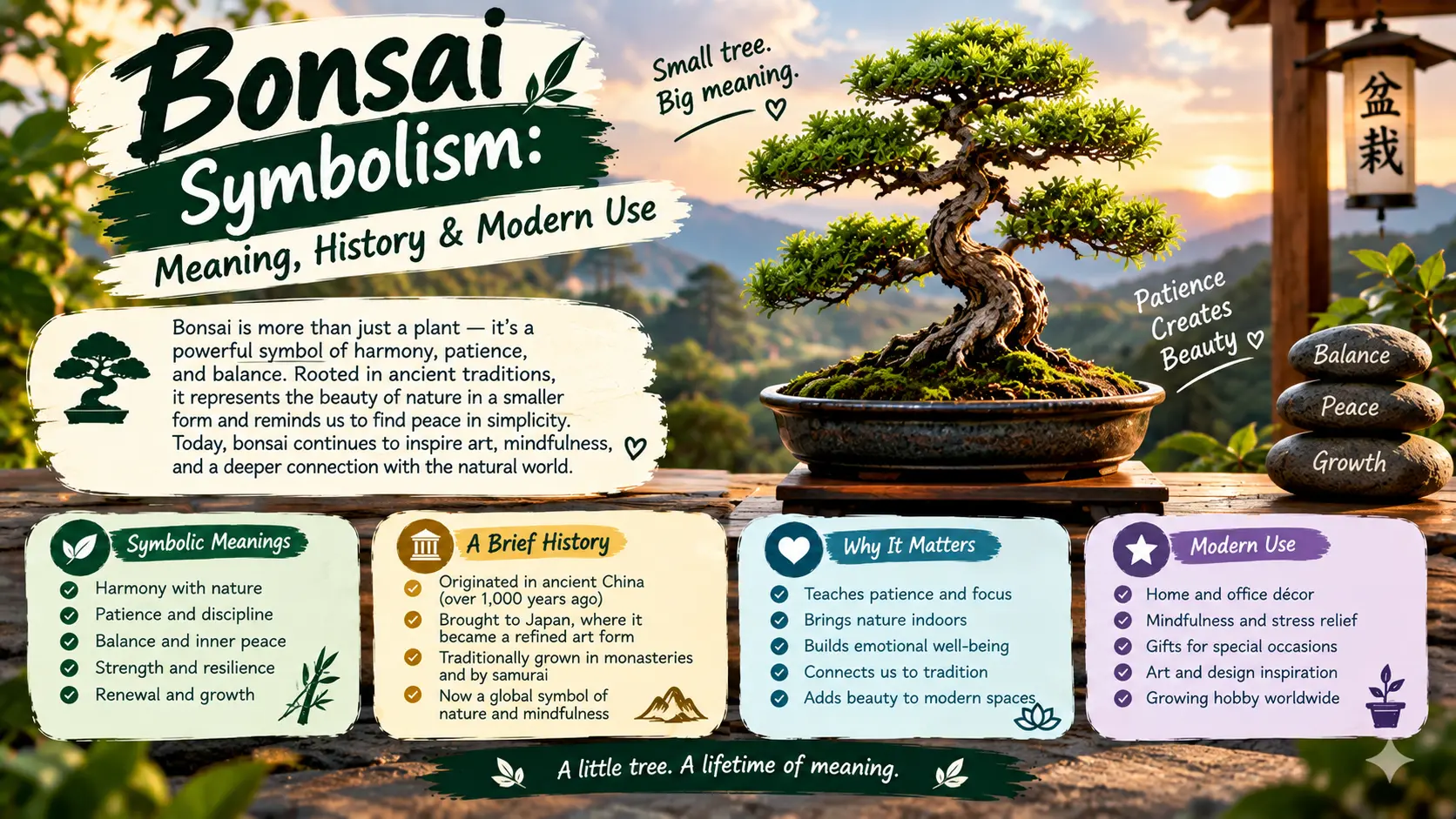
Bonsai Symbolism: Meaning, History & Modern Use
Quick Answer
Bonsai symbolism is commonly associated with patience, balance, discipline, resilience, harmony, longevity, and personal growth. A bonsai is a living tree intentionally cultivated in a small container, and its miniature form does not simply represent a small tree. It reflects a long process of careful cultivation in which natural growth is guided rather than completely controlled.
Because bonsai requires regular attention over many years, it is often viewed as a symbol of patience and commitment. Its changing branches, roots, trunk, and foliage can also represent the passage of time and the ability to adapt while maintaining a strong foundation.
In modern culture, people may give bonsai trees as gifts to express friendship, respect, appreciation, prosperity, or wishes for a long and meaningful life. The exact meaning depends on the species, context, cultural tradition, and personal interpretation.
TL;DR
- Bonsai commonly symbolizes: patience, balance, discipline, harmony, resilience, and longevity.
- Its miniature appearance represents carefully guided natural growth, rather than simply a small version of a full-sized tree.
- Bonsai developed through East Asian traditions, with important historical influences from Chinese penjing and Japanese bonsai cultivation.
- Japanese aesthetic principles emphasize simplicity, asymmetry, naturalness, and appreciation of imperfection.
- In the United States, bonsai is commonly associated with mindfulness, gardening, artistic expression, and personal development.
- As a gift, bonsai can communicate respect, friendship, appreciation, prosperity, or long-term commitment.
- Bonsai tattoos often represent growth, endurance, patience, roots, transformation, and staying grounded.
- There is no single universal meaning for every bonsai tree. Species, form, cultural context, and personal experience all influence interpretation.
What Bonsai Symbolizes and Represents
A bonsai tree can symbolize the relationship between nature, time, human attention, and personal growth. Although its size is deliberately maintained, it remains a living tree with changing seasons, developing roots, new growth, aging branches, and a continuously evolving shape.
This makes bonsai especially meaningful as a symbol of growth within limitations. A person may face boundaries, responsibilities, or difficult circumstances while still developing strength and character. The bonsai offers a visual reminder that meaningful growth does not always require unlimited space.
Bonsai can also represent balance. Successful cultivation involves managing water, light, soil, pruning, roots, and seasonal changes. Too much intervention can harm the tree, while too little care can allow problems to develop. Symbolically, this balance can relate to knowing when to act and when to allow natural processes to unfold.
Another important association is longevity. Some bonsai trees can be cultivated for decades or even generations. Their age and continuity make them powerful symbols of time, endurance, heritage, and lasting value.
Bonsai Symbolism by Tree Type, Shape, and Color
The symbolism of bonsai can change depending on the species and visual characteristics of the tree. There is no universal symbolic dictionary, but different forms can encourage different interpretations.
Pine bonsai is frequently associated with longevity, endurance, strength, and resilience. Pine trees remain evergreen in many climates, making their continued foliage a natural visual connection with persistence and continuity.
Juniper bonsai can suggest protection, endurance, and ruggedness. Its weathered appearance often emphasizes the ability of living things to survive challenging conditions.
Maple bonsai can represent change, seasonal transformation, beauty, and the passage of time. Its changing foliage makes it particularly appropriate for reflections on life’s different stages.
Cherry bonsai may evoke beauty, renewal, and the temporary nature of life, especially when considered alongside broader Japanese cultural associations with cherry blossoms.
The shape of a bonsai also influences its symbolism. A tree with an upright trunk may suggest strength and stability, while a windswept form can evoke resilience in difficult circumstances. Cascading forms may suggest flexibility, adaptation, or the ability to continue growing despite challenging conditions.
Why Bonsai Represents Patience, Discipline, and Care
Few plants demonstrate the relationship between time and care as clearly as bonsai. Developing a mature bonsai appearance can require years of pruning, wiring, repotting, watering, observation, and seasonal management.
This slow process makes patience one of the strongest modern associations with bonsai. The cultivator cannot force a mature appearance immediately. Instead, development occurs gradually through repeated decisions.
Bonsai also symbolizes discipline because its health depends on consistent care. A missed watering, unsuitable placement, poor pruning decision, or neglected root system can affect the tree’s development.
At the same time, bonsai demonstrates that discipline does not mean controlling every detail. Good cultivation involves understanding the tree’s natural characteristics and working with them. Symbolically, this creates a lesson about guidance rather than domination.
The Ancient Roots of Bonsai Cultivation
The history of bonsai is connected to older East Asian traditions of cultivating and displaying miniature landscapes and plants. One important predecessor is the Chinese tradition known as penjing, in which artists created miniature landscapes using trees, rocks, water, and other natural elements.
These practices developed over long periods and were influenced by changing artistic, cultural, and horticultural traditions. The miniature landscape was not simply about making something small. It involved creating an impression of a larger natural world within a limited space.
This historical background helps explain why bonsai is often interpreted as an art form as well as horticulture. The tree’s appearance, container, trunk movement, branches, roots, and surrounding presentation can all contribute to its visual meaning.
Chinese Origins and the Development of Miniature Trees
Chinese miniature landscape traditions played an important role in the historical development of practices that later influenced bonsai in Japan. Penjing could include elaborate natural scenes designed to evoke mountains, forests, and landscapes.
These traditions demonstrate an important symbolic idea: nature can be contemplated through a carefully constructed miniature representation.
Over time, related practices traveled across cultural boundaries and were adapted to different environments and aesthetic preferences. Japanese practitioners developed their own approaches to cultivating and displaying miniature trees, eventually contributing to what is widely recognized today as bonsai.
Understanding these roots is important because bonsai symbolism is not the product of one isolated culture or one single historical moment. Its meaning developed through centuries of horticultural, artistic, and philosophical exchange.
Japanese Influence and the Aesthetic Meaning of Bonsai
Japan played a major role in shaping the bonsai traditions recognized internationally today. Japanese approaches placed strong emphasis on the tree’s form, seasonal character, natural appearance, and relationship with the container and display setting.
Several Japanese aesthetic ideas can help explain why bonsai is often associated with simplicity and imperfection. Concepts connected with asymmetry, simplicity, impermanence, and naturalness can be reflected in bonsai design.
A bonsai does not necessarily aim to look perfectly symmetrical. A curved trunk, uneven branches, exposed roots, aged bark, or weathered appearance can contribute to its character.
This gives bonsai a distinctive symbolic quality. Beauty does not have to mean perfection. Signs of age, change, and irregularity can become part of the tree’s visual identity.
Balance Between Nature, Growth, and Human Guidance
One of the most meaningful ideas represented by bonsai is the balance between human influence and natural growth.
The cultivator chooses a container, manages the soil, prunes branches, directs growth, and monitors the roots. Yet the tree remains a living organism with its own biological processes. It responds to light, temperature, water, seasons, disease, and environmental conditions.
Symbolically, this relationship can represent the difference between guidance and control. A person can influence the direction of development without having complete power over the outcome.
For many people, this makes bonsai a useful metaphor for life. Goals require effort and discipline, but flexibility and acceptance are also necessary because not every circumstance can be controlled.
Bonsai Symbolism in the United States Today
In the United States, bonsai is commonly encountered through gardening, botanical collections, exhibitions, specialty nurseries, clubs, educational programs, and personal hobbies.
Its symbolic meaning in contemporary American culture is often connected with mindfulness, patience, craftsmanship, nature appreciation, and personal growth. People may cultivate bonsai as a quiet hobby that encourages observation and regular care.
Bonsai can also represent an interest in Japanese and broader East Asian horticultural traditions. However, it is important not to assume that every American bonsai owner attaches the same cultural or spiritual meaning to the practice.
For some people, bonsai is primarily horticultural. For others, it is artistic, philosophical, emotional, or symbolic. Personal interpretation matters.
Emotional and Psychological Meaning of Bonsai
Bonsai can carry emotional meaning because it visibly changes over time. A person who cares for one tree for many years may associate its development with particular periods of life.
A bonsai may therefore symbolize memory and continuity. New growth can represent progress, while an old trunk can remind the owner of years that have passed.
The practice of observing and caring for a living tree can also encourage a slower relationship with time. Instead of expecting immediate results, the cultivator works with gradual development.
This is why bonsai is sometimes used as a personal reminder to slow down, remain consistent, accept change, and value long-term progress.
What a Bonsai Tree Means as a Gift
Giving a bonsai tree can communicate different messages depending on the relationship between the giver and recipient.
As a gift between friends, bonsai may symbolize lasting friendship, appreciation, and shared memories. In a professional setting, it may express respect, recognition, or wishes for continued success.
A bonsai can also be meaningful for birthdays, anniversaries, housewarmings, graduations, retirements, or other milestones because its long-term growth naturally connects with ideas of new beginnings and continued development.
However, bonsai is not automatically a universal symbol of good fortune or love. The intended message is best understood through the specific occasion and relationship.
Spiritual and Reflective Meanings of Bonsai
Bonsai can encourage spiritual reflection without having one mandatory religious meaning. Its slow growth, changing appearance, and dependence on natural cycles can inspire contemplation about impermanence, patience, simplicity, and interconnectedness.
The tree’s roots provide another powerful metaphor. Although much of a bonsai’s visible beauty exists above the soil, its health depends heavily on an unseen root system.
Symbolically, this can represent the importance of strong foundations, hidden effort, family roots, personal values, and inner development.
For some people, caring for bonsai becomes a reflective practice. For others, it remains an artistic or gardening activity. These interpretations can coexist without requiring a single spiritual definition.
Bonsai in Home Decor, Interior Design, and Lifestyle
Bonsai has become a recognizable element of interior and exterior design. Its compact size allows people to introduce a living tree into spaces where a full-sized tree would not be practical.
In a home, bonsai may symbolize calmness, natural beauty, simplicity, and intentional living. Its sculptural shape can also function as a decorative focal point.
Different species create different visual impressions. Flowering bonsai can introduce seasonal color, while evergreen species can create a more consistent appearance.
The symbolic value of bonsai in interior spaces often comes from its combination of living nature and artistic form.
Bonsai Symbolism in Feng Shui and Traditional Beliefs
Bonsai is sometimes discussed in connection with feng shui, particularly in modern home-design and plant-care discussions. However, claims about the symbolic or energetic effects of specific bonsai species vary widely.
Some modern interpretations associate living plants with growth, vitality, and natural energy. Particular species may also be assigned meanings such as prosperity, longevity, or harmony.
These interpretations should be distinguished from established horticultural facts. Feng shui symbolism is a traditional and cultural interpretive framework, not a scientific measurement of energy.
For someone choosing bonsai for symbolic reasons, cultural context and personal intention can be more useful than treating one interpretation as universally correct.
Bonsai Tattoos and Personal Symbolism
A bonsai tattoo can represent a deeply personal interpretation of growth and endurance. Because the tree develops slowly and requires continual attention, it can symbolize patience, resilience, transformation, and commitment.
Roots are especially meaningful in tattoo designs. They can represent family, identity, history, belonging, or a strong personal foundation.
A bonsai growing from a damaged or weathered trunk may symbolize surviving hardship. New leaves can represent renewal, while falling leaves may represent change or acceptance.
Some people choose bonsai tattoos simply because they appreciate the art form and natural imagery. The tattoo’s meaning ultimately depends on the individual story behind it.
Bonsai as a Symbol of Personal Growth and Resilience
Bonsai provides a powerful metaphor for personal development because its growth is neither completely unrestricted nor completely predetermined.
A tree can encounter storms, broken branches, seasonal changes, and other challenges while continuing to develop. This makes bonsai a natural symbol of resilience and adaptation.
Its small size can also challenge the assumption that something must be large to be important. A carefully developed bonsai may represent the idea that depth, character, and history matter more than physical size.
For personal reflection, bonsai can therefore represent progress that happens gradually rather than dramatically.
Bonsai Symbolism in Relationships, Family, and Friendship
In relationships, bonsai can symbolize long-term care and commitment. Unlike a short-lived decorative gift, a bonsai requires ongoing attention, which can make it a meaningful metaphor for relationships that develop over time.
Within families, an older bonsai can represent continuity between generations. A tree cared for by different family members may become a living reminder of shared history.
Between friends, it can symbolize a relationship that has endured changing circumstances. The strongest symbolic connection is often not the tree itself but the time and intention associated with caring for it.
Common Misunderstandings About Bonsai Meaning
One common misunderstanding is that bonsai simply means “a small tree.” Bonsai is better understood as a horticultural art and cultivation practice involving the training and presentation of trees in containers.
Another misconception is that every bonsai has exactly the same symbolism. In reality, meaning varies according to species, cultural background, appearance, occasion, and personal interpretation.
It is also inaccurate to assume that bonsai automatically represents one particular religion or spiritual belief. While bonsai has historical relationships with East Asian cultural and aesthetic traditions, modern practitioners may approach it as art, gardening, meditation, education, or personal expression.
Bonsai Trees in Art, Media, and Popular Culture
Bonsai frequently appears in films, television, books, advertisements, illustrations, photography, and other forms of visual culture. Its distinctive appearance makes it easy to recognize and useful as a visual shorthand for ideas such as wisdom, patience, discipline, Japanese aesthetics, or peaceful reflection.
Popular culture sometimes simplifies bonsai symbolism, presenting it as a universal sign of tranquility or wisdom. Real-world bonsai practice is considerably more diverse.
The tree’s recognizable shape has nevertheless helped make bonsai an international symbol of miniature landscapes, careful craftsmanship, and long-term cultivation.
Caring for Bonsai as a Symbolic Daily Practice
The practical care of bonsai can reinforce the meanings people attach to it. Watering, checking the leaves, observing soil conditions, pruning, repotting, and monitoring seasonal growth all require attention.
This routine can symbolize consistency over intensity. A tree does not become mature because of one dramatic act of care. Its development depends on many small actions repeated over time.
That idea can easily translate into everyday life. Personal goals, relationships, skills, and creative projects often develop through the same principle: small, consistent efforts can create meaningful long-term change.
How Bonsai Symbolism Has Evolved Over Time
Bonsai symbolism has changed as the practice moved across cultures and historical periods. Earlier miniature landscape traditions were connected with broader artistic and cultural ideas about representing nature in compact forms.
Japanese cultivation traditions developed distinctive aesthetic approaches, while international interest later introduced bonsai to audiences around the world.
Today, bonsai may symbolize traditional aesthetics, environmental appreciation, patience, mindfulness, artistic creativity, personal growth, or simply an enjoyable horticultural hobby.
Its modern popularity demonstrates how symbols can gain new meanings without completely losing their historical foundations.
Choosing a Bonsai Based on Its Symbolic Meaning
If symbolism is important when choosing a bonsai, begin with the message you want the tree to communicate.
For longevity and endurance, an evergreen species such as pine may fit the intended symbolism.
For change and seasonal transformation, a maple can be meaningful because of its changing foliage.
For resilience and rugged character, a weathered-looking juniper may provide a strong visual connection.
The tree’s shape can also matter. A sturdy upright form may suggest stability, while a windswept or dramatically curved tree may evoke endurance and adaptation.
Most importantly, choose a tree that is appropriate for the recipient’s environment and ability to care for it. A meaningful bonsai is still a living plant with real horticultural needs.
FAQs About Bonsai Symbolism
What does a bonsai tree symbolize?
A bonsai commonly symbolizes patience, balance, discipline, resilience, longevity, and personal growth. Its meaning comes partly from the long-term process of cultivating and shaping a living tree.
Is a bonsai tree a symbol of good luck?
Bonsai may be associated with prosperity or positive outcomes in some modern cultural interpretations, but good luck is not its single universal meaning. Different traditions and individuals interpret bonsai differently.
What does giving someone a bonsai tree mean?
A bonsai gift can communicate respect, appreciation, friendship, longevity, or wishes for continued growth. The meaning depends on the relationship and occasion.
What does a bonsai symbolize spiritually?
Spiritually, bonsai can encourage reflection on impermanence, patience, balance, natural cycles, and the importance of strong foundations. Its spiritual meaning varies according to personal and cultural beliefs.
What does a bonsai tattoo represent?
A bonsai tattoo often represents personal growth, resilience, patience, roots, transformation, and long-term development. Specific details such as leaves, roots, flowers, and trunk shape can add personal meaning.
Conclusion
Bonsai symbolism centers on the relationship between time, nature, care, and growth. Its strongest associations include patience, discipline, balance, resilience, longevity, harmony, and personal development.
The history of bonsai connects it with older East Asian miniature landscape traditions and the distinctive cultivation and aesthetic practices that developed in Japan. Today, bonsai has become an international symbol that can carry cultural, artistic, emotional, and personal meanings.
Whether displayed in a home, given as a gift, cultivated as a hobby, or represented in a tattoo, bonsai can serve as a reminder that meaningful growth often happens gradually. Its enduring appeal comes from the way a small living tree can express ideas about time, change, care, and the continuing process of becoming.