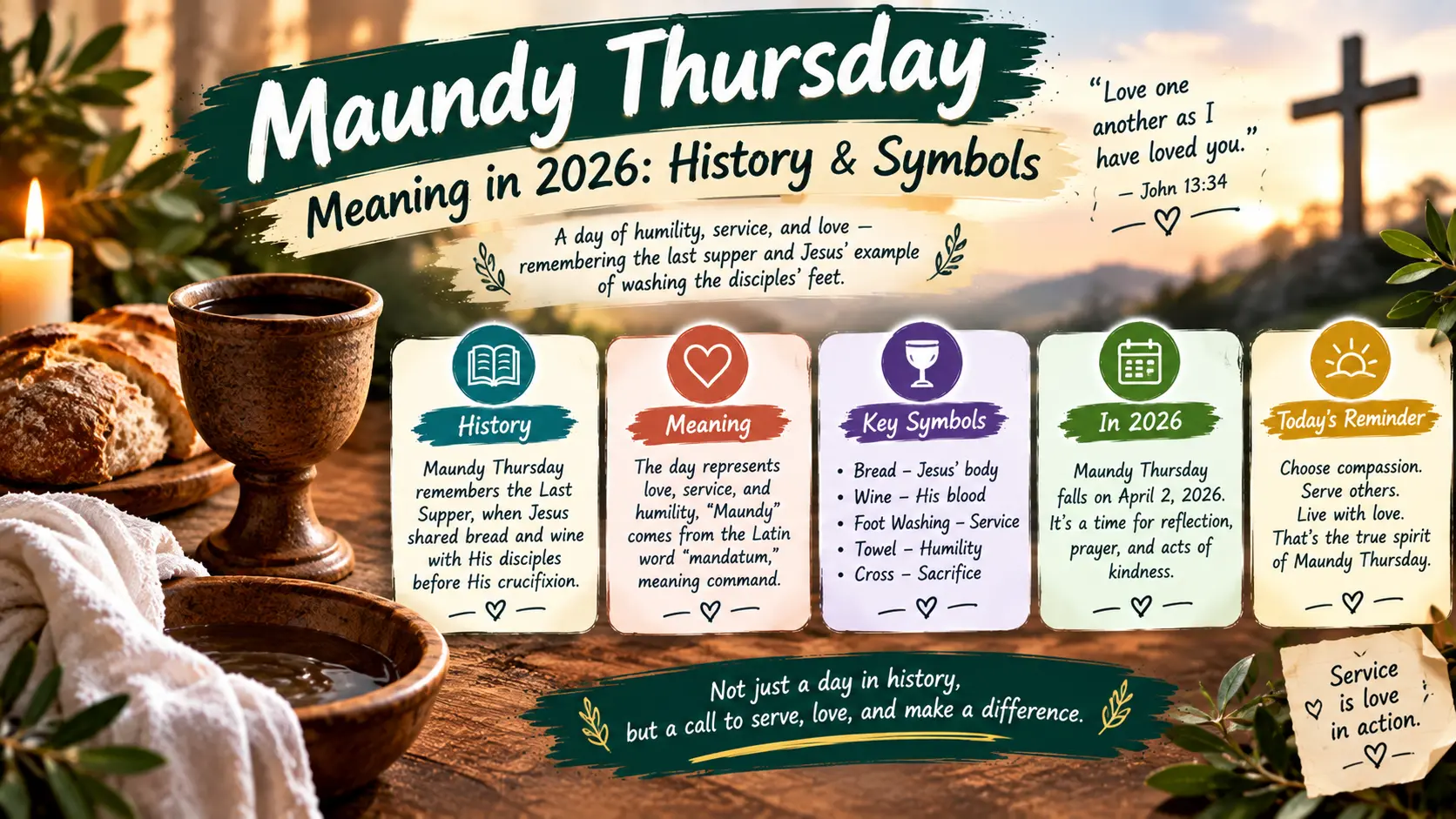
Maundy Thursday Meaning in 2026: History & Symbols
Quick Answer
Maundy Thursday is the Christian day of Holy Week that commemorates Jesus Christ’s Last Supper with His disciples, His washing of their feet, and His command to love and serve others. The word “Maundy” comes from the Latin mandatum, meaning “commandment,” referring to Jesus’ command to love one another. The day is observed by many Catholic, Anglican, Lutheran, Methodist, Presbyterian, and other Christian communities.
TL;DR
Maundy Thursday is observed during Holy Week immediately before Good Friday. Its central themes are love, humility, service, communion, sacrifice, and remembrance. Common symbols include bread and wine, water, a towel, the cross, and silence. Churches may hold communion services, foot-washing ceremonies, prayer gatherings, and special evening liturgies. In the United States, it is generally a religious observance rather than a federal public holiday.
What Is Maundy Thursday?
Simple Definition
Maundy Thursday is the Christian observance marking the Thursday before Easter Sunday. It is part of the most important period of the Christian liturgical calendar, commonly known as Holy Week.
The day focuses on the events traditionally associated with Jesus’ final evening with His disciples before His crucifixion. Rather than being primarily a celebration, Maundy Thursday combines love, fellowship, humility, remembrance, and anticipation of the suffering that follows.
What Maundy Thursday Commemorates
Maundy Thursday particularly commemorates the Last Supper, when Jesus shared a final meal with His disciples before His arrest. Christian traditions connect this meal with the institution or remembrance of the Eucharist or Holy Communion.
Another central event is Jesus washing His disciples’ feet. This action demonstrated that leadership in Christian teaching is connected with humility and service rather than status or power.
The day also remembers Jesus’ commandment that His followers should love one another. This commandment is the main reason the day is associated with the word “Maundy.”
When Maundy Thursday Occurs
Maundy Thursday does not fall on the same calendar date every year because its date depends on Easter.
In 2026, Maundy Thursday falls on April 2. It is followed by Good Friday on April 3 and Easter Sunday on April 5.
Because Easter is a movable feast, Maundy Thursday can occur on different dates from one year to another.
What Does “Maundy” Mean?
The Meaning of the Word “Maundy”
“Maundy” comes from the Latin word mandatum, meaning “command” or “commandment.” It is associated with the Latin phrase traditionally connected with Jesus’ teaching about loving one another.
Over time, mandatum developed through different forms and languages into the English word “Maundy.”
The word therefore points toward one of the central messages of the day: Christian love should be expressed through action and service.
The Connection to Jesus’ Commandment of Love
The commandment remembered on Maundy Thursday is closely connected with Jesus’ teaching that His followers should love one another.
This gives the day a meaning that goes beyond simply remembering an ancient meal. It encourages Christians to consider how compassion, forgiveness, generosity, and service can be expressed in everyday life.
How the Name Developed
The name developed through centuries of Christian use. The Latin mandatum became associated with the foot-washing ceremony and the commandment of love.
As Christian traditions spread across Europe, the term evolved linguistically. The modern English word Maundy preserves this historical connection.
See Also: PTSO Meaning & Hiatus Meaning Explained (2026 Guide)
The Biblical Meaning of Maundy Thursday
The Last Supper
The Last Supper is at the heart of Maundy Thursday. The Gospel accounts describe Jesus eating with His disciples shortly before His arrest.
Christian communities understand this event as deeply significant because it combines fellowship, remembrance, prophecy, and preparation for what Jesus would soon experience.
For many Christians, communion today serves as a continuing remembrance of this final meal.
Jesus Washing the Disciples’ Feet
Foot washing is one of the strongest symbols of Maundy Thursday. In the biblical account, Jesus washes His disciples’ feet, an action that would normally have been associated with a servant.
The symbolism is powerful: a teacher and leader takes the position of a servant.
The ceremony therefore represents humility and challenges people to think about leadership as something connected with caring for others.
The New Commandment of Love
Maundy Thursday is also associated with Jesus’ commandment to love one another.
This teaching gives the day its distinctive moral focus. Love is not presented merely as an emotion but as something demonstrated through service, forgiveness, patience, generosity, and concern for others.
Key Symbols of Maundy Thursday
Bread and Wine
Bread and wine are central symbols because they are connected with the Last Supper and Christian communion.
Bread can represent nourishment, fellowship, and remembrance, while wine is associated with the covenant and sacrifice in Christian theology.
During Maundy Thursday services, many churches celebrate Communion or the Eucharist as part of remembering Jesus’ final meal with His disciples.
Foot Washing
Foot washing symbolizes humility, service, and selflessness.
Some churches recreate this practice during Maundy Thursday services. The purpose is generally not simply to reproduce an ancient custom but to communicate the lesson that serving others can require humility.
The Cross
Although the cross is especially prominent on Good Friday, it can also appear in Maundy Thursday worship because the day leads directly toward the crucifixion.
The cross can symbolize sacrifice, suffering, redemption, and Christian faith.
Water and Towel
Water and a towel are closely associated with the foot-washing account.
Water represents the practical act of washing, while the towel represents the willingness to serve. Together, they create a visual reminder that humility is expressed through action.
Darkness and Silence
Many Maundy Thursday services become increasingly quiet as they progress.
Lights may be reduced, music may become more restrained, or the church may enter a period of silence. These practices can represent the transition from the fellowship of the Last Supper toward the darkness of Jesus’ arrest and coming crucifixion.
Historical Origins of Maundy Thursday
Early Christian Roots
The roots of Maundy Thursday are found in early Christian remembrance of the final events of Jesus’ life.
As Christians developed practices for remembering the Passion and Resurrection, the days immediately preceding Easter became increasingly structured around particular events and themes.
Maundy Thursday eventually became an important part of this developing Holy Week tradition.
Development of Holy Week Traditions
Over time, Christian communities established special services for different days of Holy Week.
Maundy Thursday became associated with the Last Supper, the Eucharist, Jesus’ commandment of love, and foot washing.
These traditions helped Christians move through Holy Week in a deliberate sequence, from the Last Supper to the crucifixion and ultimately to Easter.
Medieval Observances
During the medieval period, Maundy Thursday developed numerous liturgical customs.
Foot washing became an important expression of humility and charity. In some European traditions, rulers and religious leaders participated in ceremonies emphasizing service to the poor.
The historical practice of distributing charity also contributed to the development of Maundy-related traditions of generosity and service.
How the Tradition Evolved
Maundy Thursday has changed in outward form over the centuries, but its major themes have remained recognizable.
Different denominations emphasize different elements. Some focus heavily on the Eucharist, while others emphasize foot washing, preaching, prayer, music, or community service.
Maundy Thursday Meaning in the Catholic Church
Mass of the Lord’s Supper
In the Catholic tradition, Maundy Thursday is associated with the Mass of the Lord’s Supper.
The liturgy remembers the Last Supper and emphasizes the Eucharist, Christ’s commandment of love, and Christian service.
It also begins the period commonly called the Easter Triduum, the central three-day observance leading to Easter.
Washing of the Feet
Foot washing may be included in the Maundy Thursday liturgy.
Its purpose is to demonstrate the meaning of humble service. The ceremony connects Christian worship with the practical responsibility to care for other people.
Eucharistic Adoration
After the Mass of the Lord’s Supper, some Catholic communities observe a period of prayer and adoration.
This provides an opportunity for quiet reflection on the Last Supper, Jesus’ prayer, and the events leading toward His arrest.
Stripping of the Altar
In some Catholic traditions, the altar is stripped after the Maundy Thursday liturgy.
This creates a visually stark atmosphere and helps mark the transition from the celebration of the Last Supper toward the solemnity of Good Friday.
Maundy Thursday Meaning in Protestant Christianity
Lutheran and Anglican Traditions
Lutheran and Anglican churches may observe Maundy Thursday through special evening worship, Communion, Scripture readings, prayers, hymns, and symbolic actions.
Some congregations include foot washing, while others place greater emphasis on the Eucharist and the commandment of love.
Methodist and Presbyterian Practices
Methodist and Presbyterian congregations may hold special Holy Week services centered on Communion, prayer, Scripture, and reflection.
Practices vary between individual churches, so there is no single Protestant way to observe Maundy Thursday.
Evangelical Observances
Some evangelical churches observe Maundy Thursday through Communion services, small-group gatherings, Bible teaching, prayer, or special Holy Week programs.
Other evangelical communities may not formally observe the day at all.
Communion and Prayer Services
Communion and prayer are common themes across many Christian traditions.
These practices allow worshippers to remember the Last Supper while reflecting on sacrifice, forgiveness, faith, and service.
Maundy Thursday Meaning in the USA
How American Churches Observe the Day
In the United States, Maundy Thursday is primarily observed by churches and Christian communities rather than through nationwide public celebrations.
Services can include Communion, Scripture readings, foot washing, music, prayer, and sermons about humility and love.
The exact form depends heavily on denomination and local church tradition.
Community Service and Acts of Love
Some American congregations connect Maundy Thursday with practical service.
Activities may include helping people experiencing hardship, preparing meals, collecting donations, visiting vulnerable community members, or organizing charitable projects.
These activities reflect the central message that love becomes meaningful when it is expressed through service.
Quiet and Reflective Worship
Maundy Thursday often has a quieter tone than Easter Sunday.
The mood can be reflective because worshippers are remembering the final meal before Jesus’ arrest and looking ahead to Good Friday.
Why It Is Not Generally a Federal Holiday
Maundy Thursday is not a U.S. federal public holiday.
Schools, businesses, government offices, and other institutions generally operate according to their normal schedules, although individual Christian organizations or schools may have special observances.
Emotional and Psychological Meaning of Maundy Thursday
Humility and Service
The foot-washing story can encourage people to reconsider how they understand leadership and personal importance.
Psychologically, the symbolism can encourage humility, empathy, and a willingness to help others without seeking recognition.
Love and Compassion
Maundy Thursday places strong emphasis on active love.
For believers, this can inspire reflection on relationships, forgiveness, family responsibilities, friendship, and care for people who may be struggling.
Grief and Anticipation
The day contains an unusual emotional combination. It begins with the fellowship of a shared meal but moves toward betrayal, arrest, suffering, and death.
This creates a sense of anticipation and sadness, especially as the celebration transitions toward Good Friday.
Reflection and Spiritual Renewal
Maundy Thursday can also be a time for personal examination.
People may reflect on whether their actions demonstrate compassion and whether they are willing to forgive, serve, or repair damaged relationships.
Spiritual Lessons of Maundy Thursday
The Meaning of Serving Others
One of the clearest lessons is that service is not beneath anyone.
The image of Jesus washing His disciples’ feet communicates that genuine spiritual leadership can involve humility and practical care.
The Importance of Forgiveness
The events surrounding the Last Supper can also lead Christians to think about betrayal, weakness, forgiveness, and reconciliation.
The day can become an opportunity to release resentment and consider how forgiveness might transform relationships.
Love Through Action
Maundy Thursday emphasizes that love should not remain an abstract idea.
Helping someone, listening carefully, showing patience, offering forgiveness, and giving practical support can all become expressions of love.
Finding Meaning in Sacrifice
The day leads into the Passion narrative, making sacrifice an important theme.
For Christians, Jesus’ willingness to serve and ultimately suffer is connected with the larger theological meaning of Easter.
Cross-Cultural and Spiritual Parallels
Shared Themes of Service and Compassion
Many cultures and spiritual traditions value humility, hospitality, generosity, and care for others.
These similarities do not mean that other traditions are identical to Maundy Thursday. Instead, they show that service and compassion are widely recognized human values.
Rituals Involving Food and Community
Shared meals frequently carry symbolic meaning across cultures.
The Last Supper is particularly important in Christianity because food, fellowship, remembrance, and covenant are brought together in a religious context.
Washing and Cleansing as Spiritual Symbols
Water is commonly used as a symbol of cleansing or renewal in many religious traditions.
On Maundy Thursday, however, foot washing has a particularly specific Christian meaning: humble service modeled after Jesus.
Respectful Interfaith Perspectives
People from different religious backgrounds can study Maundy Thursday as an important Christian tradition without treating it as their own religious practice.
Its themes of humility, service, compassion, and community can be explored respectfully from cultural, historical, or educational perspectives.
Maundy Thursday in Modern Life
Church Services and Community Events
Modern churches may combine traditional liturgy with contemporary worship styles.
Some communities hold evening services, communal meals, foot-washing ceremonies, prayer vigils, or charitable activities.
Education and Religious Studies
Maundy Thursday is also studied in schools, universities, religious education programs, and courses covering Christianity or Western religious history.
It provides a useful example of how biblical narratives become connected with centuries of ritual and cultural development.
Personal Prayer and Reflection
People do not necessarily need to attend a formal service to spend time reflecting on the themes of Maundy Thursday.
Prayer, reading the Gospel accounts, serving someone in need, or quietly considering personal relationships can all become forms of reflection.
Social Media and Modern Discussions
In 2026, Maundy Thursday may also appear in digital conversations, inspirational posts, church announcements, devotional content, and Easter-related discussions.
Social media can make religious traditions more visible while also encouraging people to explore the historical and theological meaning behind familiar symbols.
Maundy Thursday Symbols and Their Meanings
| Symbol | Meaning | Common Association |
|---|---|---|
| Bread | Spiritual nourishment and fellowship | Last Supper |
| Wine | Covenant and remembrance | Eucharist |
| Water | Humility and service | Foot washing |
| Towel | Servanthood | Washing the disciples’ feet |
| Cross | Sacrifice and faith | Holy Week |
| Silence | Reflection and mourning | Passion narrative |
Common Misunderstandings About Maundy Thursday
Is Maundy Connected to the Word “Mourn”?
No. The word Maundy does not come from “mourn.”
It is historically connected to the Latin mandatum, meaning “commandment” or “command.” The name points toward Jesus’ commandment of love.
Is Maundy Thursday the Same as Good Friday?
No. They are separate days with different emphases.
Maundy Thursday focuses particularly on the Last Supper, foot washing, service, and Jesus’ commandment of love. Good Friday commemorates Jesus’ crucifixion.
Do All Christians Celebrate It?
No. Christian observance varies.
Many Catholic, Anglican, Lutheran, Methodist, Presbyterian, Orthodox, and other Christian communities recognize Holy Thursday or Maundy Thursday. Some Christian groups do not formally observe the day.
Is Maundy Thursday a Public Holiday?
In the United States, Maundy Thursday is not a federal public holiday.
Individual churches, religious schools, and Christian organizations may nevertheless hold special events or close for observance.
Does the Day Have to Be Celebrated in a Church?
No single practice is required across all Christians.
People may attend a service, participate in Communion, pray privately, read Scripture, perform an act of service, or simply reflect on the themes of the day.
How Maundy Thursday Has Changed Over Time
From Early Christian Worship to Formal Liturgy
Maundy Thursday developed as Christians created increasingly structured ways to remember the final events of Jesus’ earthly ministry.
Over centuries, different traditions added distinctive ceremonies, prayers, music, and acts of service.
Medieval and Modern Developments
Medieval Christian communities placed considerable emphasis on ritual, charity, and foot washing.
Modern churches continue many of these themes but may express them through contemporary worship, community projects, educational programs, and personal reflection.
From Ritual to Personal Reflection
Although ritual remains important, modern observance can also emphasize the meaning behind the ritual.
A towel can represent service, bread can recall fellowship, and silence can encourage reflection. The central message remains focused on love expressed through humble action.
Maundy Thursday and Christian Identity in 2026
Why the Day Still Matters
Maundy Thursday remains meaningful because its central questions are not limited to ancient history.
The day asks Christians to consider what it means to love others, serve without pride, forgive, share, and remain compassionate during difficult circumstances.
Service in a Modern Society
Modern communities face loneliness, economic hardship, social division, and many forms of personal difficulty.
The Maundy Thursday emphasis on service can encourage Christians to translate religious belief into practical acts of kindness and community support.
Faith, Community, and Compassion
The Last Supper itself is an image of people gathered around a table.
In modern Christian life, this can represent the importance of community, belonging, shared faith, hospitality, and mutual care.
Keeping Ancient Traditions Relevant
Traditions remain meaningful when people understand their purpose.
In 2026, Maundy Thursday can connect an ancient Christian story with contemporary concerns about empathy, service, relationships, forgiveness, and responsible leadership.
Maundy Thursday vs. Good Friday vs. Holy Saturday
Maundy Thursday
Maundy Thursday remembers the Last Supper, Jesus’ commandment of love, and His act of washing the disciples’ feet.
It emphasizes fellowship, Eucharistic remembrance, humility, and service.
Good Friday
Good Friday commemorates the crucifixion and death of Jesus.
Its tone is generally solemn and reflective, focusing on sacrifice, suffering, and the Passion of Christ.
Holy Saturday
Holy Saturday falls between Good Friday and Easter Sunday.
It is associated with waiting, silence, and anticipation before the celebration of the Resurrection.
How the Three Days Connect
Together, Maundy Thursday, Good Friday, and Holy Saturday form the central sequence of the Easter Triduum in many Christian traditions.
The progression moves from the Last Supper and service, through crucifixion and mourning, toward the hope and celebration of Easter.
FAQs About Maundy Thursday
What does Maundy Thursday commemorate?
Maundy Thursday commemorates the Last Supper and Jesus’ commandment to love one another. It also remembers Jesus washing His disciples’ feet, emphasizing humility and service.
Why is it called Maundy Thursday?
“Maundy” comes from the Latin mandatum, meaning “commandment” or “command.” The term is connected with Jesus’ command that His followers love one another.
Why is foot washing important on Maundy Thursday?
Foot washing represents humility and servant leadership. Jesus’ action demonstrates that serving others is an important expression of Christian love.
Is Maundy Thursday a public holiday in the U.S.?
No. Maundy Thursday is generally not a federal public holiday in the United States. Churches and Christian organizations may hold special observances.
Do all Christians observe Maundy Thursday?
No. Different Christian denominations have different practices. Many churches observe the day, while others do not formally include it in their worship calendar.
What happens in church on Maundy Thursday?
Depending on denomination, a service may include Scripture readings, Communion, prayers, hymns, preaching, foot washing, and other symbolic ceremonies connected with the Last Supper.
How is Maundy Thursday different from Good Friday?
Maundy Thursday focuses on the Last Supper, Jesus’ commandment of love, and service. Good Friday focuses on Jesus’ crucifixion and death.
What colors are associated with Maundy Thursday?
Color practices vary by denomination. Some Christian traditions use white or gold for the Eucharistic celebration, while others use different liturgical colors or transition toward the solemn colors associated with the Passion.
Can non-Christians learn from the meaning of Maundy Thursday?
Yes. Although Maundy Thursday is specifically Christian, people studying religion or culture can explore its themes of humility, compassion, service, community, and love from an educational or cultural perspective.
Conclusion: The Meaning of Maundy Thursday in 2026
Maundy Thursday remains one of the most meaningful observances of Holy Week. Its central story brings together the Last Supper, Jesus’ commandment of love, and the powerful image of Jesus washing His disciples’ feet.
In 2026, its message continues to center on humility, compassion, service, forgiveness, and community. Whether experienced through a church service, Communion, foot washing, prayer, charitable work, or personal reflection, Maundy Thursday encourages people to consider how love can become visible through everyday actions.