Profound Definition & Hiatus Meaning Explained (2026)
Quick Answer
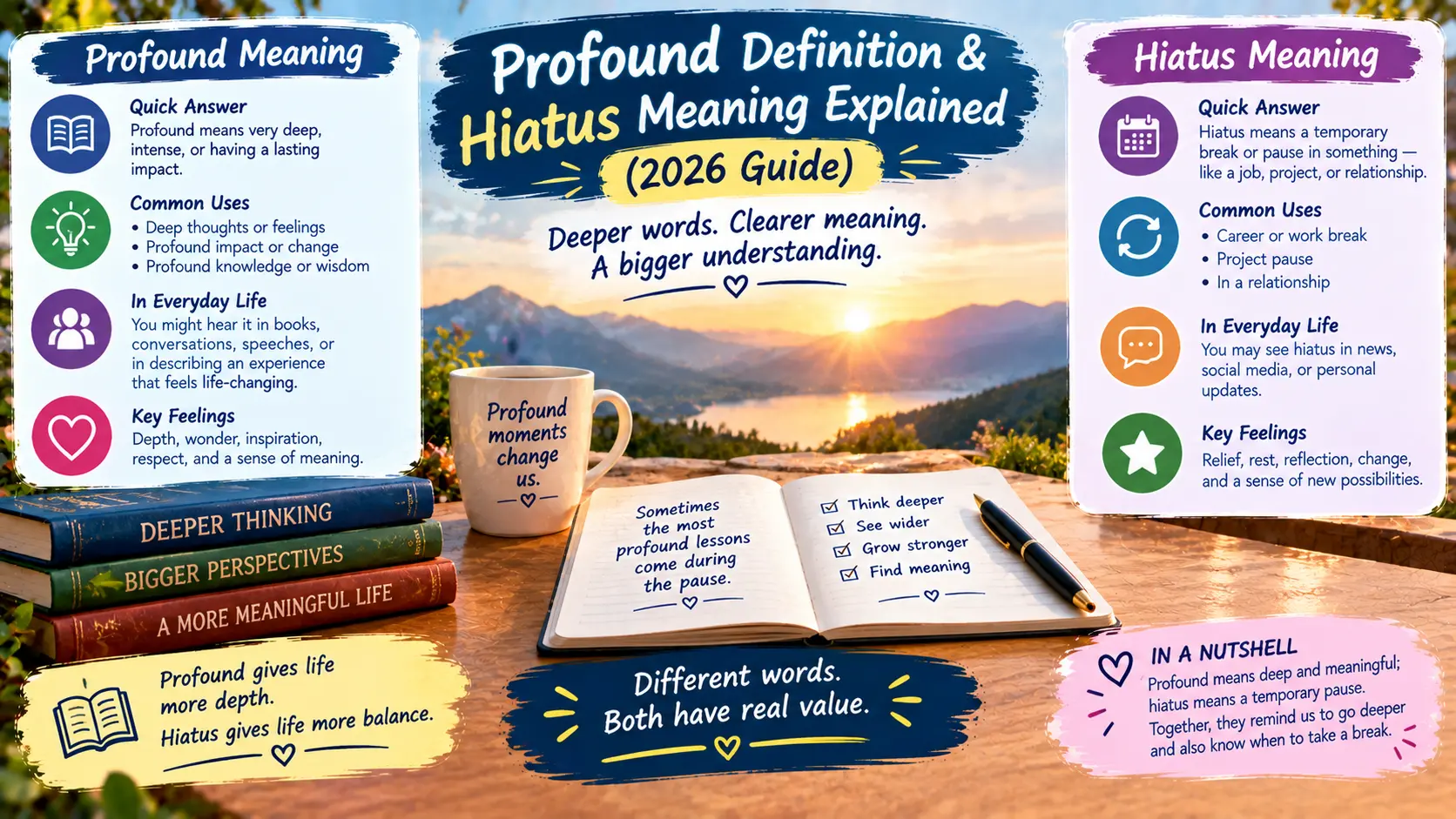
Profound means extremely deep, meaningful, intense, or intellectually significant. It can describe an idea, emotion, experience, statement, effect, or realization that has a strong and lasting impact.
Hiatus means a temporary pause, interruption, or period when an activity stops before potentially continuing again. It is commonly used for television shows, careers, projects, creative work, organizations, and personal activities.
Although profound and hiatus have very different dictionary meanings, both can appear in conversations about meaningful experiences, personal development, creativity, and periods of change.
TL;DR
- Profound = very deep, meaningful, significant, or powerful.
- Hiatus = a temporary break or pause in an activity.
- A profound experience can change the way someone thinks or feels.
- A hiatus usually suggests a pause rather than a permanent ending.
- Both words are common in modern American English, although hiatus sounds somewhat more formal than “break.”
Understanding “Profound” and “Hiatus” at a Glance
What Does “Profound” Mean?
The adjective profound describes something that has considerable depth, importance, or intensity. It is often used when an ordinary word such as “deep” or “important” does not fully express the strength of an idea or experience.
For example, someone might describe a life-changing conversation as a profound conversation, or call a thoughtful observation a profound insight. The word can refer to emotional depth, intellectual complexity, personal significance, or a powerful effect.
What Does “Hiatus” Mean?
A hiatus is a temporary period of interruption or inactivity. If a person, show, project, or organization stops doing something for a period and later expects to resume, that period can be called a hiatus.
For example, a musician might take a hiatus from performing, while a television program may go on hiatus between seasons. The word does not automatically mean something has ended permanently.
How the Two Words Differ
The easiest way to distinguish them is to remember that profound describes depth or significance, while hiatus describes a pause or interruption.
You might say, “The book had a profound message,” because the message was deeply meaningful. You might say, “The author took a hiatus from writing,” because the writing activity temporarily stopped.
Profound Meaning in Everyday American English
Simple Definition of Profound
In everyday American English, profound generally means unusually deep, meaningful, powerful, or significant.
It can describe both positive and negative experiences. A profound realization may be inspiring, while profound grief can describe extremely intense sadness. Likewise, a profound change can be beneficial, difficult, or simply important.
Common examples include:
- Profound impact — a very strong or lasting effect.
- Profound insight — a deeply thoughtful understanding.
- Profound sadness — extremely deep sadness.
- Profound change — a major or meaningful transformation.
- Profound question — a question involving deep or important ideas.
Common Ways Americans Use “Profound”
Americans often use profound when ordinary descriptions such as “deep,” “serious,” or “important” seem insufficient.
A person might say, “That was a profound experience,” after something changed their perspective. Someone discussing philosophy may refer to a profound question about life. In education, a teacher might describe a student’s observation as profound if it demonstrates unusual insight.
The word is also common in reviews, essays, interviews, journalism, and public speeches.
Profound in Emotional, Intellectual, and Personal Contexts
Profound can describe emotional depth, such as profound love, profound grief, or profound gratitude. It can also describe intellectual depth, such as a profound theory or profound observation.
In personal conversations, the word often signals that something mattered beyond the surface level. It suggests that an experience, thought, or feeling reached an important part of a person’s understanding or identity.
Hiatus Meaning in Everyday American English
Simple Definition of Hiatus
A hiatus is a period during which an activity is temporarily stopped or interrupted.
The important idea is temporary interruption. The activity may eventually resume, although the word itself does not guarantee that it will.
For example:
The podcast is taking a hiatus for several months.
This suggests that the podcast is pausing rather than necessarily ending.
Common Ways Americans Use “Hiatus”
The word frequently appears in entertainment, employment, creative work, sports, media, and personal announcements.
Examples include:
- A TV series going on hiatus.
- A band taking a hiatus.
- A creator taking a social media hiatus.
- An employee taking a career hiatus.
- A company temporarily suspending a project.
- A writer taking a hiatus from publishing.
In casual conversation, however, Americans may simply say break instead of hiatus.
Hiatus vs. Break, Pause, and Quitting
A break is the broadest and most casual term. A pause emphasizes stopping something temporarily. Hiatus is more formal and often suggests a noticeable or extended interruption.
Quitting is different because it normally implies ending an activity or leaving something permanently.
For example, “She is taking a break from social media” and “She is taking a social media hiatus” can have similar meanings. But “She quit social media” sounds much more permanent.
Historical Origins of “Profound” and “Hiatus”
Latin Roots of “Profound”
Profound ultimately comes from Latin profundus, meaning deep or having great depth. The original concept was connected strongly with physical depth, but the meaning gradually expanded.
English eventually developed the figurative sense of something being deeply meaningful, intellectually serious, or emotionally intense. This is why modern English can describe both a deep body of water and a profound idea, although the figurative meaning is much more common in everyday discussion.
Latin Roots of “Hiatus”
Hiatus comes from the Latin hiatus, associated with an opening, gap, or separation. The underlying idea involves something being open or interrupted.
English adopted the word with meanings connected to a gap, break, or interruption. Over time, its modern sense became especially associated with a temporary period during which an activity stops.
How the Words Entered English
Both words demonstrate how English frequently adopted Latin vocabulary and expanded its meanings over centuries.
Profound developed from a physical idea of depth into a broader description of intellectual and emotional depth. Hiatus developed around the idea of an opening or gap and came to describe an interruption in activity.
Their histories help explain why both words can sound more formal than simpler alternatives such as “deep” and “break.”
What “Profound” Symbolically Represents
Emotional Depth and Intensity
Symbolically, profound often represents something that reaches beneath the surface. A profound emotion is not merely noticeable; it may influence someone’s thoughts, behavior, memories, or understanding.
This is why people often associate the word with love, grief, gratitude, transformation, wisdom, and major life experiences.
Wisdom and Intellectual Depth
Profound ideas are commonly associated with wisdom and deeper understanding. A profound observation can encourage someone to reconsider an assumption or view an ordinary situation from a new perspective.
The symbolic message is often look beyond the surface. Something profound invites reflection rather than a quick reaction.
Personal Growth and Self-Reflection
A profound experience can become a turning point in someone’s personal development. It may cause a person to rethink their priorities, relationships, beliefs, or goals.
In this sense, profound experiences symbolically represent growth through deeper awareness.
Moral and Spiritual Significance
In philosophical and spiritual discussions, profound is sometimes used for experiences that seem to carry extraordinary meaning.
However, the word itself does not require a religious interpretation. A profound moment can be spiritual, emotional, intellectual, artistic, or completely personal.
What “Hiatus” Symbolically Represents
Rest, Recovery, and Renewal
A hiatus can symbolize the need to step away from constant activity. Instead of representing failure, a pause can create room for rest, evaluation, and preparation.
This interpretation is especially common when people intentionally take time away from work, social media, public life, or creative projects.
Space for Reflection
A period of inactivity can provide an opportunity to reconsider direction and priorities. Someone may use a hiatus to determine whether they want to continue an existing path or make changes.
Symbolically, hiatus can therefore represent space before the next stage.
Transition and Personal Change
A hiatus may occur during a transitional period. Someone might temporarily step away from one role while preparing for another.
The pause becomes a boundary between two phases rather than simply an absence of activity.
Why a Pause Does Not Always Mean an Ending
One of the most important distinctions surrounding hiatus is that it generally suggests interruption rather than definite termination.
A person who announces a hiatus may intend to return, but circumstances can change. Therefore, hiatus communicates a pause without guaranteeing a particular outcome.
Psychological Meaning and Emotional Associations
Why People Seek Depth and Meaning
People naturally try to understand experiences that affect them deeply. The word profound provides a way to describe experiences that feel more significant than ordinary events.
Calling something profound can indicate that it changed one’s perspective, produced strong emotions, or revealed something previously unnoticed.
Why People Need Periods of Pause
Constant activity can make reflection difficult. A hiatus can create psychological distance from routines, responsibilities, or public expectations.
For some people, stepping away temporarily provides an opportunity to reconsider goals and return with a clearer sense of direction.
See Also: Whitney Meaning: Name Origin, History & Modern Symbolism
Emotional Safety and Personal Boundaries
A public hiatus can also communicate a personal boundary. Someone may not want to provide detailed explanations for their absence, so saying they are taking a hiatus can establish distance without revealing private information.
In this context, the word can function as a respectful and relatively neutral announcement.
Identity and Self-Image
Both words can become connected with identity. A profound experience may influence how someone sees themselves, while a hiatus may represent a temporary change in how they participate in work, creativity, or public life.
Neither word automatically tells us exactly what a person feels. Context is essential when interpreting them.
Profound and Hiatus in Modern American Culture
Social Media and Online Communication
On social media, people frequently use hiatus when temporarily stepping away from posting or interacting online.
A creator might announce a “social media hiatus” to explain an absence without providing extensive personal details. The phrase can sound more intentional and structured than simply saying, “I won’t be posting for a while.”
Profound is also widely used online to describe meaningful quotes, personal realizations, emotional experiences, and philosophical observations.
Work, Careers, and Professional Life
In professional contexts, a career hiatus can refer to a period away from employment or a particular career path.
People may describe these periods in connection with education, caregiving, travel, personal development, creative projects, or other major life changes. The term can provide a neutral description without automatically suggesting failure or permanent withdrawal.
Creativity, Entertainment, and Public Figures
Entertainment media frequently uses hiatus to describe temporary breaks involving television programs, musicians, performers, podcasts, or other creative projects.
The word can create an important distinction between temporary inactivity and cancellation or permanent separation.
The word profound, meanwhile, often appears when critics or audiences discuss emotionally powerful films, performances, books, music, or artistic experiences.
Relationships and Personal Announcements
In personal communication, profound can describe an experience that deeply affected a relationship or an individual’s outlook.
Hiatus is less common for ordinary relationships but may appear in carefully worded public announcements when someone wants to communicate that they are temporarily stepping away from an activity or public presence.
Profound vs. Hiatus: Key Differences
Meaning and Purpose
Profound is an adjective describing depth, importance, or intensity.
Hiatus is a noun describing a temporary interruption or period of inactivity.
They serve different grammatical and semantic purposes, so they should not normally be treated as synonyms or interchangeable terms.
Emotional Tone
Profound often carries an emotional or intellectual tone. It can suggest seriousness, depth, significance, or intensity.
Hiatus tends to be more neutral. It describes a condition or period of interruption without automatically communicating whether the situation is positive or negative.
Typical Contexts
| Word | Main Meaning | Common Contexts |
|---|---|---|
| Profound | Deep or highly meaningful | Ideas, emotions, experiences, effects |
| Hiatus | Temporary interruption | Work, shows, careers, projects, media |
| Deep | Having great depth or intensity | Feelings, ideas, physical dimensions |
| Break | Temporary stop | Work, activities, routines |
| Pause | Short interruption | Speech, activities, processes |
| Quit | Stop permanently or leave | Jobs, habits, activities |
Examples in Everyday Sentences
Profound:
- “Her speech had a profound effect on the audience.”
- “The experience gave him a profound appreciation for family.”
- “That question raises a profound issue about human nature.”
Hiatus:
- “The series is currently on hiatus.”
- “She took a brief hiatus from performing.”
- “The project went on hiatus while the team reconsidered its direction.”
Contextual Meanings in the United States
Table of Common Uses and Interpretations
| Context | “Profound” Meaning | “Hiatus” Meaning |
|---|---|---|
| Education | Deep understanding or insight | Temporary break from study |
| Work | Significant effect or change | Career or employment break |
| Entertainment | Emotionally or intellectually powerful | Temporary production break |
| Social Media | Deep or meaningful content | Temporary absence from platforms |
| Personal Life | Deep emotional experience | Intentional period away |
| Creativity | Powerful artistic meaning | Break from creating or publishing |
| Philosophy | Deep intellectual significance | Less commonly used |
| Public Announcements | Serious or meaningful message | Formal announcement of a break |
Cross-Cultural and Spiritual Perspectives
Universal Ideas of Depth and Meaning
The concept behind profound exists across cultures. People everywhere distinguish between ordinary experiences and moments that feel unusually meaningful or transformative.
Different languages and traditions use different expressions, but the human desire to describe emotional and intellectual depth is widespread.
Cultural Views of Rest and Withdrawal
The idea behind hiatus also has broad cultural parallels. Many societies recognize the value of periods of rest, retreat, reflection, or temporary withdrawal.
The interpretation can vary considerably. In one context, taking time away may represent wisdom and renewal; in another, it might be interpreted as uncertainty or disengagement.
Spiritual Ideas About Reflection and Renewal
Some spiritual traditions view periods of stillness and withdrawal as opportunities for contemplation. While hiatus itself is not inherently spiritual, its concept of pausing can fit broader themes of reflection and renewal.
Likewise, profound can describe experiences that feel spiritually significant, although the word does not require a spiritual meaning.
See Also: Tenure Definition & Hiatus Meaning Explained (2026)
Why Interpretations Vary Across Cultures
Words acquire meaning from the communities that use them. Context, cultural expectations, profession, age, and communication style can all influence how a word is understood.
Therefore, a hiatus should not automatically be interpreted as a crisis, just as something described as profound does not necessarily represent sadness or spirituality.
Common Misunderstandings and Misuse
Confusing Profound With Complicated
Something can be complicated without being profound.
A complicated subject may simply contain many parts or difficult details. A profound idea, by contrast, has unusual depth or significance. The two qualities can overlap, but they are not identical.
Confusing Hiatus With Quitting
A hiatus generally indicates a temporary interruption, while quitting usually communicates that someone has stopped an activity or left something.
That distinction matters in professional and public communication. Calling something a hiatus can intentionally avoid suggesting that an activity has permanently ended.
Using Profound Too Broadly
Because profound sounds impressive, people sometimes use it for ordinary observations that are merely interesting.
Overuse can weaken the word. When everything is described as profound, the term loses some of its ability to communicate genuine depth.
When Hiatus Is the More Accurate Word
Use hiatus when an activity is intentionally or formally paused and may resume later.
For short everyday interruptions, break or pause may sound more natural. Hiatus is particularly useful when discussing longer or more noticeable periods of inactivity.
How the Meanings Have Changed Over Time
Historical Meaning vs. Modern Meaning
Profound originally had a strong connection with physical depth before developing broader figurative meanings involving thought, emotion, and significance.
Hiatus developed from a concept involving an opening or gap and eventually became associated with an interruption or temporary break in activity.
Changes in American Usage
Modern American English uses both words beyond their traditional literal senses. Profound is now strongly associated with intellectual, emotional, and personal depth.
Hiatus is especially common in entertainment, professional communication, and public announcements.
Influence of Media and Social Language
Television, journalism, social media, and online communities have helped make hiatus recognizable to a broad audience.
Meanwhile, inspirational content, interviews, books, film reviews, and online discussions have expanded everyday exposure to profound.
What These Words Mean Today
In 2026, the core meanings remain stable:
Profound communicates depth, significance, or intensity.
Hiatus communicates a temporary interruption or period of inactivity.
Their modern meanings are flexible enough to work across personal, professional, creative, and cultural contexts.
Examples of “Profound” and “Hiatus” in Sentences
Examples Using “Profound”
- “The documentary had a profound effect on viewers.”
- “She gained a profound understanding of the subject.”
- “His words had profound meaning for the family.”
- “The experience led to a profound change in his priorities.”
- “The artist explored profound questions about identity.”
- “The discovery had a profound impact on the field.”
- “Their conversation became unexpectedly profound.”
Examples Using “Hiatus”
- “The podcast is taking a hiatus until next month.”
- “The band announced a temporary hiatus.”
- “She took a hiatus from social media.”
- “The television series returned after a long hiatus.”
- “The project went on hiatus because of scheduling issues.”
- “He took a career hiatus to pursue further education.”
- “The creator announced a short hiatus from publishing.”
Formal vs. Casual Examples
Formal:
“The organization announced a temporary hiatus in operations.”
Casual:
“The organization is taking a break.”
Formal:
“The experience had a profound impact on her perspective.”
Casual:
“The experience really changed how she saw things.”
This demonstrates why word choice depends on audience and context. Profound and hiatus can sound polished and precise, while simpler alternatives may feel more natural in casual conversation.
FAQs About Profound and Hiatus
What does “profound” mean in everyday American English?
Profound means extremely deep, meaningful, significant, or powerful. It can describe ideas, emotions, experiences, changes, effects, and observations.
What does “hiatus” mean in simple terms?
A hiatus is a temporary break or pause in an activity. It usually suggests that the activity has stopped for a period rather than necessarily ended forever.
Is a hiatus the same as quitting?
No. A hiatus is generally temporary, while quitting usually suggests stopping permanently or leaving something. Context can affect the exact interpretation.
Can something be profound without being sad?
Yes. Something profound can be joyful, inspiring, beautiful, surprising, intellectually stimulating, spiritual, or emotionally powerful. Profound does not automatically mean negative or sad.
Why do people announce a hiatus publicly?
People may announce a hiatus to explain an absence, establish expectations, maintain privacy, or let an audience know that they are temporarily stepping away from an activity.
Is “profound” a formal word?
Profound is somewhat more formal than “deep,” but it is common in everyday American English. It appears in casual conversations as well as academic, professional, literary, and journalistic writing.
Is “hiatus” commonly used in American English?
Yes. Hiatus is well established in American English, especially in entertainment, professional communication, media, and discussions about careers or projects. In casual speech, “break” is often more common.
Conclusion
Profound and hiatus describe two very different ideas. Profound refers to unusual depth, importance, intensity, or significance, while hiatus refers to a temporary pause or interruption.
Understanding the distinction makes communication more precise. A profound experience can change how someone thinks or feels, while a hiatus can provide time to rest, reflect, reorganize, or prepare for what comes next.
Both words remain useful in modern American English because they communicate ideas that simpler terms do not always express as precisely. Whether discussing an important realization, a creative project, a career, or a public absence, the surrounding context ultimately determines the intended meaning.