Ambiguous Definition: Meaning, Usage, and the True Essence
Quick Answer
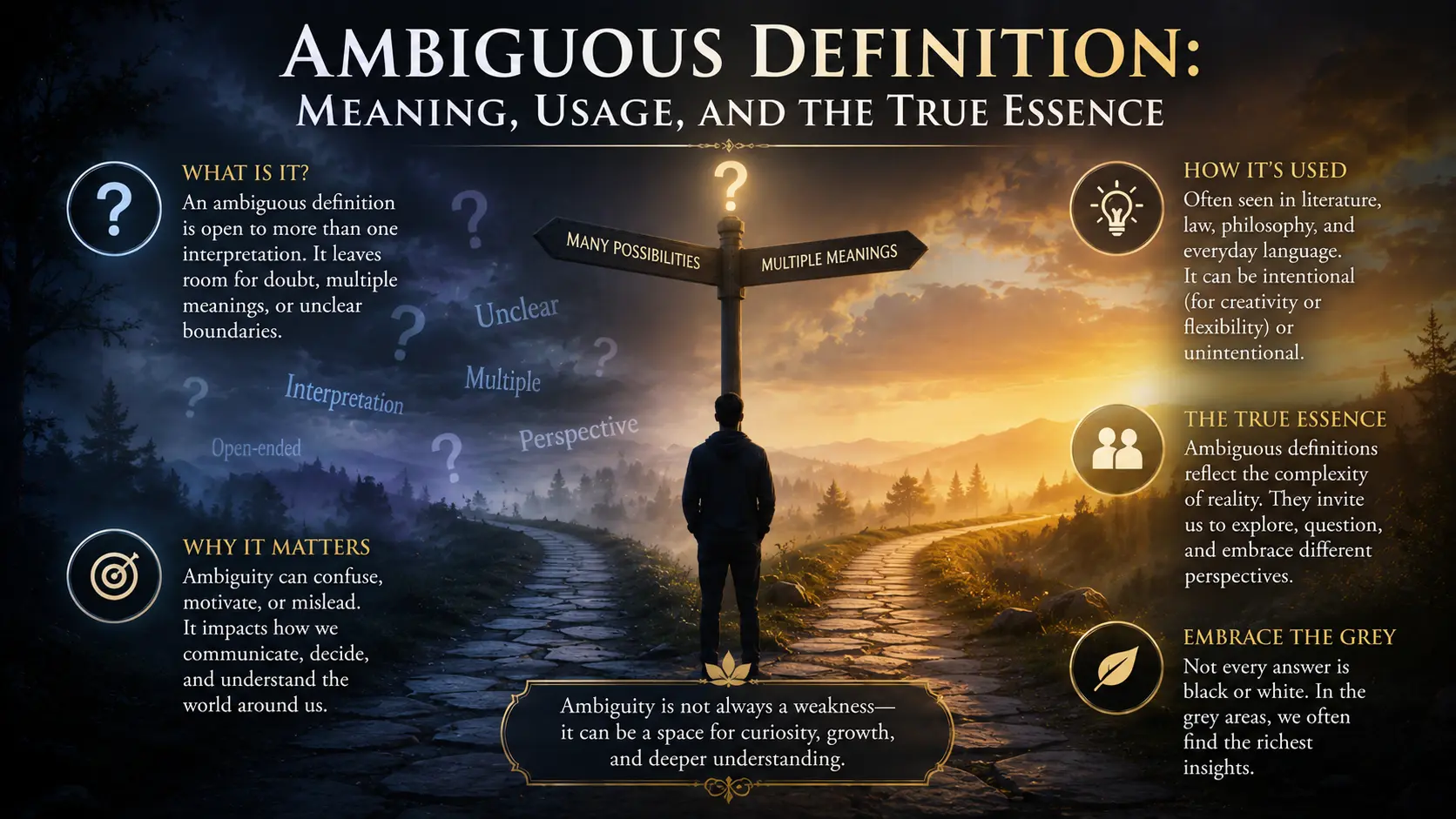
An ambiguous definition is a definition, statement, word, or phrase that can reasonably be understood in more than one way. Instead of pointing to one precise meaning, it leaves room for different interpretations depending on context, intention, culture, or personal perspective.
For example, the sentence “I saw her duck” can mean that someone saw a woman lower her head or saw the bird belonging to her. The wording itself does not provide enough information to determine the intended meaning.
Ambiguity is not necessarily an error. It can create confusion, but it can also be useful in literature, humor, advertising, politics, law, storytelling, and everyday communication.
TL;DR
- Ambiguous means open to more than one reasonable interpretation.
- An ambiguous definition lacks enough precision to establish only one meaning.
- Context often determines which interpretation makes the most sense.
- Ambiguity can be accidental or deliberately created.
- It appears frequently in everyday conversation, media, law, advertising, and digital communication.
- Ambiguity is not always negative; sometimes it encourages creativity, flexibility, or deeper thought.
- Clear communication usually requires enough context to reduce unwanted ambiguity.
What Is an Ambiguous Definition?
An ambiguous definition is one that allows two or more plausible interpretations. The uncertainty may come from a word having multiple meanings, a sentence having different grammatical interpretations, or a concept being described too broadly.
Ambiguity differs from simple ignorance. If someone does not know what a word means, the problem is a lack of knowledge. With ambiguity, the wording itself can legitimately point toward different meanings.
Core Traits of Ambiguity
Several characteristics commonly make a definition ambiguous:
- Multiple meanings: A word may have several established meanings.
- Insufficient context: The surrounding information does not identify the intended interpretation.
- Unclear structure: Grammar or sentence construction permits different readings.
- Broad wording: A definition may be so general that several possibilities fit.
- Subjective interpretation: Different people may understand the same expression differently.
- Changing meanings: A term may have developed new meanings over time.
Ambiguity can occur at the level of a single word, an entire sentence, or even a larger argument.
Simple Example
Consider the statement: “The chicken is ready to eat.”
It could mean the chicken is prepared and ready to be eaten, or that the chicken itself is ready to eat food. The sentence is grammatically understandable, but its intended meaning depends on context.
Another example is the word “bank.” It can refer to a financial institution or the side of a river. The surrounding sentence normally resolves the ambiguity.
Historical Roots of Ambiguous Language
Ambiguity is not a modern problem created by social media or texting. It has existed for as long as humans have used symbolic language.
Human communication has always depended on words whose meanings can shift according to situation, speaker, audience, and culture.
Ancient and Classical Influences
Ancient languages contained words and expressions with multiple meanings. Philosophers and scholars recognized that unclear language could create disagreement, particularly when people attempted to define abstract concepts.
Classical rhetoric also demonstrated that language could be interpreted in different ways. Speakers could intentionally select wording that encouraged a particular interpretation while avoiding an overly direct statement.
This made ambiguity both a communication challenge and a rhetorical resource.
Evolution Over Time
Meanings evolve as societies change. A word that once carried a narrow meaning may gradually develop broader or completely different uses.
Social changes, technological developments, literature, politics, migration, and popular culture all influence vocabulary.
The result is that language is never perfectly static. A dictionary can document meanings, but actual usage continues to change through everyday communication.
Why Ambiguous Definitions Matter in the USA
Ambiguous language has particular importance in the United States because American communication operates across a highly diverse linguistic and cultural environment.
People from different regions, generations, professions, and cultural backgrounds may attach different meanings to the same expression.
Cultural Importance
American English contains regional expressions, slang, idioms, professional terminology, and culturally specific phrases.
For instance, an expression that sounds obvious to someone from one region may be unfamiliar or interpreted differently by someone elsewhere.
Ambiguity therefore reflects part of the broader diversity of American communication.
Everyday Impact
Ambiguity appears in ordinary situations such as:
- Text messages
- Workplace conversations
- School assignments
- Advertising
- Social media posts
- Customer service
- Instructions
- Relationships
- News headlines
A short message such as “We need to talk later” may sound neutral to one person but alarming to another. The words do not necessarily communicate one emotional interpretation.
Ambiguity in American Law and Policy
Legal language attempts to be precise, but laws, regulations, contracts, and policies can still contain terms that are open to interpretation.
Legal ambiguity can become important when different parties disagree about what a particular provision means.
Legal Ambiguity Explained
A legal phrase may become ambiguous when its wording supports multiple reasonable interpretations.
Courts may then examine factors such as:
- The language itself
- The surrounding provisions
- Legislative purpose
- Historical context
- Prior legal decisions
- The practical consequences of different interpretations
The exact method varies according to the legal issue and jurisdiction.
Why It’s Controversial
Ambiguous legal language can create uncertainty about rights, responsibilities, or enforcement.
One side may argue that a provision clearly supports its position, while another argues that the same words mean something different.
This is why precise drafting is highly valued in law. At the same time, complete elimination of ambiguity is difficult because laws must often address complicated situations that cannot all be predicted in advance.
Ambiguous Definition in Media and Pop Culture
Media frequently uses ambiguity because uncertainty can make information more interesting.
Movies, television shows, songs, headlines, advertisements, and social media posts may intentionally leave certain details open to interpretation.
Common Media Uses
Ambiguity is commonly used to:
- Create suspense
- Encourage discussion
- Generate curiosity
- Build mystery
- Produce humor
- Allow multiple interpretations
- Increase audience engagement
An ending that does not completely explain a character’s fate may encourage viewers to debate what actually happened.
Psychological Pull
People naturally seek patterns and explanations when information is incomplete.
Ambiguous messages can therefore encourage attention because the audience wants to resolve the uncertainty.
This does not mean every ambiguous message is psychologically powerful. Its effect depends on the subject, audience, context, and emotional significance.
Emotional and Psychological Associations
Ambiguous language can create different emotional reactions depending on how much uncertainty a person is comfortable with.
Common Emotional Responses
Ambiguity may produce:
- Curiosity
- Confusion
- Anxiety
- Excitement
- Suspicion
- Amusement
- Frustration
- Wonder
For example, an ambiguous mystery can feel exciting because uncertainty is part of the entertainment. In an important workplace or personal situation, the same uncertainty may feel stressful.
Identity and Interpretation
Personal experiences influence how people interpret unclear communication.
Two individuals can receive exactly the same ambiguous statement and reach different conclusions because they bring different assumptions, expectations, memories, and cultural experiences.
This demonstrates an important principle: meaning is not always contained entirely within words.
Ambiguity as a Tool, Not a Flaw
Ambiguity is often treated as something communication should eliminate. However, deliberate ambiguity can be useful.
Writers, artists, comedians, advertisers, and speakers sometimes use uncertainty to create richer experiences.
Strategic Uses
Intentional ambiguity can help:
- Make a story more thought-provoking
- Create a memorable slogan
- Allow audiences to identify personally with a message
- Create double meanings in humor
- Maintain mystery
- Avoid unnecessary rigidity
- Encourage interpretation
Poetry, for example, often benefits from language that can suggest several ideas at once.
Ethical Tension
The same technique can become problematic when ambiguity is used to mislead people.
There is an important difference between inviting interpretation and deliberately hiding important information.
Ethical communication generally requires greater clarity when people are making decisions involving money, safety, rights, responsibilities, or significant consequences.
Cross-Cultural Views on Ambiguous Meaning
Ambiguity exists across languages and cultures, although different societies may handle indirectness and uncertainty differently.
Comparative Perspective
Some communication styles place greater emphasis on explicit wording, while others rely more heavily on shared context, relationships, tone, or implication.
Translation can introduce another layer of ambiguity because one expression may not have a perfect equivalent in another language.
Therefore, an apparently ambiguous phrase may become even more complicated when it crosses cultural or linguistic boundaries.
Shared Human Pattern
Despite cultural differences, ambiguity is a universal feature of human communication.
Every language contains words, expressions, or structures that can acquire different meanings according to context.
This shared pattern demonstrates that ambiguity is not evidence that one particular language is poorly designed. It is a natural consequence of flexible human communication.
Misunderstandings and Misuse of Ambiguous Definitions
Ambiguity becomes troublesome when people assume that an unclear statement has only one possible meaning.
Common Misuses
Common problems include:
- Treating a broad definition as an exact one
- Ignoring context
- Assuming personal interpretation is universal
- Using vague wording in important instructions
- Confusing ambiguity with contradiction
- Deliberately exploiting unclear language
- Taking figurative language literally
For example, saying “Come early” without specifying a time creates uncertainty because different people may have different ideas about what “early” means.
Why It Persists
Ambiguity persists because natural language is designed for flexibility rather than mathematical precision.
People communicate quickly, omit information they believe is obvious, use shorthand, and rely on shared knowledge.
In casual conversation, this usually works. Problems arise when the listener does not share the speaker’s assumptions.
Spiritual Meaning and Symbolism of the Star: Deeper Meanings
How Meanings Shift Over Time
Language changes continuously, so an ambiguous definition may become clearer or more complicated as usage evolves.
Forces Behind Shifts
Meaning can change because of:
- Technology
- Social trends
- Generational differences
- Popular culture
- Political developments
- Scientific discoveries
- Advertising
- Internet communities
- Everyday slang
A term can even acquire meanings that coexist with its older definitions.
Old vs. New Interpretations
Older generations may understand a word according to its traditional meaning, while younger speakers may recognize an additional modern meaning.
Neither interpretation is automatically wrong. The surrounding context determines which meaning is intended.
This is one reason dictionaries periodically add, revise, or update definitions.
Modern Usage: Digital Life and Identity
Digital communication has made ambiguity especially noticeable.
Short messages often remove tone, facial expression, timing, and other clues that would normally help people interpret meaning.
Where Ambiguity Shows Up Today
Ambiguous language is common in:
- Texting
- Social media captions
- Memes
- Comments
- Emojis
- Online usernames
- Search queries
- Headlines
- Digital advertising
- Artificial intelligence conversations
A single emoji or short phrase can communicate different emotions to different audiences.
Psychological Effect Online
Online ambiguity can encourage both curiosity and misunderstanding.
Because digital communication is often fast and brief, people may fill missing information with their own assumptions.
This can make a neutral message appear sarcastic, angry, romantic, dismissive, or humorous depending on the reader.
Context Matters More Than Definition
A dictionary definition provides useful information, but context often determines which meaning is relevant.
Contextual Clues
Useful clues include:
- The words surrounding the expression
- The speaker’s intention
- The situation
- Tone
- Timing
- Audience
- Cultural background
- Previous conversation
Consider the word “light.” It can refer to illumination, something that is not heavy, or a pale color. The sentence and situation normally reveal which interpretation applies.
Practical Takeaway
When a statement seems ambiguous, do not immediately assume the worst or choose the first meaning that comes to mind.
Instead, ask:
“What other reasonable interpretation could this have?”
If the distinction matters, clarification is usually the simplest solution.
Ambiguous Definition Across Contexts (Table)
| Context | Example of Ambiguity | Why It Happens | Best Approach |
|---|---|---|---|
| Everyday Speech | “I’ll meet you later.” | “Later” has no exact time | Ask for a specific time |
| Text Messaging | “Okay.” | Tone is unclear | Consider the conversation context |
| Education | Broad assignment instructions | Requirements may be unclear | Request clarification |
| Workplace | “Finish it soon.” | “Soon” is subjective | Establish a deadline |
| Law | Broad statutory wording | Multiple interpretations may exist | Examine legal context |
| Advertising | Double-meaning slogan | Designed to attract attention | Read the full message |
| Literature | Open-ended ending | Author leaves interpretation open | Consider multiple readings |
| Social Media | Short caption | Missing context and tone | Avoid assuming intent |
| Science | Broad informal term | Technical meaning may differ | Use the technical definition |
| Relationships | “We need to talk.” | Emotional meaning is uncertain | Communicate directly |
| Politics | Flexible terminology | Different groups define terms differently | Examine the specific definition |
| Culture | Idioms and expressions | Shared meanings vary | Consider cultural context |
FAQs
Is ambiguity always a bad thing?
No. Ambiguity can be useful when it creates creativity, humor, mystery, artistic interpretation, or flexibility. It becomes harmful mainly when clarity is necessary and unclear wording causes misunderstanding.
Why do Americans argue so much about word meanings?
Disagreements about meaning can arise from regional differences, cultural backgrounds, political contexts, generations, professions, and changing language. People may also use the same word while relying on different definitions.
Can a definition be both clear and ambiguous?
Yes, depending on the level being considered. A definition may clearly identify a general concept while remaining ambiguous about its boundaries or specific applications.
Does ambiguity mean language is broken?
No. Ambiguity is a natural feature of human language. Languages allow words and expressions to carry different meanings because this flexibility makes communication efficient, expressive, and adaptable.
How can I avoid misunderstandings from ambiguity?
Use specific words, provide context, state deadlines clearly, define important terms, and ask questions when something is unclear. For important communication, clarity is usually better than relying on assumptions.
Conclusion
The ambiguous definition describes language that can reasonably support more than one interpretation. It can arise from multiple word meanings, unclear grammar, incomplete context, cultural differences, or changing language.
Ambiguity is neither automatically good nor automatically bad. In literature, comedy, advertising, and storytelling, it can make communication more engaging and meaningful. In law, instructions, professional communication, and important decisions, unnecessary ambiguity can create confusion and disagreement.
The most important lesson is that meaning depends heavily on context. Words provide the foundation, but situation, intention, culture, tone, and shared knowledge help determine what those words actually communicate.
Understanding ambiguity makes communication more thoughtful. Instead of assuming that our first interpretation must be correct, we can recognize alternative meanings, seek context, and clarify when necessary. In this sense, ambiguity is not simply a weakness of language—it is one of the features that makes language flexible, creative, and deeply human.