Dog Howling in Sleep: Spiritual Meaning and Symbolism
Quick Answer
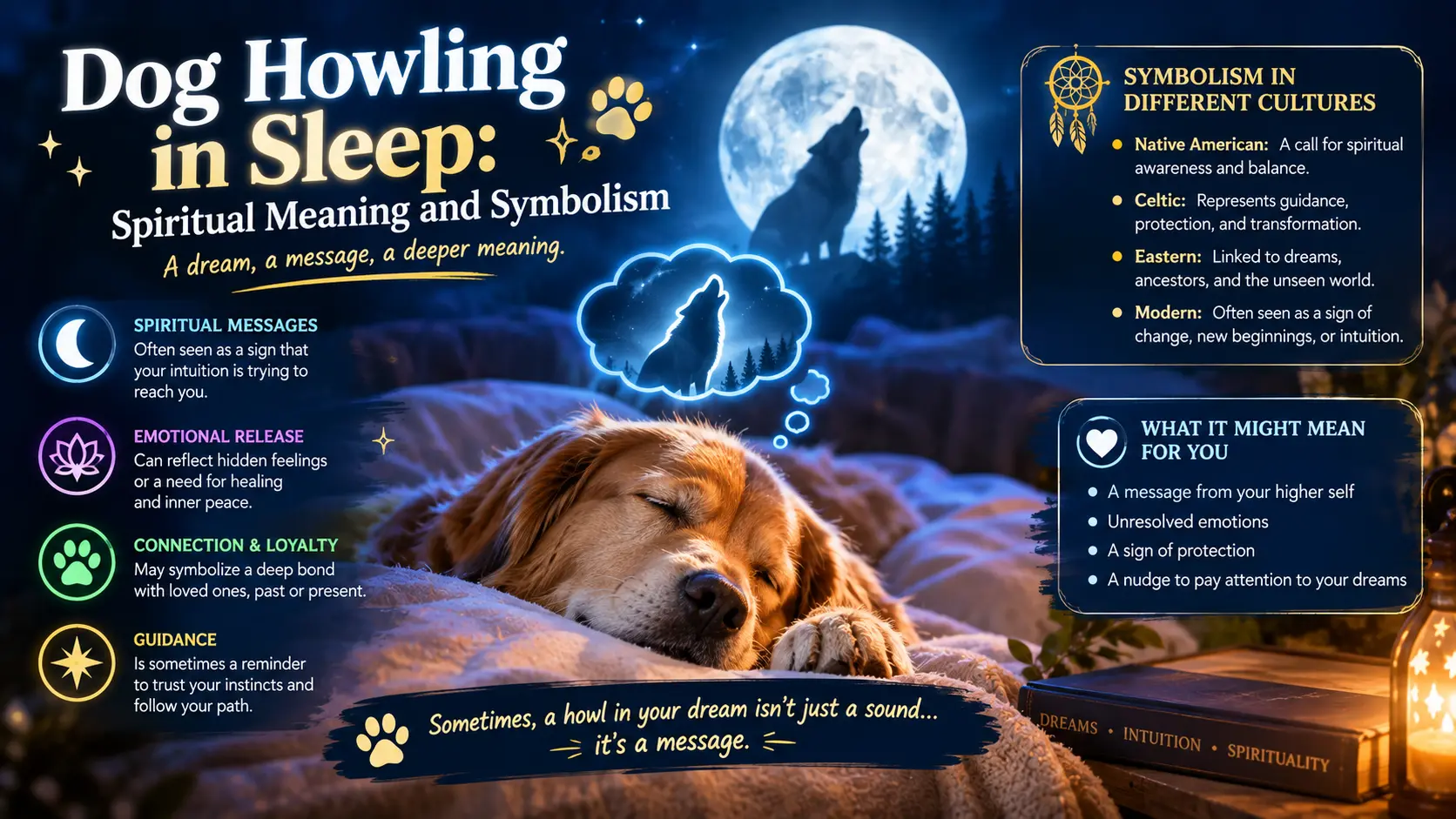
A dog howling in sleep is usually a normal part of dreaming rather than a supernatural warning. Dogs can vocalize, twitch, whimper, bark, or howl during sleep as their brains move through dream-related activity. Symbolically, however, people may interpret sleep howling as a sign of intuition, communication, protection, emotional release, or a connection between the conscious and unconscious worlds.
The spiritual meaning depends heavily on the circumstances. A peaceful howl may be viewed as an expression of instinct or inner awareness, while repeated distressed vocalizations may symbolize anxiety, unresolved emotions, or a need for greater attention and care.
TL;DR
- Physically, dogs may howl, bark, whimper, or move while dreaming.
- Spiritually, howling can symbolize communication, intuition, protection, or emotional release.
- Ancient traditions often associated dogs with guardianship, death, loyalty, and the boundary between worlds.
- A sleeping dog howling does not automatically mean something bad is about to happen.
- Stress, excitement, memories, environmental sounds, and individual temperament can influence sleep vocalizations.
- Modern interpretations often combine traditional symbolism with a more practical understanding of canine sleep.
What Does a Dog Howling in Sleep Look Like?
A dog howling during sleep may appear to be deeply asleep while suddenly producing a long, rising vocalization. The sound can range from a soft whine to a surprisingly loud howl.
Sometimes the dog’s paws move, its ears twitch, its whiskers tremble, or its eyes move beneath closed eyelids. These behaviors can make the experience seem mysterious, particularly when the dog appears completely unaware of what it is doing.
Common Physical Signs
A sleeping dog may twitch its legs, move its muzzle, flick its ears, wag its tail, whimper, bark, growl, or howl. These behaviors can occur during dream-related stages of sleep.
The dog’s breathing may also change temporarily. A single howl followed by continued peaceful sleep is generally less concerning than persistent vocalization accompanied by obvious distress or unusual physical behavior.
Why It Feels Significant
Humans naturally attach meaning to unusual animal behavior. Dogs are especially likely to inspire symbolic interpretations because of their long relationship with people and their reputation for heightened senses.
When a dog howls while apparently dreaming, the behavior can feel like a message from an unseen place. Spiritually, this creates a powerful metaphor for communication between the visible and invisible, conscious and unconscious, or ordinary and mysterious aspects of life.
Core Symbolic Meanings at a Glance
Dog howling in sleep can carry several symbolic interpretations depending on personal beliefs and cultural background.
Most Common Associations
| Symbolic Theme | Possible Meaning |
|---|---|
| Communication | Expressing something that cannot easily be spoken |
| Intuition | Paying attention to subtle feelings or instincts |
| Protection | A guardian responding to something perceived as important |
| Dreams | Connection with the unconscious mind |
| Emotional release | Letting go of tension or suppressed feelings |
| Loyalty | Deep bonds with loved ones |
| Transition | Moving from one emotional or life phase to another |
| Mystery | Awareness of things that remain unexplained |
The most balanced interpretation is that symbolism should be treated as personal reflection rather than a prediction. A howl may invite you to consider what you are feeling, but it does not establish that an external supernatural event is occurring.
Ancient Roots of Dog Howling Symbolism
Dogs have held symbolic importance for thousands of years. Their roles as hunters, companions, guards, and scavengers gave them a distinctive position in many ancient societies.
Their ability to hear sounds humans cannot hear also contributed to beliefs that dogs could detect things beyond ordinary human awareness.
Pre-Christian and Ancient Beliefs
In several ancient traditions, dogs were associated with guardianship and boundaries. They could represent protectors of homes, sacred spaces, roads, graves, or entrances to other realms.
Greek mythology provides one of the most famous examples through Cerberus, the multi-headed dog associated with the entrance to the underworld. Ancient Egyptian traditions likewise connected dogs and dog-like animals with death, burial, and protective deities.
Because howling occurs naturally and can sound mournful or mysterious, it became easy for communities to associate it with omens, spirits, transitions, or messages from beyond ordinary experience.
Dogs as Dreamers in Historical Thought
The scientific understanding of animal sleep is relatively modern, but people have long noticed that sleeping animals sometimes move and make sounds.
Early Interpretations
Before modern sleep science, unusual movements or sounds from sleeping animals could be interpreted through religious, folkloric, or supernatural frameworks.
A dog appearing to react to something while asleep could therefore be understood as having access to a hidden realm. The dream state itself became a symbolic bridge between ordinary consciousness and mystery.
Today, people can appreciate the symbolic tradition while also recognizing that dogs experience complex sleep cycles and can display behaviors associated with dreaming.
Symbolism in the United States Today
In the United States, interpretations of a howling dog vary considerably. Some people view howling as simply a natural canine behavior, while others continue to associate it with intuition, warnings, loneliness, or spiritual sensitivity.
Modern American Views
Popular folklore sometimes portrays a dog howling at night as an omen. Movies, television, ghost stories, and internet discussions have reinforced the association between howling dogs and mysterious events.
At the same time, modern pet owners are increasingly familiar with canine sleep behavior. A dog making noises while asleep is often understood as dreaming rather than predicting the future.
This creates an interesting combination of old symbolism and modern observation: the behavior can be biologically ordinary while still feeling spiritually meaningful to the person witnessing it.
Common USA Contexts and Meanings
The setting can influence how people interpret a sleeping dog’s howl.
A dog howling after an unusually active day might symbolically represent processing experiences. A dog that howls after a stressful event might be viewed as expressing emotional tension.
A dog that howls peacefully and then settles back into sleep may inspire gentler interpretations, such as dream exploration, instinct, companionship, and emotional connection.
In American folklore, nighttime behavior often receives more supernatural attention than daytime behavior because darkness has historically been associated with mystery and the unknown.
Emotional and Psychological Symbolism
Dogs often function as emotional mirrors in human symbolism. Because they are strongly associated with companionship and loyalty, their behavior can encourage people to reflect on their own emotional states.
What It Signals Emotionally
A sleeping howl can symbolize feelings that are present beneath conscious awareness. In this interpretation, the dog becomes a metaphor for emotions that surface when the rational mind is resting.
The symbolism may be particularly meaningful if you are experiencing uncertainty, grief, loneliness, excitement, or major change. Rather than treating the howl as a supernatural prediction, you can use it as a prompt to ask: What am I processing emotionally right now?
Spiritual Interpretations in Modern Belief Systems
Modern spiritual communities offer many interpretations of unusual animal behavior. Dogs are commonly viewed as loyal companions, guardians, intuitive creatures, and symbols of unconditional connection.
Common Spiritual Views
One interpretation is that a howling dog represents communication from the deeper self. Because the dog is asleep, the symbolism focuses less on conscious decision-making and more on instinct, dreams, and subconscious expression.
Another interpretation connects the howl with protection and awareness. The dog may symbolically represent the part of you that notices subtle changes before your conscious mind recognizes them.
Some spiritual traditions may also view animals as sensitive to energy or unseen presences. This is a belief rather than an established scientific fact, and there is no reliable evidence that a sleeping dog’s howl proves it has detected a spirit or supernatural presence.
Cross-Cultural Meanings Beyond the USA
Dog symbolism differs widely around the world. In some cultures dogs are celebrated as protectors and companions, while in others they have stronger associations with death, wilderness, or supernatural boundaries.
Global Perspectives
Across different traditions, the dog can represent loyalty, protection, transition, guidance, instinct, and guardianship.
Howling adds another layer because it is a form of long-distance communication among dogs. Symbolically, this can become a metaphor for calling out, searching, warning, remembering, or attempting to connect.
The important point is that there is no single universal spiritual meaning. Cultural context determines whether a howl is interpreted positively, negatively, or simply as natural behavior.
Modern Media and Popular Culture Influence
Popular culture has played a major role in shaping beliefs about howling dogs.
Cultural Reinforcement
Horror films frequently use a distant dog howl to create suspense. Television shows and novels may use the sound as a signal that something mysterious or frightening is happening.
These repeated associations can influence how people interpret an ordinary sleeping dog. A harmless howl may suddenly feel ominous because audiences have learned to associate the sound with danger or supernatural events.
Understanding this influence can help separate cultural storytelling from the dog’s actual behavior.
Misunderstandings and Common Fears
A sleeping dog can make surprisingly strange sounds, and unfamiliar behavior can easily produce worry.
What It Usually Does NOT Mean
A dog howling during sleep does not automatically mean death, bad luck, a spirit, an impending disaster, or a supernatural warning.
There is no scientific basis for assuming that one episode predicts a future event. In many cases, the simplest explanation is that the dog is dreaming or reacting to ordinary sensory or neurological activity during sleep.
If the behavior is sudden, extreme, frequent, or accompanied by signs of illness, pain, seizures, breathing problems, or major changes in behavior, the appropriate response is practical rather than spiritual: consider speaking with a veterinarian.
How Meaning Has Shifted Over Time
The symbolism of a howling dog has changed considerably as human understanding of animals has developed.
Then vs. Now
| Earlier Interpretations | Modern Interpretations |
|---|---|
| Omen or warning | Dream-related vocalization |
| Spirit communication | Natural sleep behavior |
| Guardian of boundaries | Companion and protector |
| Connection with death | Emotional and cultural symbolism |
| Supernatural sensitivity | Instinct and sensory awareness |
The modern view does not necessarily eliminate symbolism. Instead, it allows people to distinguish between what the behavior physically means and what it personally symbolizes.
A dog can be dreaming naturally while the moment still inspires reflection about loyalty, intuition, memory, or emotional connection.
FAQs
Is a dog howling in sleep a spiritual sign?
It can be interpreted symbolically as communication, intuition, protection, or emotional release, but there is no scientific evidence that sleep howling itself is a supernatural sign.
Should I wake my dog if it howls in sleep?
Usually, there is no need to wake a peacefully sleeping dog. Sudden waking can startle some dogs, so it is generally better to let the dog continue sleeping unless there are signs of distress.
Does this mean my dog senses something unseen?
Not necessarily. Dogs have highly developed senses, but a sleeping howl does not prove that a dog is detecting spirits, entities, or another supernatural presence.
Is this behavior rare?
No. Dogs can vocalize and move during sleep, particularly during dream-related sleep. Individual dogs vary in how often they bark, whine, twitch, or howl.
Can stress trigger sleep howling?
Stress and changes in a dog’s experiences can potentially influence sleep behavior, but a howl alone cannot establish that stress is the cause. Consider the dog’s overall behavior and circumstances.
Conclusion
A dog howling in sleep sits at an interesting intersection of natural animal behavior, human emotion, folklore, and spiritual symbolism. From ancient associations with guardianship and otherworldly boundaries to modern ideas about dreams and intuition, dogs have consistently occupied a special place in human imagination.
Spiritually, the howl can be viewed as a symbol of communication, protection, instinct, emotional release, or unconscious awareness. However, it should not automatically be interpreted as a bad omen or supernatural warning.
The most balanced approach is to appreciate both sides: understand the behavior naturally while allowing its symbolism to inspire personal reflection. Sometimes an unusual moment does not need to predict anything—it simply gives us a reason to pause, observe, and think more deeply about the bonds we share with animals.