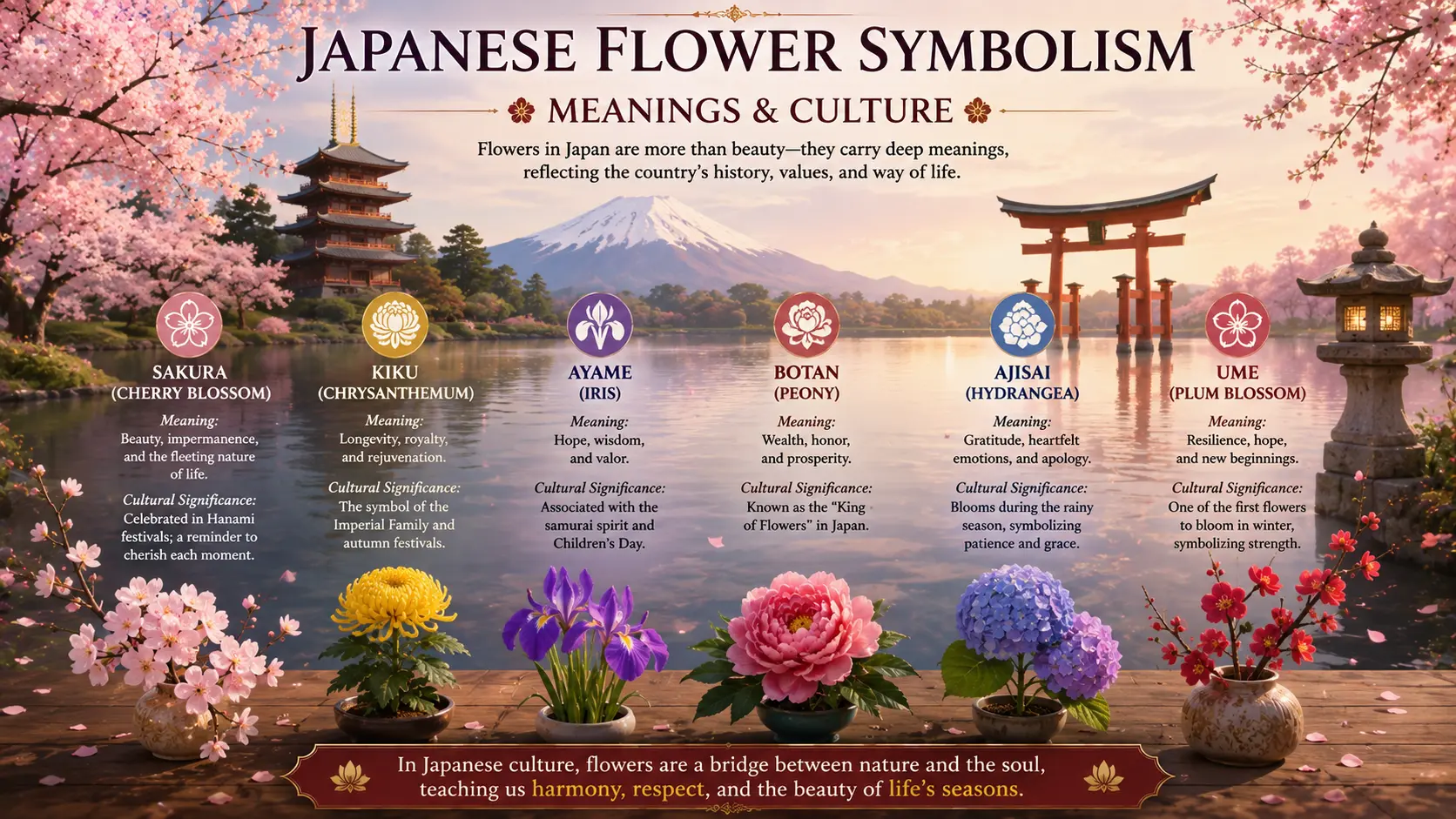
Japanese Flower Symbolism: Meanings & Culture
Flowers hold a special place in Japanese culture, where beauty is often understood as something temporary, delicate, and deeply meaningful. A flower may represent love, purity, courage, prosperity, remembrance, renewal, or the passing of time depending on its species, color, season, and cultural context.
Japanese flower symbolism is closely connected with seasonality, aesthetics, literature, religion, art, festivals, and everyday traditions. The famous cherry blossom, for example, is more than a beautiful spring flower. Its brief blooming season can evoke the beauty and impermanence of life. Likewise, the chrysanthemum carries associations with longevity and the imperial tradition, while the lotus can suggest spiritual awakening and purity.
Understanding these meanings requires some nuance. There is not always one fixed symbolic definition for every flower. Meanings can vary according to historical period, region, color, artistic context, and personal interpretation.
The Cultural Roots of Japanese Flower Symbolism
Japanese flower symbolism developed through a combination of indigenous traditions, Buddhist and Shinto influences, Chinese cultural exchange, poetry, visual art, and seasonal customs. Nature has long been observed not simply as scenery but as a source of emotional and philosophical insight.
The concept of mono no aware—often described as an awareness of the impermanence and emotional beauty of things—is particularly important when interpreting Japanese flowers. A blossom can be beautiful precisely because it does not last forever.
Seasonality is equally important. Japanese culture traditionally recognizes distinct seasonal changes, and flowers often serve as visual markers of those transitions. Plum blossoms announce the approach of spring, cherry blossoms dominate the emotional landscape of spring, wisteria evokes late spring, and chrysanthemums become prominent in autumn.
This connection between flowers and time gives Japanese floral symbolism an especially reflective quality. A flower can symbolize not only what something is, but also when it appears and how long it remains.
Cherry Blossom (Sakura)
Cherry blossoms, known as sakura, are perhaps the most recognizable symbol associated with Japan. Their delicate pink and white flowers appear for a relatively short period, making them powerful reminders of life’s temporary nature.
Symbolism:
Sakura commonly symbolizes beauty, impermanence, renewal, youth, and the fleeting nature of life. Their brief flowering period makes them an especially strong visual expression of change.
The falling petals can also suggest that beautiful moments should be appreciated while they are present. Rather than treating impermanence only as something sad, Japanese aesthetics can recognize it as part of what makes beauty meaningful.
Cultural Significance:
Cherry-blossom viewing, known as hanami, is an important seasonal tradition. People gather beneath blooming trees with family, friends, or colleagues to appreciate the flowers and enjoy the arrival of spring.
Sakura also appears extensively in Japanese poetry, paintings, textiles, ceramics, advertisements, architecture, and popular culture. Its imagery has become one of the strongest visual representations of Japan internationally.
Spiritual Meaning:
Spiritually, sakura can represent acceptance of change and appreciation of the present moment. The blossom encourages reflection on how quickly circumstances can transform.
Its message can be understood as: beauty does not have to last forever to be valuable. Sometimes the temporary nature of an experience is precisely what gives it emotional depth.
Chrysanthemum (Kiku)
The chrysanthemum, or kiku, is one of Japan’s most culturally significant flowers. Its carefully arranged petals and association with autumn have given it an important place in Japanese visual and ceremonial traditions.
Symbolism:
The chrysanthemum commonly represents longevity, nobility, dignity, rejuvenation, and good fortune.
Because chrysanthemums can bloom in autumn when many other flowers are fading, they have also acquired associations with endurance and continued vitality.
Cultural Significance:
The chrysanthemum has a particularly strong connection with Japan’s imperial tradition. The Chrysanthemum Crest is associated with the Imperial Family, giving the flower a distinctive historical and symbolic status.
Chrysanthemum exhibitions and seasonal displays also demonstrate the Japanese appreciation for cultivating flowers with precision and patience.
Spiritual Meaning:
Spiritually, the chrysanthemum can symbolize long life, resilience, dignity, and inner strength. Its orderly petals may also inspire thoughts about balance and harmony.
The flower can serve as a reminder that maturity and endurance have their own kind of beauty.
Plum Blossom (Ume)
The plum blossom, called ume, is one of the earliest flowers associated with the arrival of spring in Japan. It can bloom while winter conditions are still present, giving it a particularly resilient character.
Symbolism:
Ume often symbolizes resilience, perseverance, renewal, courage, and hope.
Its ability to flower before the full arrival of spring makes it an especially appropriate symbol for enduring difficult circumstances and anticipating better times.
Cultural Significance:
Plum blossoms have been celebrated in Japanese poetry and art for centuries. Historically, they were highly admired and were particularly influential in classical Japanese culture.
Plum-blossom viewing, known as ume matsuri in festival contexts, remains a seasonal activity in various parts of Japan.
Spiritual Meaning:
Spiritually, ume represents strength during adversity and hope during transition. It suggests that difficult seasons do not necessarily prevent new growth.
Its appearance can be interpreted as an invitation to remain patient when positive change has not yet fully arrived.
Peony (Botan)
The peony, known as botan, is admired for its large, luxurious blossoms. Its visual richness has made it a recurring subject in Japanese art and decorative design.
Symbolism:
Peonies are commonly associated with wealth, prosperity, beauty, honor, elegance, and good fortune.
Their full, abundant appearance naturally lends itself to associations with abundance and flourishing.
Cultural Significance:
Peonies appear in paintings, textiles, woodblock prints, gardens, ceramics, and other decorative arts. Their dramatic form makes them especially effective in compositions designed to communicate richness and refinement.
The flower also reflects the historical influence of Chinese culture on Japanese floral art and symbolism.
Spiritual Meaning:
Spiritually, the peony can represent abundance and the confidence to embrace one’s natural beauty. Its generous blossoms suggest flourishing rather than scarcity.
It may symbolize a stage of life in which growth, prosperity, and self-expression are allowed to become fully visible.
Iris (Ayame)
The iris has several Japanese names and cultural associations, including ayame. Iris imagery has been especially connected with spring and traditional seasonal customs.
Symbolism:
The iris can symbolize strength, protection, courage, elegance, and resilience.
Its upright leaves and distinctive flowers contribute to an image of determination and graceful strength.
Cultural Significance:
Iris plants have an important place in Japanese gardens and seasonal traditions. Iris-related customs are particularly visible around the traditional Boys’ Day, now celebrated as Children’s Day, when iris leaves have historically been associated with protection and strength.
The Japanese word shōbu can refer to iris varieties and has also been associated linguistically with martial qualities, adding another layer to the flower’s cultural symbolism.
Spiritual Meaning:
Spiritually, the iris can represent protection, courage, and moving forward with confidence.
Its symbolism encourages a balance between gentleness and strength—the ability to remain graceful without becoming fragile.
Wisteria (Fuji)
Wisteria, called fuji, is famous for its long cascading clusters of flowers. Its flowing appearance has made it an enduring symbol in Japanese gardens, art, and literature.
Symbolism:
Wisteria can symbolize grace, love, longevity, elegance, and enduring connection.
Because the vines can live for many years and become substantial plants, they can also suggest continuity and lasting relationships.
Cultural Significance:
Wisteria has been celebrated in Japanese poetry and literature for centuries. One of the most famous examples is its appearance in The Tale of Genji, where floral imagery contributes to the work’s refined aesthetic world.
Wisteria festivals and garden displays continue to attract visitors during its blooming season.
Spiritual Meaning:
Spiritually, wisteria can suggest patience, interconnectedness, and graceful growth. Its vines demonstrate how something can become strong while remaining flexible.
The cascading flowers may also symbolize allowing life to unfold naturally rather than forcing every stage of growth.
Lotus (Hasu)
The lotus, known as hasu, carries some of the strongest spiritual associations among Japanese flowers. Its symbolism is deeply connected with Buddhist thought.
Symbolism:
The lotus commonly symbolizes purity, enlightenment, spiritual awakening, transformation, and transcendence.
One reason for this symbolism is the plant’s ability to rise from muddy water and produce an elegant flower above the surface.
Cultural Significance:
Buddhist imagery frequently depicts the lotus as a seat or foundation for enlightened beings. Lotus motifs can therefore be found in temples, religious artwork, sculpture, paintings, and decorative objects.
The flower also appears in poetry and seasonal imagery, where its distinctive shape and aquatic environment contribute to a contemplative atmosphere.
Spiritual Meaning:
The lotus represents the idea that spiritual beauty can emerge from difficult or imperfect circumstances.
Its journey from muddy water to an open flower can be understood as a metaphor for personal transformation: challenges do not necessarily prevent growth and may become part of the path toward wisdom.
Camellia (Tsubaki)
The camellia, or tsubaki, is an elegant flower with smooth petals and a distinctive form. It has been appreciated in Japanese gardens, art, tea culture, and traditional aesthetics.
Symbolism:
Camellias can represent beauty, humility, love, refinement, and devotion. Red camellias in particular can carry associations with romantic love and deep affection.
However, camellia symbolism is context-dependent. In traditional flower language, the way the blossom falls as a whole has sometimes contributed to less favorable associations, particularly in historical contexts involving samurai culture.
Cultural Significance:
Tsubaki has been used in Japanese gardens, decorative arts, hair ornaments, textiles, and tea-related aesthetics.
Its simple but sophisticated appearance fits the Japanese appreciation for restrained beauty and carefully observed natural forms.
Spiritual Meaning:
Spiritually, the camellia can represent quiet beauty and sincere affection. It encourages appreciation of qualities that do not need excessive display to have meaning.
Its symbolism can be especially appropriate for devotion that is steady rather than dramatic.
Maple (Momiji)
Although the Japanese maple is technically a tree rather than a flower, momiji deserves attention in Japanese seasonal symbolism because its autumn leaves are among the country’s most recognizable natural images.
Symbolism:
Momiji commonly symbolizes change, maturity, beauty, impermanence, and the passage of time.
The transformation from green leaves to brilliant autumn colors provides a natural metaphor for life’s transitions.
Cultural Significance:
Autumn leaf viewing, known as kōyō, is a major seasonal tradition. People travel to mountains, temples, gardens, and parks to appreciate changing foliage.
Like cherry blossoms, autumn leaves are connected with the appreciation of temporary beauty.
Spiritual Meaning:
Spiritually, momiji encourages acceptance of transformation. Its changing colors demonstrate that change does not necessarily mean decline.
Instead, a transition can reveal a different form of beauty and wisdom.
Flower Colors and Their Symbolism in Japan
Color can significantly influence how a flower is perceived. However, color symbolism should not be treated as a universal dictionary because meanings vary according to context and flower type.
White flowers may suggest purity, simplicity, sincerity, mourning, or spiritual cleanliness depending on the setting.
Red flowers often communicate strong emotions such as love, passion, vitality, or courage. Red can also carry associations with protection and auspiciousness in broader Japanese visual culture.
Pink flowers can evoke gentleness, affection, youth, tenderness, and springtime beauty. Sakura’s pink tones are particularly connected with renewal and impermanence.
Purple flowers are frequently associated with elegance, refinement, mystery, or nobility. Wisteria provides one of the most recognizable examples.
Yellow flowers can communicate warmth, brightness, optimism, and vitality, although their interpretation depends heavily on the particular flower and cultural context.
The most accurate interpretation therefore combines flower + color + season + occasion + artistic context rather than relying on color alone.
Japanese Flower Symbolism in Art & Literature
Flowers are deeply woven into Japanese artistic expression. They appear in paintings, poetry, folding screens, ceramics, textiles, gardens, woodblock prints, and decorative objects.
Japanese art often emphasizes the changing relationship between nature and human emotion. A flower may represent a season, but it can simultaneously communicate longing, nostalgia, beauty, mortality, love, or social status.
Classical poetry frequently uses flowers indirectly. Instead of explaining an emotion directly, a poet may mention a seasonal flower and allow the reader to infer the emotional atmosphere.
This approach reflects a broader aesthetic principle: nature can communicate feelings without words.
Flowers also appear in Japanese literature as markers of time. When a character encounters falling blossoms or changing leaves, the natural image can reinforce themes of aging, separation, memory, or emotional transformation.
Japanese Flower Symbolism in Tattoos & Modern Culture
Japanese floral imagery remains popular in contemporary tattoos and visual design. Sakura, lotus, chrysanthemum, peony, maple leaves, and wisteria can all be incorporated into Japanese-inspired compositions.
A sakura tattoo may express impermanence, new beginnings, or appreciation for life.
A lotus tattoo often emphasizes transformation, spiritual growth, or overcoming difficult circumstances.
A peony tattoo can convey prosperity, beauty, confidence, or abundance.
A chrysanthemum tattoo may suggest longevity, dignity, or resilience.
A maple-leaf design can represent change, maturity, and acceptance of life’s seasons.
Modern tattoo symbolism is highly personal, however. A person may choose a flower because of a memory, favorite season, family connection, or aesthetic preference rather than its traditional symbolism.
Flowers in Japanese Festivals & Ceremonies
Flowers and seasonal plants are closely connected with Japanese festivals and ceremonies. Their presence helps mark the rhythm of the year.
Cherry blossoms are central to springtime hanami. Plum blossoms are celebrated before and around the beginning of spring. Iris traditions connect flowers with Children’s Day, while chrysanthemums become especially visible during autumn.
Flowers are also important in Buddhist and other ceremonial contexts. Floral offerings can express respect, gratitude, remembrance, and devotion.
Traditional Japanese flower arrangement, ikebana, takes this seasonal awareness even further. Rather than simply placing flowers in a container, ikebana emphasizes line, space, balance, movement, and the relationship between natural materials.
The result is not merely decoration. It can become a meditation on nature, impermanence, proportion, and harmony.
Lessons from Japanese Flower Symbolism
Japanese flower symbolism offers several philosophical lessons that remain meaningful today.
Beauty can be temporary. Sakura teaches that something does not need to last forever to have profound value.
Hardship can produce strength. Ume blooming near the end of winter represents endurance and hope.
Growth can emerge from difficult conditions. The lotus provides one of the clearest metaphors for transformation.
Change is natural. Momiji reminds us that transformation can create a new form of beauty.
Abundance deserves appreciation. The peony encourages an awareness of prosperity, richness, and flourishing.
Grace can coexist with strength. The iris and wisteria offer different expressions of resilience without sacrificing elegance.
Taken together, these flowers suggest a worldview in which nature is not separate from human life. Instead, the natural world becomes a mirror through which people can understand emotions, relationships, time, and personal growth.
Flowers in Japanese Dreams
Dream interpretations involving Japanese flowers are highly personal, and traditional Japanese culture does not provide one universal dream dictionary for every flower.
Still, flowers appearing in dreams can be explored through their cultural associations.
Dreaming of cherry blossoms may symbolically invite reflection on change, memories, relationships, or a new chapter.
A lotus may represent inner growth, healing, spiritual development, or emerging wisdom.
A plum blossom may suggest resilience and hope after a challenging period.
A peony may symbolize confidence, prosperity, beauty, or a desire for greater abundance.
A chrysanthemum may evoke longevity, family, dignity, remembrance, or maturity.
A wisteria dream may suggest patience, connection, affection, or relationships developing over time.
The emotional tone of the dream matters as much as the flower itself. A bright, healthy flower can create a very different interpretation from a wilted or damaged one.
FAQs on Japanese Flower Symbolism
What is the most symbolic flower in Japan?
Cherry blossom is arguably the most internationally recognized Japanese flower symbol. Sakura represents beauty, impermanence, renewal, and the fleeting nature of life.
What flower represents love in Japanese culture?
Several flowers can represent love depending on context. Red camellias and peonies can be associated with affection, beauty, and romantic feelings, while other flowers may express devotion or emotional connection differently.
What Japanese flower symbolizes strength?
The plum blossom (ume) is strongly associated with resilience because it blooms early, sometimes while winter conditions remain. Iris symbolism can also involve courage and protection.
What Japanese flower represents purity?
The lotus is one of the strongest symbols of purity and spiritual transformation, particularly within Buddhist symbolism. Its emergence from muddy water contributes to this meaning.
What flower represents death or impermanence in Japan?
Cherry blossoms are strongly connected with impermanence, while flowers used in funerary and memorial contexts can carry associations with death and remembrance. The meaning depends greatly on the specific flower and setting.
What does a Japanese flower tattoo mean?
A Japanese flower tattoo does not have one universal meaning. Sakura may represent impermanence or renewal, lotus spiritual transformation, peony prosperity, and chrysanthemum longevity or dignity.
Conclusion
Japanese flower symbolism transforms ordinary plants into powerful reflections on beauty, time, resilience, spirituality, love, prosperity, and change. From the fleeting petals of sakura to the enduring resilience of ume and the spiritual purity of the lotus, each flower offers a different way of understanding life.
The deepest lesson is perhaps that flowers are meaningful not simply because of what they look like, but because of when they bloom, how they change, and what emotions they awaken.
Japanese floral traditions encourage us to notice temporary beauty rather than taking it for granted. They remind us that growth can emerge from hardship, that change can be beautiful, and that even a brief moment can carry lasting meaning.
In this sense, Japanese flower symbolism is ultimately a language of nature—one that teaches us to observe, appreciate, accept, and grow.