Fein Definition & Meaning: What Does “Fein” Mean?
Quick Answer
“Fein” is primarily a word found in German and Yiddish, rather than a standard English word. In German, fein can mean fine, excellent, delicate, pleasant, or refined, depending on the context. It can describe something of good quality, something delicate, or something that feels pleasant or agreeable.
In Yiddish, related forms can carry meanings connected with fine, good, nice, or excellent. Because of its similarity to the English word “fine,” people sometimes encounter “fein” in multilingual conversations, names, cultural expressions, or informal online communication and wonder what it means.
The most important point is that “fein” does not mean “hiatus.” Hiatus is a completely different English word referring to a pause, interruption, or gap.
TL;DR
Fein generally means fine, good, pleasant, excellent, delicate, or refined in German, with related usage in Yiddish. Its exact meaning depends on the language and context. It should not automatically be treated as an English synonym for “fine,” and it has no direct meaning of “hiatus.”
What Does “Fein” Mean?
Basic Definition of “Fein”
The German word fein has several related meanings. One common translation is “fine,” but that English translation does not capture every possible use.
Depending on context, fein may describe something high-quality, delicate, subtle, pleasant, elegant, or excellent. For example, it can be used when describing the quality or texture of something, a person’s manners, or something that produces a positive impression.
This makes fein a context-dependent word. Translating it mechanically as “fine” can sometimes produce an awkward or incomplete interpretation.
“Fein” in Different Contexts
The meaning of fein changes according to what it describes. When referring to quality, it may suggest something fine or excellent. When describing texture, it can indicate something delicate, fine-grained, or finely made.
In social or conversational contexts, it can communicate an idea such as nice, pleasant, or good. Therefore, looking at the surrounding sentence is essential before deciding on the most accurate English translation.
Simple Examples of “Fein” in Use
A German sentence containing fein might use the word to describe something enjoyable, delicate, or high-quality. The appropriate English translation could therefore vary.
For example, an expression involving food might suggest that something tastes pleasant or delicious, while a description of craftsmanship might suggest that something is fine or delicate. The same word can therefore have slightly different shades of meaning.
Is “Fein” an English Word?
English Dictionary Status
Fein is not generally considered a standard everyday English word. Someone encountering it in English text should therefore avoid assuming that it has one fixed English definition.
It may appear because the writer is using a German or Yiddish term, discussing a cultural expression, using a surname or proper name, or communicating in a multilingual environment.
Foreign-Language Uses of “Fein”
The clearest established use of fein is in German. It is also relevant to Yiddish, where related vocabulary reflects historical connections among Germanic languages and Jewish communities in Europe.
This is why the word can occasionally appear in English-language conversations without actually being an English vocabulary item.
Why the Word Can Be Confusing
The biggest source of confusion is its resemblance to “fine.” English speakers may see fein and assume it is simply a spelling variation.
However, spelling similarity does not necessarily mean that two words function identically in modern English. Language, context, pronunciation, and grammatical role all matter.
The Origin and History of “Fein”
German Origins
Fein is an established German adjective with a long history. Modern German uses it in several senses related to fineness, quality, delicacy, pleasantness, and refinement.
Its history reflects the development of German vocabulary over many centuries. Like many common adjectives, its modern meanings have developed through repeated use in different contexts.
Yiddish and European Influence
Yiddish developed through a combination of linguistic influences, particularly Germanic vocabulary alongside Hebrew-Aramaic and Slavic elements.
Because Yiddish developed within European Jewish communities and historically shared substantial vocabulary with German varieties, words resembling fein can appear in related forms and meanings.
How “Fein” Entered American Usage
American English has absorbed many words and expressions from immigrant languages and cultural communities. German and Yiddish have both contributed vocabulary, expressions, pronunciation patterns, and cultural terminology to American language.
However, the appearance of fein in an American context does not necessarily mean that it has become standard American English. Its meaning may still depend on the particular cultural or linguistic setting.
What Does “Fein” Mean in German?
Meaning in Standard German
In standard German, fein has a broad semantic range. Depending on context, it can mean fine, delicate, elegant, good, pleasant, or excellent.
It can describe physical characteristics as well as abstract qualities. That flexibility is one reason a single English translation does not always work perfectly.
How Germans Use “Fein”
German speakers may use fein to describe quality, texture, appearance, behavior, taste, or an agreeable situation.
Its meaning becomes clearer when you consider the noun or expression accompanying it. A literal translation may be technically possible while still missing the natural tone intended by the speaker.
See Also: Yellow Roses Meaning: Symbolism, Love & Friendship
Examples of “Fein” in German Expressions
The word can appear in combinations where it conveys an idea of fineness, delicacy, quality, or pleasantness.
For learners, the best approach is to learn fein as a flexible word rather than memorizing one English equivalent. The surrounding words usually reveal which sense is intended.
What Does “Fein” Mean in Yiddish?
Yiddish Meaning and Usage
In Yiddish-related contexts, fein or related forms may communicate ideas such as fine, good, nice, or excellent.
The precise meaning depends on the particular expression, dialect, speaker, and historical context. Yiddish has considerable regional and historical variation, so a dictionary-style translation may not capture every nuance.
Cultural Context
Yiddish vocabulary is closely connected with the history and culture of Ashkenazi Jewish communities in Europe and later in places such as the United States.
Words with Germanic roots can therefore have cultural associations that extend beyond their literal dictionary definitions.
Differences From German “Fein”
Although German and Yiddish share substantial historical vocabulary, a similar-looking word should not automatically be assumed to have precisely the same modern usage in both languages.
Pronunciation, grammar, idiomatic expressions, and cultural context can all influence how a word is understood.
How “Fein” Is Used in American English
Casual and Conversational Usage
In ordinary American English, fein is not a common replacement for “fine.” Most English speakers would normally write “fine” when they mean fine.
If someone uses fein in an English conversation, it may be intentional—for example, because they are using a German or Yiddish expression, referring to a cultural background, or playing with language.
Online and Social Media Usage
Online communication creates more opportunities for multilingual words to circulate. A word may appear in social posts, usernames, memes, comments, or conversations even when it is not standard English vocabulary.
Consequently, seeing fein online does not automatically establish a new English definition. The surrounding post and the speaker’s linguistic context are important.
Regional or Cultural Influences
Certain communities may use foreign-language words more frequently than the broader English-speaking population. In these settings, fein can be understood because participants share cultural or linguistic knowledge.
Outside that context, however, readers may interpret it as a typo or unfamiliar term.
Fein vs. Fine: What Is the Difference?
Meaning of “Fine” in English
The English word fine has many meanings. It can describe something of high quality, something acceptable, something thin or delicate, a monetary penalty, or a state of being satisfactory.
Its exact meaning depends heavily on context.
Meaning of “Fein” in Other Languages
Fein, by contrast, belongs primarily to German vocabulary and has related historical connections with Yiddish.
While “fine” is often a useful English translation, the two words are not simply interchangeable in every sentence.
Common Spelling Confusion
Because the words differ by only one letter, spelling confusion is understandable. Someone typing quickly might accidentally write fein instead of fine, especially when using a multilingual keyboard or working across languages.
Before interpreting the word, check whether the context suggests German, Yiddish, English, or simply a spelling mistake.
Fein vs. “Hiatus”: Why They Are Different
What “Hiatus” Actually Means
Hiatus is a standard English noun meaning a pause, interruption, or period during which something temporarily stops.
For example, a television program can go on hiatus, or a person can take a hiatus from a particular activity.
Why “Fein” Does Not Mean “Hiatus”
There is no standard linguistic basis for treating “fein” as a synonym for “hiatus.” They come from different linguistic histories and express entirely different concepts.
Fein is associated with meanings such as fine, delicate, pleasant, or excellent, while hiatus concerns a break or interruption.
When to Use Each Word
Use hiatus when you mean a temporary pause or interruption.
Use fine, or the appropriate German/Yiddish word, when discussing quality, pleasantness, delicacy, or a related concept. Choosing the correct word depends on the language in which you are communicating.
Emotional and Cultural Associations of “Fein”
Positive and Refined Associations
Because fein can describe something fine, delicate, pleasant, or high-quality, it can carry a positive or refined tone.
In some contexts, it may suggest careful craftsmanship, elegance, subtlety, or something pleasing to the senses.
Cultural and Social Nuances
Words carry cultural associations beyond their literal translations. A German or Yiddish expression may communicate a sense of cultural familiarity that an English translation does not completely reproduce.
Therefore, understanding fein can sometimes involve understanding the community and situation in which it is being used.
How Context Changes the Meaning
Context determines whether fein is best translated as fine, good, nice, delicate, excellent, or refined.
This is common with adjectives in all languages. A dictionary gives possibilities, but the sentence determines the intended meaning.
Common Uses and Examples of “Fein”
“Fein” in Everyday Expressions
German speakers may encounter fein in ordinary expressions concerning food, objects, behavior, quality, or pleasant experiences.
Its use is not restricted to one specific subject. Instead, it can function naturally across several areas of everyday language.
“Fein” in Written Communication
In written German, fein follows normal German grammatical rules and can appear in descriptive sentences, expressions, and compounds.
If you encounter it in an English-language text, however, consider whether the writer is intentionally using a foreign-language word.
Example Sentences Explained
Imagine a German sentence where fein describes a delicate texture. In that case, fine or delicate may be the best English translation.
If it describes something enjoyable or pleasing, nice or pleasant might work better. If it describes exceptional quality, excellent could communicate the intended meaning more naturally.
Common Misunderstandings About “Fein”
Confusing “Fein” With “Fine”
The most common misunderstanding is assuming that fein is merely another spelling of the English fine.
Although the words are historically related and can correspond in translation, they belong to different linguistic systems.
Assuming It Is Standard English Slang
There is no reason to assume that every appearance of fein represents American slang.
It may instead be German vocabulary, Yiddish-related vocabulary, a proper name, a cultural reference, or a spelling error.
Misinterpreting Its Cultural Meaning
Another mistake is translating the word without considering its cultural context.
When a term comes from another language, understanding the speaker’s intended meaning often requires looking at the entire expression rather than translating one word in isolation.
How the Meaning of “Fein” Has Changed
Historical Usage
The history of fein reflects the development of Germanic vocabulary and the ways words acquire additional meanings through centuries of use.
Meanings connected with fineness, quality, delicacy, and pleasantness have developed within broader linguistic and cultural changes.
Modern Usage
Modern German continues to use fein in multiple contexts. English speakers may encounter it through language learning, travel, cultural content, translation, or multilingual online communication.
Its presence in modern English-language spaces does not necessarily make it a standard English word.
Influence of Global Communication
The internet has made it much easier for words to move between languages. People routinely mix languages in social media, entertainment, business, and personal communication.
This increased exposure can make words such as fein familiar to English speakers without fully integrating them into standard English.
Is “Fein” Appropriate in Professional Communication?
When It May Be Appropriate
Using fein can be appropriate when you are communicating in German or discussing a German-language concept.
It may also be appropriate when a particular audience understands the cultural or linguistic reference.
When to Choose a Standard English Word
If your audience expects standard English and may not know German or Yiddish, choose the appropriate English translation instead.
For example, depending on context, fine, excellent, delicate, pleasant, or refined may communicate the intended idea more clearly.
Avoiding Unnecessary Confusion
Professional writing benefits from clarity. If a foreign-language word does not add meaningful context, using a familiar English equivalent can prevent readers from misunderstanding your message.
The best word is therefore not always the most unusual one—it is the one that communicates your intended meaning accurately.
Similar Words and Possible Alternatives
Alternatives for “Fine”
Depending on context, English alternatives can include:
- Excellent
- Good
- Pleasant
- Delicate
- Refined
- High-quality
- Elegant
Each alternative has a slightly different meaning, so the surrounding sentence should guide the choice.
Alternatives for “Good” or “Excellent”
If fein is being used in a positive sense, words such as good, excellent, superb, pleasant, lovely, or admirable may work depending on the situation.
However, these should be viewed as contextual translations rather than perfect one-to-one replacements.
Alternatives Depending on Context
When translating fein, ask what quality the speaker is emphasizing. Is it physical fineness, high quality, pleasantness, elegance, or approval?
Once that distinction is clear, selecting the natural English equivalent becomes much easier.
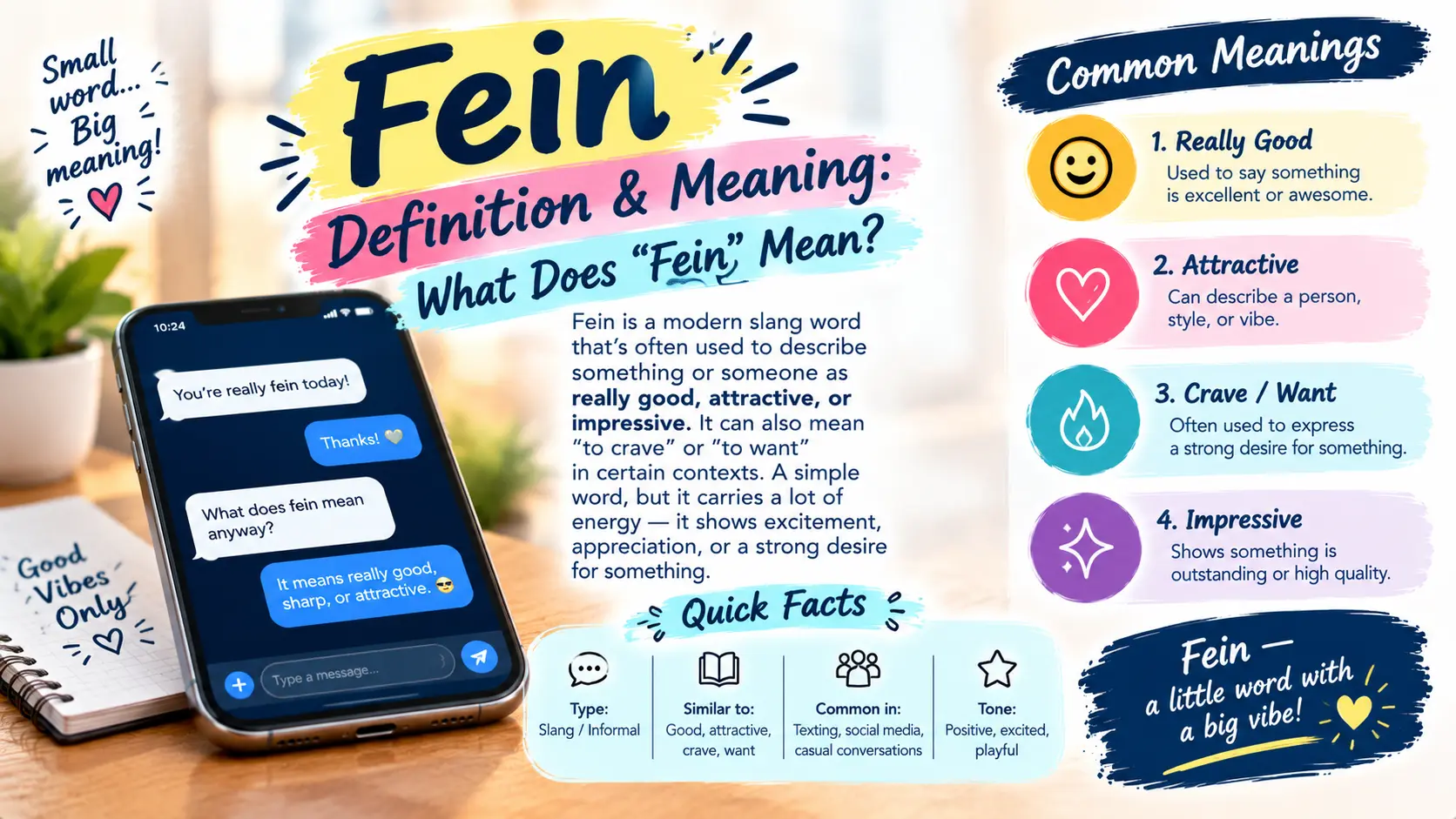
How to Understand “Fein” in Text Messages
What It May Mean in a Message
If you see fein in a text message, do not immediately assume it is English slang.
The sender could be using German, Yiddish-related vocabulary, a cultural expression, or an intentional spelling.
Context and Tone
Look at the surrounding words and the relationship between the speakers. A multilingual conversation may make the meaning obvious, while an isolated message may require clarification.
Examples From Digital Communication
If someone uses fein while speaking German, the intended meaning may relate to something being fine, good, pleasant, delicate, or excellent.
If the entire conversation is in English, consider whether the writer intended fine or deliberately inserted a foreign-language term.
FAQs About “Fein”
Is “fein” an English word?
Fein is not generally a standard everyday English word. It is primarily associated with German and also has related usage in Yiddish.
What does “fein” mean in German?
In German, fein can mean fine, delicate, pleasant, excellent, elegant, or refined, depending on context.
What does “fein” mean in Yiddish?
In Yiddish-related contexts, fein or related forms can express ideas such as fine, good, nice, or excellent. The exact interpretation depends on the expression and dialect.
Is “fein” the same as “fine”?
Not exactly. “Fine” is an English word, while fein is primarily German. They can correspond in translation and have historical linguistic connections, but they are not interchangeable in every context.
Does “fein” mean “hiatus”?
No. Fein and hiatus have different meanings. Hiatus refers to a pause or interruption, while fein is associated with meanings such as fine, delicate, pleasant, or excellent.
How do you use “fein” in a sentence?
The word is normally used according to German grammar when writing German. Its English translation should be selected according to context rather than automatically replacing it with one fixed word.
Is “fein” commonly used in American English?
No, not as a general everyday English word. It may appear in multilingual, cultural, historical, German-American, Yiddish-related, or online contexts.
Conclusion
“Fein” is primarily a German word with related Yiddish usage, and its meaning depends on context. It can communicate ideas such as fine, delicate, pleasant, excellent, elegant, or refined. Although it resembles the English word “fine,” it should not automatically be treated as an English spelling variant.
Most importantly, “fein” does not mean “hiatus.” If you encounter the word in a message or article, identify the language and examine the surrounding sentence before deciding what the writer means. Understanding that context will give you a much more accurate interpretation than relying on a single translation.