Dead Cat Outside My House: Spiritual Meaning Explained
Quick Answer
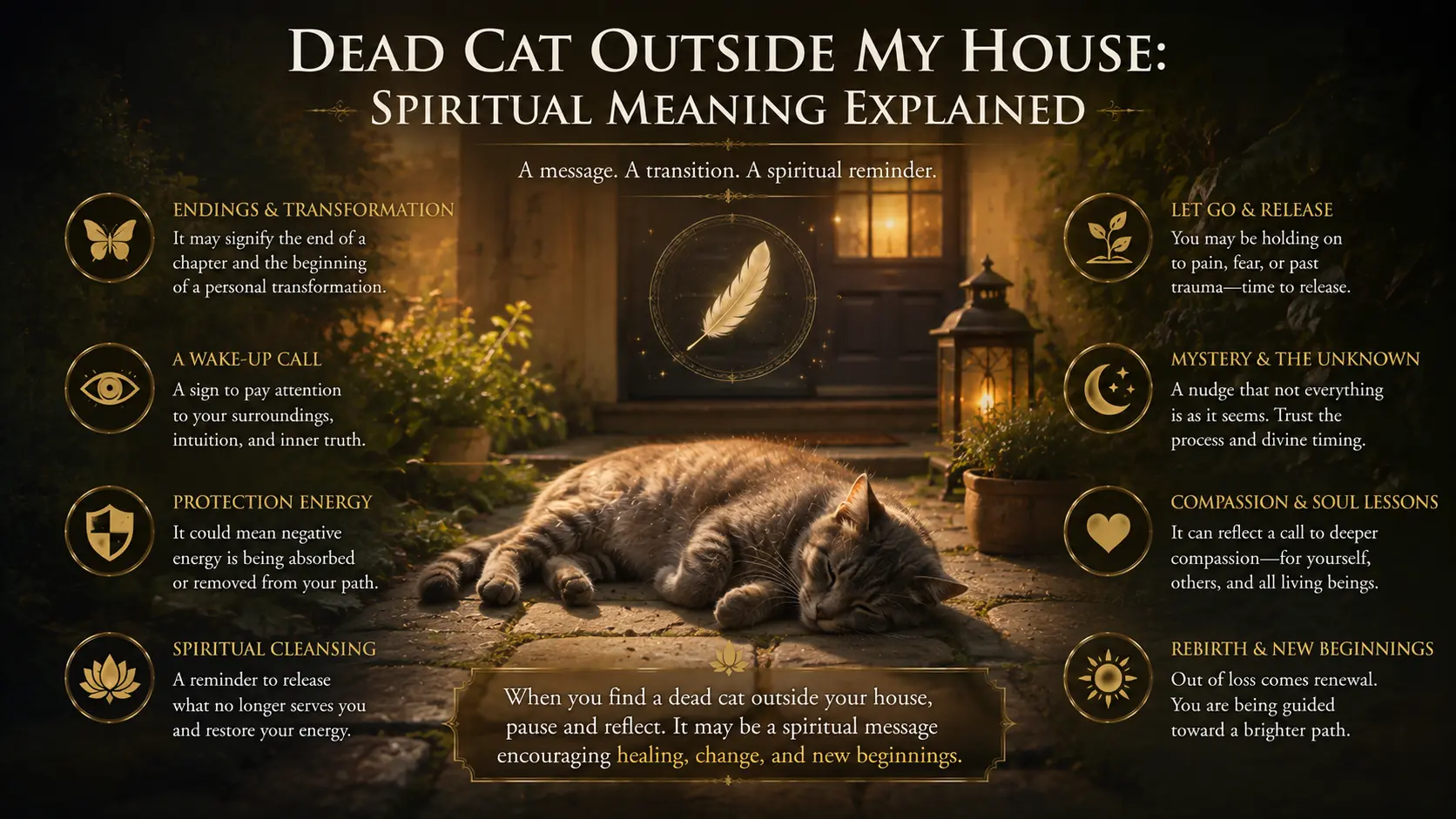
Finding a dead cat outside your house can feel deeply unsettling, especially when the animal appears in a place you associate with safety and home. Spiritually, there is no universal belief that a dead cat predicts bad luck, death, or a curse. In symbolic traditions, cats can represent independence, intuition, mystery, protection, transition, and the unknown. A dead cat may therefore be interpreted metaphorically as an ending, transformation, or reminder to pay attention to something changing in your life.
At the same time, the most practical explanation is often simply that an animal died nearby and happened to be found outside your home. Spiritual interpretations are personal rather than proven predictions. If the experience feels meaningful to you, it can be used as an opportunity for reflection without assuming that something bad is destined to happen.
TL;DR
A dead cat outside your house does not inherently mean bad luck, death, witchcraft, or a curse. Cats have carried many different meanings across cultures, from sacred animals and household companions to symbols of mystery and independence.
In a modern spiritual interpretation, the experience may represent closure, transition, letting go, vulnerability, or heightened awareness. The meaning you give it is usually shaped by your beliefs, emotions, circumstances, and relationship with cats.
What It Means to Find a Dead Cat Outside Your Home
Discovering a dead animal can produce a much stronger reaction than encountering an ordinary animal. The contrast between a familiar living creature and the reality of death naturally draws attention. When the animal is a cat—and especially when it is directly outside your home—you may instinctively wonder whether the event has a deeper meaning.
From a spiritual perspective, the symbolism is best understood as metaphorical rather than predictive. Death often symbolizes the ending of a phase, while the home can represent personal life, security, family, and inner identity. Together, the image can invite reflection on what is changing or what may need to be released.
The Immediate Symbolic Reaction
The first reaction may be shock, sadness, fear, or curiosity. Those emotions can influence the meaning you attach to the experience. Someone who loves cats may interpret the event very differently from someone who has never owned one.
Symbolically, the death of an animal can represent the end of a cycle or the transformation of something familiar. It does not necessarily indicate that another death is coming. Instead, it can serve as a powerful metaphor for change.
Why the Location Matters
The location outside your home can make the experience feel unusually personal. Houses commonly symbolize safety, family, privacy, identity, and the boundary between your inner and outer world.
A symbolic interpretation might therefore focus on boundaries, transitions, or something entering your awareness. However, location alone does not prove that the event was spiritually directed toward you. Animals naturally move through neighborhoods, roads, yards, and residential areas.
Core Symbolic Themes at a Glance
The symbolism surrounding a dead cat can involve several themes at once. Different spiritual traditions may emphasize different aspects, so there is no single interpretation that applies to everyone.
The strongest modern symbolic themes tend to involve endings, intuition, independence, mystery, transformation, protection, and emotional awareness.
Most Common Associations
- Ending: A chapter, habit, relationship, or situation may be coming to a close.
- Transformation: Death can symbolize movement from one state of life to another.
- Letting go: The image may encourage acceptance rather than resistance.
- Intuition: Cats are frequently associated with awareness and instinct.
- Independence: Cats can symbolize autonomy and self-reliance.
- Mystery: Their nocturnal and independent behavior has historically inspired mystical associations.
- Vulnerability: The event can remind us that life is fragile.
- Reflection: An unexpected encounter may encourage deeper thought about priorities.
These associations should be treated as symbolic possibilities, not supernatural predictions.
Historical Roots of Cat Symbolism
Cats have occupied an unusual place in human culture for thousands of years. They have been admired, feared, worshipped, misunderstood, and cherished. Their symbolic meanings have never been completely consistent.
Understanding this history helps explain why a dead cat can evoke such powerful associations today. Many modern ideas about cats and spirituality are influenced by layers of ancient religion, folklore, literature, superstition, and popular culture.
Ancient and Pre-Christian Views
In ancient Egypt, cats had an important cultural and religious role. The goddess Bastet became strongly associated with cats and was connected with protection, domestic life, fertility, and motherhood.
Cats were also valued because they could help protect food stores from rodents. Their practical importance and distinctive behavior contributed to their elevated cultural status.
Elsewhere, attitudes toward cats varied considerably. Some traditions viewed them as mysterious or connected with supernatural forces, while others simply regarded them as useful domestic animals.
How Meaning Shifted Over Time
European medieval folklore sometimes associated cats—particularly black cats—with witchcraft, superstition, and mysterious forces. These ideas were not universal, but they influenced later Western symbolism.
Over the centuries, the cat gradually became increasingly associated with companionship, independence, curiosity, elegance, and domestic life. Modern interpretations are therefore a mixture of ancient symbolism, folklore, religious history, and contemporary culture.
What Cats Symbolize in American Culture
In the United States, cats are overwhelmingly familiar as household companions. Millions of people associate them with affection, comfort, personality, and family life.
This modern cultural relationship changes how people emotionally respond when they encounter a dead cat. Rather than seeing only an abstract symbol, many people immediately imagine someone’s missing pet or a beloved companion.
Cats as Companions
Cats commonly symbolize companionship, comfort, independence, affection, and individuality.
Because cats can be affectionate while maintaining a strong sense of independence, they are often viewed as symbols of balanced relationships—being connected to others while retaining personal space.
A dead cat can consequently evoke thoughts about attachment, loss, responsibility, and the temporary nature of life.
Media and Pop Culture Influence
Movies, television, books, cartoons, memes, and social media have made cats some of the most recognizable animals in modern American culture.
Characters such as mysterious cats, magical cats, black cats, and humorous household pets have reinforced multiple interpretations. As a result, a person may associate a dead cat with mystery or superstition even when those associations come primarily from entertainment rather than religious tradition.
Spiritual Meaning in a Modern U.S. Context
Modern American spirituality often combines elements from religion, folklore, personal beliefs, psychology, and popular culture. Consequently, people may interpret unusual encounters in highly individualized ways.
A dead cat outside your home may therefore become meaningful because of what the experience represents to you, rather than because there is one established spiritual rule governing the event.
Common Spiritual Interpretations
Some people may interpret the experience as a reminder of:
Closure: Something in life may have reached its natural conclusion.
Transformation: An old phase may be giving way to something new.
Release: You may be encouraged to stop holding onto something that no longer serves you.
Awareness: The experience may prompt you to pay closer attention to your surroundings or emotions.
Mortality: Seeing death unexpectedly can remind us to value the time we have.
Boundaries: Because the cat was outside the home, the event may symbolically draw attention to personal or emotional boundaries.
None of these interpretations means that a specific future event will happen.
Why It Feels Symbolic
Humans naturally search for meaning when something emotionally powerful or unexpected happens. An unusual event outside your home feels more significant than an ordinary event in a distant location.
The combination of death + an animal + your home + surprise creates a strong emotional image. That intensity can make the event feel like a message even when there is a straightforward natural explanation.
Cross-Cultural and Religious Perspectives
There is no single global interpretation of a dead cat. Beliefs differ substantially between cultures, religions, families, and individuals.
Brief Global Views
Some traditions have treated cats as sacred, protective, mysterious, or spiritually significant. Other cultures have associated particular cats with superstition or bad luck.
Many religious traditions, however, do not teach that discovering a dead animal outside your home automatically predicts a future event. Religious perspectives often emphasize compassion, mortality, humility, and the natural cycle of life rather than treating every unusual occurrence as an omen.
The safest approach is to distinguish documented cultural beliefs from personal spiritual interpretation.
Emotional and Psychological Associations
A dead animal can have a genuine emotional impact even when someone does not consider themselves spiritual. The experience confronts us with vulnerability and mortality in an immediate way.
This reaction is completely understandable. You do not need to believe in omens for the encounter to affect you.
The Emotional Impact
People may experience sadness, anxiety, disgust, shock, sympathy, or lingering thoughts after finding a dead cat.
If the cat appears to have been someone’s pet, the experience may also trigger empathy for an unknown owner. The emotional response can be especially strong when the animal resembles a pet someone has loved.
Why the Brain Looks for Symbols
The human brain is highly skilled at detecting patterns and connections. When something unusual happens, we naturally ask, “Why did this happen?”
This tendency can be helpful, but it can also make coincidences feel personally directed. Recognizing this does not invalidate spirituality. It simply helps maintain perspective and prevents an upsetting event from automatically becoming a prediction of something worse.
Is It a Bad Omen or a Sign of Death?
One of the most common fears is that finding a dead cat means another death will occur. There is no reliable evidence that finding a dead cat predicts someone’s death.
The association largely comes from longstanding folklore in which animals, unusual sounds, or unexpected encounters were interpreted as omens.
Clearing Up the Fear
A dead cat outside your house does not automatically mean:
- Someone in your family will die.
- You will experience bad luck.
- Your home is cursed.
- Something supernatural is targeting you.
- A negative event is guaranteed to happen.
The event can be sad or disturbing without being a prophecy.
Why the Myth Persists
Death is naturally frightening, and cats have historically been surrounded by folklore. When these two subjects overlap, powerful stories can develop.
Repeated storytelling can make a superstition feel like established truth. However, cultural repetition is not the same as evidence.
Modern Usage and Symbolism Today
Today, cat symbolism appears throughout social media, art, tattoos, literature, spirituality communities, and online discussions.
The meaning is often less literal than traditional superstition. A cat may symbolize individuality, mystery, intuition, resilience, or emotional independence.
Social Media and Online Discussion
Online communities frequently discuss unusual animal encounters as spiritual signs. People share personal experiences and interpretations, which can make particular meanings spread quickly.
These discussions can be meaningful as personal storytelling, but they should not be confused with universal spiritual rules. One person’s interpretation may not apply to another person’s situation.
Art, Tattoos, and Expression
In visual art and tattoos, a dead or skeletal cat can represent mortality, transformation, remembrance, impermanence, or acceptance.
The same image can also be used simply for gothic, mysterious, surreal, or artistic expression. Symbolism depends heavily on context.
Common Misunderstandings and Misuses
Spiritual symbolism can be comforting when used for reflection, but it can become harmful when frightening interpretations are presented as certainty.
When Meaning Becomes Harmful
It can be unhelpful to tell someone that a dead cat guarantees death, curses, financial disaster, relationship failure, or supernatural attack.
Such claims can increase unnecessary fear and anxiety. Symbolism should encourage reflection rather than create panic.
Keeping Perspective
A balanced interpretation can hold two ideas at the same time:
The event may feel personally meaningful to you, and it may also have an ordinary natural explanation.
You do not have to choose between respecting your spiritual feelings and recognizing reality. Meaning can be personal without being predictive.
How Interpretations Have Shifted Over Time
Cat symbolism has changed significantly as societies have changed. A cat that once represented supernatural mystery may now represent companionship, independence, internet culture, or personal identity.
This shift is important when interpreting unusual encounters.
From Omen to Metaphor
Older folklore often treated unusual animal behavior or encounters as potential signs of future events. Modern interpretations increasingly treat these experiences as metaphors for personal reflection.
In this approach, death does not necessarily mean literal death. It can symbolize the end of a habit, relationship, identity, phase, or emotional pattern.
Why This Shift Matters
Viewing symbolism metaphorically reduces unnecessary fear while preserving the emotional significance of the experience.
Instead of asking, “What terrible thing is going to happen?”, you might ask, “What is changing in my life, and what do I need to release or understand?”
That question is more constructive and leaves room for personal meaning without turning coincidence into certainty.
Symbolism at a Glance (USA Context)
| Symbolic Element | Possible Meaning |
|---|---|
| Cat | Independence, intuition, mystery, companionship |
| Death | Ending, transition, transformation, impermanence |
| Outside the house | Boundaries, external influences, awareness |
| Near the doorway | Transition, entering or leaving a life phase |
| Unexpected discovery | Reflection, heightened awareness, emotional awakening |
| Black cat | Mystery, folklore, independence; not inherently bad luck |
| White cat | Peace, innocence, gentleness in some symbolic traditions |
| Stray cat | Freedom, survival, self-reliance |
| Pet cat | Attachment, companionship, memories |
| Overall symbolism | Closure, change, mortality, reflection |
These meanings are interpretive rather than universal facts. Personal beliefs and cultural background can significantly change the way the experience is understood.
FAQs
Does a dead cat outside my house mean bad luck?
No, finding a dead cat does not automatically mean bad luck. Some folklore connects cats with omens, but these beliefs vary by culture and are not evidence that misfortune is coming.
Is this a spiritual sign or just coincidence?
It can be meaningful to you without necessarily being a supernatural sign. A natural event can inspire spiritual reflection without being a message predicting your future.
What if I keep thinking about it?
That is understandable, particularly if the discovery was sudden or upsetting. Give yourself time to process the experience and remember that repeatedly thinking about it does not mean it has a hidden negative prediction.
Does cat color change the meaning?
Cat colors have different associations in folklore and popular culture, but color does not provide a universal spiritual meaning. Black cats, for example, have both positive and negative associations depending on the culture.
Should I perform a ritual or cleansing?
There is no universal requirement to perform a ritual after finding a dead cat. If a harmless personal practice such as prayer, quiet reflection, or cleaning your surroundings gives you peace, you may choose to do it as a form of comfort rather than fear.
Is this linked to witchcraft or curses?
Finding a dead cat outside your home is not evidence of witchcraft or a curse. Historical folklore has connected cats with witchcraft in some contexts, but those associations do not establish that an unexplained animal death has supernatural causes.
Conclusion
Finding a dead cat outside your house can be a disturbing and emotionally powerful experience. Because cats have accumulated layers of cultural, religious, folkloric, and modern symbolism, it is understandable that someone might wonder whether the event carries a deeper meaning.
From a modern spiritual perspective, the most constructive interpretation is often symbolic rather than predictive. The cat may represent independence, intuition, mystery, companionship, or vulnerability, while death can represent closure, transformation, impermanence, and letting go. The house can add themes of personal identity, security, and boundaries.
Most importantly, a dead cat outside your home does not automatically mean bad luck, death, a curse, or an impending negative event. You can acknowledge the emotional significance of the experience while recognizing that animals die for ordinary natural reasons. If the encounter prompts you to reflect on change, gratitude, compassion, or what you need to release, that personal reflection can be meaningful without becoming a source of fear.