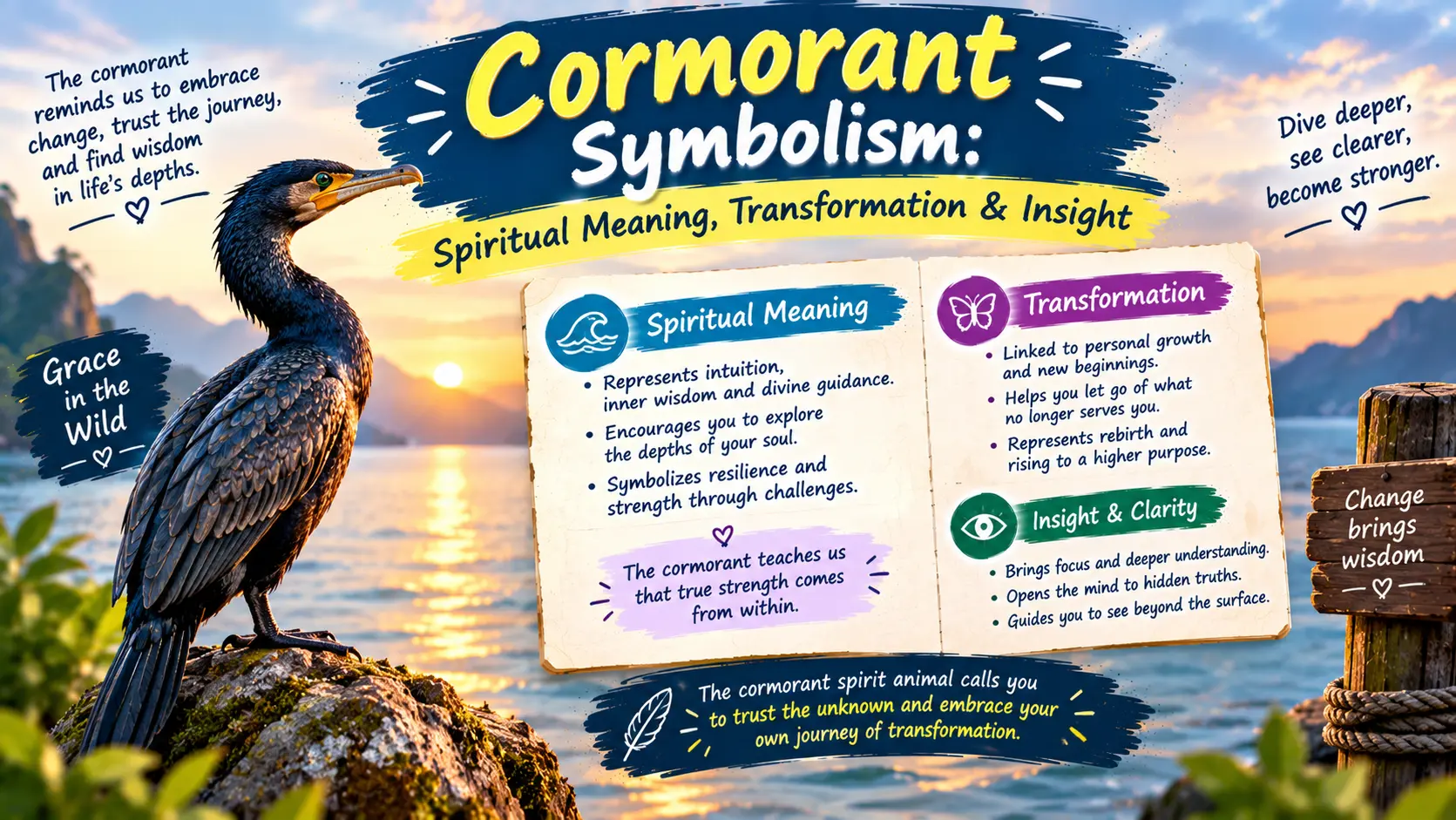
Cormorant Symbolism: Spiritual Meaning, Transformation & Insight
Quick Answer
Cormorant symbolism is often associated with transformation, adaptability, intuition, emotional depth, resilience, and the ability to look beneath the surface. Because cormorants spend time both in the air and underwater, they can represent movement between different levels of awareness. Their diving behavior is especially meaningful in symbolic interpretations because it suggests exploring hidden emotions, discovering truth, and returning with greater understanding.
A cormorant may also symbolize patience and persistence. It can spend considerable time searching beneath the water before returning to the surface. Spiritually, this can represent the value of looking deeper instead of accepting everything at face value.
TL;DR
- Cormorants symbolize transformation and adaptability.
- They can represent intuition, emotional depth, and inner exploration.
- Diving beneath water may symbolize looking beyond appearances.
- Flying can represent freedom, perspective, and spiritual awareness.
- Drying the wings may symbolize recovery, renewal, and preparation.
- Seeing a cormorant repeatedly can encourage patience and deeper self-reflection.
- In dreams, the cormorant’s meaning depends strongly on the setting and emotions involved.
What Is a Cormorant?
A cormorant is a waterbird recognized for its dark plumage, long neck, hooked bill, webbed feet, and remarkable diving ability. Cormorants can swim underwater to pursue fish and other aquatic prey, making them especially distinctive among birds associated with lakes, rivers, coastlines, and wetlands.
Their unusual relationship with water contributes greatly to their symbolic appeal. They are creatures that move naturally between air, land, and water, creating a symbolic connection between freedom, physical reality, and emotional or spiritual depth.
Physical Traits and Natural Behavior
Cormorants are strong swimmers and divers. They can disappear beneath the surface and later return to land or a branch where they often spread their wings.
This wing-spreading behavior is one of the most recognizable images associated with cormorants. Symbolically, it can suggest opening oneself after difficulty, releasing emotional weight, or preparing for another stage of life.
Their dark coloration may also contribute to associations with mystery, the unknown, introspection, and hidden knowledge. However, darkness in symbolism does not automatically mean something negative. It can simply represent what has not yet been understood.
Why Cormorants Inspire Symbolic Meaning
Cormorants demonstrate several behaviors that humans naturally interpret metaphorically. They dive beneath visible surfaces, adapt to aquatic environments, travel through the air, and repeatedly return to familiar resting places.
These qualities create a broad symbolic message: explore deeply, adapt intelligently, and return to yourself with new knowledge.
Rather than assigning one universal meaning to the bird, it is more useful to consider what aspect of the cormorant stands out during an encounter.
Core Symbolism of Cormorants
Cormorant symbolism brings together several themes connected with water, movement, survival, and observation.
Key Symbolic Themes at a Glance
| Symbolic Theme | Possible Meaning |
|---|---|
| Transformation | Moving from one life stage to another |
| Adaptability | Adjusting to changing circumstances |
| Diving | Exploring hidden emotions or truths |
| Water | Intuition and emotional awareness |
| Flight | Freedom and broader perspective |
| Wing spreading | Recovery and renewal |
| Fishing | Patience and focused effort |
| Solitude | Reflection and independence |
| Group behavior | Cooperation and shared direction |
| Resilience | Continuing despite challenges |
The central lesson of the cormorant is depth. The bird does not remain only on the surface. Its natural behavior encourages a symbolic willingness to investigate what lies underneath.
Transformation, Adaptability, and Resilience
Cormorants are comfortable in environments that require swimming, diving, flying, and resting on land. Their flexibility can represent the ability to change without losing one’s essential identity.
Spiritually, this may become particularly meaningful during periods of transition. A person starting a new career, changing relationships, moving to a different environment, or reconsidering personal priorities may connect with the cormorant as a symbol of adaptation.
Spiritual Meaning of Cormorants
The spiritual meaning of a cormorant often centers on inner exploration, intuition, transformation, and emotional awareness.
Its relationship with water makes it particularly suitable as a symbolic image for emotions and the unconscious mind. Its ability to dive beneath the surface suggests that important answers may not always be immediately visible.
Intuition and Inner Wisdom
Cormorants can symbolize the importance of trusting your deeper perception. Just as the bird searches beneath the water rather than relying solely on what can be seen from above, the symbolism encourages looking beyond obvious appearances.
This does not mean every encounter with a cormorant is a supernatural message. Instead, the image can serve as a useful personal reminder to listen carefully to your instincts and examine situations more deeply.
Emotional Depth and Self-Discovery
Water is frequently used as a metaphor for emotions. A cormorant diving into water can therefore represent entering deeper emotional territory.
You may encounter this symbolism during a period when you are processing old feelings, reconsidering personal choices, or trying to understand something that previously seemed confusing.
Renewal, Transformation, and Personal Growth
The cormorant’s repeated movement between water and air can symbolize cycles of immersion and emergence.
Sometimes growth requires going inward before moving forward. A period of solitude, reflection, or emotional processing does not necessarily represent stagnation. It may be preparation for a new stage.
Cormorant Symbolism in Different Cultures
Bird symbolism varies significantly across cultures. A cormorant does not have one fixed spiritual meaning shared by every tradition.
Ancient and Historical Associations
Cormorants have long lived close to human communities in coastal and river environments. Their connection with fishing made them especially noticeable to people who depended upon waterways.
In symbolic interpretation, this relationship can connect the bird with water, sustenance, patience, observation, and survival.
Asian Cultural Perspectives
Cormorants have a particularly notable place in East Asian visual culture and traditional fishing practices. In some regions, trained cormorants have historically been used in fishing.
This association can contribute themes of discipline, cooperation between humans and animals, patience, and practical skill.
At the same time, cultural meanings should not be generalized across all Asian societies. Different communities have their own traditions and interpretations.
See Also: Orange Symbolism: Spiritual Meaning & Cultural Guide
European Folklore and Maritime Traditions
In European coastal and maritime settings, cormorants have often been encountered as familiar waterbirds. Their dark appearance and association with shorelines can give them a mysterious visual quality.
Symbolically, this can contribute associations with the sea, exploration, uncertainty, endurance, and the unknown.
Indigenous and Nature-Based Perspectives
Indigenous traditions are diverse, and there is no single universal Indigenous interpretation of the cormorant.
When discussing Indigenous symbolism, it is important to avoid presenting one community’s beliefs as representative of all Indigenous peoples. Nature-based interpretations may emphasize relationships among animals, waterways, seasons, community, and ecological balance.
Cormorant Symbolism by Behavior
A cormorant’s behavior can influence the symbolic meaning people attach to an encounter.
Cormorant Diving Into Water
A diving cormorant can symbolize going beneath the surface to discover something important.
This may relate to emotions, hidden information, personal memories, or an issue that requires deeper examination. The message can be simple: do not make important judgments based only on appearances.
Cormorant Flying
A flying cormorant can represent freedom, movement, perspective, and transition.
Seeing the bird take flight may symbolically encourage you to step away from a situation temporarily and view it from a broader perspective.
Cormorant Drying Its Wings
A cormorant standing with its wings spread is a powerful symbolic image. It can represent recovery after emotional immersion.
The posture may inspire a message about allowing yourself time to recover rather than immediately rushing into another challenge.
Cormorant Fishing
Fishing requires patience and concentration. Symbolically, a fishing cormorant can represent waiting for the right opportunity rather than forcing an outcome.
Its behavior can remind you that focused effort often matters more than constant activity.
Cormorant Sitting Alone
A solitary cormorant may symbolize independence, contemplation, or the need for personal space.
This does not necessarily mean isolation. Instead, it can suggest that some answers are easier to discover when distractions are reduced.
Seeing Multiple Cormorants Together
Several cormorants may symbolize community, cooperation, shared resources, and collective movement.
The image can encourage balancing independence with connection. You can maintain your individuality while still benefiting from supportive relationships.
Cormorant Symbolism in Dreams
Dream symbolism is highly personal. A cormorant appearing in a dream may reflect your memories, emotions, recent experiences, or personal associations with birds and water.
Seeing a Cormorant in a Dream
A cormorant in a dream may represent something beneath the surface that deserves attention.
The meaning can become clearer by considering your feelings during the dream. Peaceful emotions may suggest acceptance or discovery, while fear or confusion could point toward unresolved uncertainty.
Cormorant Flying in a Dream
A flying cormorant can symbolize freedom, transition, or gaining a broader view.
If the bird appears calm and graceful, the dream may reflect confidence about moving forward. If it struggles to fly, the imagery may represent perceived obstacles or hesitation.
Cormorant Diving or Swimming
A diving cormorant may represent emotional exploration.
It can symbolically suggest that you are entering a deeper phase of self-understanding, particularly if water plays a major role in the dream.
Injured or Dead Cormorant in a Dream
An injured cormorant may represent vulnerability, exhaustion, or difficulty adapting to change.
A dead cormorant should not automatically be interpreted as a prediction of death. In symbolic dream language, death often represents closure, transition, or the end of a particular phase.
What the Dream May Reflect Emotionally
The most useful question is not simply, “What does the cormorant mean?” but “What was happening in my life when this dream appeared?”
Your emotional response, the condition of the bird, the water, the weather, and other dream details may all influence the interpretation.
Cormorants and the Symbolism of Water
Water is one of the most important elements in cormorant symbolism.
Water as a Symbol of Emotion and Intuition
Across many symbolic systems, water can represent emotions, intuition, change, mystery, and the unconscious.
Because cormorants actively enter water, they can represent a willingness to encounter emotions rather than permanently remaining on the surface.
Diving Beneath the Surface
The cormorant’s dive provides an especially strong metaphor for investigation.
What appears obvious may not always represent the entire truth. The symbolic lesson is to look deeper, gather information, and allow understanding to develop before making conclusions.
Emerging With New Understanding
The bird eventually returns to the surface after diving. This creates a useful image of the complete process of personal growth:
enter → explore → understand → emerge → move forward.
It suggests that introspection becomes most useful when it eventually leads to clarity and action.
Cormorants as Symbols of Transformation and Resilience
Cormorants can be meaningful symbols during periods when life feels uncertain or rapidly changing.
Adapting to Changing Circumstances
Cormorants move between different environments and modes of movement. Symbolically, this represents flexibility.
Adaptability does not mean abandoning your values. It means changing your approach while maintaining your core identity.
Learning Through Challenges
A cormorant’s survival depends on skill, timing, and persistence.
Its symbolism can therefore encourage viewing difficult experiences as opportunities to develop greater awareness, patience, and competence.
Finding Strength Through Experience
Cormorant symbolism does not suggest that transformation must always be comfortable.
Instead, it emphasizes learning from what you encounter. Difficult experiences can become sources of wisdom when approached thoughtfully.
Cormorants in Art, Literature, and Modern Culture
Cormorants have a distinctive appearance that makes them visually memorable.
Cormorants in Visual Art
Artists may use cormorants to create images of coastlines, rivers, wetlands, fishing communities, and solitude.
Their dark bodies against bright water or open skies can create strong visual contrasts associated with mystery, freedom, and natural power.
Cormorants in Literature and Storytelling
In storytelling, waterbirds can function as symbols of journeys, observation, survival, or the boundary between familiar and unknown worlds.
Cormorants are particularly effective symbols because they can occupy several environments while remaining strongly associated with water.
Cormorants in Modern Symbolism and Social Media
Today, people may use animal encounters as prompts for reflection and personal storytelling.
A photograph of a cormorant can symbolize independence, travel, resilience, nature connection, or emotional depth. However, modern spiritual interpretations are personal rather than universally established facts.
What It Means to Keep Seeing Cormorants
Repeatedly noticing cormorants can feel significant, especially when the encounters occur during meaningful moments.
Repeated Encounters and Personal Reflection
Seeing the same type of bird repeatedly may encourage you to pause and consider what is happening in your life.
Rather than assuming the encounters have one predetermined spiritual message, use them as an opportunity for reflection and awareness.
Timing, Location, and Emotional Context
Where you see the cormorant can influence your interpretation.
A cormorant near the ocean may evoke themes of freedom and vastness. One near a quiet lake may feel more connected to introspection. A cormorant appearing during a major life transition may naturally become a personal symbol of change.
Spiritual Interpretation Versus Coincidence
Not every repeated animal encounter needs a supernatural explanation. Birds live in specific habitats and may simply be common in certain areas.
You can appreciate the personal symbolism while still recognizing the natural explanation. Meaning can be personally valuable without needing to be scientifically proven as a supernatural message.
Cormorant Symbolism in the USA Today
In the United States, cormorants can be encountered around coastal areas, lakes, rivers, and other aquatic environments.
Nature, Wildlife, and Environmental Awareness
Modern encounters with cormorants can inspire greater appreciation for wetlands and aquatic ecosystems.
Their presence can remind people that waterways support interconnected communities of birds, fish, plants, and other wildlife.
Personal and Spiritual Interpretations
Many modern spiritual interpretations focus on themes such as intuition, resilience, emotional depth, and transformation.
These interpretations are best treated as personal symbolism rather than universal spiritual rules.
Modern Lessons From the Cormorant
The cormorant can represent a balanced approach to modern life: work when action is required, withdraw when reflection is needed, and adapt when circumstances change.
Its natural behavior offers an accessible metaphor for managing uncertainty without losing direction.
Life Lessons From Cormorants
Cormorant symbolism becomes especially meaningful when translated into practical life lessons.
Trust Your Intuition
Not every important insight comes from immediate evidence. Give yourself enough quiet time to notice what your instincts are telling you.
Adapt Without Losing Yourself
Change is unavoidable, but adaptation does not require abandoning your identity.
Stay connected to your values while remaining flexible about how you reach your goals.
Go Beneath the Surface
The cormorant encourages deeper investigation.
When something feels confusing, resist the temptation to make a quick judgment. Gather information, examine your emotions, and look for what may be missing.
Rest, Recover, and Regain Strength
The wing-spreading cormorant can be viewed as an image of restoration.
Rest is not necessarily a sign of weakness. Sometimes recovery is what prepares you for your next period of action.
Embrace Change and Transformation
Cormorant symbolism ultimately encourages movement.
You may need to dive into uncertainty, learn something new, emerge with greater clarity, and continue your journey from a stronger position.
Common Misunderstandings About Cormorant Symbolism
Symbolic interpretations can become misleading when treated as universal rules.
Symbolism Is Not a Fixed Meaning
There is no single meaning that applies to every cormorant encounter.
Your culture, personal experiences, emotions, and circumstances all influence the symbolism you may attach to the bird.
Cultural Context Matters
A symbol can have different meanings in different societies. Historical fishing traditions, folklore, artistic traditions, and contemporary spirituality may each approach the cormorant differently.
Respectful interpretation requires avoiding broad claims about cultures without specific evidence.
Spiritual Meaning and Scientific Behavior Are Different
Cormorants dive because their biology and environment support this behavior. Their wing-spreading posture also has natural explanations.
Spiritual symbolism is an interpretive layer placed upon natural behavior; it should not be confused with scientific explanation.
FAQ About Cormorant Symbolism
What does a cormorant symbolize spiritually?
A cormorant can symbolize transformation, intuition, emotional depth, adaptability, resilience, and self-discovery. Its ability to dive beneath water makes it especially associated with looking beyond the surface and exploring deeper aspects of life.
What does seeing a cormorant mean?
Seeing a cormorant may serve as a personal reminder to be patient, adaptable, and willing to investigate something more deeply. The meaning depends on the circumstances and your emotional response to the encounter.
What does a cormorant represent in dreams?
In dreams, a cormorant may represent emotional exploration, hidden knowledge, transformation, or the need for a broader perspective. The bird’s behavior and the condition of the water can add additional symbolic context.
Are cormorants symbols of transformation?
Yes, cormorants can be interpreted as symbols of transformation because they move between air, water, and land. Their behavior creates a strong metaphor for adaptation, transition, inner exploration, and renewal.
What does a cormorant symbolize in different cultures?
Cormorant symbolism varies by culture and historical context. Associations can include fishing, water, patience, survival, mystery, cooperation, and nature. There is no single interpretation that applies universally.
Conclusion: The Deeper Meaning of the Cormorant
Cormorant symbolism centers on depth, transformation, adaptability, intuition, and resilience. The bird’s ability to dive beneath the water makes it a natural metaphor for exploring emotions, hidden knowledge, and experiences that cannot be understood from the surface alone.
Its ability to move between water, land, and air also offers a powerful lesson about flexibility. Life continually changes, and the cormorant reminds us that adapting does not mean losing ourselves. Sometimes we must go inward, sometimes we must act, and sometimes we simply need time to recover.
Ultimately, the cormorant can be viewed as a symbol of going deeper, learning from experience, and emerging with greater clarity. Whether encountered in nature, dreams, artwork, or personal reflection, its symbolism invites patience, awareness, and a willingness to embrace transformation.