Sri Yantra Symbol Meaning: Spiritual Power and Significance
The Sri Yantra is one of the most recognized sacred geometric symbols in Hindu spiritual traditions. It is known for its intricate arrangement of interlocking triangles, lotus petals, circles, and a central point. More than a geometric design, it represents the relationship between divine energy, consciousness, creation, and the universe.
The Sri Yantra is also called Sri Chakra. In the Sri Vidya tradition, it is closely associated with Goddess Lalita Tripurasundari, who represents divine feminine power (Shakti). Its design symbolizes the union of Shiva and Shakti, the two complementary principles associated with consciousness and creative energy.
Many people connect the Sri Yantra with prosperity, abundance, harmony, spiritual growth, and meditation. Its geometric structure also makes it an important subject in sacred art and spiritual philosophy.
Although modern interpretations often associate it with success and good fortune, its traditional religious significance is much deeper. Understanding its individual elements helps explain why the Sri Yantra holds such an important place in Hindu spiritual practices.
What Is the Sri Yantra Symbol?
The Sri Yantra is a sacred geometric diagram used in Hindu worship, meditation, and Tantric traditions. The word “Sri” is associated with auspiciousness, prosperity, and divine beauty, while “Yantra” refers to an instrument or diagram used in spiritual practice.
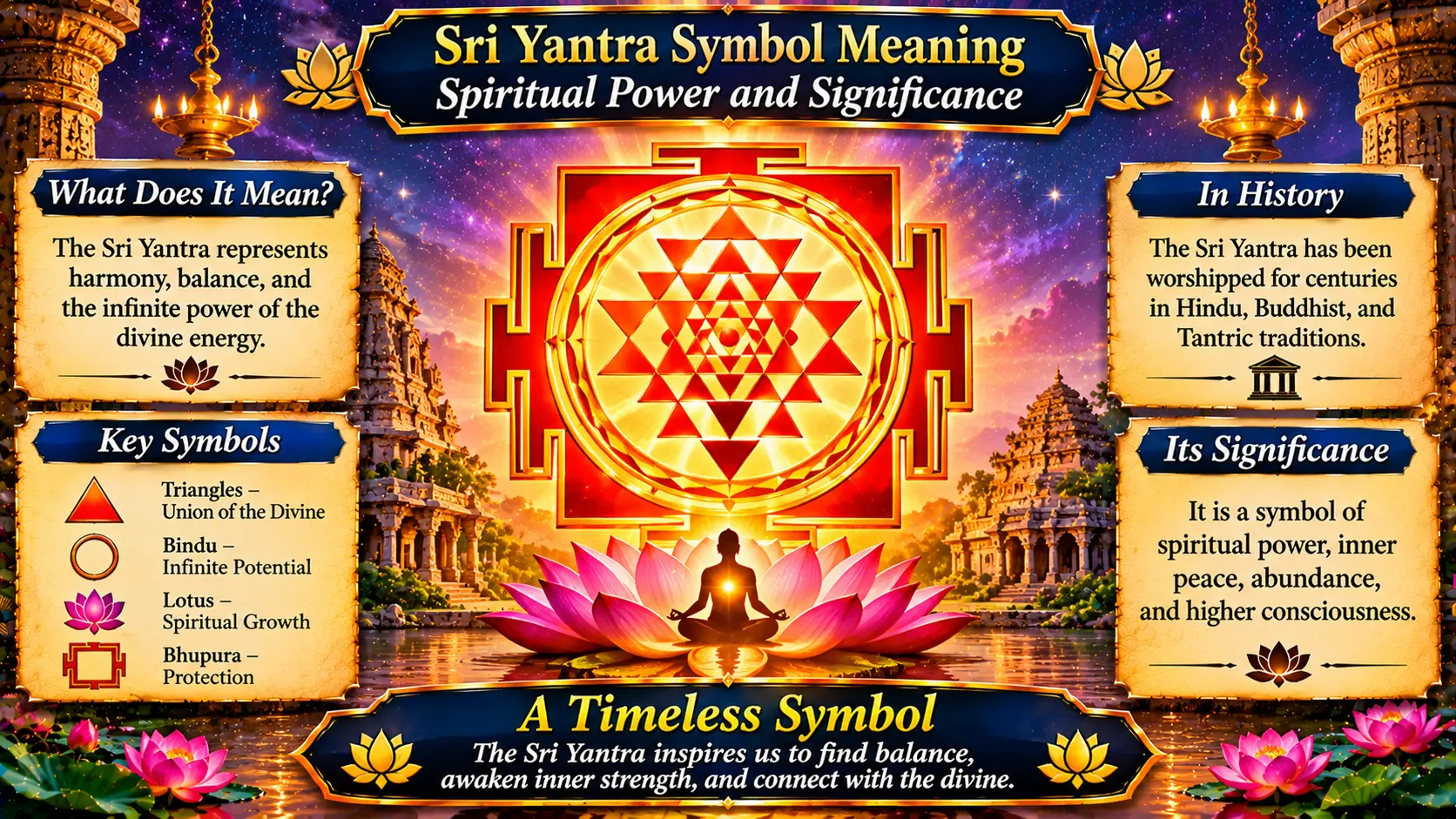
Its design consists of nine interlocking triangles surrounded by lotus petals, circles, and an outer square with four openings. Together, these elements create a complex geometric structure representing the universe and divine consciousness.
The Sri Yantra is particularly important in the Sri Vidya tradition, where it is regarded as a sacred representation of Goddess Lalita Tripurasundari.
It is not simply decorative geometry. Each part has a place within a larger spiritual framework, and practitioners may use the diagram as a focus for worship and meditation.
What Does the Sri Yantra Symbol Mean?
The Sri Yantra generally symbolizes divine energy, cosmic creation, spiritual unity, prosperity, and the connection between the individual and the universe.
Its central design represents the relationship between Shiva and Shakti. The overlapping triangles illustrate how complementary divine principles come together to express the creative nature of existence.
Its main symbolic meanings include:
- Divine Energy: Representing the creative power associated with the Goddess.
- Prosperity: Traditionally associated with auspiciousness, abundance, and well-being.
- Unity: Symbolizing the relationship between Shiva and Shakti.
- Creation: Representing the manifestation of the universe.
- Spiritual Growth: Reflecting the journey toward deeper awareness.
- Harmony: Expressing the relationship between different cosmic principles.
- Consciousness: Representing the movement toward spiritual understanding.
- Balance: Symbolizing the complementary forces within creation.
The Sri Yantra is therefore understood as both a representation of the universe and a visual aid for spiritual contemplation.
What Are the Main Elements of the Sri Yantra?
Each part of the Sri Yantra contributes to its overall religious and symbolic meaning. Its structure includes several geometric elements arranged around a central point called the Bindu.
| Sri Yantra Element | Symbolic Meaning |
| Bindu | Divine source, unity, and ultimate consciousness |
| Four upward triangles | Shiva and the principle of consciousness |
| Five downward triangles | Shakti and creative divine energy |
| Nine interlocking triangles | Union of Shiva and Shakti |
| Forty-three smaller triangles | Different aspects of cosmic manifestation |
| Eight-petal lotus | Spiritual awareness and divine energy |
| Sixteen-petal lotus | Fulfillment and completeness |
| Outer square | Protection, stability, and sacred boundaries |
| Four gateways | Openings connecting the outer and inner sacred space |
Together, these elements form a sacred geometric design associated with divine unity and the structure of existence.
What Do the Nine Interlocking Triangles Symbolize?
The nine interlocking triangles are the most recognizable feature of the Sri Yantra. They consist of four upward-pointing triangles and five downward-pointing triangles.
In traditional Hindu interpretations, the four upward triangles represent Shiva, while the five downward triangles represent Shakti.
Their intersection creates forty-three smaller triangles arranged around the central region.
These triangles symbolize the relationship between consciousness and creative energy. Their combination represents the manifestation of the universe through the union of complementary divine principles.
The nine triangles are also connected with the nine enclosures, or Avaranas, of the Sri Yantra. Each enclosure has a particular place in traditional worship and spiritual interpretation.
What Does the Bindu in the Sri Yantra Symbolize?
The Bindu is the central point of the Sri Yantra. It is one of its most important elements because it represents the ultimate source from which everything emerges.
In Hindu Tantric philosophy, the Bindu is associated with unity, divine consciousness, and the unmanifest source of creation.
It represents:
- The origin of the universe.
- The unity of divine principles.
- The highest state of spiritual awareness.
- The connection between creation and its source.
- The ultimate focus of meditation.
In Sri Vidya traditions, the Bindu is closely associated with Goddess Lalita Tripurasundari.
The movement of attention toward this central point during meditation can represent a journey from the outer world toward inner awareness and spiritual understanding.
Sri Yantra Spiritual Meaning
The spiritual meaning of the Sri Yantra is connected with divine consciousness, sacred energy, balance, and the relationship between the individual and the universe.
In Hindu Tantric traditions, it is used as a visual instrument for worship and meditation. Practitioners may focus on its geometric arrangement to develop concentration and contemplate the relationship between different levels of existence.
The Sri Yantra is also associated with Goddess Lalita Tripurasundari, who represents the divine feminine power of creation.
Some modern spiritual interpretations connect the symbol with:
- Inner peace and awareness.
- Spiritual development.
- Harmony and balance.
- Divine protection.
- Abundance and well-being.
- A deeper understanding of existence.
However, these interpretations should be understood within their spiritual and cultural contexts. The Sri Yantra is not a guarantee of wealth, success, or particular life outcomes.
Sri Yantra Symbolism in Hinduism
The Sri Yantra has a significant place in Hindu religious and philosophical traditions, especially in Sri Vidya and Shakta Tantra.
Shakta traditions emphasize the worship of the Divine Mother as the supreme creative power. Within Sri Vidya, the Sri Yantra is closely connected with Lalita Tripurasundari, a form of the Goddess.
The diagram represents the relationship between the Goddess, the universe, and the spiritual nature of existence.
Its nine enclosures are important in traditional worship. Practitioners may perform rituals that involve mantras, offerings, and contemplation of the different parts of the diagram.
The Sri Yantra is therefore more than a symbol of prosperity. It is a sacred representation of divine reality and the relationship between the universe and its source.
Sri Yantra Symbolism in Prosperity and Abundance
The Sri Yantra is widely associated with prosperity and abundance in modern spiritual interpretations and Hindu devotional practices.
Its connection with auspiciousness is partly related to the word “Sri,” which carries associations with prosperity, beauty, and good fortune.
Some people keep Sri Yantra images or representations in their homes, prayer spaces, or workplaces as expressions of devotion and as reminders of their hopes for a balanced and prosperous life.
Its prosperity symbolism may represent:
- Appreciation for available opportunities.
- Hope for financial stability.
- Gratitude and generosity.
- Personal development.
- A balanced approach to material and spiritual life.
These associations are religious and personal beliefs rather than scientifically established effects. The symbol itself does not guarantee financial success.
Sri Yantra Symbol Meaning in Meditation
The Sri Yantra has an important role in certain Hindu meditation practices. Its detailed geometry provides a visual focus for concentration and spiritual contemplation.
Meditation traditions may involve moving attention through the outer enclosures toward the central Bindu. This inward movement can represent a journey from external experiences toward deeper levels of awareness.
The Sri Yantra may be used in meditation to encourage:
- Concentration and attention.
- Quiet reflection.
- Awareness of the present moment.
- Contemplation of spiritual unity.
- A deeper connection with religious beliefs.
The exact method of worship or meditation can vary between traditions and teachers.
Sri Yantra Symbolism in Love and Relationships
In modern spiritual interpretations, the Sri Yantra can represent harmony, unity, understanding, and balance in relationships.
Its interlocking triangles provide a visual representation of complementary principles coming together. This can be used as a metaphor for cooperation and mutual respect between people.
It may symbolize:
- Harmony: Maintaining peace and understanding.
- Unity: Building a meaningful connection.
- Respect: Appreciating different perspectives.
- Balance: Supporting each other’s individual needs.
- Growth: Learning and developing together.
- Understanding: Communicating with patience and kindness.
The Sri Yantra does not guarantee romantic relationships or predict a person’s future in love. Its relationship symbolism is best understood as a modern personal interpretation.
Sri Yantra Symbol Meaning for Twin Flames
In contemporary spiritual interpretations, the Sri Yantra may be connected with the idea of twin flames because of its interlocking triangles and symbolism of complementary energies.
The upward and downward triangles represent Shiva and Shakti in traditional interpretations. Some modern readers use this union as a metaphor for spiritual connection, personal development, and balance.
It may be associated with:
- Spiritual growth.
- Understanding complementary energies.
- Emotional balance.
- Self-awareness.
- Mutual respect.
- Personal transformation.
These twin-flame associations are modern interpretations rather than a specific established teaching about the Sri Yantra in traditional Hindu texts.
A meaningful relationship should always involve respect, communication, and individual well-being.
Sri Yantra Symbolism in History and Culture
The Sri Yantra has a long-standing place in Hindu religious and Tantric traditions. It is also known as the Sri Chakra and is particularly important in South Indian Sri Vidya practices.
Its historical development is connected with the broader history of yantras, sacred diagrams, and Tantric worship.
In religious settings, the Sri Yantra has been used in ritual worship, temple traditions, manuscripts, and spiritual instruction.
| Cultural or Religious Context | Historical or Symbolic Association |
| Sri Vidya tradition | Sacred diagram associated with Lalita Tripurasundari |
| Shakta Hinduism | Divine feminine energy and the Goddess |
| Hindu Tantra | Ritual worship and spiritual contemplation |
| South Indian traditions | Worship of the Sri Chakra |
| Sacred geometry | Interlocking triangles and cosmic structure |
| Modern spiritual culture | Prosperity, harmony, and meditation |
Its meaning has developed through religious traditions and modern interpretations, so it is important to distinguish established devotional practices from newer popular beliefs.
What Do the Different Parts of the Sri Yantra Represent?
The Sri Yantra is traditionally described through nine enclosures called Avaranas. These enclosures form different layers of its geometric structure.
Each layer has a specific place in Sri Vidya worship and represents an aspect of the sacred diagram.
The main parts include:
- Outer Square: Represents the sacred boundary and the four gateways.
- Three Outer Lines: Form the protective framework around the diagram.
- Sixteen-Petal Lotus: Represents one of the outer enclosures.
- Eight-Petal Lotus: Forms another sacred enclosure.
- Fourteen Triangles: Represent one of the triangular enclosures.
- Ten Triangles: Form two separate groups within the design.
- Eight Triangles: Surround the innermost triangular region.
- Central Triangle: Represents an important sacred area associated with the Goddess.
- Bindu: Represents the central point and ultimate unity.
The arrangement creates a structured visual representation of the spiritual universe in Sri Vidya traditions.
What Do Different Sri Yantra Colors Symbolize?
Sri Yantra designs appear in different colors depending on their artistic style, religious use, and personal interpretation.
There is no single universal color system for every Sri Yantra. However, modern color symbolism often connects its colors with particular ideas.
| Sri Yantra Color | Common Modern Association |
| Red | Divine energy, strength, and devotion |
| Gold | Prosperity, dignity, and auspiciousness |
| Yellow | Knowledge, optimism, and positivity |
| White | Peace, purity, and clarity |
| Orange | Spiritual enthusiasm and transformation |
| Pink | Love, kindness, and compassion |
| Blue | Calmness, wisdom, and stability |
| Green | Growth, harmony, and renewal |
| Purple | Spirituality, imagination, and mystery |
For example, a red Sri Yantra may emphasize divine feminine energy, while a gold design may highlight associations with prosperity and auspiciousness.
These color meanings are not fixed religious rules and may vary across different artistic and cultural settings.
Sri Yantra Symbolism in Art, Jewelry, and Tattoos
The Sri Yantra is used in religious artwork, decorative designs, jewelry, and contemporary spiritual art.
Its geometric structure makes it visually distinctive, while its religious associations give it deeper meaning for people who value Hindu spiritual traditions.
In artwork, the Sri Yantra may represent:
- Divine creation and cosmic unity.
- Spiritual devotion.
- The relationship between Shiva and Shakti.
- Meditation and inner awareness.
- Prosperity and auspiciousness.
Some people also choose Sri Yantra jewelry or tattoo designs to express their spiritual beliefs or appreciation of sacred geometry.
Because it is a sacred symbol in particular Hindu traditions, it is important to approach its use with cultural understanding and respect.
What Does It Mean When You See a Sri Yantra?
Seeing a Sri Yantra may remind someone of spiritual awareness, divine energy, harmony, and the importance of inner balance.
If the symbol appears in a temple, religious artwork, meditation space, or personal setting, its significance depends on the context.
Some people interpret seeing the Sri Yantra as a reminder to:
- Focus on personal growth.
- Appreciate spiritual traditions.
- Seek balance in everyday life.
- Practice gratitude.
- Develop patience and concentration.
- Remember the connection between different aspects of existence.
There is no reliable evidence that unexpectedly seeing a Sri Yantra predicts future events or guarantees a particular outcome. Its meaning can come from personal beliefs, religious understanding, and the context in which it appears.
Sri Yantra Symbol vs. Related Sacred Symbols
The Sri Yantra shares some themes with other sacred symbols, particularly those connected with spiritual unity, meditation, and cosmic creation. However, each symbol has its own religious meaning and structure.
| Symbol | Main Meaning | Key Difference |
| Sri Yantra | Divine unity and cosmic creation | Nine interlocking triangles and lotus enclosures |
| Om Symbol | Sacred sound and ultimate reality | Represents a sacred syllable |
| Mandala | Wholeness and cosmic order | Usually organized around a circular design |
| Lotus | Purity and spiritual growth | Represents spiritual development and awakening |
| Shiva Lingam | Shiva and divine creative power | A sacred representation worshipped in Hinduism |
| Swastika | Auspiciousness and well-being in Hindu traditions | A distinct ancient symbol with its own history |
Although these symbols may share certain spiritual themes, they should not be treated as interchangeable.
Common Misconceptions About Sri Yantra Symbolism
There are several misunderstandings about the Sri Yantra and its meaning.
Misconception 1: The Sri Yantra is only a symbol of wealth.
The Sri Yantra is associated with prosperity, but its traditional significance also includes divine consciousness, creation, and the relationship between Shiva and Shakti.
Misconception 2: Every Sri Yantra has the same spiritual meaning for everyone.
Its interpretation depends on religious tradition, devotional practice, and personal understanding.
Misconception 3: The Sri Yantra is simply a decorative geometric design.
Although it has a beautiful geometric structure, it is also an important sacred diagram in Hindu Tantric traditions.
Misconception 4: The Sri Yantra guarantees success and good fortune.
Its association with prosperity is based on religious and spiritual beliefs. It does not guarantee financial or personal success.
Misconception 5: All Sri Yantra designs are identical.
Designs may differ in artistic presentation and detail. Traditional constructions, however, follow specific geometric principles.
Lessons We Can Learn from the Sri Yantra Symbol
The Sri Yantra offers several meaningful ideas about balance, unity, and spiritual awareness.
Its geometric arrangement provides a visual reminder of the relationship between different parts of existence.
Some lessons associated with its symbolism include:
- Seek balance: Recognize the importance of harmony in different areas of life.
- Value unity: Understand how different principles can work together.
- Practice awareness: Make time for reflection and personal development.
- Respect spirituality: Appreciate the cultural and religious meaning of sacred symbols.
- Develop patience: Understand that growth often requires time and dedication.
- Practice gratitude: Appreciate opportunities, relationships, and everyday experiences.
- Look within: Remember the importance of self-awareness and inner understanding.
The Sri Yantra reminds us that spiritual growth involves more than material success. It can also involve developing awareness, balance, and a deeper appreciation of life.
Frequently Asked Questions About Sri Yantra Symbol Meaning
What does the Sri Yantra symbolize?
The Sri Yantra symbolizes divine energy, cosmic creation, unity, and spiritual consciousness. It is also associated with prosperity and harmony in Hindu traditions.
What is the spiritual meaning of the Sri Yantra?
Its spiritual meaning is connected with divine consciousness, the union of Shiva and Shakti, and the relationship between the individual and the universe.
Why does the Sri Yantra have nine triangles?
The Sri Yantra contains four upward-pointing triangles associated with Shiva and five downward-pointing triangles associated with Shakti. Their intersection creates forty-three smaller triangles.
What does the Bindu represent in the Sri Yantra?
The Bindu is the central point of the Sri Yantra. It represents unity, divine consciousness, and the source of creation.
Is the Sri Yantra associated with Goddess Lakshmi?
The Sri Yantra is traditionally associated especially with Lalita Tripurasundari in Sri Vidya traditions. It is also commonly connected with prosperity and auspiciousness in modern devotional interpretations involving Lakshmi.
What does the Sri Yantra symbolize in Hinduism?
In Hinduism, particularly Sri Vidya and Shakta traditions, it represents the Goddess, divine energy, cosmic creation, and the union of Shiva and Shakti.
What is the meaning of the Sri Yantra in meditation?
In meditation, the Sri Yantra serves as a visual focus for concentration and contemplation. Moving attention toward its central Bindu can represent a journey toward deeper awareness.
What do the lotus petals in the Sri Yantra represent?
The sixteen-petal and eight-petal lotus enclosures form important parts of its sacred geometry. They have specific symbolic and ritual roles in Sri Vidya traditions.
What does a red Sri Yantra symbolize?
In modern color interpretations, red is commonly associated with divine energy, strength, devotion, and spiritual power. Its meaning may vary according to context.
What is the main lesson of the Sri Yantra symbol?
The main lesson is the importance of unity, balance, spiritual awareness, and the relationship between different aspects of existence.
Final Thoughts
The Sri Yantra is much more than an intricate geometric design. It is a sacred symbol representing divine energy, cosmic creation, spiritual unity, and the relationship between Shiva and Shakti. Its nine interlocking triangles, lotus petals, outer square, and central Bindu each contribute to its deeper meaning. In Hindu traditions, particularly Sri Vidya, it holds an important place in worship and meditation. Whether explored through sacred geometry, religious philosophy, or modern spiritual interpretations, the Sri Yantra remains a meaningful representation of harmony, consciousness, and the connection between the individual and the universe.