Zen Symbol Meaning: Peace, Balance, and Enlightenment
The Zen symbol is commonly associated with peace, simplicity, mindfulness, and spiritual awareness. One of its most recognizable forms is the Enso, a circular brushstroke used in Japanese Zen Buddhist art. Although it may look like a simple circle, it can express deep ideas about life, existence, imperfection, and the connection between the mind and the universe.
The Zen symbol reminds people to slow down, remain present, and find balance in everyday life. Its circular shape is often interpreted as a representation of wholeness, unity, and the continuous nature of existence. An open circle may suggest freedom, possibility, and acceptance of imperfection.
Today, Zen-inspired symbols appear in meditation spaces, artwork, tattoos, jewelry, gardens, and home decorations. Their meanings can vary depending on the design and cultural context, but they commonly encourage simplicity, inner calm, self-awareness, and a deeper appreciation of the present moment.
What Is the Zen Symbol?
The Zen symbol is most commonly represented by the Enso, a circle created with a single expressive brushstroke. The word Enso (円相) is Japanese and can be translated as “circle” or “circular form.”
Enso is an important image in Japanese Zen Buddhist calligraphy and painting. It is often created with one continuous brush movement, reflecting concentration, awareness, and the state of mind of the artist at that moment.
Some Enso circles are completely closed, while others have a visible opening. Both forms can carry meaningful interpretations.
The Enso is not simply a decorative circle. It can represent ideas that are difficult to express through words, including emptiness, wholeness, enlightenment, and the relationship between simplicity and complexity.
What Does the Zen Symbol Mean?
The Zen symbol has several common meanings connected with mindfulness, spiritual understanding, and the nature of existence.
Its most recognized symbolic associations include:
- Peace: Finding calmness and balance within yourself.
- Mindfulness: Paying attention to the present moment.
- Enlightenment: Developing deeper spiritual awareness.
- Unity: Recognizing the connection between different aspects of existence.
- Wholeness: Understanding life as a complete experience.
- Imperfection: Accepting that life does not need to be flawless.
- Freedom: Letting go of unnecessary expectations and limitations.
- Simplicity: Appreciating what is meaningful without unnecessary complexity.
- Emptiness: Reflecting on the Buddhist idea that things do not exist independently or permanently.
The Zen symbol encourages people to look beyond appearances and develop a more thoughtful understanding of life.
Main Elements of the Zen Symbol
The Enso circle may look simple, but its appearance can influence how people interpret it. Its shape, brushwork, and open or closed design are important elements.
| Element | Common symbolic meaning |
| Circular shape | Wholeness, unity, and completeness |
| Open circle | Freedom, possibility, and imperfection |
| Closed circle | Completion and unity |
| Single brushstroke | Focus, awareness, and spontaneity |
| Uneven edges | Acceptance of imperfection |
| Empty center | Space, openness, and Buddhist emptiness |
| Ink variations | Natural expression and the moment of creation |
These interpretations are commonly associated with Enso artwork. They are not strict rules that every Zen tradition follows.
Different Types of Zen Symbols
Zen-inspired artwork includes several recognizable designs. The Enso is especially well known, but other images also appear in Zen Buddhist settings and Japanese visual culture.
| Symbol | Description | Common meaning |
| Enso circle | A hand-painted circle | Wholeness and awareness |
| Buddha image | Representation of the Buddha | Wisdom and enlightenment |
| Lotus flower | A flower growing from muddy water | Purity and spiritual growth |
| Bodhi tree | Tree associated with the Buddha’s awakening | Wisdom and awakening |
| Zazen posture | Seated meditation position | Concentration and mindfulness |
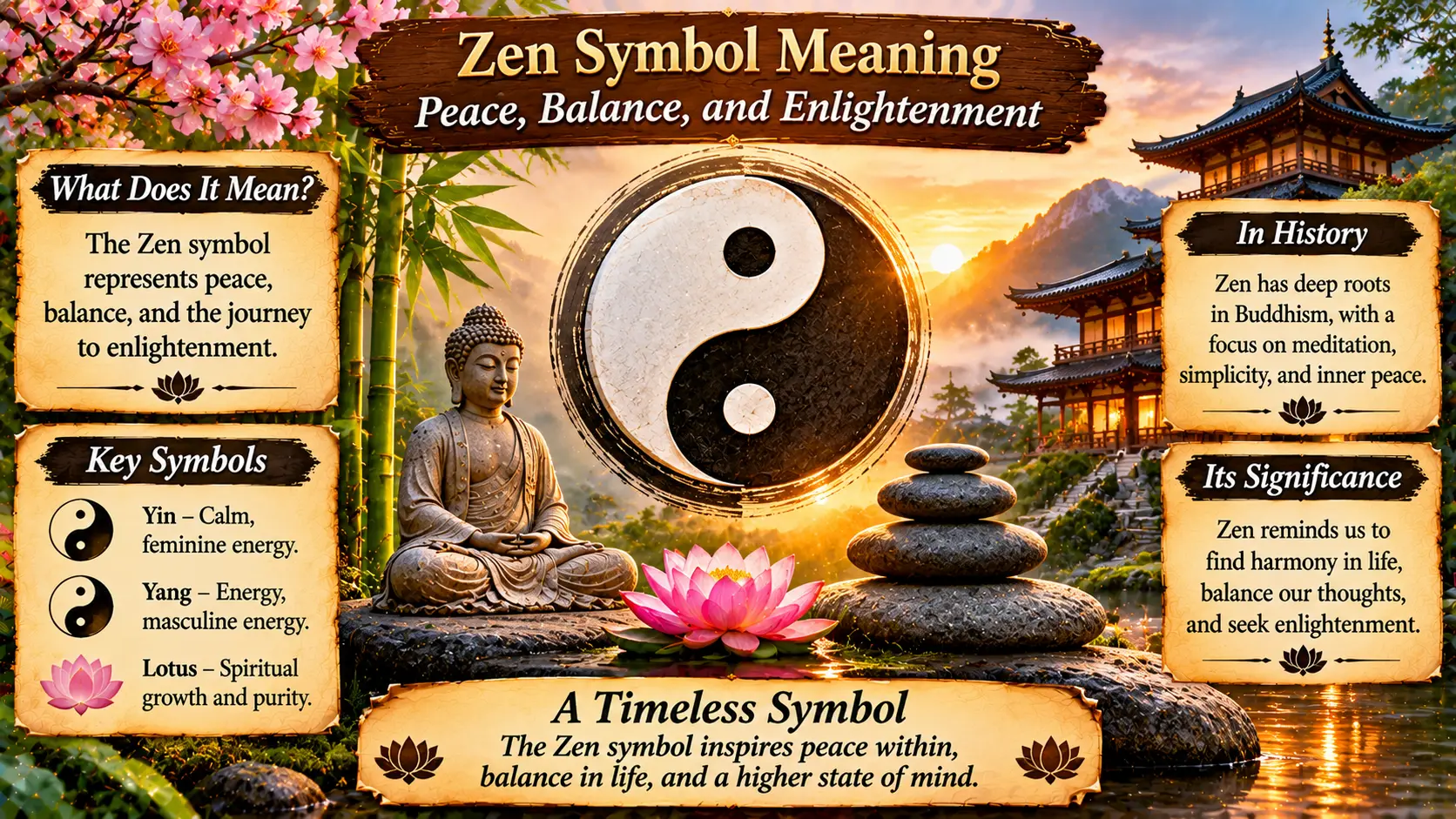
| Yin-yang | A circular design with contrasting sections | Complementary forces and balance |
Not all these symbols are exclusive to Zen Buddhism. For example, the lotus is important in several Buddhist traditions, while yin-yang belongs to a different philosophical tradition.
Zen Symbol Spiritual Meaning
Spiritually, the Zen symbol is often associated with awareness, inner peace, simplicity, and enlightenment. It encourages people to observe their thoughts and experiences without becoming completely controlled by them.
The Enso circle can also represent the idea that life is interconnected. Its continuous form suggests unity, while its open design may encourage acceptance of uncertainty and change.
In Zen-inspired reflection, the symbol can remind people to:
- Pay attention to the present moment.
- Accept that life is not always perfect.
- Develop patience and self-awareness.
- Let go of unnecessary distractions.
- Appreciate simplicity and stillness.
- Approach everyday experiences with an open mind.
In Buddhist philosophy, emptiness does not simply mean nothingness. It refers to the idea that things do not possess an independent, permanent existence. This is a deeper philosophical concept than simply feeling peaceful or relaxed.
Zen Symbolism in Love and Relationships
In modern symbolic interpretations, the Zen symbol can represent balance, understanding, patience, and harmony in relationships.
Its circular shape may suggest the importance of building a connection based on mutual respect and emotional understanding. The open Enso can also remind people that relationships involve growth, change, and acceptance.
| Relationship symbolism | Meaning |
| Balance | Maintaining a healthy connection |
| Understanding | Listening and respecting different perspectives |
| Patience | Allowing relationships to develop naturally |
| Acceptance | Recognizing that nobody is perfect |
| Unity | Building a sense of togetherness |
| Personal space | Respecting individual needs and boundaries |
The Zen symbol offers a useful reminder that healthy relationships require both connection and independence. Peace in a relationship comes from mutual respect, honest communication, and consideration for one another.
Zen Symbol Meaning for Twin Flames
In modern twin-flame spirituality, the Zen symbol may represent balance, self-awareness, patience, and personal development.
The Enso circle can be interpreted as a reminder that personal growth is an ongoing process. Its open form may also suggest that people should remain willing to learn and understand themselves.
Some contemporary interpretations connect it with:
- Emotional balance and self-understanding.
- Patience during personal changes.
- Respect for individuality.
- Acceptance of life’s uncertainties.
- Developing a peaceful approach to relationships.
However, the Enso does not have an established traditional meaning specifically connected to twin flames. This association comes from modern spiritual interpretations rather than classical Zen Buddhist teachings.
Zen Symbol in Japanese Culture and Buddhist History
The Enso has an important place in Japanese Zen art, but its history is connected with broader Buddhist ideas and artistic practices.
Buddhist origins: Zen developed from the Chinese Buddhist tradition known as Chan, which was influenced by earlier Indian Buddhist teachings. It later became established in Japan, where it developed distinctive artistic and cultural expressions.
Japanese calligraphy: Zen monks and artists used brushwork to express ideas through simple, direct images. The Enso became an important example of this artistic approach.
Meditation and awareness: Zen practice places importance on meditation, direct experience, and awareness. The circle is often interpreted as reflecting these qualities.
Artistic expression: Enso circles are traditionally created with ink and a brush, often in one continuous movement. The result reflects the artist’s expression at the time of creation.
Modern culture: Today, the Enso appears in paintings, books, clothing, tattoos, interior decoration, and meditation-related designs. It is widely recognized as an image associated with Zen and mindfulness.
Although the Enso is strongly associated with Japanese Zen, circles and circular imagery have much broader histories across different cultures.
Zen Symbolism in Dreams
Dream interpretation is personal, and there is no universal Buddhist rule explaining what an Enso in a dream means. However, modern symbolic interpretations often connect it with peace, balance, self-awareness, and personal reflection.
Some possible interpretations include:
- Seeing a complete circle: May represent a desire for wholeness, stability, or completion.
- Seeing an open circle: May suggest freedom, new possibilities, or acceptance of uncertainty.
- Drawing an Enso: Could represent creativity, concentration, or a desire for greater awareness.
- Seeing a broken circle: May reflect feelings of change or incompleteness.
- Seeing a beautiful Zen painting: May suggest an interest in simplicity, calmness, or reflection.
- Meditating beside a circle: May represent a desire for greater focus and inner balance.
The emotions and circumstances surrounding the dream are important. A dream symbol should not be treated as a prediction of future events.
Zen Symbolism in Art, Tattoos, and Jewelry
The Enso is popular in modern art and decorative design because its simple appearance can communicate complex ideas.
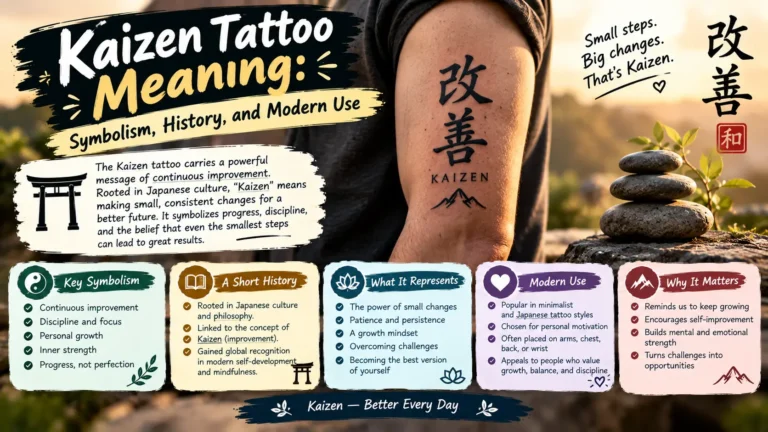
Zen tattoos: An Enso tattoo may represent mindfulness, inner peace, personal growth, acceptance, or the beauty of imperfection. Some people choose an open circle to express freedom and an ongoing journey.
Zen jewelry: Pendants, rings, bracelets, and other accessories featuring Enso designs can represent simplicity, balance, and spiritual awareness.
Zen paintings: Artists often use black ink on white paper to emphasize the movement and texture of the brushstroke. The contrast creates a simple but expressive image.
Home decoration: Enso artwork is commonly displayed in meditation rooms, living spaces, and offices. It can serve as a visual reminder to appreciate simplicity and remain present.
When choosing a Zen-inspired design, it is helpful to understand its Buddhist and Japanese cultural background rather than treating it only as a decorative pattern.
What Does It Mean When You See a Zen Symbol?
Seeing an Enso symbol may encourage reflection on peace, mindfulness, balance, and acceptance. Its meaning depends on where it appears and what it represents in that particular context.
For example:
- In a meditation room: It may represent awareness and concentration.
- In Japanese artwork: It may express Zen philosophy and artistic simplicity.
- In a tattoo: It may communicate personal growth or acceptance.
- In a book: It may introduce ideas about mindfulness or Buddhist philosophy.
- In a business logo: It may suggest simplicity, balance, or a calm approach.
Some people interpret seeing the symbol as a personal reminder to slow down and pay attention to life. However, seeing an Enso does not automatically indicate a supernatural message.
The Difference Between Open and Closed Zen Circles
One of the most interesting features of the Enso is that it can be painted as an open or closed circle. Both forms are meaningful in Zen-inspired art.
| Type | Appearance | Common interpretation |
| Open Enso | Circle with a visible gap | Freedom, possibility, and imperfection |
| Closed Enso | Complete circular shape | Wholeness, unity, and completion |
| Uneven Enso | Irregular brushstroke | Natural expression and acceptance |
| Bold Enso | Thick, dark brushstroke | Strength, presence, and confidence |
| Light Enso | Thin or delicate brushstroke | Simplicity and subtle expression |
An open Enso is sometimes associated with the idea that there is always room for growth. A closed Enso may suggest completeness or unity.
These interpretations are not fixed definitions. The artist’s intention and the context of the artwork also matter.
Zen Symbol vs. Other Spiritual Symbols
The Enso is sometimes compared with other symbols associated with peace, balance, and spiritual awareness. However, each has a distinct history and meaning.
| Symbol | Main meaning | Key difference |
| Enso | Wholeness and awareness | Connected with Japanese Zen art |
| Lotus flower | Purity and spiritual growth | Important in several Buddhist traditions |
| Yin-yang | Complementary forces | Comes from Chinese philosophical traditions |
| Om | Sacred sound and spiritual reality | Important in Hinduism and some other Indian religious traditions |
| Mandala | Symbolic representation of the universe | Used in different Hindu and Buddhist traditions |
| Bodhi tree | Awakening and wisdom | Associated with the Buddha’s enlightenment |
Although these symbols may appear together in modern spiritual artwork, they should not be treated as interchangeable.
Common Misconceptions About the Zen Symbol
The Enso is widely used in modern design, but some explanations oversimplify its history and meaning.
Misconception 1: The Enso is just a decorative circle.
It is an important image in Japanese Zen calligraphy and can express ideas about awareness, emptiness, and wholeness.
Misconception 2: Every Enso has exactly the same meaning.
Its interpretation may depend on the artist, brushwork, tradition, and context.
Misconception 3: An open circle always means imperfection.
Imperfection is one common interpretation, but an open circle may also suggest freedom, openness, or possibility.
Misconception 4: Zen means simply feeling relaxed.
Zen Buddhism involves philosophical and spiritual practices, including meditation and direct experience. It is more than a general feeling of calmness.
Misconception 5: All circular spiritual symbols come from Zen.
Many cultures and religious traditions use circles. The Enso has its own specific connection with Japanese Zen art.
Lessons and Significance of the Zen Symbol in Daily Life
The Zen symbol offers several ideas that can be applied to ordinary experiences. Its message encourages people to approach life with greater awareness and appreciation.
Accept imperfection: Life does not need to be flawless to be meaningful. Mistakes can become opportunities to learn.
Practice mindfulness: Give attention to what you are doing instead of constantly worrying about what comes next.
Value simplicity: Focus on the things that genuinely matter rather than filling every moment with unnecessary distractions.
Develop balance: Make time for responsibilities, relationships, rest, and personal interests.
Remain open to change: Life is always developing, and accepting change can help you respond more thoughtfully.
Understand yourself: Taking time for reflection can help you recognize your thoughts, values, and goals.
The Enso reminds us that life is an ongoing experience. Its circle offers a visual expression of unity, while its natural brushstroke celebrates the beauty of the present moment.
Frequently Asked Questions About Zen Symbol Meaning
What does the Zen symbol mean?
The Zen symbol, especially the Enso circle, commonly represents wholeness, mindfulness, peace, enlightenment, and the nature of existence.
What is the spiritual meaning of the Enso circle?
Spiritually, the Enso may represent awareness, unity, emptiness, and enlightenment. Its interpretation depends on the Buddhist and artistic context.
What does an open Zen circle symbolize?
An open Enso is often associated with freedom, possibility, openness, and acceptance of imperfection. It may also suggest that personal growth is ongoing.
What does a closed Zen circle symbolize?
A closed Enso commonly represents wholeness, unity, and completeness. It can also express the interconnected nature of existence.
What does a Zen symbol tattoo mean?
A Zen circle tattoo may represent mindfulness, inner peace, personal growth, simplicity, and acceptance. Its meaning can also depend on whether the circle is open or closed.
Is the Enso a Buddhist symbol?
Yes. The Enso is strongly associated with Japanese Zen Buddhism, particularly its calligraphy and artistic traditions.
What does the Zen circle mean in love?
In modern symbolic interpretations, it can represent harmony, acceptance, patience, and balance in relationships. It is not a specific traditional symbol of romantic love.
What does the Zen symbol mean in dreams?
A Zen circle in a dream may represent reflection, balance, or a desire for greater awareness. Dream interpretations are personal rather than universal.
What is the difference between Zen and the Enso?
Zen is a school and tradition of Buddhism, while the Enso is a circular image commonly used in Japanese Zen art to express philosophical and spiritual ideas.
Why is the Zen symbol sometimes incomplete?
Some Enso circles are intentionally left open. This can express freedom, openness, possibility, or the acceptance of imperfection.
Final Thoughts
The Zen symbol, especially the Enso circle, represents mindfulness, peace, unity, simplicity, and spiritual awareness. Its open and closed forms offer different ways to reflect on wholeness, freedom, and the beauty of imperfection. Rooted in Japanese Zen Buddhist art, the symbol encourages people to appreciate the present, accept change, and develop a deeper understanding of themselves. Whether seen in artwork, meditation spaces, or tattoos, the Enso remains a meaningful reminder that life is an ongoing journey.