Faravahar Symbol: Meaning, History and Origins
The Faravahar is one of the most recognizable symbols of ancient Persia and Zoroastrian heritage. Featuring a winged human figure emerging from a circular design, this ancient emblem represents a powerful connection to Iranian history, spiritual beliefs, and cultural identity. Its distinctive image appears on historic monuments, architectural carvings, jewelry, and modern artwork, connecting generations with the legacy of ancient Iran.
The Faravahar is commonly associated with wisdom, spiritual protection, eternity, and the principles of Good Thoughts, Good Words, and Good Deeds. These values make it an important symbol of ethical living and personal responsibility. However, its original meaning during the ancient Persian empires remains a subject of historical discussion. Some interpretations connect the ancient winged figure with Ahura Mazda, while others associate it with Khvarenah (divine royal glory) or the Zoroastrian concept of Fravashi.
Understanding the Faravahar requires looking beyond its appearance. Its history connects ancient Near Eastern art, the Achaemenid Empire, Zoroastrian traditions, and modern Iranian identity. This guide explores its meaning, historical origins, seven commonly interpreted elements, and continuing cultural significance.
What Is the Faravahar Symbol?
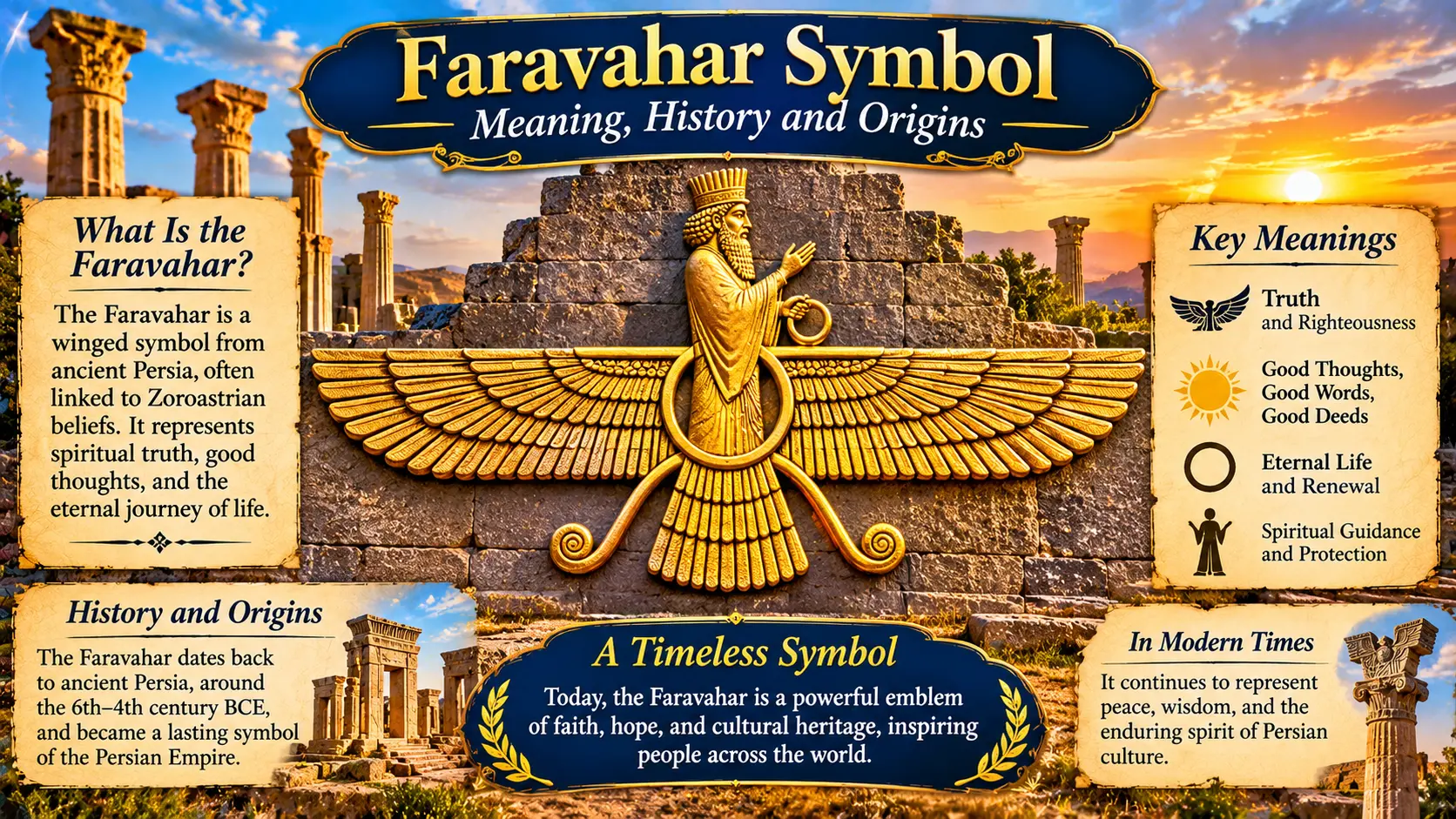
The Faravahar is an ancient winged figure widely associated with Persian civilization and Zoroastrianism. Its recognizable design features a human figure, two extended wings, a central circular element, a raised hand, a ring, and two lower streamers with a three-part tail.
The symbol is particularly associated with the Achaemenid Empire (approximately 550–330 BCE), when similar winged figures appeared in royal reliefs and monumental architecture.
The name appears in several English spellings, including:
- Faravahar: The most widely recognized modern spelling.
- Farvahar: An alternative spelling commonly used in English publications.
- Farohar: Another traditional spelling.
- Fravahar: A spelling associated with historical and religious terminology.
Today, the Faravahar is recognized as an important emblem of Iranian heritage. Zoroastrians associate it with their religious and cultural traditions, while many other Iranians display it as an expression of pride in Persian history.
It is important to distinguish the modern Faravahar emblem from the original ancient winged figure. Although they are visually connected, historians do not universally agree on what ancient Persian artists intended the figure to represent.
What Does Faravahar Mean?
The Faravahar is commonly associated with spiritual protection, wisdom, eternity, and the responsibility to live an ethical life. Its modern interpretation is strongly connected to the Zoroastrian concept of Fravashi, although the historical relationship between the ancient reliefs and this religious concept remains debated.
The term is often linked to the Avestan word Fravashi, which describes a spiritual entity in Zoroastrian religious thought.
In Zoroastrian tradition, Fravashis have several important characteristics:
- Existence before birth: A Fravashi is understood to exist before an individual enters the physical world.
- Spiritual protection: It is associated with guidance and protection.
- Existence beyond death: Fravashis are understood to endure beyond physical life.
- Connection with righteousness: They are associated with goodness, spiritual order, and the cosmic struggle between truth and falsehood.
Because of these beliefs, the Faravahar is frequently interpreted as a representation of humanity’s enduring spiritual nature.
However, Fravashi and Faravahar are not necessarily identical concepts. Fravashi is a religious concept in Zoroastrianism, whereas Faravahar is the modern name commonly given to the recognizable winged emblem.
History and Origins of the Faravahar Symbol
The history of the Faravahar is closely connected to ancient Iranian civilization, particularly the Achaemenid Empire. However, its artistic background extends into a much wider tradition of ancient Near Eastern imagery.
Early Winged Symbols in the Ancient Near East
Long before the Achaemenid rulers established their empire, winged symbols appeared throughout several ancient civilizations.
Ancient Egyptians used winged sun disks in religious and royal artwork, often associating them with divine protection and authority.
Assyrian artists also created winged figures and disks, including imagery connected with the god Ashur and the sacred Tree of Life.
These artistic traditions provide important context for understanding the Faravahar. Although these designs share visual similarities, they should not automatically be considered identical in meaning or religious purpose.
The ancient Iranian winged figure developed within this broader artistic environment and eventually became strongly associated with Persian royal monuments.
Faravahar During the Achaemenid Empire
The Achaemenid Empire was one of the most influential ancient Persian empires, ruling extensive territories across Western and Central Asia.
During this period, winged human figures became prominent in royal artistic representations. They appeared in monumental architecture and stone reliefs associated with Persian kings.
This imagery is particularly connected with the reigns of Cyrus the Great, Darius I, and their successors.
The winged figure is frequently shown above or near royal representations. Its placement has encouraged historians to explore possible connections with divine favor, kingship, and religious authority.
Although its precise identity remains debated, its appearance in royal settings demonstrates its importance within Achaemenid visual culture.
Faravahar at Persepolis and Other Ancient Sites
Several archaeological sites help illustrate the historical importance of ancient Persian winged imagery.
- Persepolis: The ceremonial capital of the Achaemenid Empire contains remarkable examples of Persian royal art and monumental architecture.
- Naqsh-e Rostam: This archaeological complex features monumental royal tombs and reliefs associated with Achaemenid rulers.
- Pasargadae: The early Achaemenid capital provides valuable evidence of the dynasty’s artistic and architectural traditions.
- Bisotun: The famous relief of Darius I offers important insight into Achaemenid royal ideology and imperial imagery.
These historical locations demonstrate how Persian rulers used monumental artwork to communicate authority, legitimacy, and connections with divine power.
The Faravahar Through Later Iranian History
The winged figure became less prominent in Iranian artistic traditions after the fall of the Achaemenid Empire.
The Parthian and Sasanian periods developed their own distinctive artistic and religious styles. Later, the spread of Islam transformed Iranian visual culture and artistic traditions.
The ancient winged emblem did not remain continuously prominent in the same way throughout these periods.
Its modern revival is connected with renewed interest in pre-Islamic Iranian history, archaeology, and national heritage, particularly during the nineteenth and twentieth centuries.
Today, the Faravahar is widely recognized as an enduring symbol of Persian civilization, Zoroastrian heritage, and Iranian cultural identity.
What Do the Seven Parts of the Faravahar Symbol Represent?
The Faravahar is recognized for its detailed design, with each component carrying symbolic meaning in modern Zoroastrian and Iranian cultural interpretations.
Although these explanations are widely shared today, there is no definitive ancient text confirming that every part of the original Achaemenid figure was intended to represent these specific meanings.
1. The Elderly Human Figure
The human figure at the center of the Faravahar is commonly interpreted as a representation of wisdom, maturity, and life experience.
Its elderly appearance is associated with knowledge gained throughout life. It reminds people that personal growth requires learning from experience, making thoughtful decisions, and developing strong moral character.
In modern interpretations, the human figure represents:
- Wisdom: Learning from experience and understanding the consequences of actions.
- Maturity: Developing patience, responsibility, and good judgment.
- Personal growth: Continuously improving oneself.
- Spiritual awareness: Seeking a meaningful and ethical life.
This element encourages people to approach life with understanding, patience, and a willingness to learn.
2. The Raised Hand
One of the figure’s hands is raised upward. In popular interpretations, this gesture represents a commitment to goodness and the desire to move toward a higher purpose.
It is understood as a reminder that people should continuously improve their behavior and make positive choices.
The raised hand can symbolize:
- Aspiration toward goodness.
- Commitment to personal improvement.
- Respect for spiritual values.
- Determination to follow an ethical path.
Its message is closely connected with the idea that a meaningful life begins with conscious and positive choices.
3. The Ring Held in the Hand
The other hand holds a circular object commonly interpreted as a ring of loyalty or covenant.
Similar to a ring used to represent a promise or commitment, it symbolizes faithfulness, responsibility, and the importance of keeping one’s word.
Its modern symbolic meanings include:
- Loyalty to personal values.
- Faithfulness in relationships.
- Honoring promises and commitments.
- Remaining committed to truth and goodness.
The ring reminds people that trust is built through honesty, consistency, and responsible actions.
4. The Central Circle
The large circle around the central part of the figure is commonly associated with eternity, continuity, and the enduring nature of existence.
A circle has no visible beginning or ending, making it a natural representation of timelessness and continuity.
In popular interpretations of the Faravahar, this element represents the eternal nature of spiritual existence and the connection between physical and spiritual life.
It can also serve as a reminder that human actions have lasting consequences.
5. The Upper Wings
The wings are among the most recognizable features of the Faravahar. Their three rows of feathers are commonly connected with the three fundamental principles of Zoroastrian ethics:
- Good Thoughts: Developing positive intentions and choosing wisdom over ignorance.
- Good Words: Speaking honestly, respectfully, and truthfully.
- Good Deeds: Acting with kindness, justice, and responsibility.
The wings also symbolize spiritual progress and the desire to rise above harmful behavior.
Together, their three rows provide a powerful visual reminder that a meaningful life depends on the quality of our thoughts, words, and actions.
6. The Lower Tail
The lower tail contains three sections commonly interpreted as the opposites of the three ethical principles.
They represent:
- Bad Thoughts: Jealousy, hatred, dishonesty, and harmful intentions.
- Bad Words: Lies, insults, gossip, and destructive speech.
- Bad Deeds: Cruelty, injustice, and actions that harm others.
In popular interpretations, the lower position of these feathers represents the need to reject negative behavior rather than allow it to control one’s life.
The contrast between the wings and tail communicates an important moral lesson: people must consciously choose goodness over destructive behavior.
7. The Two Side Streamers
The two ribbons or streamers extending from the central circle are often associated with opposing spiritual forces.
In modern interpretations, they are connected with:
- Spenta Mainyu: The constructive or beneficent spiritual force.
- Angra Mainyu: The destructive spiritual force associated with evil.
Their arrangement is commonly interpreted as a reminder to move toward goodness and turn away from harmful choices.
This interpretation reflects an important theme in Zoroastrian thought: every individual has a responsibility to choose between constructive and destructive behavior.
The Three Principles of Zoroastrianism and Their Connection to Faravahar
One of the most important teachings associated with Zoroastrianism is the ethical principle of Good Thoughts, Good Words, and Good Deeds.
These three values are expressed through the Avestan terms Humata, Hukhta, and Hvarshta. They form an important part of modern explanations of the Faravahar’s wings and tail.
Good Thoughts (Humata)
Good thoughts begin with the intentions behind human behavior.
Zoroastrian ethics encourages people to develop honesty, compassion, wisdom, and respect for others. It also teaches the importance of avoiding hatred, jealousy, and dishonesty.
Good thoughts include:
- Thinking positively and responsibly.
- Respecting the rights of others.
- Choosing wisdom over ignorance.
- Developing honest intentions.
- Practicing compassion and understanding.
Positive thoughts create the foundation for positive behavior and responsible decisions.
Good Words (Hukhta)
Words have the power to encourage, support, educate, and influence others.
Good words involve communicating honestly and respectfully. They also require avoiding lies, harmful gossip, and language intended to hurt others.
This principle encourages individuals to:
- Speak the truth.
- Keep promises.
- Communicate respectfully.
- Avoid spreading harmful information.
- Use language to support and encourage others.
It reminds people that words can strengthen relationships and create understanding.
Good Deeds (Hvarshta)
Good deeds turn positive intentions and honest words into meaningful actions.
This principle encourages individuals to help others, act fairly, protect what is valuable, and take responsibility for their decisions.
Examples include:
- Helping people in need.
- Treating others fairly.
- Protecting nature and animals.
- Acting with honesty and kindness.
- Taking responsibility for mistakes.
Together, these three principles express a practical approach to ethical living. They also explain why the Faravahar is frequently viewed as a reminder of personal responsibility, kindness, and moral character.
Faravahar and Fravashi: Are They the Same?
Faravahar and Fravashi are closely associated terms, but they do not necessarily mean the same thing.
Fravashi is a religious concept found in Zoroastrian scriptures, particularly the Avesta. It describes a spiritual entity associated with protection, existence, and the continuing spiritual order.
In Zoroastrian tradition, Fravashis are not limited to the spirits of deceased individuals. They are associated with the living, the dead, and those who have not yet been born.
The concept therefore extends beyond the ordinary understanding of a human soul.
Zoroastrian religious thought also distinguishes between different aspects of human existence, including:
- Tanu: The physical body.
- Urvan: The individual soul, associated with moral accountability.
- Fravashi: The spiritual entity associated with protection and a person’s spiritual existence.
The Faravahar, meanwhile, is the name commonly used for the winged emblem recognized in Persian historical and cultural imagery.
Why Are They Connected?
The modern Faravahar is frequently interpreted as a visual representation of the Fravashi because of its association with spiritual protection and eternity.
However, the identification of the ancient Achaemenid winged figure as a Fravashi is not universally accepted by historians.
Understanding this distinction helps separate religious tradition, modern cultural interpretation, and archaeological evidence.
Faravahar, Ahura Mazda, and Khvarenah: Different Interpretations
The original meaning of the ancient Persian winged figure remains a subject of scholarly discussion. Several interpretations have been proposed, reflecting the religious and political environment of the Achaemenid Empire.
Faravahar as a Representation of Ahura Mazda
Ahura Mazda is the supreme deity in Zoroastrianism and is associated with wisdom, truth, and righteousness.
Some earlier interpretations identified the winged figure in Achaemenid reliefs as a representation of Ahura Mazda.
This interpretation connects the figure with divine authority and the religious beliefs of ancient Persian rulers.
However, its exact identification remains debated. Its appearance alone does not establish that the figure directly represents the deity.
Faravahar and Khvarenah (Farr)
Another important interpretation connects the winged figure with Khvarenah, also known as Farr.
Khvarenah is an ancient Iranian concept associated with divine glory, fortune, and legitimate authority.
In royal contexts, it was understood as a form of divine favor that could distinguish a rightful ruler.
Its significance included:
- Royal authority: The special legitimacy associated with a ruler.
- Divine favor: A blessing connected with higher spiritual power.
- Leadership: The qualities and fortune associated with rightful kingship.
- Glory: The prestige and majesty of a legitimate ruler.
Some scholars have therefore interpreted the winged figure as a representation of royal Khvarenah rather than a literal depiction of a god or guardian spirit.
What Do Historians and Scholars Believe?
There is no universally accepted explanation of the original Achaemenid winged figure.
Different interpretations have associated it with Ahura Mazda, Khvarenah, ancestral or protective spiritual concepts, and royal ideology.
This uncertainty is important because the familiar meanings assigned to the individual parts of the modern Faravahar are not all supported by direct ancient inscriptions.
A historically responsible explanation should distinguish what can be observed in ancient monuments from what later religious and cultural traditions have come to associate with the symbol.
Is Faravahar a Zoroastrian or Persian National Symbol?
The Faravahar has strong connections with Zoroastrianism and ancient Persian civilization. However, its modern cultural significance extends beyond its religious associations.
For Zoroastrians, the emblem is closely connected with their religious heritage, spiritual traditions, and ethical teachings. It serves as a recognizable expression of a faith that has played an important role in Iranian history.
For many other Iranians, the Faravahar represents something broader: a connection to Persian civilization, ancient history, and cultural identity.
Its modern use reflects several different meanings:
- Religious identity: A recognizable emblem associated with Zoroastrian heritage.
- Historical connection: A reminder of the ancient Persian empires.
- Cultural pride: An expression of appreciation for Iranian civilization.
- Shared heritage: A symbol recognized by many Iranians regardless of religious background.
It is therefore more accurate to describe the Faravahar as a symbol with Zoroastrian and ancient Iranian associations that has also become an important expression of modern Persian identity.
It is not an official national symbol representing every Iranian, nor does everyone interpret it in exactly the same way.
Faravahar in Modern Iranian Culture
The Faravahar continues to appear in Iranian art, fashion, architecture, and cultural expression. Its distinctive design makes it recognizable across generations and among Iranian communities around the world.
Faravahar in Jewelry and Fashion
Jewelry is one of the most common ways people display the Faravahar today.
Its symmetrical wings and central human figure make it suitable for detailed decorative designs. Persian jewelry makers incorporate the emblem into necklaces, pendants, rings, bracelets, and earrings.
Gold and silver are particularly popular materials, although contemporary designs also use other metals and decorative finishes.
People wear Faravahar jewelry for different reasons:
- To express pride in Persian heritage.
- To maintain a connection with Iranian history.
- To recognize Zoroastrian cultural traditions.
- To appreciate its artistic design and symbolic meaning.
- To represent personal values such as wisdom and goodness.
Faravahar in Art and Architecture
The Faravahar also appears in contemporary artwork and decorative architecture.
Artists use its distinctive shape in paintings, sculptures, metalwork, wood carvings, and graphic designs.
Its historical association with Persepolis and other ancient Iranian monuments makes it particularly meaningful in cultural exhibitions and heritage displays.
Modern designers also adapt the emblem for home decorations, public installations, and artistic representations of Iranian history.
Faravahar Among the Iranian Diaspora
For many Iranians living outside Iran, the Faravahar provides a visible connection to their cultural background.
It appears in jewelry, personal collections, artwork, and cultural gatherings. Some people use it to introduce younger generations to ancient Persian civilization and its historical traditions.
Its significance can be especially meaningful for families who want to preserve their cultural heritage while living in different countries.
The Faravahar therefore serves not only as a historical emblem but also as a recognizable expression of cultural continuity and belonging.
Can Anyone Wear the Faravahar Symbol?
Yes. People from different religious and cultural backgrounds wear the Faravahar.
Although the symbol has important connections with Zoroastrianism, its modern use is not limited to followers of that religion.
Many people wear it because they appreciate Persian history, Iranian culture, or the ethical values commonly associated with its design.
For Zoroastrians, it may express a connection to their religious heritage. For others, it may represent family history, cultural pride, or admiration for ancient Persian civilization.
When wearing the Faravahar, it is helpful to understand its historical background and recognize that its religious and cultural meanings can differ between individuals.
Respecting these different interpretations allows people to appreciate the symbol without assuming that everyone who wears it shares the same beliefs.
Faravahar vs. Other Ancient Persian Symbols
Ancient Iranian civilization produced many recognizable symbols, each associated with different aspects of its history, mythology, and cultural traditions.
The Faravahar is often discussed alongside other Persian symbols, but their meanings and origins are not interchangeable.
| Symbol | Main association |
|---|---|
| Faravahar | Ancient Iranian heritage and modern Zoroastrian symbolism |
| Lion and Sun | Iranian historical and national identity |
| Simurgh | Persian mythology, wisdom, and protection |
| Cypress tree | Eternity, resilience, and Persian cultural symbolism |
Faravahar: Known for its winged human figure, the Faravahar is associated with Achaemenid artistic traditions, Zoroastrian heritage, and Iranian identity.
Lion and Sun: This emblem has a long history in Iranian visual culture and became particularly prominent as a national symbol during later periods of Iranian history.
Simurgh: A legendary bird from Persian mythology and literature, the Simurgh is associated with wisdom, protection, and spiritual knowledge. It appears in famous literary works, including the Shahnameh.
Cypress tree: The cypress has an important place in Persian gardens, poetry, and visual art. It is frequently associated with longevity, beauty, and resilience.
These symbols demonstrate the variety of artistic and cultural traditions that have shaped Iranian identity throughout history.
Common Misconceptions About the Faravahar
Despite its popularity, several misunderstandings surround the Faravahar. Understanding the difference between historical evidence and modern interpretation helps explain the symbol more accurately.
Is the Faravahar Definitely a Picture of Ahura Mazda?
Not necessarily. Some interpretations connect the ancient winged figure with Ahura Mazda, but other scholars have proposed different explanations, including Khvarenah and royal symbolism.
Its original identity has not been conclusively established.
Does the Symbol Exclusively Belong to Zoroastrians?
No. It has strong Zoroastrian associations, but many people also use it as an expression of Iranian and Persian cultural heritage.
Are All Seven Symbolic Interpretations Ancient?
No. The familiar explanations of the wings, tail, ring, and other components are primarily modern interpretations. They should not automatically be presented as meanings documented by ancient Achaemenid artists.
Is Faravahar Identical to Fravashi?
No. Fravashi is a spiritual concept in Zoroastrianism, while Faravahar is the modern name commonly used for the winged emblem. The two are closely associated in modern interpretations but are not interchangeable terms.
Did the Faravahar Originate in Ancient Egypt?
The winged figure belongs to a wider family of ancient Near Eastern artistic imagery. Egyptian and Assyrian winged symbols provide useful comparisons, but this does not establish that the Persian emblem was directly copied from either civilization.
Is It an Official Symbol of All Iranians?
No. The Faravahar is widely recognized as an emblem of Iranian heritage, but it does not represent every Iranian’s personal beliefs or identity.
Frequently Asked Questions About Faravahar
What Does the Faravahar Symbol Mean?
The Faravahar is commonly associated with wisdom, spiritual growth, eternity, and moral responsibility. Its modern interpretation also emphasizes Good Thoughts, Good Words, and Good Deeds.
What Is the Origin of the Faravahar?
The Faravahar is associated with ancient Iranian civilization, particularly the Achaemenid Empire (550–330 BCE). Its artistic background is connected to the wider tradition of winged imagery in the ancient Near East.
Is Faravahar a Zoroastrian Symbol?
Yes. The Faravahar is strongly associated with Zoroastrian heritage and is widely recognized as a symbol connected with the religion. It is also used more broadly to express Persian cultural identity.
What Do the Wings of Faravahar Represent?
In popular modern interpretations, the three rows of feathers represent Good Thoughts, Good Words, and Good Deeds. The wings also symbolize spiritual progress and the pursuit of goodness.
What Does the Circle in Faravahar Symbolize?
The central circle is commonly interpreted as a symbol of eternity, continuity, and the enduring nature of spiritual existence.
What Are the Three Principles Associated With Faravahar?
The three principles are Good Thoughts (Humata), Good Words (Hukhta), and Good Deeds (Hvarshta). They represent important ethical values in Zoroastrian tradition.
Is Faravahar the Same as Fravashi?
No. Fravashi is a spiritual concept in Zoroastrian belief, while Faravahar is the name commonly given to the winged emblem. The modern symbol is frequently associated with the Fravashi concept.
Can Non-Zoroastrians Wear Faravahar?
Yes. People of different religious backgrounds wear the Faravahar to express their appreciation for Persian history, Iranian heritage, and its commonly understood ethical values.
What Is the Difference Between Faravahar and Ahura Mazda?
Ahura Mazda is the supreme deity in Zoroastrianism. Faravahar is the name commonly used for the winged emblem associated with ancient Persian art and modern Zoroastrian symbolism. Some historical interpretations connect the ancient figure with Ahura Mazda, but this identification remains debated.
Where Can Faravahar Be Found in Ancient Persia?
Winged figures associated with the Faravahar tradition can be seen in ancient Persian monumental art, particularly at Persepolis and Naqsh-e Rostam. Related Achaemenid imagery is also found at other historical sites, including Pasargadae and Bisotun.
Conclusion: The Enduring Meaning of the Faravahar
The Faravahar is more than an ancient Persian symbol; it represents a lasting connection to the Achaemenid Empire, Zoroastrian heritage, and Iranian cultural identity. Its distinctive wings, human figure, and central circle symbolize wisdom, spiritual growth, protection, and moral responsibility. Although historians continue to debate its original meaning, its modern significance remains deeply connected to the principles of Good Thoughts, Good Words, and Good Deeds. These values remind us that our character is shaped by our intentions, words, and actions. Whether displayed on ancient monuments, worn as jewelry, or featured in modern artwork, the Faravahar continues to inspire people to embrace goodness, pursue wisdom, speak truthfully, and preserve their cultural heritage.