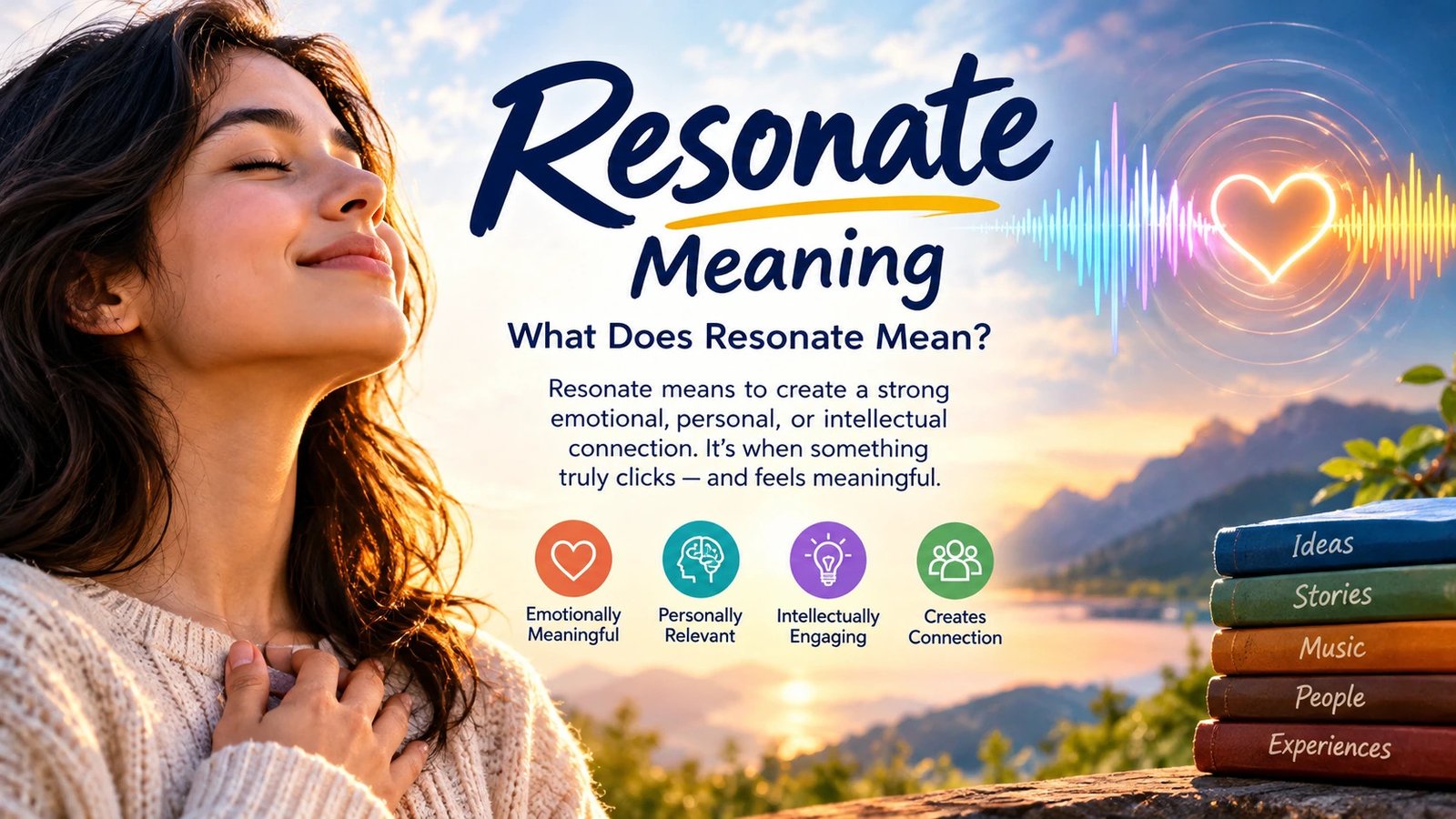
Resonate Meaning: What Does Resonate Mean?
The word resonate is commonly used when something creates a strong emotional, personal, or intellectual connection. You may hear someone say, “That really resonates with me,” when a story, idea, song, experience, or message feels especially meaningful to them.
Resonate can also have a literal meaning connected to sound and vibration. In everyday American English, however, its figurative meaning is extremely common.
Understanding the word becomes easier when you look at the context. Something can resonate with a person because it reminds them of their own experiences, reflects their values, expresses something they feel, or simply makes a powerful impression.
What Does Resonate Mean?
Simple Definition of Resonate
Resonate means to create a strong feeling, connection, or response in someone.
For example:
“Her story resonated with me.”
This means her story felt personally meaningful or relatable to the speaker.
The word can also describe sound. In its literal sense, resonate means to produce or continue producing a deep, clear sound or to vibrate in response to another sound.
Wanna know about the 67 Meaning?
Resonate Meaning in Simple Words
In simple terms, to resonate means to feel meaningful or to strongly connect with someone.
If something resonates with you, it may make you think, feel, remember, or understand something in a deeper way.
For example:
- “That advice really resonated with me.”
- “The movie resonated with many viewers.”
- “Her message resonated with the audience.”
In each example, something has created a meaningful response.
Resonate Pronunciation
Resonate is commonly pronounced REZ-uh-nate.
It is a verb, so it describes an action or effect. Common forms include:
- Resonate
- Resonates
- Resonated
- Resonating
For example, “The message resonates with people” uses the present tense, while “The message resonated with people” describes something that happened in the past.
Resonate Meaning in Different Contexts
The meaning of resonate can change slightly depending on the situation.
Resonate With Someone
When something resonates with someone, it creates a strong personal or emotional connection.
For example:
“His experience resonated with me because I went through something similar.”
The speaker is saying that the other person’s experience felt familiar and meaningful.
Resonate With People
A message, idea, story, product, or piece of content can resonate with a group of people.
For example:
“The campaign’s message resonated with many people.”
This means many people found the message meaningful, relevant, or emotionally compelling.
Resonate Emotionally
When something resonates emotionally, it creates a noticeable emotional response.
A song might resonate emotionally because its lyrics remind someone of an important relationship. A movie might resonate because its story reflects a difficult experience.
The word does not necessarily mean the reaction is happy. Something can resonate because it brings feelings of sadness, hope, nostalgia, frustration, comfort, or inspiration.
Resonate With an Experience
A person’s past experiences can influence what resonates with them.
For example:
“The character’s struggles resonated with me.”
This suggests that the character’s experiences reminded the speaker of their own life or feelings.
Literal Meaning of Resonate
Resonate in Sound and Physics
The original and literal sense of resonate is connected to sound and vibration.
An object can resonate when it vibrates at a particular frequency, producing or amplifying a sound. The concept is important in areas involving acoustics, music, and physics.
For example:
“The chamber resonated with a deep sound.”
Here, resonate is describing an actual physical sound rather than an emotional response.
Resonate in Music
In music, resonate can describe how a voice or instrument produces a rich, sustained, or noticeable sound.
For example:
“The guitar resonated throughout the room.”
This describes the physical quality of the sound.
Music can also resonate in the figurative sense:
“The song resonated with listeners.”
In this sentence, the focus is not on vibration but on the emotional or personal effect of the song.
Figurative Meaning of Resonate
The figurative meaning is especially common in everyday communication.
Resonate With an Idea
An idea can resonate with someone when it feels meaningful, sensible, or personally relevant.
For example:
“The idea of working fewer hours resonated with employees.”
The employees found the idea appealing or meaningful.
Resonate With a Message
A message can resonate with an audience when people feel connected to what it communicates.
For example:
“The speaker’s message resonated with the audience.”
This means the audience responded strongly to the message or found it meaningful.
Resonate With Your Values
Something may resonate with you because it reflects your beliefs or values.
For example:
“The organization’s focus on community service resonates with my values.”
The speaker feels a meaningful connection between the organization’s focus and their own values.
Resonate Meaning in a Sentence
Here are several natural examples of resonate in everyday English:
“Her story really resonated with me.”
The story created a strong personal connection.
“The message resonated with young adults.”
Many young adults found the message meaningful or relevant.
“That song resonates with me.”
The song creates a strong emotional or personal response.
“His advice resonated with what I was already feeling.”
His advice matched or expressed feelings the speaker already had.
“The campaign’s message resonated with its audience.”
The audience responded strongly to the message.
These examples show that resonate often goes beyond simply saying that you like something.
Examples of Resonate in Everyday Conversation
Resonate in Personal Conversations
People often use resonate when talking about experiences, advice, emotions, and personal stories.
For example:
“What you said really resonates with me.”
This can mean that the person’s words expressed something the listener already felt or experienced.
Another example is:
“That part of your story really resonated with me.”
The speaker identifies a personal connection with the story.
Resonate at Work
In professional settings, resonate can describe how employees, customers, or colleagues respond to an idea.
For example:
“The presentation’s main idea resonated with the team.”
This means the team found the idea meaningful or relevant.
A manager might also say:
“We need a message that resonates with our customers.”
The goal is to communicate something that customers understand and find relevant.
Resonate in School
Students may use resonate when discussing books, lessons, historical events, or personal experiences.
For example:
“The character’s experience resonated with me.”
A student may feel connected to the character because of shared emotions or experiences.
A lesson can also resonate:
“The teacher’s explanation resonated with me more than the textbook.”
Here, the explanation felt more understandable or meaningful.
Resonate on Social Media
The word is also common on social media.
Someone may comment:
“This really resonates with me.”
They are usually saying that the post expresses something they personally understand, believe, or have experienced.
A quote, video, personal story, or discussion can resonate with someone because it describes a feeling they have had but struggled to express.
What Does “That Resonates With Me” Mean?
“That resonates with me” means “That feels meaningful to me,” “I strongly relate to that,” or “That connects with something I feel or believe.”
For example:
“You said that success isn’t only about money. That really resonates with me.”
The speaker is saying that the idea strongly connects with their own beliefs.
Another example:
“Your story about starting over resonates with me.”
This indicates that the listener sees a meaningful connection between the story and their own experience.
The phrase is usually more expressive than simply saying, “I agree.”
You can agree with an idea without having a personal connection to it. When something resonates, it often has a deeper personal or emotional impact.
Resonate vs. Relate
What Does Relate Mean?
Relate can mean to understand or identify with another person’s experience.
For example:
“I can relate to what you’re going through.”
This means the speaker understands the experience because they have experienced something similar or can identify with it.
What Does Resonate Mean?
Resonate often emphasizes the meaningful effect something has on a person.
For example:
“Her story resonated with me.”
The story did more than seem familiar. It created a meaningful emotional or personal response.
Resonate and Relate Examples
Consider these two sentences:
“I can relate to his experience.”
This emphasizes shared understanding or experience.
“His experience resonated with me.”
This emphasizes the impact or personal meaning of that experience.
The two words can overlap, but they are not always interchangeable.
Resonate vs. Connect
Connect and resonate have similar meanings in some contexts.
For example:
“I connected with the character.”
This means the speaker felt a personal connection to the character.
“The character resonated with me.”
This suggests that the character or story created a meaningful emotional or intellectual response.
Connect is broader and can describe many types of relationships or interactions. Resonate often emphasizes the feeling that something has struck a meaningful chord within someone.
Resonate Synonyms
Depending on the context, useful synonyms for resonate include:
- Connect
- Relate
- Strike a chord
- Ring true
- Affect
- Move
- Inspire
- Touch
- Appeal
- Echo
These words are not perfect replacements in every sentence.
For example, “The song moved me” focuses on emotion, while “The song resonated with me” can suggest both emotional and personal meaning.
Which Synonym Should You Use?
Choose the synonym according to the type of connection you want to describe.
Use relate when emphasizing shared experience. Use connect when emphasizing a relationship or general sense of connection. Use move when emphasizing emotion. Use resonate when something feels especially meaningful, relevant, or personally significant.
Opposite of Resonate
There is no single perfect opposite of resonate in every context.
Depending on the sentence, possible opposites include:
- Disconnect
- Fail to connect
- Fall flat
- Feel irrelevant
- Have little impact
- Go unnoticed
For example:
“The message failed to resonate with the audience.”
This means the audience did not find the message meaningful, relevant, or compelling.
The phrase “fall flat” can sometimes express a similar idea, particularly when a message or attempt does not produce the intended reaction.
Common Phrases With Resonate
“Resonate With Me”
This means something feels personally meaningful or relatable.
“That quote really resonates with me.”
“Resonate With People”
This means something creates a meaningful response among people.
“The story resonated with people around the world.”
“Resonate With the Audience”
This is common in communication, presentations, entertainment, and marketing.
“The speaker’s story resonated with the audience.”
“Resonate Deeply”
This emphasizes a particularly strong personal or emotional effect.
“The book resonated deeply with readers.”
“Strongly Resonate”
This means something creates a powerful response.
“The theme strongly resonated with viewers.”
“Really Resonate”
This is a common conversational form.
“Those words really resonate with me.”
“Resonate Emotionally”
This emphasizes the emotional effect.
“The final scene resonated emotionally with many viewers.”
Is Resonate a Positive Word?
Resonate is generally a neutral word.
Its meaning depends on the context.
Something can resonate positively:
“Her message of hope resonated with the audience.”
Something can also resonate because it brings up difficult emotions:
“The story of loss resonated with many readers.”
In both cases, resonate simply describes a strong or meaningful response. The word itself does not automatically mean that the reaction is positive.
Can a Person Resonate With You?
Yes, although the most natural phrasing often focuses on something about the person.
For example:
“Her story resonated with me.”
“His experiences really resonated with me.”
“I connected with her perspective.”
People can create a strong sense of resonance through their stories, experiences, values, personality, or words.
However, “resonate with” usually describes the effect of something on a person rather than simply describing a relationship between two people.
Resonate Meaning in Relationships
In relationships, resonate can describe a feeling of emotional or personal connection.
For example:
“Her values resonate with mine.”
This means the speaker sees a meaningful similarity between their own values and hers.
Another example:
“His way of communicating really resonates with me.”
This suggests that his communication style feels especially meaningful or natural to the speaker.
Resonance does not necessarily mean complete agreement. Two people can have different opinions while still finding certain experiences, values, or feelings meaningful.
Resonate Meaning in Business and Marketing
What Does It Mean When a Message Resonates?
When a message resonates, people respond to it because they find it relevant, meaningful, memorable, or emotionally significant.
For example:
“The company’s message about simplifying everyday life resonated with customers.”
This means the message connected with what customers valued or experienced.
Why Brands Use the Word Resonate
Businesses often use resonate when discussing communication with an audience.
The idea is that effective communication should feel relevant to the people receiving it.
For example:
“The brand wanted its message to resonate with younger customers.”
Here, resonate means the company wanted its message to connect meaningfully with that audience.
Example of a Resonating Marketing Message
Imagine a fictional company that sells reusable water bottles.
Its message says:
“Small daily choices can make a difference.”
If customers care about reducing waste and making practical changes, that message may resonate with them because it reflects their values.
Resonate Meaning in Literature, Art, and Culture
Stories, poems, paintings, movies, music, and other forms of art can resonate with audiences.
A work of art may resonate because it explores universal experiences such as:
- Love
- Loss
- Family
- Identity
- Hope
- Friendship
- Change
- Belonging
- Fear
- Personal growth
For example:
“The novel’s theme of belonging resonated with many readers.”
This means readers found the theme personally meaningful.
Different people can respond differently to the same work. Something that strongly resonates with one person may have little effect on another because people have different backgrounds, experiences, values, and perspectives.
Word Origin and History of Resonate
Where Does Resonate Come From?
The word resonate comes from Latin roots associated with sounding again or echoing.
Its historical connection to sound helps explain its modern meanings.
The literal idea involves something producing or repeating a sound. Over time, English developed the figurative use of the word to describe ideas, experiences, emotions, and messages that seem to echo within someone’s thoughts or feelings.
How the Meaning Developed
The modern figurative meaning is closely connected to the idea of an echo.
When an idea resonates with someone, it is almost as though that idea creates an echo of something already present within the person’s thoughts, values, memories, or emotions.
That is why the word works naturally in both sound-related and emotional contexts.
How to Use Resonate Correctly
Common Grammar Pattern
One of the most common structures is:
resonate with + person or group
Examples:
- “It resonated with me.”
- “The idea resonated with employees.”
- “The story resonated with readers.”
You can also say:
resonate with + idea, value, experience, or feeling
Examples:
- “That message resonates with my values.”
- “The story resonated with my experience.”
- “The idea resonates with what I believe.”
Resonate as a Verb
Resonate is a verb.
Examples include:
- “The message resonates.”
- “The story resonated with me.”
- “Her words are resonating with many people.”
The noun resonance is related to the word.
For example:
“The story has emotional resonance.”
Here, resonance refers to the quality or effect of being meaningful or emotionally powerful.
Common Usage Mistakes
One common mistake is using the wrong preposition.
The standard expression is generally “resonate with.”
For example:
Correct: “That idea resonates with me.”
Another possible mistake is treating resonate as exactly the same as agree.
If someone says, “That resonates with me,” they may agree, but they may also simply feel emotionally connected to or personally affected by the idea.
Resonate in American English
Resonate is widely used in modern American English in personal, professional, academic, creative, and online communication.
You may hear expressions such as:
- “That really resonates with me.”
- “The message resonated with the audience.”
- “I can really relate to that.”
- “That idea resonates with my values.”
The word can sound more expressive than simply saying “I like it” or “I understand it.”
For example, saying:
“That idea resonates with me.”
suggests a deeper personal response than:
“I like that idea.”
The exact strength of the response still depends on the context.
Frequently Asked Questions About Resonate Meaning
What does resonate mean in simple terms?
Resonate means to create a strong or meaningful connection with someone. If something resonates with you, it feels relevant, familiar, emotionally meaningful, or personally important.
What does “this resonates with me” mean?
“This resonates with me” usually means “I strongly relate to this” or “This feels personally meaningful to me.” It can describe an idea, story, experience, song, statement, or message.
Is resonate the same as relate?
Not exactly. Relate often emphasizes understanding or sharing an experience, while resonate often emphasizes the meaningful effect something has on you. Their meanings can overlap.
What is an example of resonate?
A simple example is: “Her story resonated with me.” This means her story created a strong personal or emotional connection for the speaker.
Can a person resonate with someone?
Yes, but English often sounds more natural when you describe what about the person creates the connection. For example, “Her story resonated with me” or “His perspective really resonated with me.”
What is the opposite of resonate?
Depending on the context, possible opposites include disconnect, fail to connect, fall flat, feel irrelevant, or have little impact.
Is resonate a positive or negative word?
Resonate is generally neutral. Something can resonate because it creates positive feelings, difficult emotions, nostalgia, inspiration, or another meaningful response.
How do you use resonate in a sentence?
A common structure is “resonate with + person or group.” For example: “The speaker’s message resonated with the audience.”
What does resonate mean emotionally?
Emotionally, resonate means that something creates a strong feeling or personal connection. A story, song, memory, or message may resonate because it reflects something meaningful in your life.
What does resonate mean in music?
In music and acoustics, resonate can describe a sound or object vibrating and producing a sustained or rich sound. It can also describe the emotional effect a song has on listeners.
Final Thoughts on Resonate Meaning
The word resonate describes the idea of creating a meaningful response or connection. In everyday English, it is often used when a story, message, idea, song, or experience feels personally significant.
The most common phrase is “resonate with.” When someone says, “That resonates with me,” they usually mean that something strongly connects with their thoughts, feelings, experiences, or values.
The word also has a literal connection to sound and vibration, which helps explain its figurative meaning. Just as a sound can echo or vibrate, an idea can seem to echo within a person’s mind or emotions.
Understanding this distinction makes it easier to use resonate naturally in conversations, writing, work, school, social media, and everyday American English.