Symbolism in The Giver: Meaning, Themes & Symbols
Quick Answer
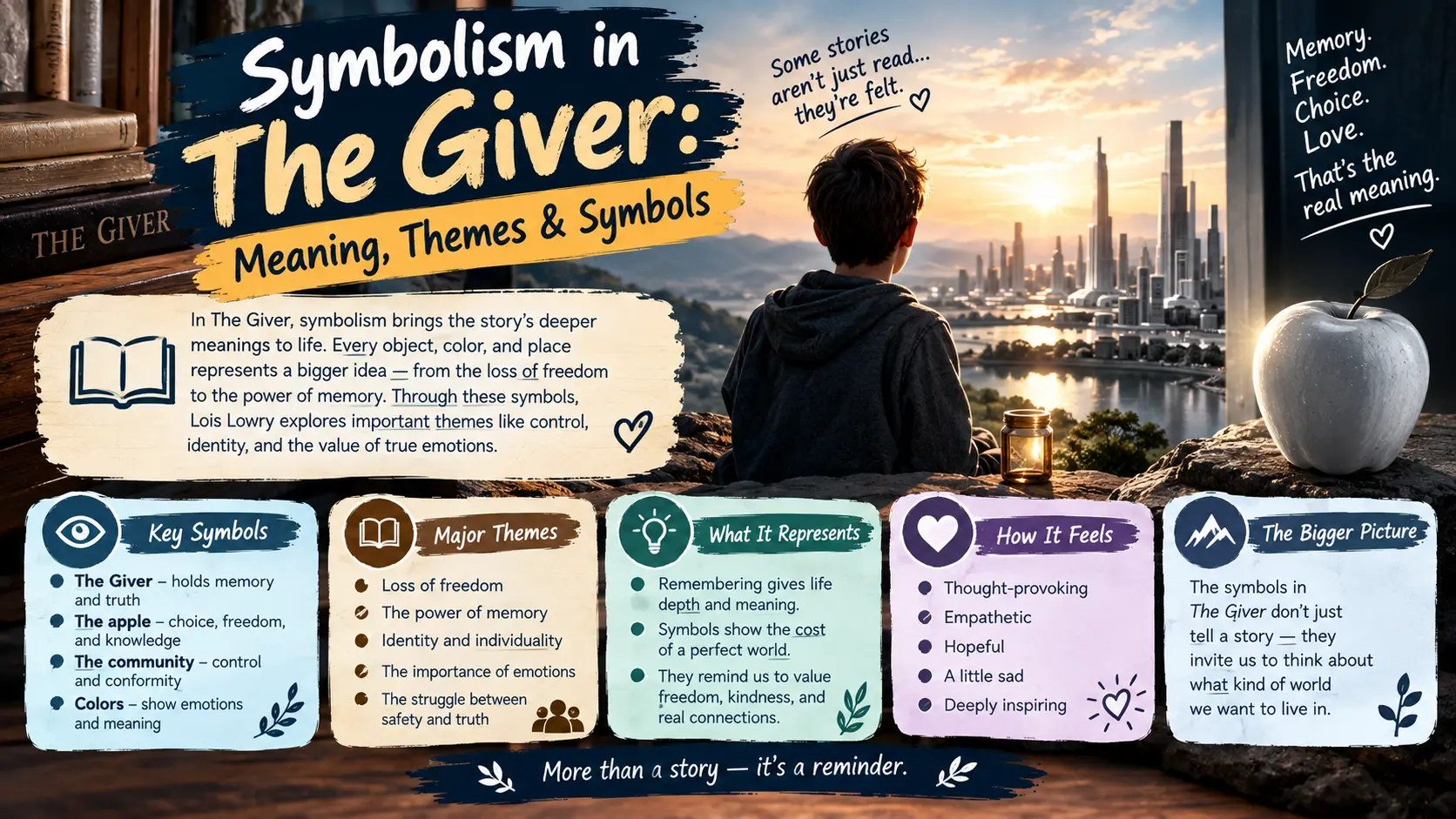
Symbolism in The Giver by Lois Lowry helps readers understand ideas that are not always stated directly. The novel uses memory, color, the apple, the river, family, nature, release, and Sameness to explore freedom, identity, emotion, choice, and the cost of creating a perfectly controlled society.
The symbols become especially important as Jonas begins to recognize that his community has removed many ordinary human experiences in exchange for security and predictability. What first appears peaceful gradually becomes more complicated as Jonas gains access to memories of pain, love, beauty, war, family, and nature.
At its heart, the symbolism of The Giver contrasts comfort with freedom and control with individuality. The symbols do not all have one fixed meaning; their significance develops as Jonas’s understanding of his world changes.
TL;DR
- Sameness symbolizes the removal of individuality and meaningful choice.
- Memory represents history, identity, emotion, and human wisdom.
- Color symbolizes awareness, difference, beauty, and expanded perception.
- The apple is connected with Jonas’s early awakening to something beyond ordinary perception.
- The Giver represents the burden of remembering experiences that society has rejected.
- Release symbolizes the darker consequences of euphemistic language and social control.
- Family units represent relationships designed and regulated by the community.
- Nature represents experiences that cannot be completely controlled.
- The river can be interpreted as movement, separation, transition, and escape.
- Together, these symbols reveal the novel’s larger questions about freedom, responsibility, individuality, and what makes life fully human.
What The Giver Is About and Why Its Symbols Matter
The Giver follows Jonas, a young boy living in a highly organized community where almost every part of life is regulated. Citizens receive assigned jobs, follow established rules, use carefully controlled language, and live according to a social system designed to minimize conflict and uncertainty.
When Jonas is selected to become the new Receiver of Memory, he begins receiving memories from The Giver. These memories introduce him to experiences that his community has eliminated or hidden, including intense pain, deep love, war, family connections, color, natural landscapes, and physical suffering.
Symbolism makes this transformation easier to understand. A symbol can represent an idea beyond its literal function, and Lowry repeatedly uses ordinary objects, experiences, and institutions to communicate larger themes.
For example, color is not merely a visual detail. As Jonas begins noticing color, readers can connect his changing perception with his growing awareness. Similarly, memory is more than information from the past. It becomes a representation of the experiences necessary for understanding humanity.
The symbolic structure therefore develops alongside Jonas. As his perception expands, the meanings of familiar things become increasingly complicated.
The Controlled World of the Community
The community is designed around predictability. Citizens are given carefully regulated lives, and major decisions are made through social systems rather than individual preference. The environment appears orderly because many sources of uncertainty have been deliberately removed.
This controlled environment functions symbolically as a picture of security taken to an extreme. The community attempts to prevent suffering by limiting the experiences that might produce it. In doing so, however, it also limits freedom, diversity, emotional depth, and personal choice.
The setting demonstrates an important tension: a society can reduce certain forms of suffering while also reducing opportunities for genuine human experience. Jonas gradually recognizes that the community’s peaceful appearance depends partly on what its citizens do not know.
The controlled environment also makes the later symbols more powerful. When Jonas encounters color, memories, music, nature, and intense emotions, these experiences seem extraordinary partly because his ordinary world has been so carefully restricted.
Sameness and the Loss of Individuality
Sameness is one of the most important symbolic concepts in The Giver. It represents the community’s attempt to eliminate differences that might produce disagreement, inequality, uncertainty, or discomfort.
On one level, Sameness promises stability. People do not have to navigate countless choices because the community has already determined many aspects of their lives. This creates an environment in which citizens can follow familiar patterns without constantly making difficult decisions.
On another level, however, Sameness symbolizes the loss of individuality. Differences in appearance, climate, landscape, personal preference, and lifestyle are reduced or eliminated. Jonas eventually discovers that eliminating differences also eliminates many forms of beauty and personal experience.
The symbol becomes especially significant because Jonas does not initially understand what has been lost. His growing awareness allows readers to see the difference between simply having a safe life and having the freedom to experience life in its full range.
Sameness therefore represents both social order and the price of excessive uniformity.
The Core Meaning of the Story’s Symbolic System
The symbols in The Giver work together rather than existing as completely separate ideas. Memory, color, Sameness, release, family, and nature all contribute to the novel’s larger exploration of human experience.
Many of these symbols can be understood through contrasts. Memory contrasts with ignorance. Color contrasts with uniformity. Choice contrasts with assignment. Emotion contrasts with regulation. Nature contrasts with artificial control.
This pattern gives the novel its symbolic structure. Jonas moves from a limited understanding of his community toward a broader understanding of what has been sacrificed to maintain its stability.
The symbolic system also encourages readers to think about the difference between knowing that something exists and actually experiencing it. Jonas may have been physically safe before becoming the Receiver, but he had not yet experienced the emotional and historical knowledge that allows him to understand that safety critically.
The symbols ultimately reinforce the idea that human life involves complexity, difference, memory, emotion, and responsibility.
Memory as a Symbol of Identity and Human Experience
Memory is arguably the most important symbol in the novel. The community has separated ordinary citizens from collective memories, while The Giver and Receiver carry those memories on behalf of everyone else.
This arrangement allows the community to avoid confronting painful historical experiences. Citizens do not have to remember war, hunger, extreme weather, or other suffering. But they also lose access to memories of deep happiness, beauty, love, and connection.
Memory therefore symbolizes the complete range of human experience.
Jonas’s memories also transform his understanding of identity. Before becoming the Receiver, he knows the rules and routines of his community. After receiving memories, he begins understanding why certain emotions and experiences matter.
Memory gives him context. Without it, the present appears complete. With it, Jonas realizes that the community’s present has been constructed by removing parts of the past.
The symbol suggests that remembering is not simply an intellectual activity. Memory influences empathy, judgment, identity, and moral understanding.
Emotional Control and the Cost of Stability
The community regulates emotions as carefully as it regulates behavior. Citizens use prescribed language and take medication to control strong feelings associated with sexual development.
This emotional regulation symbolizes an attempt to create social stability by limiting experiences that can be unpredictable or difficult.
The system initially appears practical. If citizens do not experience overwhelming emotions, they may be less likely to experience jealousy, conflict, obsession, or intense desire. Yet the novel gradually reveals another side of this arrangement.
When Jonas begins experiencing deeper emotions, he realizes that eliminating emotional extremes also reduces the possibility of profound love, passion, grief, and joy.
Emotional control therefore becomes a symbol of the larger conflict between a life that is carefully managed and a life that is deeply experienced.
Color as a Symbol of Awareness and Change
Color is one of the most recognizable symbols in The Giver. Jonas gradually begins seeing color while most members of the community do not consciously perceive the full range of colors.
Red is particularly important because it is among the first colors Jonas notices. The experience signals that his perception is changing.
Color can therefore symbolize awareness, individuality, beauty, and the discovery of differences. In a community organized around Sameness, seeing color becomes a reminder that the world contains distinctions that the social system has attempted to suppress.
The symbolism becomes stronger as Jonas understands that his community’s lack of color is not simply a natural condition. It is connected to deliberate social control.
Color also parallels Jonas’s development. His vision expands at roughly the same time that his emotional and intellectual awareness expands. What he sees becomes a visual representation of what he is beginning to understand.
The Apple in The Giver: A Symbol of Awakening
The apple appears early in Jonas’s story and becomes associated with his unusual perception. When Jonas notices something different about the apple, he cannot initially explain what he has seen.
Later, readers understand that Jonas is beginning to perceive color.
The apple can therefore be interpreted as a symbol of awakening perception. It is an ordinary object that becomes extraordinary because Jonas sees something that others do not consciously recognize.
The moment also prepares readers for Jonas’s later transformation. His ability to notice the apple’s difference is an early indication that he is capable of perceiving beyond the limitations of the community.
The apple can also be connected to the novel’s broader theme of discovery. Jonas is not simply learning new facts; he is learning to question what he previously assumed was normal.
Jonas and the Symbolism of Seeing Beyond the Ordinary
Jonas himself develops into an important symbolic figure. His transformation represents the process of moving from passive acceptance toward conscious awareness.
At the beginning, Jonas follows community expectations and assumes that its systems are appropriate. He has no reason to question many of the practices around him because he has never experienced an alternative.
As Receiver, however, he gains knowledge unavailable to most citizens. His new awareness makes ordinary events look different.
Jonas’s developing ability to perceive color, understand memories, and recognize emotional complexity symbolizes the awakening of individual consciousness.
His journey is not simply about breaking rules. It is about understanding what those rules mean and recognizing the consequences hidden behind seemingly harmless language and traditions.
The Giver and the Burden of Collective Memory
The Giver represents one of the most complicated symbols in the novel. He is the person who carries the community’s memories and passes them to Jonas.
His role demonstrates that knowledge can be both valuable and painful.
The Giver knows about experiences that ordinary citizens cannot access. This gives him a depth of understanding but also isolates him. He carries memories of suffering that the community has chosen to forget.
In this sense, The Giver symbolizes the responsibility and burden of preserving difficult knowledge.
His relationship with Jonas also demonstrates the importance of sharing experience. The memories become less isolating when another person begins to understand them.
The Giver therefore represents both the preservation of humanity’s past and the emotional cost of being responsible for knowledge that others have rejected.
Release as a Symbol of Power and Ethical Conflict
The word “release” is one of the novel’s most important examples of euphemistic language. The community uses a relatively gentle word for an act whose actual meaning is far more serious.
This makes release a symbol of how controlled language can hide morally significant actions.
Because citizens use familiar terminology, they may not initially question what release involves. The language creates psychological distance between the action and its consequences.
Jonas’s growing understanding changes the meaning of the word for him. What once sounded administrative becomes disturbing because he understands what actually happens.
The symbol demonstrates why language matters. Words do not merely describe reality; they can influence how people perceive and respond to reality.
Family Units and the Symbolism of Manufactured Relationships
Family units appear ordinary at first, but they are carefully designed by the community. Adults are matched, children are assigned, and family structures are governed by established rules.
These arrangements symbolize the community’s larger effort to regulate even the most intimate parts of life.
The family unit provides stability, but it does not operate in exactly the same way as an independently formed family based on personal choice and biological connection. The community determines much of the structure.
This becomes particularly meaningful when Jonas receives memories of families experiencing deeper forms of love and connection.
The contrast suggests that relationships can be organized socially without necessarily reproducing the full emotional complexity of human attachment.
Family therefore becomes another example of the novel’s central question: what happens when a society tries to eliminate uncertainty by controlling personal life?
Nature, Weather, and the River as Symbols of Freedom
Nature represents experiences that exist beyond the community’s carefully engineered environment. Memories of snow, sunshine, landscapes, animals, and weather introduce Jonas to forms of beauty and danger that his community has largely eliminated.
Snow is especially significant because it represents a natural environment with both beauty and difficulty. The community’s climate control removes the problems associated with extreme weather, but it also removes the experience itself.
Nature can therefore symbolize freedom, unpredictability, beauty, and the unavoidable complexity of life.
The river has a more specific symbolic role. It forms a boundary and becomes associated with movement, separation, danger, and transition. Jonas’s journey is physically and symbolically connected to crossing boundaries that once seemed fixed.
The river can consequently be interpreted as a symbol of change and passage from one state of existence to another.
Its meaning is not limited to a single interpretation. Depending on the scene and reader, the river may also suggest uncertainty, escape, connection, or the boundary between the controlled community and a less predictable world.
Important Symbols in The Giver at a Glance
| Symbol | Common Interpretation |
|---|---|
| Sameness | Uniformity, control, reduced individuality |
| Memory | History, identity, wisdom, human experience |
| Color | Awareness, difference, beauty, perception |
| Apple | Early awakening and changed perception |
| The Giver | Knowledge, memory, responsibility, burden |
| Release | Hidden consequences and euphemistic control |
| Family units | Social organization of relationships |
| Nature | Freedom, unpredictability, beauty |
| River | Transition, boundaries, movement, escape |
| Snow | Natural experience and complexity |
| Music | Emotional depth, connection, and discovery |
| Jonas | Awareness, individuality, moral questioning |
These symbols become more meaningful when considered together. Rather than delivering isolated messages, they create a network of contrasts between control and freedom, sameness and difference, ignorance and knowledge, and safety and authentic experience.
How U.S. Schools Interpret the Novel’s Symbolism
The Giver has been widely used in U.S. educational settings because its accessible narrative introduces students to complex ideas about society, ethics, individuality, language, and government.
Classroom interpretations often examine how the community’s systems affect individual freedom and decision-making. Students may also analyze symbols such as color, memory, the apple, the river, and release to understand how literary details contribute to the novel’s themes.
The book is particularly useful for teaching symbolism because many symbols develop gradually. Students can identify an object or event early in the story and then reconsider its meaning after learning more about Jonas’s world.
In educational discussions, the novel can also support conversations about dystopian fiction, social conformity, ethical responsibility, persuasive language, and the relationship between individual identity and society.
Interpretations can differ between classrooms because symbolism is not always limited to one officially correct meaning. Strong literary analysis usually connects an interpretation to specific details from the text rather than treating every possible association as equally supported.
Why Symbolism Matters to the Novel’s Central Themes
Without its symbolic elements, The Giver would still tell the story of Jonas and his community, but the story’s larger ideas would be less layered.
Symbols allow Lowry to turn abstract concepts into experiences readers can visualize. Instead of simply explaining that individuality matters, the novel shows Jonas discovering color. Instead of simply stating that history matters, it makes memory a physical burden carried by particular people.
This approach gives the themes emotional force.
The symbols also encourage readers to question appearances. The community appears peaceful, but the meaning of release complicates that peace. Family units appear familiar, but their construction raises questions about personal choice. Emotional control appears orderly, but it also removes emotional depth.
Symbolism makes the reader look beneath the surface of the community, just as Jonas learns to do.
Psychological Meaning and the Reader’s Experience
The symbolism of The Giver can also be understood through the psychological experience of perception and awareness.
Jonas begins with a relatively narrow understanding of his world. As he receives memories, his emotional range and ability to recognize complexity increase.
Readers experience a similar shift. At first, the community’s rules may seem strange but orderly. Later revelations force readers to reconsider earlier scenes.
This creates a psychological effect in which knowledge changes the meaning of previous experiences.
The symbolism of color is especially effective in this respect. When Jonas begins seeing something different, the reader is invited to experience his curiosity before fully understanding its significance.
Memory works similarly. A remembered experience can change how a person understands the present, which mirrors the novel’s larger argument about the relationship between knowledge and perception.
How the Meaning of The Giver Has Evolved Over Time
The central concerns of The Giver remain relevant because questions about individuality, technology, social organization, emotional regulation, and personal choice continue to appear in modern discussions.
Readers from different generations may emphasize different aspects of the novel. Earlier readers may focus strongly on conformity and political or social control, while contemporary readers may also examine information management, standardized systems, emotional well-being, privacy, and the effects of highly regulated environments.
The novel’s symbolism supports this continuing reinterpretation because its major symbols are broad enough to connect with changing cultural concerns.
Importantly, modern interpretation does not require changing the original meaning of the book. Instead, new readers can bring different experiences to the same symbolic details.
The continuing relevance of The Giver comes partly from its central question: how much should people give up in exchange for safety, stability, and predictability?
Symbolism in The Giver in Modern Culture and Education
The symbols from The Giver continue to appear in classroom discussions, literary analysis, essays, book clubs, and conversations about dystopian fiction.
The idea of Sameness is particularly recognizable because it provides a simple way to discuss the tension between equality and individuality. Memory remains important because modern societies also debate how historical knowledge shapes identity and collective responsibility.
Color has become one of the easiest symbols for readers to remember because it connects a visible transformation with an intellectual one. Jonas does not merely learn that differences exist; he begins to perceive them directly.
The novel’s symbolic vocabulary also helps explain why dystopian fiction remains attractive to young readers. Stories about controlled societies give readers a fictional space in which they can examine choice, conformity, identity, responsibility, and freedom without beginning with an abstract philosophical argument.
FAQs About Symbolism in The Giver
Why does memory matter so much in The Giver?
Memory represents the accumulated experiences of humanity. It gives Jonas knowledge of both suffering and happiness that the community has removed from ordinary life. Memory also creates empathy and helps people understand the consequences of their choices.
What does color represent in The Giver?
Color commonly symbolizes awareness, individuality, difference, and beauty. Jonas’s ability to see color develops as he becomes more aware of the limitations of Sameness. Color therefore visually represents his expanding perception.
Why does the story use the term “release”?
“Release” is a euphemistic term used by the community to make a serious action sound neutral or administrative. Its symbolic importance lies in showing how controlled language can conceal uncomfortable realities and affect how people understand their actions.
Is Jonas a symbol of rebellion?
Jonas can be interpreted as a symbol of individual awareness and moral questioning. His actions challenge the community’s established system, but his development is more complicated than simple rebellion because he first seeks to understand the truth behind that system.
Why is The Giver frequently taught in schools?
The novel provides students with an accessible way to explore symbolism, dystopian literature, individuality, ethics, language, conformity, and social control. Its symbols also develop throughout the story, making it useful for literary analysis.
What does the river symbolize in The Giver?
The river can symbolize transition, boundaries, movement, danger, and escape. Its meaning becomes particularly important when Jonas’s physical journey parallels his movement away from the controlled community and toward an uncertain future.
Conclusion
The symbolism in The Giver gives the novel much of its emotional and intellectual depth. Sameness represents uniformity, memory represents human experience, color represents awareness, and nature represents possibilities that cannot be completely controlled.
Other symbols deepen the same ideas. The apple marks an early change in Jonas’s perception, The Giver represents the burden of knowledge, release demonstrates the power of euphemistic language, and the river suggests transition and movement beyond established boundaries.
Together, these symbols create a story about what can be lost when a society attempts to eliminate uncertainty completely. Jonas’s journey shows that freedom can involve difficult choices and painful knowledge, but it can also create opportunities for individuality, emotional depth, connection, and meaningful understanding.
Ultimately, The Giver uses symbolism to encourage readers to look beyond appearances. Its most important symbols ask readers to consider what makes a life meaningful, how memory shapes identity, and what people may sacrifice when security becomes more important than freedom and human complexity.