Fupa Meaning Slang: Definition, Uses & Examples
If you have seen “fupa” in a TikTok comment, Instagram caption, meme, or casual conversation, you may have wondered what this unusual slang word means.
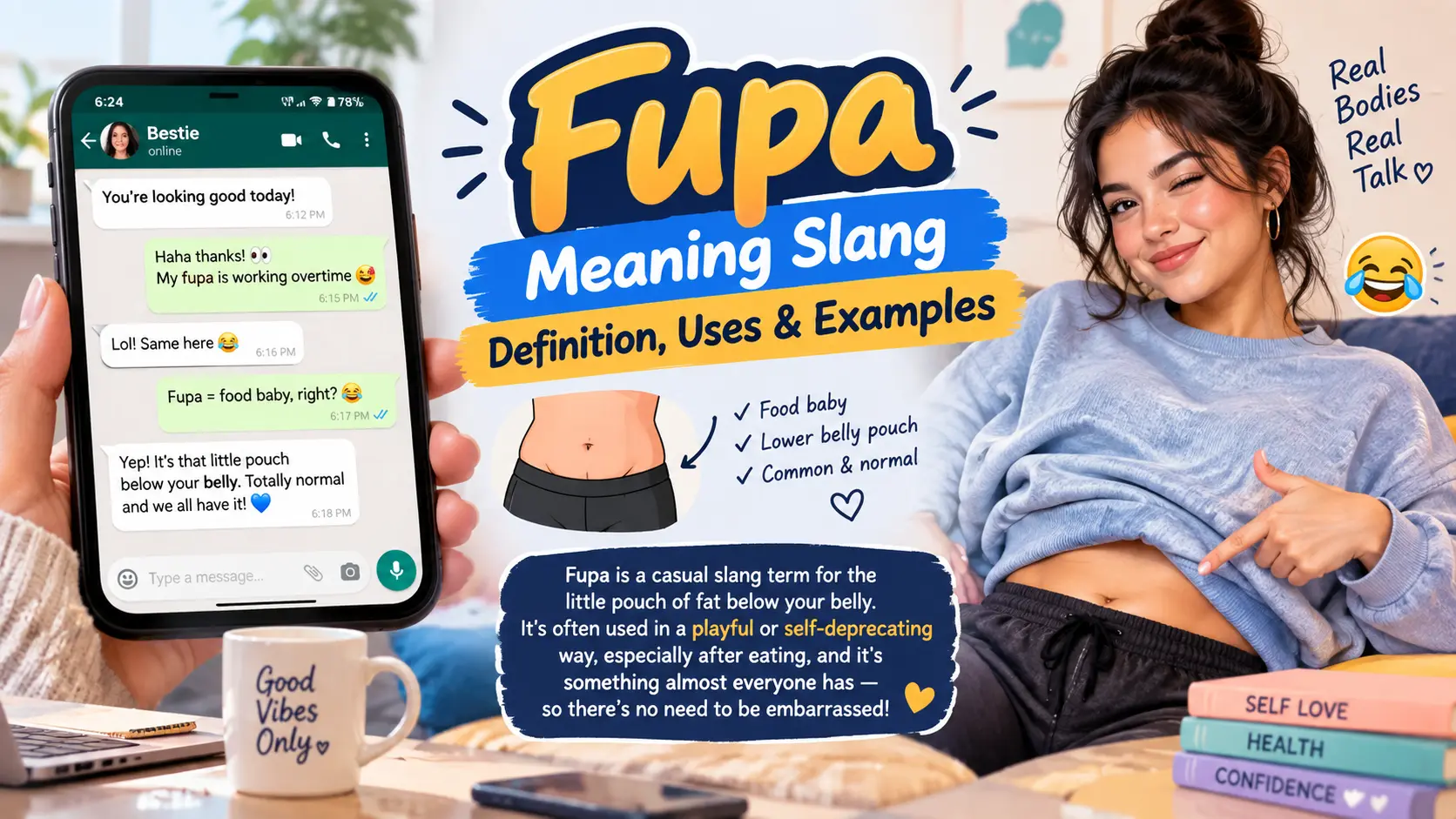
Fupa is an informal slang term commonly used to describe the soft or fatty area of the lower abdomen, particularly the area between the belly button and the pubic region. It is often used in conversations about body shape, weight, clothing, fitness, or body image.
The word can be humorous and self-deprecating, but it can also become insulting depending on who says it and how it is used. That difference matters because comments about someone’s body can carry much more emotional weight than the speaker intends.
In this guide, we will explore the fupa meaning slang, where the term came from, how people use it online, what emotions it can communicate, and when it is better to avoid using it.
Fupa Meaning Slang: Quick Meaning
Fupa is an informal slang word for the lower belly or lower abdominal fat area, especially the area above the pubic region.
It is not a formal anatomical term. It is primarily associated with casual internet culture, humor, body discussions, and social media.
In simple terms:
- Fupa: Slang for lower abdominal fat or a lower-belly bulge.
- Tone: Usually casual, humorous, self-deprecating, or body-focused.
- Context: Commonly seen in social media posts, memes, fitness discussions, and conversations about clothing.
- Formality: Very informal and generally unsuitable for professional communication.
For example:
“These jeans make my fupa look bigger.”
“I’m learning to be comfortable with my fupa.”
“That workout helped strengthen my core, but my lower belly is still there.”
The word can be used jokingly about oneself, but using it toward another person may sound judgmental.
Origin & Background of Fupa
The exact history of fupa is less straightforward than many common abbreviations. The word became especially visible through American internet and popular culture, where humorous body-related language often develops quickly.
One widely repeated explanation connects the term with the phrase “fat upper pubic area.” However, this expansion is often treated as a backronym rather than a clearly documented original source.
Over time, the word moved beyond niche internet conversations and became recognizable across social platforms.
6
Social media played a major role in spreading the expression.
TikTok videos, Instagram posts, memes, fitness content, and humorous personal stories helped turn fupa into a familiar piece of body-related slang.
Its meaning has also shifted slightly depending on the speaker. Someone may use it humorously, while another person may use it as part of a body-acceptance conversation.
That context is essential.
Real-Life Conversations
The easiest way to understand fupa meaning slang is to see how it sounds in actual conversations.
WhatsApp Conversation
Person A:
“I bought a fitted dress for the wedding.”
Person B:
“Nice! How does it look?”
Person A:
“Honestly, I like it, but I’m worried about my fupa showing.”
Person B:
“Don’t overthink it. You look great, and the dress suits you.”
Here, the speaker uses fupa while expressing insecurity about appearance.
Instagram DM
Person A:
“Girl, where did you get those jeans?”
Person B:
“Online. They’re super comfortable.”
Person A:
“Do they hide the lower belly area?”
Person B:
“Yeah, pretty well. I have a fupa too, and they’re actually flattering.”
In this conversation, the word is being used casually between friends.
TikTok Comment
Person A:
“This video is so relatable 😂”
Person B:
“Especially the part about trying on five outfits because of the fupa 😂”
Person A:
“Exactly! The struggle is real.”
The term becomes part of humorous internet language.
Text Message
Person A:
“I’m going to the beach tomorrow and suddenly I’m conscious about my stomach.”
Person B:
“Please don’t stress about it.”
Person A:
“I know. I just feel weird about my fupa.”
Person B:
“Everyone has things they’re insecure about. Go enjoy the beach.”
Here, the term carries emotional meaning rather than simply describing body shape.
Emotional & Psychological Meaning
Although fupa technically refers to a physical area, the emotional meaning can be much deeper.
People often use the term when discussing body insecurity, embarrassment, humor, acceptance, or confidence.
For some people, saying “I have a fupa” is a way of making an uncomfortable subject easier to discuss.
Humor can reduce embarrassment. When someone jokes about their own body, they may feel more in control of a subject that otherwise makes them uncomfortable.
At the same time, self-deprecating language can sometimes reinforce negative feelings about appearance.
For example, imagine someone getting dressed before meeting friends. Their clothes fit differently than expected, and they immediately focus on their lower stomach.
They might joke, “My fupa is having its own moment today.”
The joke may genuinely make them laugh. But underneath it could also be anxiety about how other people see their body.
This is one reason language matters. A word that feels harmless when someone uses it about themselves can feel hurtful when another person directs it at them.
Modern communication often mixes humor and vulnerability in the same sentence. Slang like fupa is a good example of that complicated relationship.
Usage in Different Contexts
Social Media
Fupa is relatively common in informal social media discussions involving body image, clothing, fitness, weight changes, and humor.
A creator might use the term in a caption to describe their own body in a playful way.
Comments may also use it jokingly, although commenters should be careful when discussing someone else’s appearance.
Friends and Relationships
Close friends may use the word comfortably when discussing clothes, exercise, confidence, or personal experiences.
The relationship matters.
A close friend making a self-directed joke is different from someone making an unsolicited comment about another person’s body.
Work and Professional Settings
Fupa should generally be avoided in professional communication.
It is slang, and conversations about another person’s body can easily become inappropriate in a workplace.
Instead of using slang, professional communication should use neutral language when discussing relevant topics such as clothing fit or general wellness.
Casual vs Serious Tone
The word is usually casual.
It may appear in:
- Memes
- TikTok captions
- Instagram posts
- Group chats
- Casual texts
- Body-positive discussions
- Fitness conversations
It is less appropriate in formal writing or professional discussions.
When NOT to Use Fupa
Knowing when not to use slang is just as important as understanding its definition.
Avoid using fupa toward someone who has not indicated that they are comfortable with body-related humor.
For example, saying:
“You have a big fupa.”
can easily sound insulting or humiliating.
Even if the speaker intended it as a joke, the recipient may hear criticism about their appearance.
It is also inappropriate to use the term in professional situations unless there is an unusually specific reason to discuss the word itself.
Cultural sensitivity matters too. Not everyone interprets body-related slang in the same way.
Some people see the term as empowering or funny. Others consider it crude, embarrassing, or disrespectful.
When uncertain, neutral language is safer.
Common Misunderstandings
1. Fupa Is Not a Medical Term
One of the most important points is that fupa is slang, not formal anatomical terminology.
A medical professional would normally use precise anatomical language rather than this internet expression.
2. It Does Not Describe One Exact Body Shape
People use the word broadly.
One person’s use may refer to a small lower-belly fold, while another person may use it for more noticeable lower-abdominal tissue.
There is no precise measurement or medical definition.
3. It Is Not Automatically an Insult
The meaning depends heavily on context.
When someone says:
“I love my fupa.”
they may be expressing body acceptance.
When someone says:
“Look at her fupa.”
the same word can become mocking or disrespectful.
4. Humor Does Not Remove Emotional Impact
A laughing emoji does not always make a body-related comment harmless.
People can joke about subjects that genuinely make them vulnerable.
5. Fupa Does Not Mean “Overweight”
The term refers to a body area, not a person’s overall weight.
People with different body types may use the word.
Comparison Table
| Expression | Meaning | Typical Tone | Common Context |
|---|---|---|---|
| Fupa | Slang for lower abdominal/pubic-area fat | Casual, humorous | Social media and personal conversations |
| Belly fat | Fat around the abdominal area | Neutral | Fitness and everyday conversation |
| Lower belly | Lower part of the abdomen | Neutral | General description |
| Love handles | Fat around the sides of the waist | Casual | Body and fitness discussions |
| Muffin top | Body fat that appears above a tight waistband | Informal | Clothing and body discussions |
| Flat stomach | An abdomen with relatively little visible protrusion | Descriptive | Fitness and appearance |
| Toned | Describes an appearance associated with muscle definition | Positive/neutral | Fitness and lifestyle |
| Slim waist | A relatively narrow waist | Descriptive | Fashion and body descriptions |
| Body-positive language | Language emphasizing acceptance and respect | Supportive | Wellness and social media |
| Body-shaming | Criticizing or humiliating someone based on appearance | Negative | Social interactions and online comments |
Key Insight
Fupa is primarily a humorous body-related slang term, but its emotional meaning depends on context, relationship, and intention. Self-use can express humor or acceptance, while directing it at another person can easily become body-shaming.
Variations and Types
There are several ways people use or adapt the term in online conversations.
1. Fupa
Meaning: The basic slang term.
It refers broadly to the lower abdominal or upper pubic-area region.
2. My Fupa
Meaning: A self-referential version.
People often use this when joking about or discussing their own body.
3. Fupa Area
Meaning: A slightly more descriptive phrase.
It is often used when someone wants to clarify which part of the body they mean.
4. Fupa Roll
Meaning: A humorous description of a fold of tissue in the lower abdominal area.
The phrase is particularly informal and should be used carefully.
5. Fupa Pouch
Meaning: A playful description of a lower-belly shape.
It frequently appears in humorous body discussions online.
6. Fupa-Friendly Clothing
Meaning: Clothing described as comfortable or flattering around the lower abdomen.
This phrase is commonly used in casual fashion discussions.
7. Fupa Workout
Meaning: A casual phrase for exercises marketed toward the lower belly.
It is worth remembering that slang fitness labels do not necessarily describe how human fat loss works physiologically.
8. Fupa Confidence
Meaning: Confidence or acceptance despite having lower abdominal fat.
This usage often appears in body-positive conversations.
9. Fupa Humor
Meaning: Jokes about the lower belly or body shape.
The humor can be self-directed or shared among people who are comfortable with the subject.
10. Fupa Acceptance
Meaning: Accepting one’s body rather than treating the lower belly as something shameful.
This represents a more supportive use of the slang.
How to Respond When Someone Uses It
Your response should depend on the relationship and tone.
Casual Replies
- “Haha, I know what you mean.”
- “Yep, bodies are bodies.”
- “Totally relatable.”
- “Honestly, same.”
Funny Replies
- “She deserves her own zip code 😂”
- “We’re not fighting the fupa today 😂”
- “Let it live!”
- “Confidence first, everything else second.”
Mature Replies
- “There is nothing wrong with having a lower belly.”
- “I think comfort matters more than perfection.”
- “Bodies naturally have different shapes.”
Respectful Replies
- “I understand what you mean.”
- “If you’re comfortable talking about it, that’s what matters.”
- “Everyone’s body is different.”
- “You don’t need to apologize for your body.”
If someone uses the term negatively toward you, you can also set a simple boundary:
“I’d rather not have comments made about my body.”
That response is direct without escalating the situation.
Regional & Cultural Usage
The meaning of fupa slang is relatively consistent online, but its social acceptability can differ between communities.
Western Culture
In the United States and other English-speaking Western communities, the word has become recognizable through internet culture, entertainment, memes, and social media.
It is generally understood as informal body-related slang.
Asian Culture
In many Asian communities, English internet slang is frequently mixed with local languages.
The term may be understood by younger social-media users but may not be familiar to older generations.
Body-related conversations can also carry different levels of social sensitivity depending on family and cultural setting.
Middle Eastern Culture
Among English-speaking internet users in the Middle East, the word may appear through global social media platforms.
However, body-related slang may not be equally comfortable in every social or family environment.
A private joke among friends can have a very different meaning from a public comment.
Global Internet Usage
TikTok, Instagram, YouTube, Reddit, and other platforms have helped slang travel across national boundaries.
As a result, someone in one country may recognize an American slang term even though they would never use it in everyday conversation.
Gen Z vs Millennials
Younger internet users may encounter fupa primarily through short-form videos, memes, comments, and body-positive content.
Millennials may recognize it through earlier internet culture, blogs, forums, entertainment, and social media.
The difference is not absolute. Individual familiarity depends more on online communities and interests than age alone.
Is Fupa Safe for Kids?
Fupa is not inherently dangerous, but it is body-related slang and requires context.
Children may encounter it online without understanding why someone might find the term embarrassing or offensive.
Parents and educators can explain that slang words sometimes describe people’s bodies in humorous ways, but that does not give people permission to make unwanted comments about someone’s appearance.
The larger lesson is simple: respect other people’s boundaries when discussing bodies.
FAQs
What does fupa mean in slang?
Fupa is informal slang for the soft or fatty area of the lower abdomen, particularly the area above the pubic region.
Is fupa a medical term?
No. Fupa is slang, not a formal medical or anatomical term.
Is calling someone fupa an insult?
It can be. The term may be harmless when someone uses it about themselves, but directing it at another person’s body can sound insulting or body-shaming.
Where did the word fupa come from?
The word became popular through American internet and popular culture. It is often explained as meaning “fat upper pubic area,” although that expansion is commonly treated as a later backronym rather than a firmly established original source.
Can I use fupa in a professional conversation?
Generally, no. It is highly informal body-related slang and is better avoided in workplace or professional communication.
Is fupa the same as belly fat?
Not exactly. Fupa is an informal term generally referring to the lower abdominal or upper pubic area, while belly fat is a broader term for abdominal fat.
Can fupa be used positively?
Yes. Some people use the word humorously or positively when discussing body acceptance, confidence, and self-love.
Conclusion
Understanding fupa meaning slang is about more than memorizing a definition.
The word generally describes the lower-belly or upper pubic-area region, but its emotional meaning changes according to who says it, who hears it, and why it is being used.
Online, fupa can appear as a joke, a personal description, a body-positive statement, or an uncomfortable comment about someone’s appearance.
The safest approach is to pay attention to context and consent. Using the term about yourself can be a personal choice, but using body-related slang about someone else requires greater sensitivity.
Slang constantly evolves, and understanding that evolution helps us communicate with more confidence while still treating people with respect.