Solti Meaning in Text: What Does Solti Mean?
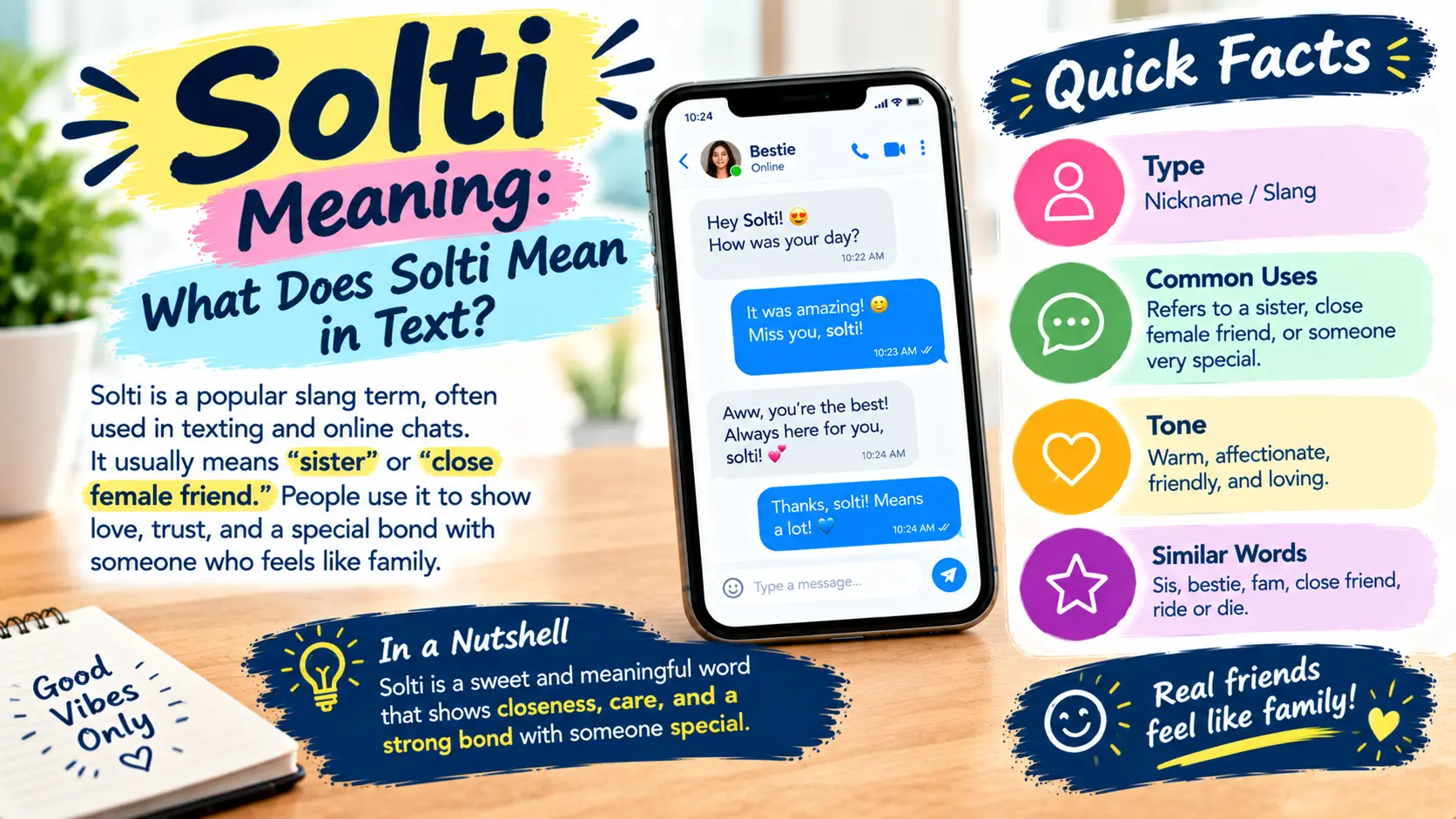
If you have recently seen “solti” in a text message, TikTok comment, Instagram DM, or casual conversation, you may have wondered what the word actually means.
At first glance, solti can look like modern internet slang. In reality, it is strongly associated with Nepali language and culture, and its meaning can change depending on the relationship between the people using it.
In casual conversations, solti is often used as a friendly way to address a male friend or familiar person. Depending on the speaker and situation, it can feel similar to “bro,” “buddy,” “mate,” “dude,” or “my guy.”
There is another important layer to understand. In some Nepali communities, solti also has a kinship-related meaning connected with family or in-law relationships. That is why translating the word into one fixed English word can sometimes be misleading.
The good news is that context usually makes the intended meaning clear.
Whether you encountered “solti” in a funny comment, a private message, or a Nepali conversation, this guide explains the meaning, emotional tone, cultural background, examples, variations, and situations where you should or should not use it.
Solti Meaning: Quick Meaning
The most common casual meaning of solti is a friendly or familiar way of addressing a male person, particularly in Nepali conversation.
In simple English, it can be close to:
- Bro
- Buddy
- Mate
- Dude
- Friend
- Familiar male companion
The exact translation depends on the relationship and tone.
For example:
“Hey solti, where are you going?”
This can naturally mean:
“Hey bro, where are you going?”
Another example:
“Thanks, solti!”
Here, the feeling is closer to “Thanks, buddy!”
You might also see:
“K cha, solti?”
In a casual Nepali setting, this can carry the feeling of asking a friend, “What’s up, bro?”
The word is generally informal. It is not normally an English acronym, and it does not have a universal expanded form.
Origin & Background of Solti
The word solti is associated with Nepali speech and cultural vocabulary. Its background is more complicated than modern internet slang because it has connections with traditional relationship and kinship language.
In some Nepali communities, solti can refer to a particular male family or in-law relationship. The exact relationship associated with the word can vary by regional and community usage.
Over time, familiar relationship terms can move beyond their original family meaning. This happens in many languages. People begin using a word among friends because it creates a sense of closeness, familiarity, or playful connection.
That development helps explain why solti can sound completely natural between friends who are not actually related.
Social media has made this kind of usage even more visible.
Nepali speakers living in different countries can communicate through Instagram, TikTok, WhatsApp, Facebook, YouTube, and messaging apps. Local expressions can therefore travel far beyond their original communities.
A word that was once mainly heard in everyday speech can now appear in comments, memes, captions, gaming conversations, and international friendships.
However, calling solti simply “internet slang” misses part of its cultural background. Its online use is better understood as an extension of informal language that already existed offline.
Solti in Real-Life Conversations
The best way to understand solti meaning in text is to see how people actually use it.
WhatsApp Conversation
Person A:
Solti, are you coming to the match today?
Person B:
Of course 😂 I’ll be there in ten minutes.
Person A:
Hurry up, solti!
Here, solti is clearly friendly. It works much like bro or buddy.
Instagram DM
Person A:
Bro, that picture turned out amazing.
Person B:
Haha thanks, solti! Took me forever to get it right.
The word adds familiarity and warmth to the conversation. It does not change the basic meaning of the message.
TikTok Comment
Person A:
Solti really thought he could make that shot 😂
Person B:
And I almost did! 😭
In this situation, solti can have a playful or teasing quality. The commenter may be joking with the person rather than criticizing him seriously.
Text Message
Person A:
You disappeared yesterday, solti. Everything okay?
Person B:
Yeah, bro. Had a rough day and needed some space.
Here, the word feels supportive and familiar. The surrounding sentence makes the emotional context clear.
These examples show an important point: solti does not carry exactly the same emotional weight in every sentence.
The relationship, punctuation, emojis, and surrounding words all influence how it sounds.
Emotional & Psychological Meaning of Solti
Words like solti are interesting because their meaning is partly social rather than purely dictionary-based.
When someone calls a close friend solti, they may be signaling familiarity. It can communicate the feeling of, “We know each other well enough to speak casually.”
That sense of belonging matters in everyday communication.
People often use informal labels with friends because formal language can create distance. Calling someone “sir” or using their full name feels different from saying “bro,” “buddy,” or solti.
Solti can therefore create a relaxed atmosphere.
It may also express playful teasing. Close friends frequently tease each other without intending genuine hostility. A culturally familiar word can make that teasing feel lighter.
For example, imagine a friend arriving twenty minutes late.
You might say:
“Finally, solti! We thought you got lost.”
The sentence is not necessarily angry. Depending on the relationship, it may actually communicate affection.
I have found that the most important clue in these situations is not the word itself. It is the relationship behind the word. The same expression can feel warm between close friends and strange when used by a stranger.
That is why context matters so much with culturally specific language.
Usage in Different Contexts
Social Media
On Instagram, TikTok, Facebook, and similar platforms, solti may appear in comments, captions, replies, and direct messages.
It can be used to greet someone, compliment them, tease them, or simply make a message sound more familiar.
For example:
“Looking good, solti 😂”
The tone is casual and friendly.
Friends and Relationships
Among friends, solti can work like bro, mate, or buddy.
It may be particularly natural when the people already have an established relationship.
The closer the relationship, the more playful the word can become.
Work and Professional Settings
Professional communication requires more caution.
Using solti with a close coworker who already speaks casually may be fine in a private conversation. However, it is not the safest choice for formal emails, interviews, client communication, official documents, or conversations with unfamiliar senior colleagues.
Instead of:
“Solti, can you send the report?”
a professional message would usually be:
“Could you please send the report when you have a moment?”
The difference is not about one word being bad. It is about choosing language that fits the situation.
Casual vs. Serious Tone
Solti is naturally more comfortable in casual communication.
If the conversation suddenly becomes serious, the word may still appear, but its emotional effect can change.
For example:
“Solti, we really need to talk about what happened.”
Here, solti creates familiarity, but the sentence itself signals seriousness.
See Also: Dipsy Meaning: What Does Dipsy Mean in Text and Conversation?
When NOT to Use Solti
Although solti is generally friendly in appropriate contexts, it should not automatically be used with everyone.
First, avoid using it with strangers if you are unsure whether they understand the expression.
Second, be careful in formal professional environments. A culturally specific casual word may sound too familiar.
Third, remember that Nepali usage can vary between communities. A person from one region or family background may interpret the term differently from someone else.
Cultural sensitivity is especially important when borrowing words from another language.
If you are not familiar with the speaker’s background, do not assume that your interpretation is automatically correct.
The safest approach is simple: look at the whole conversation before deciding what solti means.
Common Misunderstandings About Solti
One common mistake is assuming that solti has only one fixed English translation.
It does not.
In one conversation, it may feel like bro. In another, buddy or mate may be closer. In a family context, it can have a more specific kinship meaning.
Another misunderstanding is assuming that every use of solti is internet slang.
That is not necessarily true. The word has cultural and conversational roots that exist independently of social media.
People may also confuse friendly teasing with genuine insult.
Consider:
“Nice one, solti 😂”
This could be sincere praise or playful sarcasm.
Now compare:
“Seriously, solti?”
That could express disappointment, disbelief, frustration, or joking irritation.
The word has not changed. The context and tone have.
Solti Comparison Table
| Expression | Similarity to Solti | Typical Tone | Common Meaning |
|---|---|---|---|
| Bro | Very close | Friendly | Friend or familiar male |
| Buddy | Very close | Warm | Friend or companion |
| Mate | Close | Casual | Friend or peer |
| Dude | Similar | Relaxed | Informal male address |
| My guy | Similar | Friendly/playful | Familiar male friend |
| Homie | Similar | Very casual | Close friend |
| Stranger | Opposite relationship | Neutral | Someone unfamiliar |
| Sir | Different formality | Respectful | Formal male address |
| Friend | Related | Neutral/warm | Person you know positively |
| Brother | Related feeling | Warm | Male friend or relative |
Key Insight
The closest English translation of solti depends on the situation. Bro, buddy, mate, and dude can capture its casual feeling, but none of them perfectly represents every cultural or kinship-related use.
Variations and Types of Solti Usage
Solti does not have ten standardized dictionary “versions.” Instead, its meaning and emotional tone can vary according to context.
1. Friendly Solti
Meaning: A familiar male friend.
This is one of the most straightforward casual uses.
2. Playful Solti
Meaning: A friendly nickname used while joking.
It often appears alongside laughter or playful emojis.
3. Teasing Solti
Meaning: A familiar way to tease a friend.
The tone depends heavily on whether the people normally joke with each other.
4. Respectful Familiarity
Meaning: A culturally familiar form of address.
In some conversations, the word can show familiarity without being insulting or overly casual.
5. Social Media Solti
Meaning: A casual term used in comments or DMs.
It can make an online interaction feel more personal.
6. WhatsApp Solti
Meaning: A relaxed way to address someone in private messaging.
The meaning is usually understood through the relationship between the people.
7. TikTok Solti
Meaning: A playful or friendly address in short-form video communities.
It may appear in comments, jokes, or creator interactions.
8. Kinship-Related Solti
Meaning: A family or in-law relationship in certain Nepali contexts.
This is why context is essential when translating the word.
9. Sarcastic Solti
Meaning: A familiar address used during light sarcasm.
For example, someone might jokingly call a friend solti after they make an obvious mistake.
10. Affectionate Solti
Meaning: A warm expression of familiarity.
The emotional message can be closer to “my guy” or “my buddy” than a literal dictionary translation.
How to Respond When Someone Uses Solti
Your response should match the relationship and tone.
Casual Replies
- “What’s up, bro?”
- “Haha, what happened?”
- “Yeah, solti 😂”
- “I’m here, bro.”
- “What’s going on?”
Funny Replies
- “Relax, solti 😂”
- “Look who finally showed up!”
- “You called, solti?”
- “What did I do this time? 😂”
Mature Replies
- “Hey, good to hear from you.”
- “What’s going on?”
- “Sure, tell me what happened.”
- “I’m listening.”
Respectful Replies
If you are unsure about the meaning or relationship, keep your response neutral.
You could say:
“Hey, how are you?”
or:
“Hi, what’s up?”
This keeps the conversation comfortable without forcing you to use a word whose cultural meaning you may not fully understand.
Regional & Cultural Usage
Western Culture
In Western English, solti is not a standard everyday word. Someone unfamiliar with Nepali language may not recognize it.
If it appears in an English-speaking online community, it is usually being used because of the speaker’s cultural background or because the community has adopted the expression.
Asian Culture
Within South Asian conversations, language often includes relationship-based forms of address that do not translate perfectly into English.
Solti fits into this broader cultural pattern, particularly in Nepali contexts.
Its meaning may depend on community, family background, and region.
Middle Eastern Culture
Solti is not a standard Middle Eastern English expression. If you see it in a conversation involving Middle Eastern users, the safest interpretation still comes from the speaker’s own language and cultural background.
It may simply be a borrowed Nepali expression used between friends.
Global Internet Usage
Social media has allowed regional vocabulary to travel quickly.
A Nepali speaker in Australia, the United States, the United Kingdom, the Gulf, or another country can use solti while chatting with friends around the world.
That does not automatically turn it into universal English slang. It simply means more people are encountering the word.
Gen Z vs. Millennials
Younger internet users may use solti more playfully in comments, memes, group chats, and short videos.
Millennials may encounter it more often through personal relationships, Nepali-speaking communities, or everyday conversation.
The difference is not absolute. The relationship between speakers remains more important than age.
Is Solti Safe for Kids?
Generally, solti is not inherently an offensive or dangerous word.
For children, the main issue is context rather than the word itself.
A child may encounter solti in a video, game chat, social media comment, or conversation and assume it simply means “bro” or “friend.”
Parents and educators can explain that some culturally specific words have different meanings depending on who says them and why.
It is also useful to teach children not to repeat unfamiliar slang toward strangers without understanding its meaning.
That simple habit helps children communicate respectfully across cultures.
FAQs About Solti Meaning
What does solti mean in text?
In casual Nepali-influenced texting, solti usually works as a friendly way to address a male friend or familiar person, similar to “bro,” “buddy,” or “mate.”
Is solti a Nepali word?
Yes. Solti is strongly associated with Nepali language and culture and has both informal conversational and, in some communities, kinship-related uses.
Is solti an acronym?
No. Solti is generally not an acronym or abbreviation that stands for a longer English phrase.
Is solti rude?
Usually, no. It is generally casual and familiar, although tone and context can make any informal expression sound teasing, sarcastic, or disrespectful.
What does solti mean on TikTok?
On TikTok, solti generally carries the same informal meaning of bro, buddy, or friend, particularly among Nepali speakers and communities familiar with Nepali expressions.
Can girls use the word solti?
Usage depends on the speaker, community, and relationship. A woman may certainly use the word when addressing someone, but the cultural context matters more than a simple gender rule.
How should I respond when someone calls me solti?
If the message is friendly, a casual response such as “What’s up, bro?”, “Haha, hey!”, or “What’s going on?” is usually appropriate.
Conclusion
Understanding solti meaning requires more than finding a single English translation.
In casual Nepali communication, solti can function as a friendly and familiar way to address a male friend, similar to bro, buddy, mate, or dude. In certain cultural and family contexts, however, it can carry a more specific relationship-based meaning.
That is why context matters.
Look at who is speaking, who they are addressing, the language surrounding the word, and the emotional tone of the conversation. A simple “solti” can express friendship, affection, humor, teasing, or familiarity depending on the situation.
Once you understand that cultural layer, the word becomes much easier to recognize and use naturally. Language is not only about dictionary definitions. Sometimes, a single word carries the feeling of an entire relationship.