MBN Meaning in Text: What Does MBN Mean?
Quick Answer
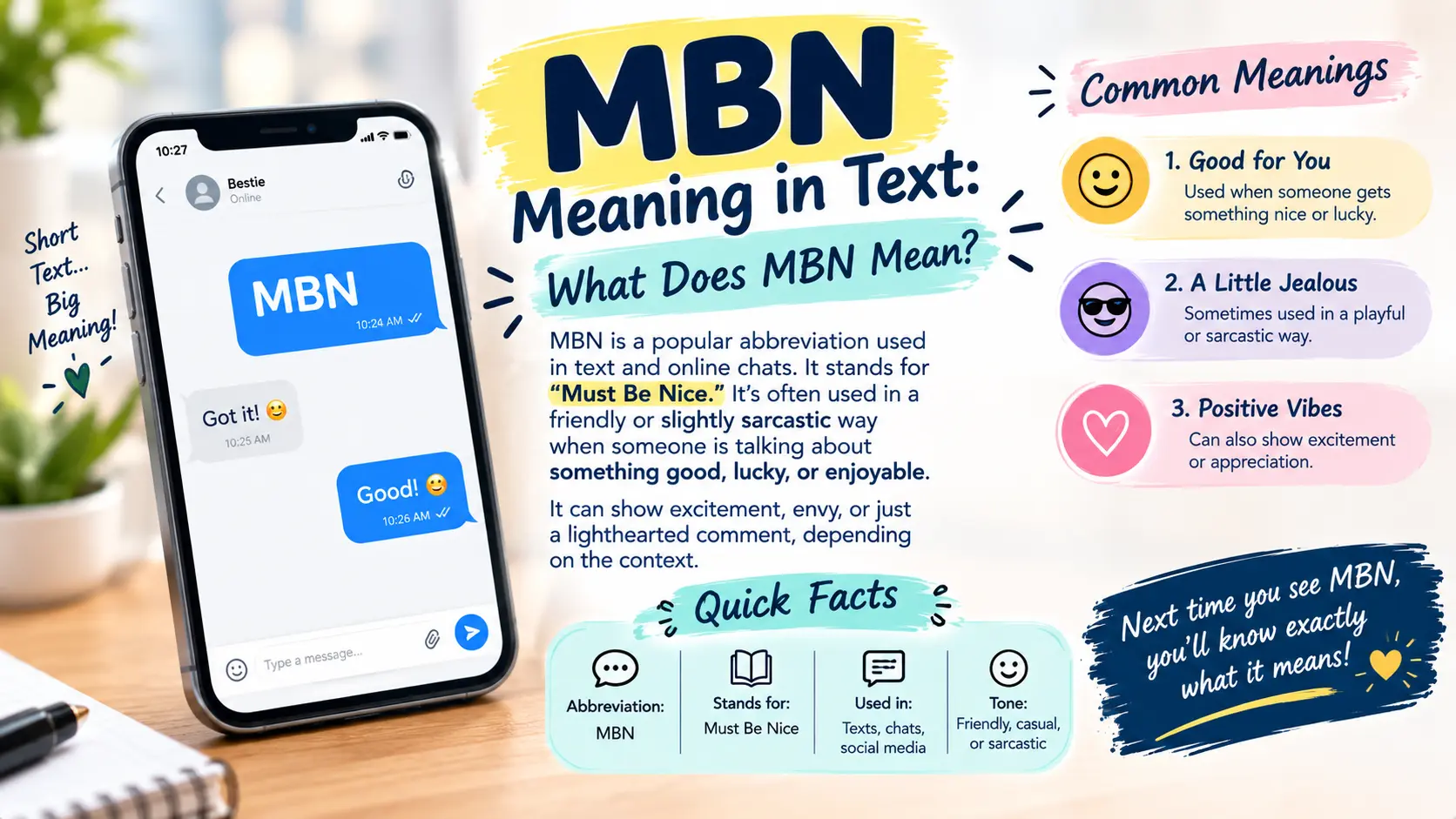
MBN in text usually means “Must Be Nice.” It is a casual abbreviation used in texting, social media comments, group chats, and online conversations. People often use MBN when reacting to something another person has, experiences, or gets that they would also like to have.
The expression can be genuine, playful, sarcastic, or slightly envious, depending on the conversation. For example, if someone says, “I’m going to Hawaii next week,” a friend might reply, “MBN!” meaning “Must be nice!”
TL;DR
- MBN usually means “Must Be Nice.”
- It is commonly used in casual texting and online communication.
- MBN can express admiration, playful envy, sarcasm, or humor.
- Context and the relationship between people determine its tone.
- It is generally informal and is best avoided in formal professional writing.
- MBN can sometimes have other meanings, but “Must Be Nice” is the common texting interpretation.
- In 2026, MBN remains understandable in casual digital conversations, although usage varies by community and age group.
What Does MBN Mean in Text?
MBN Means “Must Be Nice”
In texting, MBN is most commonly short for “Must Be Nice.” The phrase is used as a quick reaction to something positive, desirable, impressive, or fortunate.
For example:
“I have the whole weekend off.”
“MBN!”
Here, MBN means that having the entire weekend free sounds enjoyable or fortunate.
The abbreviation saves time while still communicating the same basic reaction. Like many internet abbreviations, its meaning is usually easy to understand when the surrounding conversation provides enough context.
How MBN Is Used in a Conversation
MBN is often used after someone mentions a desirable situation. It may refer to vacations, money, free time, relationships, possessions, achievements, food, entertainment, or other experiences.
For example, someone might write:
“My parents are taking me to a concert tonight.”
“MBN 😂”
The response can mean, “Must be nice to have that opportunity.” The person may genuinely be happy for their friend while also joking that they wish they could enjoy the same experience.
Why Context Changes the Meaning
The words themselves are simple, but tone is extremely important with MBN.
A message such as “MBN!” can sound enthusiastic when paired with a laughing emoji or friendly conversation. However, “mbn…” could potentially sound more sarcastic or resentful in a different situation.
That is why MBN should not automatically be interpreted as jealousy or criticism. The relationship between the speakers, the topic, punctuation, emojis, and previous messages can all affect its meaning.
MBN Meaning and Tone
Friendly and Playful Uses
One of the most common uses of MBN is friendly teasing. A person may use it to acknowledge that another person’s situation sounds better than their own.
For example:
“I don’t work tomorrow.”
“MBN 😂”
This does not necessarily indicate genuine envy. It can simply be a humorous way of saying, “Lucky you!”
Among friends, MBN can create a lighthearted tone because it recognizes someone’s good fortune without requiring a long response.
Sarcastic or Jealous Uses
MBN can sometimes carry a sarcastic undertone. If someone repeatedly brags about expensive purchases, exclusive events, or unusually good circumstances, another person might respond with MBN as a deliberately understated reaction.
In this situation, the phrase can communicate something closer to “Well, good for you” or “Lucky you.”
However, it is important not to assume negative intent. A short text message provides limited emotional information, so tone should be interpreted from the larger conversation rather than from MBN alone.
When MBN Sounds Passive-Aggressive
MBN may sound passive-aggressive when it is used to respond to sensitive topics or when the speaker already appears frustrated.
For example:
“I just bought another luxury car.”
“MBN.”
Depending on the relationship, this could be a sincere compliment or a subtle expression of annoyance.
The same abbreviation can therefore have very different emotional meanings. MBN itself is not automatically rude; the context determines how it is received.
Where Did MBN Come From?
The Origin of “Must Be Nice”
The phrase “must be nice” existed in spoken English before it became an internet abbreviation. People have long used the expression to react to another person’s fortunate circumstances.
It can be sincere:
“You get to travel for work? Must be nice.”
It can also be humorous:
“You get to sleep until noon? Must be nice.”
The abbreviation MBN developed naturally from the first letters of the phrase as digital communication became increasingly abbreviated.
How MBN Became a Texting Abbreviation
Texting culture encouraged people to shorten common expressions. Abbreviations such as LOL, BRB, TBH, IDK, and IMO became familiar parts of online communication.
MBN fits the same pattern. Instead of typing three words, users can simply type three letters.
Its usefulness comes from the fact that “must be nice” is already a familiar expression. Users generally do not need to explain what the letters represent when communicating with people familiar with online slang.
MBN in Modern Internet Slang
Today, MBN belongs to a broad category of conversational internet shorthand. It is particularly suited to quick reactions.
Social media has also helped phrases like MBN move beyond private texting. A person can use the abbreviation in a comment, direct message, group conversation, or reply to a post.
Its meaning remains closely connected to the original phrase rather than representing an entirely separate definition.
How MBN Is Used in Text Messages
MBN in One-on-One Chats
In private conversations, MBN is often a quick response to something a friend or acquaintance shares.
For example:
“I finished work early today.”
“MBN!”
The message expresses that the speaker considers the other person’s situation fortunate.
One-on-one use can also be more personal. Someone might say MBN when a friend talks about a vacation, new purchase, date, event, or other experience.
MBN in Group Chats
Group chats are another natural setting for MBN. Several people may share updates about their plans while others respond with short reactions.
For example:
“We’re going to the beach Saturday.”
“MBN, I’m stuck working 😭”
Here, MBN is clearly playful. The second person wishes they could participate but is expressing it humorously.
MBN as a Short Reply
MBN works especially well when a longer response is unnecessary.
Instead of writing:
“Wow, that sounds really nice. I wish I could do that too!”
A person might simply write:
“MBN 😂”
The abbreviation communicates the general sentiment quickly while keeping the conversation casual.
MBN Meaning on Social Media
MBN in Comments
On social media, MBN can appear as a reaction to someone’s post.
If someone posts a picture from a vacation, another user might comment:
“MBN!”
The comment can mean that the vacation looks enjoyable and that the commenter wishes they were there.
Because social media comments are often short, abbreviations like MBN are convenient for expressing reactions without writing a complete sentence.
MBN in Captions and Posts
MBN can also appear in captions or posts when someone is joking about another person’s lifestyle or situation.
For example:
“Everyone is out enjoying the weekend while I’m working. MBN.”
In this use, the person may be joking about their own situation rather than responding directly to another individual.
MBN on TikTok, Instagram, and Other Platforms
The exact popularity of MBN can differ between platforms and communities. Internet slang is not universal, and abbreviations can become more or less common over time.
On highly conversational platforms, MBN can function as a quick comment or reaction. The meaning is usually understood when the surrounding content clearly involves something desirable or fortunate.
Examples of MBN in Text
MBN in Casual Conversations
Example 1:
“I don’t have class tomorrow.”
“MBN!”
Example 2:
“I get to leave work at 2 today.”
“MBN 😂”
Example 3:
“We’re ordering pizza tonight.”
“MBN.”
In each example, the abbreviation communicates a reaction to someone’s favorable situation.
MBN About Money or Lifestyle
MBN can be used when someone mentions money or an expensive lifestyle.
For example:
“I just booked a five-star hotel for vacation.”
“MBN!”
Depending on the relationship, this could be admiration, playful envy, or sarcasm.
It is often best understood as a conversational reaction rather than a serious statement about someone’s financial circumstances.
MBN About Relationships and Experiences
MBN can also appear when someone talks about relationships or special experiences.
For example:
“My partner surprised me with concert tickets.”
“MBN 🥹”
Here, MBN can express genuine happiness for the person while acknowledging that the experience sounds wonderful.
MBN Used as a Joke
Humor is one of the most flexible uses of MBN.
For example:
“I only have to work four hours today.”
“MBN. I have an eight-hour shift.”
The person is not necessarily expressing serious resentment. They may simply be joking about the difference between their situations.
Is MBN Rude or Sarcastic?
When MBN Is Harmless
MBN is generally harmless when used among people who understand each other’s humor.
A friendly “MBN 😂” after someone announces a vacation will usually be interpreted as playful envy rather than hostility.
The abbreviation is particularly natural when the conversation is already informal.
When MBN Can Sound Jealous
Because “must be nice” can imply that someone else has an advantage, MBN can occasionally sound jealous.
For example:
“I just bought a new sports car.”
“MBN.”
Without additional context, the response could be interpreted in multiple ways.
The speaker may be impressed, joking, or quietly expressing envy. This ambiguity is one reason tone matters so much in digital communication.
How to Tell the Difference From Context
Look at the entire conversation instead of focusing on the three letters.
Consider:
- What did the other person say?
- Are the people friends or strangers?
- Are emojis being used?
- Has the conversation been playful?
- Does the speaker normally use sarcasm?
- Is the subject sensitive?
These clues can help determine whether MBN is friendly, sarcastic, or potentially passive-aggressive.
Who Commonly Uses MBN?
Teenagers and Young Adults
MBN is most naturally associated with informal digital communication, where short abbreviations are common.
Younger users may encounter it in texts, comments, group chats, and other online conversations.
However, familiarity with MBN is not limited to one age group. People who regularly communicate online may recognize and use it regardless of age.
Different Generational Uses
Different generations can interpret texting abbreviations differently.
Someone familiar with internet slang may immediately understand MBN, while another person may need the phrase explained.
This does not mean the abbreviation belongs exclusively to a particular generation. Digital language changes continuously, and users adopt expressions according to their online communities and communication habits.
American Digital Communication
In American informal communication, “must be nice” is a familiar phrase that can be sincere or sarcastic.
That makes MBN particularly easy to understand in contexts where American English and internet slang are common.
Its exact frequency varies between individuals and online communities.
Alternative Meanings of MBN
Less Common Definitions of MBN
Although “Must Be Nice” is the primary texting meaning, MBN can represent other phrases in specialized contexts.
Acronyms often have multiple definitions depending on the subject. A business, technical organization, school, or professional field may use the same letters for something completely unrelated to texting slang.
Therefore, the surrounding context is essential.
MBN in Professional or Technical Contexts
If MBN appears in a technical document, workplace report, academic material, or specialized discussion, do not automatically assume it means “Must Be Nice.”
The abbreviation may have a field-specific definition.
For casual text messages, however, “Must Be Nice” is the interpretation most likely to fit when the conversation involves someone’s favorable situation.
Why Acronyms Can Have Multiple Meanings
Three-letter abbreviations are especially likely to overlap.
Acronyms are created independently by different communities, so the same combination of letters can develop several meanings.
This is why context should always come before assumptions when interpreting unfamiliar abbreviations.
MBN vs. Similar Texting Abbreviations
MBN vs. TBH
TBH usually means “to be honest.” It introduces an opinion or honest statement.
MBN, by contrast, is normally a reaction meaning “Must Be Nice.”
For example:
“TBH, I’m tired.”
“MBN, you get to leave early.”
The two abbreviations serve different conversational purposes.
MBN vs. FR
FR commonly means “for real.” It is often used to agree with or emphasize a statement.
MBN expresses a reaction to a desirable situation.
For example:
“That vacation looks amazing.”
“FR.”
“MBN.”
The first response emphasizes agreement, while the second expresses that the experience sounds fortunate.
MBN vs. LOL
LOL generally signals laughter or amusement, while MBN means “Must Be Nice.”
They can appear together:
“You got the day off? MBN LOL.”
This combination suggests that the speaker is joking about the person’s good fortune.
MBN vs. “Good for You”
“Good for you” can be sincere, supportive, or sarcastic depending on context. MBN has a similar flexibility but more directly emphasizes the idea that someone is fortunate.
Both expressions can communicate admiration or playful envy.
How to Respond to MBN
Playful Responses
If someone sends MBN jokingly, you can respond with another playful message.
Examples include:
“I know, right? 😂”
or:
“You should’ve come with me!”
The goal is to match the casual tone of the conversation.
Friendly Responses
A simple response can keep the conversation moving:
“Haha, it really is!”
This works when MBN appears to be a genuine or friendly reaction.
Serious Responses
If you believe the message has a sarcastic or negative meaning, avoid immediately becoming defensive.
You can ask for clarification or respond calmly:
“Haha, are you joking?”
This gives the other person an opportunity to explain their tone.
When to Ignore MBN
Not every abbreviation requires a response.
If MBN appears as a casual comment on social media or as a reaction that does not require an answer, you can simply acknowledge it or leave it unanswered.
The appropriate response depends on the relationship and the importance of the conversation.
Common Mistakes When Using MBN
Using MBN Without Context
Because MBN can carry different tones, using it in a sensitive conversation can create confusion.
If someone shares difficult personal news, MBN may come across as dismissive even if you intended it as humor.
Misreading Sarcasm
Text removes many vocal and facial cues. As a result, sarcasm can be difficult to recognize.
Do not assume that every MBN is sarcastic. Likewise, do not assume every MBN is completely sincere.
Using MBN in Formal Communication
MBN is an informal abbreviation. It is generally unsuitable for formal emails, academic writing, official documents, or professional correspondence.
In formal situations, write the complete phrase or choose clearer language that directly communicates your intended meaning.
Has the Meaning of MBN Changed Over Time?
From Spoken Expression to Internet Slang
The underlying phrase “must be nice” existed before modern texting. Digital communication simply gave people a shorter way to write it.
MBN therefore represents the abbreviation of an established expression rather than an entirely new phrase.
The Rise of Sarcastic Usage
Online communication has expanded the sarcastic possibilities of everyday phrases.
MBN can now be used humorously to comment on someone’s advantages, accomplishments, possessions, free time, travel, or lifestyle.
This makes tone more dependent on context than the literal words suggest.
MBN in Modern Digital Culture
In 2026, MBN remains recognizable as a casual abbreviation for “Must Be Nice,” particularly among people familiar with texting and internet slang.
Its use is not necessarily universal, and slang popularity can vary significantly by platform, age group, and online community.
MBN Meaning Across Different Contexts
Text Messages
In text messages, MBN usually means “Must Be Nice.” It is commonly used as a short reaction to something desirable.
Social Media
On social platforms, MBN may appear in comments, replies, captions, and direct messages. It often reacts to posts about travel, money, achievements, free time, or enjoyable experiences.
Dating and Relationships
In relationship conversations, MBN can be playful when someone mentions a romantic date, surprise, gift, or special experience.
However, it should be used carefully if the topic is emotionally sensitive.
Friends and Family
Among friends and family, MBN is often lighthearted.
People may use it to tease each other about vacations, days off, new purchases, food, entertainment, or other enjoyable experiences.
Workplace Communication
MBN is generally better suited to informal workplace chats between colleagues who already communicate casually.
For formal professional communication, avoid relying on abbreviations that could be misunderstood.
FAQs About MBN Meaning
What does MBN mean in texting?
MBN usually means “Must Be Nice.” It is a casual reaction used when someone mentions something enjoyable, fortunate, desirable, or impressive.
Does MBN always mean “Must Be Nice”?
No. “Must Be Nice” is the common texting meaning, but MBN can have other definitions in specialized contexts. The surrounding conversation determines which meaning makes sense.
Is MBN a sarcastic expression?
It can be. MBN may be sincere, playful, sarcastic, or mildly envious. The tone depends on the conversation, relationship, and circumstances.
Is MBN rude to say in a text?
MBN is not inherently rude. Among friends, it is often harmless and humorous. However, it can sound passive-aggressive if used in a sensitive conversation or with a sarcastic tone.
How do you respond to MBN?
You can respond playfully with something like “I know, right?” or simply acknowledge the message. If the tone seems unclear, ask what the person means rather than assuming they are being negative.
Can MBN be used jokingly?
Yes. Joking is one of the common ways MBN is used. Friends may use it to tease one another about vacations, money, free time, food, relationships, or other desirable situations.
Is MBN still used in 2026?
Yes, MBN remains an understandable informal abbreviation for “Must Be Nice” in digital communication in 2026. Its frequency varies across platforms, communities, and individual users.
Conclusion: What MBN Means in Text
MBN usually means “Must Be Nice” in text messages and online conversations. It is a short, informal reaction that can express admiration, playful envy, humor, or sarcasm.
The most important thing to remember is that MBN does not have one fixed emotional tone. A message such as “MBN!” may be genuinely positive, while “MBN…” could feel more sarcastic depending on the situation.
When you understand the conversation around the abbreviation, MBN is usually easy to interpret. For casual texting and social media, it remains a convenient way to say that someone’s situation sounds pretty fortunate.