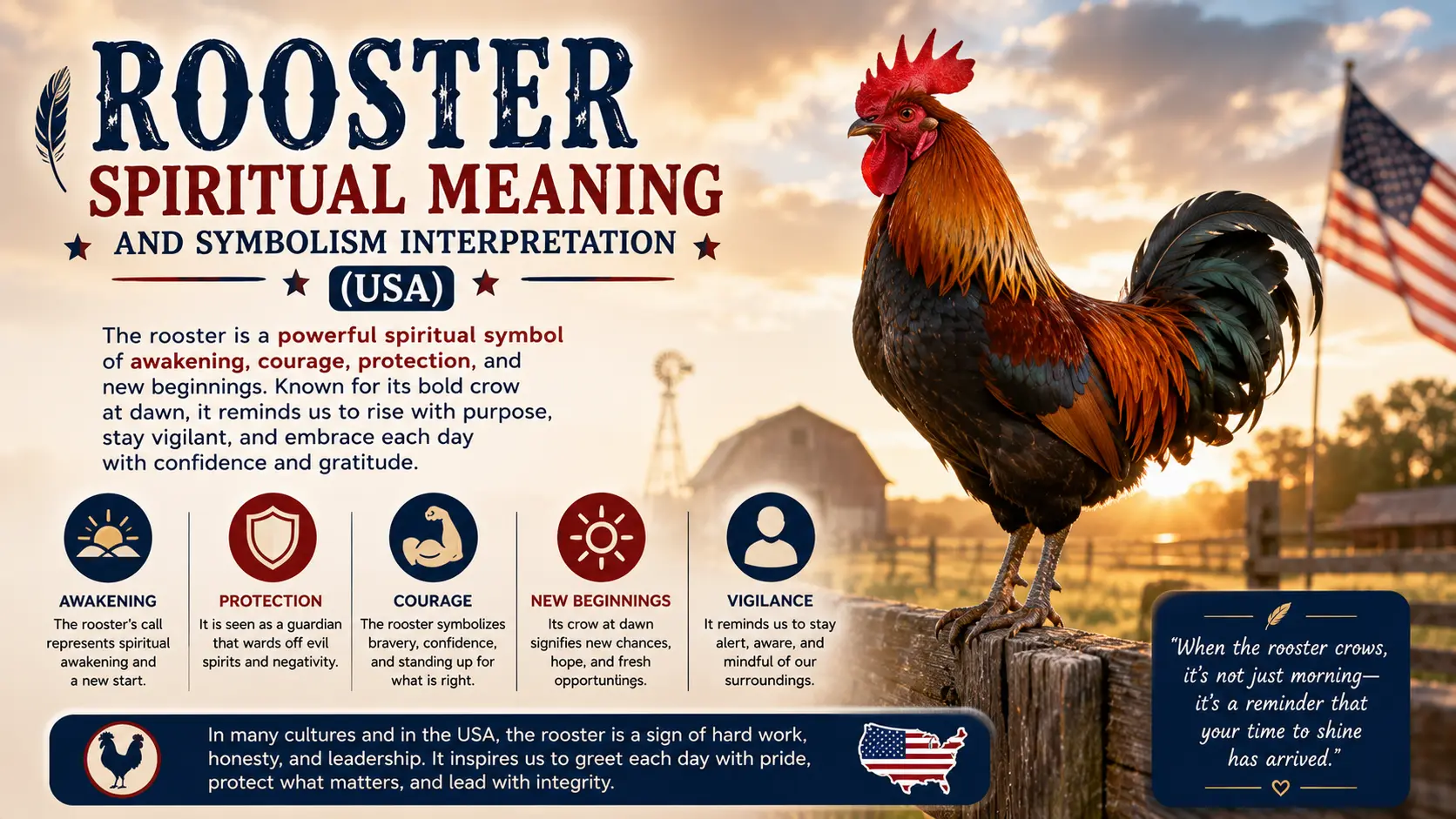
Rooster Spiritual Meaning and Symbolism Interpretation (USA)
Quick Answer
The rooster spiritually symbolizes awakening, confidence, courage, vigilance, and the beginning of a new day. Because a rooster naturally announces the dawn, it is often associated with light overcoming darkness, awareness, renewal, and the courage to make your presence known. In the United States, rooster symbolism also connects with farming traditions, independence, hard work, routine, and rural Americana.
TL;DR
A rooster can represent confidence, alertness, leadership, renewal, courage, and spiritual awakening. Seeing a rooster, dreaming about one, or choosing its image for a tattoo or decoration does not have one universal meaning; interpretation depends on personal beliefs and context. Its strongest symbolic connection comes from its relationship with dawn and the transition from darkness into light.
What Is a Rooster as a Symbol?
The rooster is one of the most recognizable animal symbols because its behavior is highly visible and predictable. Its crow announces the arrival of morning, while its upright posture, colorful feathers, and territorial behavior create strong associations with confidence and presence.
Across history, people have interpreted these qualities symbolically. The rooster can therefore represent the moment when something becomes visible, understood, or openly expressed. In spiritual interpretation, it may serve as a reminder to wake up, pay attention, and act with greater awareness.
Physical Traits That Shape Meaning
The rooster’s upright posture contributes strongly to its symbolism. With its head raised, chest forward, and distinctive comb and tail feathers, it can appear proud and self-assured.
Its crow is equally important. Unlike animals that remain relatively quiet, the rooster makes itself heard. Symbolically, this can represent speaking up, announcing one’s presence, and refusing to remain invisible.
Its daily rhythm also matters. The rooster is closely associated with morning, making it a natural symbol of routine, renewal, time, and fresh beginnings.
Contexts Where Roosters Appear
Roosters appear in farming communities, folk art, religious imagery, weather vanes, kitchen decorations, tattoos, logos, children’s stories, and popular culture.
The surrounding context can change the interpretation. A rooster standing in sunlight may emphasize awakening and optimism, while an aggressive fighting rooster may suggest competition, pride, or uncontrolled ego.
Core Rooster Meanings at a Glance
The rooster has accumulated several related symbolic meanings rather than one fixed definition. Most revolve around its behavior, appearance, and relationship with the dawn.
| Rooster Symbolism | Common Interpretation |
|---|---|
| Dawn | New beginnings and awakening |
| Crowing | Expression and communication |
| Alertness | Awareness and vigilance |
| Confidence | Self-belief and presence |
| Courage | Acting despite fear |
| Leadership | Taking initiative |
| Pride | Self-respect, or sometimes ego |
| Renewal | Starting again |
| Time | Daily rhythm and discipline |
| Light | Knowledge and clarity |
Primary Symbolic Themes
The most common rooster themes are awakening, confidence, courage, vigilance, leadership, and renewal.
Spiritually, the rooster can represent an invitation to become more conscious of what is happening in your life. It may symbolize recognizing an opportunity, confronting something you have avoided, or entering a new phase with greater confidence.
Why These Meanings Stick
These meanings are not random. They come from observable characteristics. The rooster wakes or becomes active around dawn, makes a distinctive sound, displays itself prominently, and protects its territory.
Humans have traditionally turned memorable natural behaviors into symbols. The rooster’s daily performance is particularly easy to interpret as a metaphor for waking up to life and becoming aware of one’s surroundings.
Ancient and Pre-Christian Roots of Rooster Symbolism
Rooster symbolism predates modern American culture by thousands of years. Ancient societies noticed the bird’s connection with sunrise and incorporated it into myths, rituals, calendars, and ideas about the transition between darkness and light.
Although individual cultures interpreted the rooster differently, recurring themes included time, protection, vitality, dawn, and transition.
Dawn, Light, and Sacred Time
The rooster’s crow became associated with the arrival of daylight. Before modern clocks and artificial lighting, natural signals were especially important for organizing daily life.
Symbolically, dawn represents a boundary between two states. Darkness gives way to light, sleep gives way to consciousness, and yesterday gives way to a new day. The rooster naturally fits this symbolism.
Mythological and Ritual Roles
Ancient Mediterranean and European traditions sometimes connected roosters with deities, omens, sacrifice, protection, or the sun. Their exact meanings varied considerably by region and historical period.
This history is important because it shows that rooster symbolism was never limited to one spiritual system. The bird repeatedly became meaningful because of its visibility, vocal nature, and relationship with morning.
Rooster Symbolism in Christianity and Early Europe
Christian symbolism gave the rooster another important layer of meaning. The bird became particularly associated with the biblical account of Peter’s denial of Jesus.
In that story, Jesus tells Peter that he will deny knowing him before the rooster crows. The rooster therefore became associated with remembrance, conscience, repentance, and spiritual vigilance.
The Rooster in Christian Imagery
In Christian art and tradition, the rooster can remind believers of Peter’s denial and the importance of remaining spiritually awake.
It can also symbolize the transition from darkness to light, a theme that naturally overlaps with Christian ideas about spiritual renewal and illumination.
However, the presence of a rooster in Christian imagery does not automatically mean one specific theological message. Artistic context matters.
Weather Vanes and Church Towers
Roosters became especially familiar in European architecture through weather vanes, including rooster-shaped designs placed on buildings and towers.
Their elevated position made them highly visible against the sky. Over time, the rooster weather vane became both practical and decorative, contributing to its association with homes, churches, villages, and community life.
How the Rooster Became Meaningful in American Culture
Roosters entered American symbolic culture through European traditions and the development of agriculture. In rural communities, the bird was an ordinary part of everyday life rather than merely a mythological figure.
This helped transform the rooster from an ancient symbol into an everyday emblem of work, routine, independence, and rural identity.
Farming, Independence, and Routine
For generations of farming families, the rooster’s morning crow was part of the natural rhythm of the day. Morning represented the beginning of chores, work, and responsibility.
As a result, the rooster can symbolize discipline and productivity. It can also evoke a sense of self-reliance associated with traditional agricultural life.
Americana and Folk Identity
Rooster imagery became common in American folk art, kitchenware, signs, textiles, paintings, and country-style decoration.
In this setting, the rooster often communicates warmth, simplicity, rural character, and connection to the land. Its symbolism may be cultural rather than explicitly spiritual.
Spiritual Meaning of the Rooster in the USA Today
Modern American spiritual interpretations often combine older symbolism with personal-growth ideas.
A rooster appearing in a dream, meditation, artwork, or meaningful moment may be interpreted as a metaphor for waking up to an important truth or becoming more confident about one’s direction.
Personal Awakening and Awareness
One of the strongest modern interpretations is personal awakening.
The rooster can symbolize becoming aware of something that was previously overlooked. This could involve a relationship, personal goal, opportunity, habit, or inner feeling.
Its message can be understood simply as: pay attention—something deserves your awareness.
Confidence and Speaking Up
Because the rooster loudly announces itself, it can symbolize having the courage to express yourself.
For someone who has been staying quiet, the rooster may represent a desire to communicate more honestly. It can encourage healthy confidence without requiring dominance over others.
Emotional and Psychological Associations
Beyond spiritual traditions, the rooster can be understood psychologically. Its imagery often evokes emotions connected with confidence, energy, vigilance, pride, and assertiveness.
The interpretation can be positive or negative depending on how the rooster behaves.
Confidence Without Apology
A calm, proud rooster may symbolize healthy self-esteem. It stands visibly without appearing ashamed of its appearance or presence.
Symbolically, this can encourage people to recognize their own strengths without constantly seeking outside approval.
Alertness and Mental Clarity
The rooster’s association with morning makes it a natural metaphor for mental clarity.
Seeing a rooster symbolically may represent moving from confusion toward understanding. It can suggest paying attention, becoming mentally present, and recognizing what needs to happen next.
Cross-Cultural Rooster Meanings (Brief Overview)
Rooster symbolism appears in many parts of the world, although its meanings are not identical everywhere.
The similarities often arise from the bird’s natural behavior, while differences come from religion, mythology, folklore, astrology, and local customs.
Shared Global Themes
Across cultures, recurring rooster associations include:
- Dawn and renewal
- Courage and confidence
- Alertness
- Time and routine
- Protection
- Vitality
- Communication
- Leadership
These overlapping themes make the rooster one of the more recognizable symbolic birds worldwide.
Cultural Variations
In some traditions, the rooster is connected with good fortune, bravery, masculinity, or protection. In others, it can represent pride, conflict, vanity, or excessive ego.
This variation is why symbolic interpretation should avoid claiming that every rooster sighting has the same spiritual message.
Modern Uses: Tattoos, Decor, and Identity
Today, rooster symbolism appears frequently in personal expression. People may choose rooster imagery because they connect with rural heritage, confidence, resilience, spirituality, family traditions, or simply the bird’s distinctive appearance.
The meaning is often highly personal.
Rooster Tattoos and Body Art
A rooster tattoo can symbolize confidence, courage, independence, awakening, pride, or perseverance.
A sunrise behind a rooster may emphasize renewal, while a colorful rooster may highlight individuality and vitality. A traditional or vintage rooster design can instead represent family heritage or rural Americana.
Home Decor and Digital Culture
Rooster decorations remain popular in kitchens, country homes, farms, restaurants, signs, and folk-inspired interiors.
Online, rooster imagery can also be used humorously. The bird’s exaggerated confidence, loud crow, and dramatic appearance make it naturally suited to memes, jokes, illustrations, and playful digital content.
Contexts and Meanings in the USA
The meaning of a rooster can change significantly depending on where and how it appears.
| Context | Possible Meaning |
|---|---|
| Seeing a rooster at dawn | Awakening or new beginnings |
| Rooster in a dream | Awareness, confidence, or an unresolved issue |
| Rooster tattoo | Courage, identity, pride, or renewal |
| Rooster home decor | Rural tradition and warmth |
| Rooster weather vane | Americana, direction, and tradition |
| Crowing rooster | Communication or announcement |
| Aggressive rooster | Conflict, ego, or assertiveness |
| Rooster in religious art | Vigilance, repentance, or spiritual remembrance |
| Rooster in folk art | Rural heritage and everyday life |
The most meaningful interpretation usually comes from your circumstances and emotional response rather than from the image alone.
Misunderstandings, Misuse, and Controversies
Rooster symbolism is generally positive, but some interpretations can become overly simplistic.
For example, confidence and pride are related but not identical. A rooster can represent healthy self-belief, yet its behavior can also be interpreted as excessive dominance.
Aggression vs. Confidence
A rooster standing tall is not necessarily a symbol of aggression.
Its image may represent confidence, while an attacking or fighting rooster may more strongly suggest competition, anger, defensiveness, or uncontrolled pride.
The distinction is important when interpreting tattoos, dreams, artwork, or personal experiences.
Cultural Stereotypes
Rooster symbolism can sometimes be reduced to stereotypes about masculinity, dominance, or machismo.
While these associations exist in some cultural contexts, they do not define the symbol universally. A rooster can just as easily represent renewal, awareness, creativity, discipline, or personal courage.
How Rooster Symbolism Has Shifted Over Time
The rooster’s symbolic journey reflects a broader change in how people relate to nature.
What was once closely connected with sacred time, mythology, religious stories, and agricultural routines can now appear as decorative art, branding, personal symbolism, or entertainment.
From Sacred to Everyday
In ancient societies, the rooster could participate in religious and ritual traditions. In medieval Europe, it gained visibility in Christian imagery and architecture.
In modern America, the rooster is often encountered in everyday settings—farms, kitchens, country decorations, tattoos, signs, and digital media.
Yet its older meanings have not disappeared. Dawn, vigilance, confidence, and renewal remain remarkably persistent.
Modern Personal Interpretation
Modern spirituality tends to emphasize personal meaning rather than one universally prescribed interpretation.
If a rooster repeatedly appears during an important period in someone’s life, that person may interpret it as a reminder to wake up, speak honestly, become more confident, or begin again.
The value of the symbol lies in the reflection it encourages rather than in a guaranteed supernatural prediction.
FAQs About Rooster Symbolism
What does a rooster symbolize spiritually?
A rooster commonly symbolizes awakening, confidence, courage, awareness, renewal, and speaking one’s truth. Its connection with dawn makes it especially associated with moving from darkness toward light and greater understanding.
Is the rooster a good omen?
A rooster is often viewed positively because it represents new beginnings, vitality, protection, and awareness. However, symbolic meanings vary by culture and personal circumstances, so it is not automatically a good or bad omen.
Why is the rooster connected to dawn?
Roosters are naturally associated with the early morning because their crowing commonly occurs around dawn. Before modern clocks, this behavior was a practical signal of morning, which helped create symbolic associations with time, awakening, light, and renewal.
What does a rooster tattoo usually mean?
A rooster tattoo may represent confidence, courage, independence, awakening, pride, resilience, or rural heritage. Additional imagery, such as a sunrise or particular artistic style, can make the intended meaning more specific.
Does the rooster have religious meaning in America?
Yes. The rooster has a notable Christian association through the biblical story of Peter’s denial, in which the rooster’s crow becomes a reminder of Peter’s words and actions. It can therefore symbolize remembrance, repentance, vigilance, and spiritual awareness.
Can rooster symbolism be negative?
Yes. Depending on context, a rooster can represent vanity, excessive pride, aggression, competition, or an inflated ego. These interpretations usually become stronger when the rooster is depicted fighting, attacking, or behaving aggressively.
Conclusion
The rooster spiritual meaning and symbolism is rooted in one of nature’s most recognizable daily transitions: the arrival of dawn. Its crow announces a new day, while its posture and behavior suggest confidence, vigilance, courage, and presence.
In the United States, rooster symbolism has developed through Christian tradition, farming culture, Americana, folk art, and modern personal spirituality. Today, it can represent everything from rural heritage and daily discipline to personal awakening and the courage to speak up.
Ultimately, the rooster is a powerful symbol because its message is easy to understand: wake up, pay attention, stand confidently, and make the most of the new day.