Deer Staring at Me Spiritual Meaning and Deer Symbolism
Quick Answer
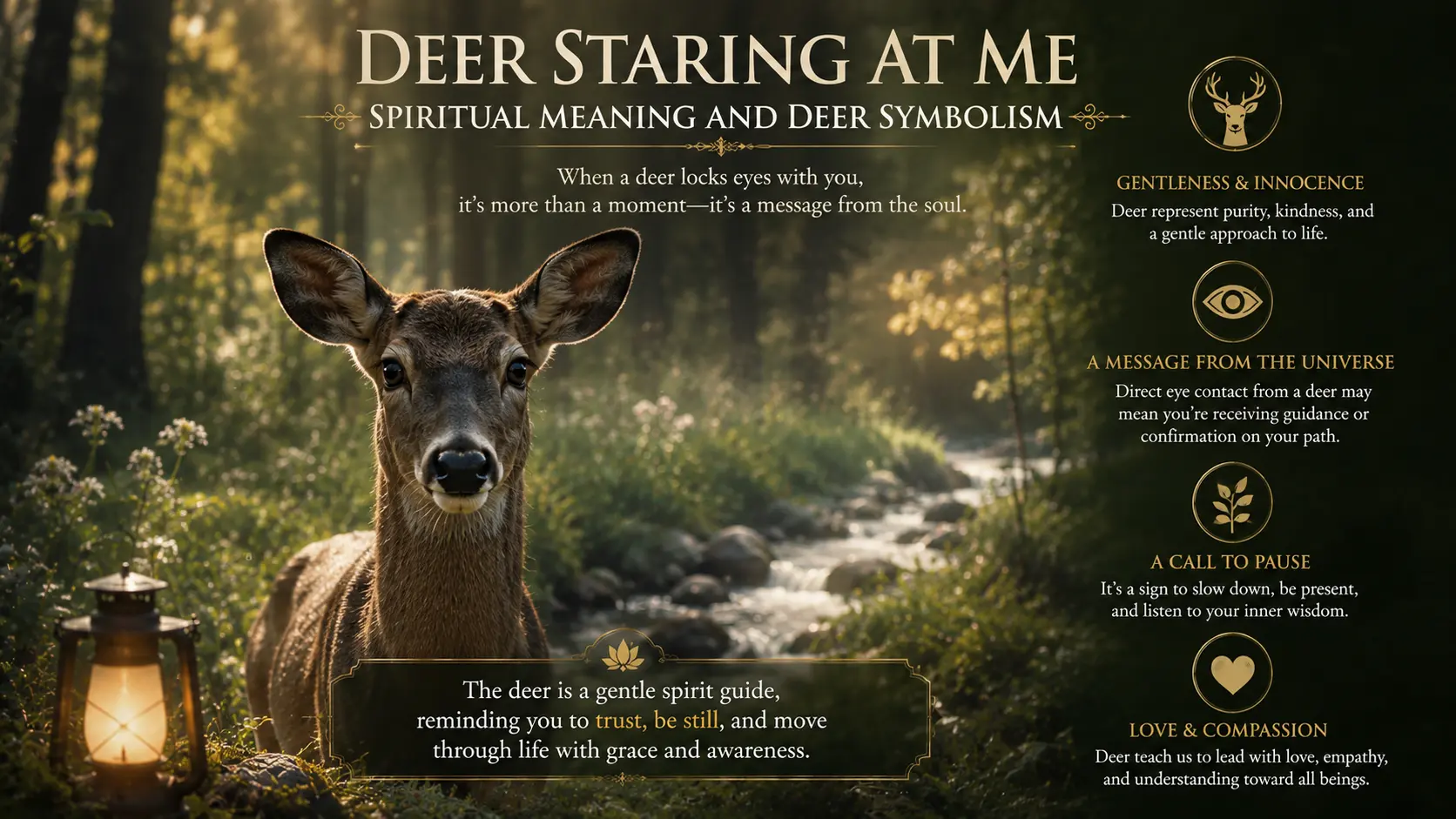
When a deer stares at you, it can feel like a meaningful or unusual encounter because deer are often associated with gentleness, intuition, awareness, peace, sensitivity, and connection with nature. Spiritually, some people interpret prolonged eye contact with a deer as an invitation to slow down, pay attention, trust intuition, or become more aware of what is happening in their lives.
However, there is no universal spiritual meaning. From a wildlife perspective, a deer may simply be assessing a potential threat, trying to identify you, or deciding whether it needs to move away. The symbolic interpretation depends on your beliefs, emotions, circumstances, and cultural background.
TL;DR
A deer staring at you is commonly interpreted symbolically as a reminder to pause, observe, stay gentle, and trust your instincts. Deer symbolism often includes peace, sensitivity, grace, protection, renewal, and awareness.
At the same time, the encounter has a natural explanation. A deer may stare because it is evaluating your movements and determining whether you are dangerous. Spiritual symbolism can add personal meaning, but it should not replace an understanding of normal animal behavior.
What It Means When a Deer Stares at You
Encountering a deer is already memorable, but direct eye contact can make the experience feel especially significant. Humans naturally pay attention to faces and eyes, so when a wild animal stops and looks directly toward us, the moment can feel almost intentional.
Symbolically, this creates a powerful contrast between stillness and movement. The deer pauses, you pause, and for a few seconds both of you become highly aware of each other.
The Power of Direct Eye Contact
Eye contact is often associated with attention, recognition, awareness, and communication. When a deer looks toward you, it can create the impression that the animal is asking you to notice something—not necessarily through a supernatural message, but through the experience itself.
In spiritual interpretations, this moment may represent being present in the moment. Instead of rushing through your surroundings, you become attentive to what is directly in front of you.
The encounter can also symbolize a need to observe before acting. Deer are alert animals, and their behavior can inspire the idea of quiet awareness rather than impulsive reaction.
Common Interpretations Today
Modern spiritual interpretations often connect a staring deer with:
- Gentleness: Approach life without unnecessary aggression.
- Intuition: Pay attention to subtle feelings and instincts.
- Awareness: Notice details you may have been overlooking.
- Peace: Create more quiet and balance in your life.
- Sensitivity: Recognize emotional or environmental changes.
- Renewal: Consider whether you are entering a new phase.
- Protection: Become more attentive to your surroundings.
- Patience: Observe circumstances before making a decision.
These meanings are interpretations rather than established facts. A deer does not necessarily appear because the universe is sending a specific message.
Overview of Deer Symbolism
Deer have accumulated rich symbolism because of their distinctive behavior and appearance. Their speed, alertness, delicate movements, antlers, and connection with forests have made them meaningful in many cultures.
Although interpretations differ widely, deer are frequently associated with grace, gentleness, vitality, instinct, fertility, renewal, and the natural world.
Physical Traits That Shape Meaning
Several characteristics contribute to the symbolic image of the deer.
Their large ears and sensitive hearing are often connected metaphorically with listening and awareness. Their ability to detect movement encourages associations with vigilance and intuition.
Their graceful movements contribute to symbolism surrounding elegance and gentleness, while their speed can represent freedom, escape, or the ability to respond quickly to changing circumstances.
Antlers have their own symbolism because they grow, shed, and regenerate in many deer species. This natural cycle makes them especially suitable as symbols of growth, transformation, renewal, and changing life stages.
Core Meanings at a Glance
| Deer Symbolism | Common Interpretation |
|---|---|
| Gentleness | Responding without unnecessary force |
| Grace | Moving through challenges with dignity |
| Awareness | Paying attention to your environment |
| Intuition | Trusting subtle instincts |
| Peace | Seeking calm and emotional balance |
| Renewal | Beginning again after change |
| Protection | Remaining alert and observant |
| Freedom | Following an independent path |
| Sensitivity | Recognizing emotions and subtle signals |
| Transformation | Growth through changing life stages |
Ancient and Pre-Christian Roots of Deer Symbolism
Deer symbolism is much older than modern spirituality. Deer appeared in the mythology, art, hunting traditions, and religious imagination of numerous societies.
It is important, however, to avoid treating all ancient cultures as though they shared one universal belief. Deer symbolism changed significantly according to geography, religion, environment, and social structure.
Indigenous and Ancient Traditions
Across different Indigenous societies, deer have held varied meanings connected with food, hunting, relationships with animals, ecological knowledge, ceremony, and storytelling. There is no single Indigenous interpretation of the deer.
In some traditions, deer can be associated with qualities such as gentleness, generosity, respect, or relationship with the natural world. In others, their significance is tied more directly to community, hunting, survival, or particular stories.
Ancient societies outside North America also represented deer in religious and artistic contexts. Deer could be connected with wilderness, fertility, hunting, kingship, or divine figures.
European Pre-Christian Beliefs
Pre-Christian European traditions frequently included deer imagery. In Celtic and other European contexts, deer could be associated with forests, wilderness, transformation, and supernatural landscapes.
The stag, especially because of its impressive antlers, could symbolize strength, authority, vitality, or connection with the wild.
Some European traditions also connected deer with divine or legendary figures. Over time, these older associations interacted with Christian imagery, folklore, medieval literature, and later romantic ideas about nature.
Deer Symbolism in Native American Traditions
Respectful Overview
There is no single “Native American meaning” of the deer. North America contains hundreds of Indigenous nations, each with distinct histories, languages, spiritual traditions, and cultural practices.
Some traditions give deer important roles in stories, ceremonies, hunting practices, or teachings. The exact meaning depends on the specific nation and cultural context.
Therefore, it is more respectful to say that deer symbolism varies among Indigenous peoples rather than assigning one generalized spiritual interpretation to every Native American community.
Influence on Modern American Thought
Modern American ideas about deer have been influenced by Indigenous knowledge, conservation movements, folklore, literature, outdoor culture, and popular spirituality.
However, modern websites sometimes combine unrelated traditions and label the result “Native American symbolism.” This can create inaccurate representations.
A responsible interpretation recognizes that Indigenous traditions are living cultures rather than collections of generalized spiritual symbols available for unrestricted reinterpretation.
Deer Symbolism in American Culture
Deer occupy a distinctive position in American culture because they are both wild animals and familiar inhabitants of developed landscapes.
Millions of Americans encounter deer near roads, forests, parks, farms, suburbs, and rural communities. This makes deer symbolism particularly connected with the relationship between human civilization and wildlife.
National and Regional Identity
In many parts of the United States, deer represent the outdoors. Hunting traditions, wildlife management, camping, hiking, photography, conservation, and rural life all contribute to their cultural significance.
The white-tailed deer is especially familiar across much of the country. Seeing one can evoke feelings of wilderness even when the encounter happens surprisingly close to a neighborhood or roadway.
Regional differences also matter. Someone living in a heavily wooded area may regard deer as ordinary wildlife, while someone from a dense urban environment may experience a deer sighting as extraordinary.
Deer in American Media
Deer frequently appear in American books, films, cartoons, advertisements, children’s stories, logos, holiday imagery, and outdoor branding.
Popular portrayals often emphasize qualities such as innocence, beauty, vulnerability, wilderness, and gentleness.
At the same time, real deer behavior is more complex. Deer can be cautious, aggressive in certain circumstances, unpredictable around roads, and highly adaptable to human environments.
Emotional and Psychological Associations
Emotional Responses
A deer staring at you can produce a surprisingly strong emotional reaction. People may experience calmness, wonder, curiosity, nervousness, awe, or a feeling of connection.
Part of this response comes from the contrast between the deer and the human environment. Seeing a wild animal pause nearby can interrupt an ordinary routine and create a memorable moment.
The animal’s large eyes and quiet behavior can also make the encounter appear emotionally expressive, even though we cannot know exactly what the deer is thinking.
Psychological Interpretation
Psychologically, a meaningful encounter does not necessarily require a supernatural explanation. Humans naturally search for patterns and meaning, particularly during emotionally important periods.
If you are already thinking about a major decision, transition, relationship, or personal challenge, an unexpected encounter with wildlife may become a useful reflection point.
The deer can function as a personal symbol because its characteristics—quietness, alertness, sensitivity, and movement—give you concepts through which to consider your own situation.
Spiritual Meaning of a Deer Staring at You
Common Spiritual Themes
For people who view animal encounters spiritually, a staring deer may symbolize several themes.
1. Slow down.
The encounter can represent a need to step away from constant activity and give yourself space to observe.
2. Trust your intuition.
Because deer are highly alert, they are often used symbolically to represent sensitivity to subtle changes.
3. Choose gentleness.
A deer may remind you that strength does not always require confrontation or force.
4. Stay aware.
The staring animal can symbolize paying closer attention to your environment and circumstances.
5. Enter a period of renewal.
The natural cycles associated with deer, particularly antler growth and shedding, can represent personal transformation.
6. Reconnect with nature.
The encounter may encourage you to spend more time outdoors and become attentive to the natural world.
Personal Context Matters
The most useful spiritual interpretation is often the one that encourages thoughtful reflection rather than fear.
Ask yourself what was happening in your life when you saw the deer. Were you feeling uncertain? Were you considering a major change? Had you been emotionally overwhelmed? Were you seeking peace or direction?
Instead of asking only, “What does the deer mean?”, consider asking, “Why did this moment stand out to me?”
That distinction allows symbolism to become a tool for self-reflection without assuming that every animal encounter contains a predetermined supernatural message.
Cross-Cultural and Religious Meanings
Eastern and Global Perspectives
Deer symbolism appears in several Asian and broader global traditions, but meanings differ considerably.
In some Buddhist contexts, deer are associated with compassion, gentleness, and peacefulness. Deer imagery is famously connected with the Deer Park where the Buddha is traditionally said to have delivered his first teaching.
Chinese artistic and cultural traditions have also given deer various associations, including longevity and prosperity in certain contexts. Japanese imagery may connect deer with particular sacred places and cultural traditions.
These examples demonstrate why deer symbolism should be understood through specific cultural contexts, rather than reduced to a universal spiritual definition.
Christian Symbolism
Christian symbolism has sometimes associated deer with spiritual longing, devotion, and the desire for God.
The image of a deer longing for water is especially important in Christian interpretation because of Psalm 42, which uses the deer as a metaphor for spiritual thirst.
In this context, a deer may represent a person’s longing for spiritual nourishment, guidance, peace, or closeness to God.
This interpretation differs from modern “angel message” interpretations. Christian symbolism is rooted primarily in scripture and theological tradition rather than the idea that every wildlife encounter is a coded divine communication.
Modern Uses of Deer Symbolism
Tattoos and Personal Expression
Deer tattoos can represent different personal ideas depending on the design.
A minimalist deer may symbolize peace, simplicity, or connection with nature. A stag with large antlers can emphasize strength, growth, independence, or transformation.
A doe may be chosen to represent gentleness, motherhood, intuition, or natural beauty, although these meanings are personal rather than universally fixed.
Home Decor and Social Media
Deer imagery appears frequently in rustic, woodland, Scandinavian-inspired, cabin, and nature-themed interiors.
On social media, photographs of deer often accompany messages about peace, mindfulness, slowing down, gratitude, and appreciating nature.
This has helped reinforce the modern image of the deer as a calm and spiritually meaningful animal, even though the symbolism is often a contemporary interpretation rather than a direct continuation of one ancient tradition.
Misunderstandings and Controversies
Over-Spiritualizing Wildlife
One of the biggest misunderstandings is assuming that unusual animal behavior automatically has a supernatural cause.
A deer may stare because it has noticed you and is trying to determine whether you are a threat. It may also be listening, watching other animals, evaluating an escape route, or simply pausing.
Understanding ordinary wildlife behavior does not make the encounter less beautiful. Natural explanations and personal symbolism can exist side by side.
Misuse of Cultural Meanings
Another problem occurs when websites combine Celtic, Christian, Indigenous, Buddhist, Native American, and modern New Age concepts into one supposedly universal “deer meaning.”
These traditions are not interchangeable.
A respectful approach identifies the cultural source of a particular interpretation and avoids presenting generalized claims as though they represent an entire people or religion.
How Deer Symbolism Has Shifted Over Time
From Survival to Symbol
For much of human history, deer were important as animals that people hunted, observed, feared, respected, and depended upon.
Their symbolism therefore developed alongside practical relationships with wildlife. Deer represented not only beauty and spirituality but also food, survival, territory, seasonal change, and ecological knowledge.
Modern urban societies are often more removed from those practical relationships. As a result, deer are increasingly portrayed through aesthetics, nature photography, spirituality, conservation, and personal symbolism.
Modern Mindfulness Culture
Contemporary mindfulness culture has strengthened the association between deer and stillness, presence, gentleness, and awareness.
A deer suddenly appearing on a quiet trail can become a natural mindfulness experience: you stop walking, observe your surroundings, breathe more slowly, and become aware of the present moment.
The spiritual value of the encounter may therefore come less from a supernatural message and more from the attention the experience creates.
Common Deer Symbolism by Context (USA)
| Situation | Possible Symbolic Meaning |
|---|---|
| Deer staring at you | Awareness, observation, intuition |
| Deer crossing your path | Transition, movement, changing direction |
| Doe with fawns | Nurturing, protection, family |
| Stag with antlers | Strength, renewal, confidence |
| Deer appearing repeatedly | Increased attention to a personal theme |
| Deer near your home | Connection between everyday life and nature |
| Deer appearing during a difficult period | Gentleness, patience, reflection |
| Deer appearing in a dream | Personal associations with vulnerability, freedom, nature, or awareness |
| Deer appearing on a quiet walk | Presence, mindfulness, peace |
| Injured or distressed deer | A reminder to respond compassionately while recognizing the need for appropriate wildlife assistance |
These are symbolic interpretations, not predictions. The same encounter can mean completely different things to different people.
FAQs
Is a deer staring at me a sign?
It can feel like a sign, especially if the encounter occurs during an emotionally important moment. Symbolically, people often interpret it as a reminder to pause, observe, and trust their awareness.
From a wildlife perspective, staring is normal behavior because the deer is assessing you. There is no scientific evidence that a deer staring at a person predicts a specific event.
What does a deer symbolize spiritually?
Deer are commonly associated with gentleness, intuition, peace, sensitivity, grace, awareness, renewal, and connection with nature.
The exact meaning depends on the spiritual or cultural tradition being discussed. Personal circumstances can also influence what the animal represents to an individual.
Is it rare for a deer to stare at a human?
No. A deer may stare at a person when it detects movement or an unfamiliar presence. It is often evaluating whether the person represents danger.
If the deer becomes tense, stomps, snorts, raises its tail, or prepares to flee, give it plenty of space and avoid approaching it.
Does deer symbolism differ by region in the USA?
Yes. Deer symbolism can vary according to local wildlife, hunting traditions, Indigenous cultures, religion, regional folklore, and people’s experiences with nature.
Someone in a rural hunting community may associate deer primarily with wildlife management and outdoor traditions, while another person may see them primarily as symbols of peace and wilderness.
Can deer symbolism be negative?
Yes. Symbolism is not always positive. A deer can represent vulnerability, fear, hesitation, fragility, or the need to escape danger.
In some situations, a deer encounter may also remind someone that gentleness does not mean ignoring threats. Awareness and self-protection can be part of the symbolism.
Why do people feel calm around deer?
Deer generally have quiet movements, soft features, and a non-predatory appearance, which can encourage feelings of calmness and wonder.
Being outdoors also gives people an opportunity to pause from technology and daily responsibilities. The emotional response may therefore come from both the animal itself and the peaceful environmental setting.
Conclusion
A deer staring at you can be understood on two levels. Naturally, the deer is most likely watching you because it is assessing an unfamiliar presence. Symbolically, the moment can represent awareness, gentleness, intuition, patience, peace, or personal renewal.
The most meaningful interpretation does not have to be supernatural. Sometimes an unexpected encounter with wildlife simply gives you a reason to stop, breathe, observe, and reconnect with the present moment.
If the experience stays with you, use it as an invitation to reflect: What were you thinking about before you saw the deer, what did you feel when it looked at you, and what quality of the deer most strongly caught your attention? Those answers may reveal why the encounter felt meaningful to you.