White Crane Symbolism: Meaning, Spirituality & Hope
What Does a White Crane Symbolize?
Quick Answer
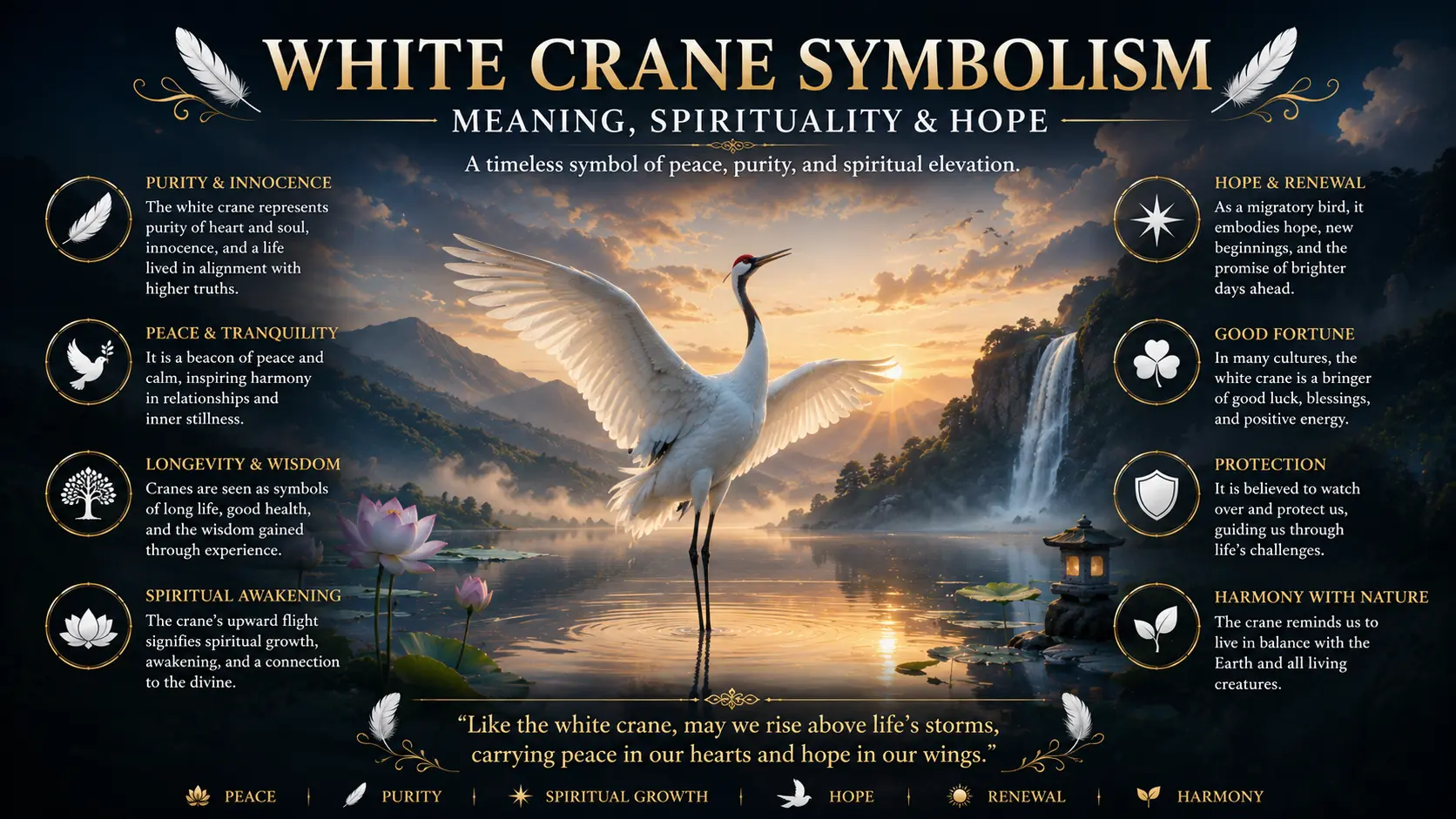
A white crane commonly symbolizes peace, purity, longevity, wisdom, hope, grace, and renewal. Across different cultures, cranes have been associated with long life, spiritual elevation, loyalty, good fortune, and the ability to move gracefully through life’s changes.
In the United States, the image can also carry meanings connected with peace, remembrance, environmental conservation, and hope. The exact interpretation depends on the cultural setting and whether the crane appears in nature, artwork, dreams, tattoos, ceremonies, or spiritual reflection.
TL;DR
The white crane is a powerful symbolic image often connected with peace, purity, wisdom, longevity, hope, and transformation. Chinese and Japanese traditions give cranes especially rich cultural meanings, while American symbolism has developed additional associations through paper cranes, peace movements, and whooping crane conservation.
Spiritually, seeing a white crane may be interpreted as a reminder to remain calm, move forward with grace, and approach a period of change with patience and hope.
Main Symbolic Meanings
Some of the most common meanings associated with white cranes include:
- Peace — a calm and harmonious state.
- Purity — innocence, clarity, and clean intentions.
- Longevity — a long and meaningful life.
- Wisdom — patience, awareness, and experience.
- Hope — encouragement during difficult transitions.
- Grace — moving through life with balance and dignity.
- Loyalty — commitment and lasting relationships.
- Renewal — beginning a new chapter after change.
These meanings are not universal rules. Symbolism changes according to culture, personal beliefs, and context.
What Is a White Crane?
Physical Characteristics and Appearance
Cranes are long-legged, long-necked birds known for their elegant posture and distinctive movements. Several crane species have substantial white plumage or white coloration, although a bird described casually as a “white crane” may not necessarily belong to a single species.
Their tall bodies, extended wings, slow movements, and dramatic flight have made cranes visually memorable throughout history. These characteristics help explain why people have connected them with elegance, freedom, balance, and spiritual elevation.
Why the White Color Matters
White has its own symbolic history. In many traditions, white can represent purity, peace, innocence, clarity, mourning, spirituality, or transformation.
When white is combined with the crane’s existing symbolism, the result can feel especially serene. A white crane may therefore be interpreted as an image of peaceful wisdom, clean intentions, spiritual hope, or a fresh beginning.
However, the meaning of white differs between cultures. It should not automatically be assumed to mean the same thing everywhere.
White Cranes in Nature and Human Culture
Cranes have fascinated people because of their distinctive appearance and behavior. Their height, elaborate courtship displays, powerful wings, and seasonal movements have inspired stories, paintings, poetry, decorative designs, and ceremonial imagery.
The crane therefore exists at an interesting intersection between nature and symbolism. People can appreciate it as a real bird while also using its image to express ideas that go beyond biology.
White Crane Symbolism at a Glance
Peace and Purity
The white crane is frequently interpreted as an image of peace and purity. Its white feathers and graceful movements create a visual impression of calmness and serenity.
In modern symbolic use, a white crane may represent the desire to leave conflict behind and move toward greater emotional or spiritual balance.
Longevity and Wisdom
Crane symbolism has a particularly strong connection with long life and wisdom in East Asian traditions.
Because cranes have traditionally been associated with longevity, their image may appear in artwork, gifts, celebrations, and designs intended to express good wishes for a long and prosperous life.
Hope and Renewal
A crane taking flight can easily become a metaphor for hope, freedom, and a new beginning.
For someone moving through a major life transition, the image may represent leaving an old chapter behind and entering another with greater confidence.
Loyalty and Grace
Cranes are also associated with graceful movement and, in some cultural traditions, enduring relationships. This can make crane imagery meaningful in contexts involving love, partnership, commitment, and devotion.
The symbolism is especially strong when a crane is depicted with another crane or within a marriage-related artistic setting.
Historical Origins of Crane Symbolism
Why Cranes Became Powerful Symbols
Cranes naturally attract symbolic attention because they are large, elegant, long-lived-looking birds that move between land, water, and sky.
Their ability to fly high also made them suitable symbols of elevation and transcendence. Their seasonal movements could suggest journeys, cycles, and transformation.
Cranes in Ancient Art and Traditions
Crane imagery appears in the artistic traditions of several cultures. In East Asia, cranes became particularly prominent in paintings, textiles, ceramics, decorative arts, and literature.
Their symbolism developed over centuries rather than from one single story. As a result, meanings such as longevity, nobility, grace, and spiritual significance became connected with crane imagery.
How Ancient Meanings Survive Today
Modern people continue to use crane designs on clothing, home decor, tattoos, jewelry, greeting cards, memorials, and artwork.
Even when people are not consciously thinking about historical traditions, the crane’s established visual associations can still influence how the image feels: peaceful, elegant, hopeful, and timeless.
White Crane Symbolism in China
Longevity and Immortality
In Chinese cultural symbolism, cranes have long been associated with longevity. The crane can appear alongside other symbols of long life and is frequently connected with wishes for health and extended years.
This association helps explain why crane imagery can be appropriate for birthdays, celebrations, traditional artwork, and gifts expressing good wishes.
Nobility, Wisdom, and Spiritual Elevation
The crane has also been associated with qualities such as nobility, dignity, wisdom, and spiritual elevation.
In traditional visual culture, the bird’s upright posture and ability to soar through the sky contributed to its elevated symbolic status.
The Crane as a Heavenly Bird
Traditional Chinese imagery sometimes presents the crane as a bird connected with the heavens and spiritual realms. This contributes to interpretations involving transcendence, immortality, and a connection between earthly and heavenly worlds.
It is important, however, not to reduce Chinese crane symbolism to a single meaning. Its significance varies according to the artwork, historical period, accompanying symbols, and cultural context.
White Crane Symbolism in Japan
Longevity and Good Fortune
In Japan, cranes are strongly associated with long life, good fortune, and happiness.
The Japanese crane, or tsuru, became an especially recognizable cultural symbol. Its elegant appearance and traditional associations have made it an enduring element of Japanese art and cultural expression.
Love, Marriage, and Faithfulness
Cranes can also symbolize lasting relationships and marital happiness.
Images of cranes may therefore appear in wedding-related designs and gifts. When two cranes are shown together, the image can suggest partnership, harmony, and enduring commitment.
The Meaning of Senbazuru
Senbazuru refers to the tradition of folding 1,000 origami cranes. The practice is connected with wishes, hope, healing, peace, and good fortune.
The symbolism became particularly powerful in the twentieth century through the story of Sadako Sasaki and the association of paper cranes with peace. Today, the folded crane is recognized far beyond Japan as a symbol capable of expressing compassion and hope.
Paper Crane Symbolism and Peace in the USA
How Paper Cranes Became Peace Symbols
The paper crane became especially meaningful in the United States through the international story surrounding Sadako Sasaki and the broader peace movement.
Although the origami crane originates from Japanese tradition, its symbolic language crossed cultural boundaries. In America, paper cranes can represent peace, remembrance, solidarity, healing, and hope.
Sadako Sasaki and the Thousand Cranes
Sadako Sasaki became an important figure in the history of the paper crane’s modern peace symbolism. Her story is associated with the traditional belief surrounding the folding of 1,000 cranes and with hopes for healing.
Her story helped transform the paper crane into an internationally recognized image of peace and remembrance, particularly in discussions of war and its effects on children.
Why Paper Cranes Represent Hope and Healing
A paper crane is small, delicate, and handmade. Folding one requires patience and repeated effort.
That physical process contributes to its symbolic power. One crane can represent a personal wish, while many cranes together can express collective hope, remembrance, solidarity, and a desire for peace.
Whooping Crane Symbolism in America
Survival and Resilience
The whooping crane has developed a particularly meaningful place in American conservation history. Its dramatic recovery from an extremely threatened population has made it a natural symbol of resilience and survival.
Unlike generalized white-crane symbolism, this meaning comes directly from the bird’s conservation story.
Rarity and the Value of Protection
Whooping cranes demonstrate how fragile wildlife populations can become and how sustained conservation efforts can make a difference.
Symbolically, this can turn the bird into a reminder that rare things require care, protection, and collective responsibility.
Conservation and Hope for the Future
In the American context, a whooping crane can represent more than beauty. It can symbolize the possibility that damaged ecosystems and endangered populations can recover when people commit to long-term conservation.
This gives the bird a particularly modern meaning: hope backed by action.
Spiritual Meaning of Seeing a White Crane
Peace and Inner Calm
Seeing a white crane may be interpreted spiritually as a reminder to seek peace, patience, and emotional balance.
Its slow, graceful appearance can encourage a person to step away from unnecessary tension and approach a situation with greater calm.
Spiritual Growth and Transformation
A flying crane can symbolize movement from one stage of life to another. Spiritually, this may represent growth, awakening, freedom, or personal transformation.
The symbolism does not necessarily predict an event. Instead, it can provide a meaningful framework for reflecting on changes already occurring in your life.
Hope During Life Changes
A white crane may also serve as a personal symbol of hope during uncertainty.
If you encounter crane imagery while beginning a new chapter, recovering from disappointment, or making an important decision, you might interpret it as encouragement to keep moving forward while maintaining patience and perspective.
A Symbolic Rather Than Literal Interpretation
Spiritual interpretations are personal and culturally influenced. Seeing a crane does not scientifically prove that a supernatural message has been sent.
A healthier symbolic approach is to ask: What does this image mean to me right now? Your emotions, circumstances, cultural background, and personal beliefs can all shape the answer.
White Crane Dream Meaning
What Seeing a White Crane in a Dream May Represent
Dream symbolism is highly personal, but a white crane may be associated with peace, freedom, hope, transformation, wisdom, or emotional healing.
If the crane appears calm and beautiful, the dream may reflect a desire for tranquility or a sense that you are becoming more comfortable with change.
Flying White Crane Meaning
A flying crane can symbolize freedom, progress, ambition, or moving beyond limitations.
It may also reflect a desire to gain a wider perspective on a problem rather than remaining focused on immediate difficulties.
White Crane Landing or Standing Still
A stationary crane may suggest patience, observation, stability, or waiting for the right moment.
Instead of constantly pushing forward, the dream may symbolically encourage you to pause, observe, and make a thoughtful decision.
How the Dream Context Changes the Meaning
The surrounding details matter. Consider:
- How you felt during the dream.
- Whether the crane was flying, standing, or walking.
- Whether there was one crane or several.
- Whether the environment was peaceful or threatening.
- What happened immediately before and after seeing it.
Dream symbolism is most useful when treated as personal reflection rather than fixed prediction.
White Crane Meaning in Love and Relationships
Loyalty and Commitment
Cranes can symbolize faithfulness and enduring partnership, particularly in traditions where paired cranes represent lasting relationships.
A crane image may therefore be chosen to communicate devotion, commitment, and the hope of building a relationship that lasts.
Harmony and Emotional Peace
The crane’s graceful appearance also lends itself to ideas of relationship harmony and emotional balance.
For couples, crane imagery may symbolize a relationship built on patience, mutual respect, and the ability to navigate life’s changes together.
New Beginnings in Love
A white crane can also represent a fresh emotional chapter. It may be meaningful after meeting someone new, beginning a marriage, rebuilding trust, or choosing to approach relationships with greater maturity.
In this context, the symbolism centers on hope rather than certainty.
White Crane Tattoo Meaning
Common Symbolic Meanings
A white crane tattoo may represent:
- Peace
- Freedom
- Longevity
- Wisdom
- Hope
- Grace
- Transformation
- Loyalty
- Spiritual growth
Because tattoos are permanent, many people choose crane imagery because its symbolism can remain meaningful through different stages of life.
White Crane With Flowers or Water
Flowers can add meanings such as beauty, growth, love, or impermanence, depending on the flower and cultural tradition.
Water can introduce themes of emotion, adaptability, renewal, and movement. Together, the crane and surrounding elements can create a more personal symbolic story.
Flying Crane Tattoo Meaning
A flying crane often emphasizes freedom, ambition, personal growth, and moving forward.
It can be especially meaningful for someone who has overcome an obstacle or entered a new phase of life.
Choosing a Crane Design With Personal Meaning
The strongest tattoo symbolism usually comes from personal connection rather than choosing a design simply because it is popular.
Think about what you want the crane to represent—peace, survival, family, freedom, longevity, or a new beginning—and choose accompanying elements that reinforce that message.
White Crane Symbolism in Modern American Culture
Peace and Humanitarian Messages
In the United States, paper crane imagery can communicate peace, remembrance, compassion, and opposition to violence.
Its connection with Japanese culture gives the symbol an important historical dimension beyond simple decoration.
Environmental Awareness and Conservation
Whooping crane conservation adds another layer to American crane symbolism.
Here, the crane can represent wildlife protection, ecological responsibility, resilience, and the possibility of recovery.
Art, Jewelry, Decor, and Personal Expression
Crane imagery is common in modern visual expression because it combines recognizable beauty with rich symbolic possibilities.
A crane on a wall, necklace, painting, tattoo, or greeting card can communicate different ideas depending on the surrounding design and the person’s intention.
White Crane Symbolism by Context
White Crane in Art and Photography
In art and photography, a white crane often creates a feeling of elegance, stillness, freedom, and natural beauty.
Its long silhouette and expansive wings also make it visually effective in compositions representing space, movement, and tranquility.
White Crane in Dreams
In dreams, the crane can become a personal symbol connected with freedom, transition, patience, or hope.
The dreamer’s emotions are often more important than any universal dream dictionary definition.
White Crane in Spiritual Encounters
For someone who follows spiritual symbolism, an unexpected crane encounter may feel like a meaningful reminder of peace, awareness, patience, or renewal.
The most respectful approach is to recognize the experience as personally meaningful without claiming that one interpretation applies to everyone.
White Crane in Memorials and Peace Messages
Paper cranes are especially powerful in memorial and peace contexts.
Hundreds or thousands of folded cranes can visually communicate collective remembrance, compassion, hope, and a commitment to peace.
White Crane vs. Whooping Crane, Heron, and Egret
How to Tell Them Apart
Cranes, herons, and egrets can look similar because all have long legs, long necks, and elongated bodies.
However, they belong to different bird groups and have different anatomical and behavioral characteristics. Correct identification is important before assigning a specific cultural or symbolic meaning.
Why Identification Matters Symbolically
A generalized “white bird” interpretation can easily become inaccurate when the actual animal is a whooping crane, heron, or egret.
For example, the conservation story of the whooping crane is distinct from the broader cultural symbolism of cranes.
Common Crane Symbolism Mix-Ups
A white bird standing near water is not automatically a crane. Herons and egrets are often mistaken for cranes because of their similar body shape.
If the identity of the bird matters to your interpretation, look at size, body proportions, bill shape, posture, habitat, markings, and behavior rather than relying only on color.
Cultural Differences and Respectful Interpretation
Chinese and Japanese Meanings Are Not Identical
Chinese and Japanese crane symbolism overlap in important ways, particularly around longevity and good fortune, but the traditions developed within different historical and cultural contexts.
It is better to appreciate these traditions individually rather than treating all Asian crane symbolism as one unified belief system.
Traditional Symbolism vs. Modern Spirituality
Traditional cultural meanings have historical roots, while modern spiritual interpretations are often more individualized.
Someone may see a white crane as a sign of inner peace, while another person may primarily associate it with Japanese culture, wildlife conservation, or personal memories.
Avoiding Oversimplified Cultural Meanings
Respectful symbolism recognizes that cultural traditions are complex.
Rather than saying that a crane has one universal meaning, it is more accurate to say that the bird has multiple established associations that change according to culture, history, artistic context, and personal interpretation.
Frequently Asked Questions About White Crane Symbolism
What does a white crane symbolize spiritually?
A white crane may symbolize peace, purity, wisdom, hope, transformation, and spiritual growth. Its meaning is personal and can depend on the circumstances in which it appears.
Is seeing a white crane considered good luck?
In traditions where cranes are associated with longevity and good fortune, seeing or receiving crane imagery can be considered auspicious. However, there is no universal rule that seeing a crane guarantees good luck.
What do white cranes symbolize in Chinese culture?
Cranes in Chinese symbolism are strongly associated with longevity, wisdom, nobility, and spiritual elevation. Their imagery has appeared extensively in traditional art and decorative culture.
What do white cranes symbolize in Japanese culture?
In Japan, cranes are commonly associated with long life, good fortune, happiness, peace, and enduring relationships. The origami crane has also become a powerful symbol of hope and peace.
What do paper cranes symbolize in the USA?
Paper cranes in the United States are often associated with peace, remembrance, healing, compassion, and hope, particularly because of the international legacy of Sadako Sasaki and the thousand-crane tradition.
What does a white crane mean in a dream?
A white crane in a dream may represent freedom, peace, patience, hope, or personal transformation. The bird’s behavior and your emotions within the dream can significantly change the interpretation.
What does a white crane tattoo symbolize?
A white crane tattoo can symbolize longevity, peace, freedom, loyalty, wisdom, hope, or overcoming change. Additional tattoo elements can give the design a more specific personal meaning.
Is a whooping crane the same as a white crane?
Not exactly. “White crane” is a broad descriptive phrase, while the whooping crane is a specific crane species native to North America. The whooping crane carries additional symbolism related to conservation, rarity, survival, and recovery.
Final Thoughts on White Crane Symbolism
White crane symbolism brings together some of humanity’s most enduring ideas: peace, purity, longevity, wisdom, loyalty, grace, and hope. Its meaning has developed across cultures rather than coming from one universal tradition.
In Chinese and Japanese culture, cranes have especially deep associations with longevity and good fortune. In the United States, paper cranes have become powerful symbols of peace and remembrance, while the whooping crane represents conservation and the possibility of wildlife recovery.
Whether you encounter a white crane in nature, artwork, a dream, a tattoo, or a spiritual moment, its most meaningful interpretation may come from the context surrounding it. The crane ultimately offers a beautiful symbolic lesson: move with grace, value what is precious, and keep hope alive through change.