Poirot Meaning: Definition, Origin, and How the Name Is Used
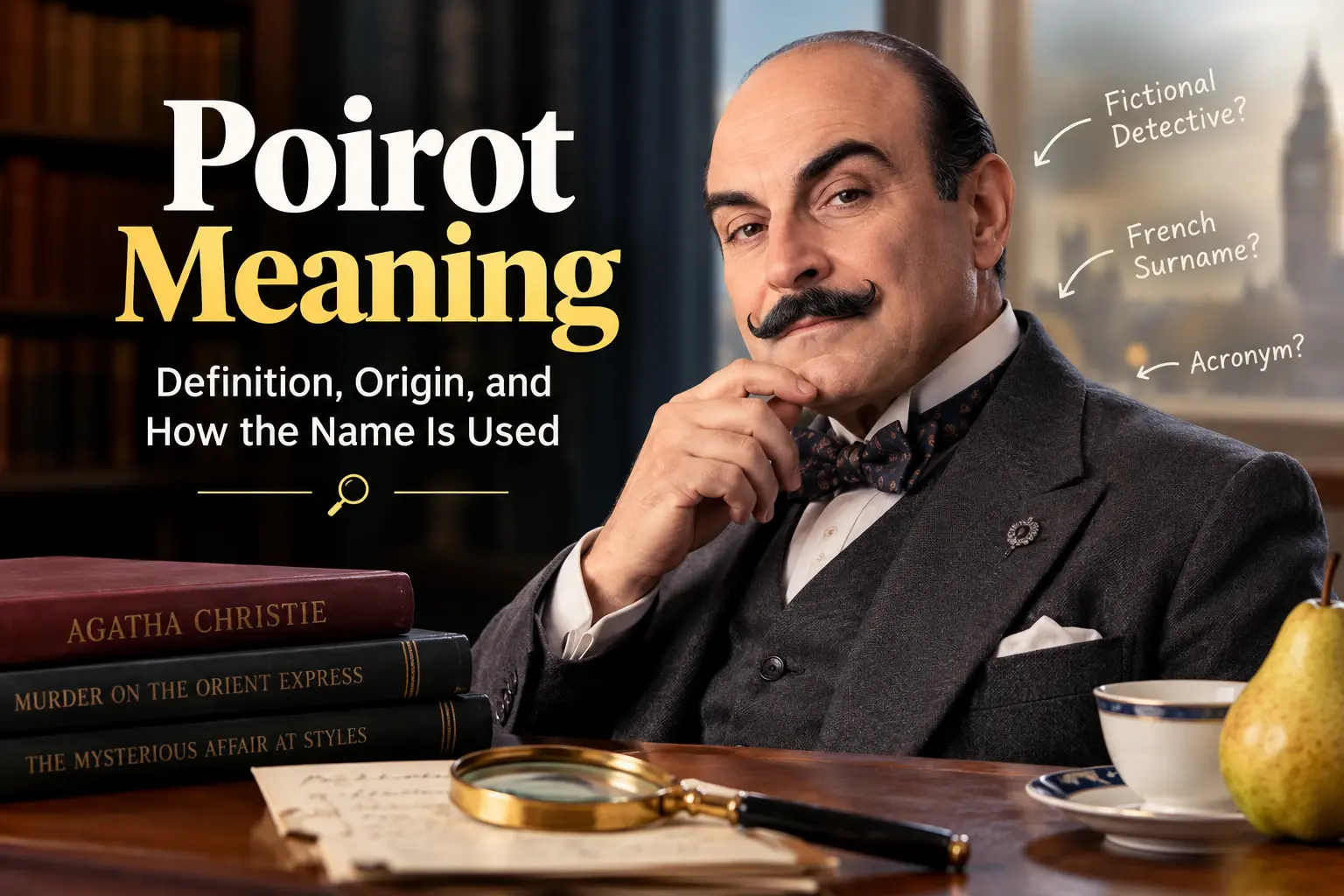
The word “Poirot” most commonly refers to Hercule Poirot, the famous fictional detective created by British mystery writer Agatha Christie. Known for his sharp mind, carefully organized thinking, and remarkable ability to solve complicated crimes, Poirot is one of the best-known characters in detective fiction.
However, the name can have more than one point of interest. Poirot is also a French surname, and people may use it informally when talking about someone who notices small details or acts like a detective.
If you have seen “Poirot” in a book, a movie, a text message, or a social media post, its meaning depends on the context. It may refer directly to the fictional detective, describe a detective-like personality, or simply be someone’s surname or username.
In this guide, we will explain the meaning of Poirot, its possible name origin, its cultural significance, and how to understand it in everyday conversations.
What Does Poirot Mean?
Poirot primarily refers to Hercule Poirot, Agatha Christie’s fictional Belgian detective. In a broader context, the name can also refer to a French family name or be used as a playful comparison for someone who is good at solving mysteries.
Here are the main interpretations:
- Fictional character: Hercule Poirot, the detective featured in Agatha Christie’s mystery stories.
- Surname: Poirot is a French surname with a history that may connect it to the French word poire, meaning “pear.”
- Informal reference: Someone might call another person “Poirot” when they are investigating a situation, noticing clues, or trying to uncover a secret.
- Online reference: On social media, the name may appear in discussions about detective stories, crime mysteries, memes, or clever problem-solving.
The fictional character is the most established meaning. The other interpretations depend on the situation in which the name appears.
Slang usage: Calling someone a “Poirot” can be a playful comparison to a detective, but that does not establish it as widely recognized texting slang. The source Meta cites for this usage should be checked before making broader claims.
Surname origin: The connection to the French word poire (pear) is plausible, but the exact historical derivation and the role of the suffix -ot should be verified with reliable surname references.
The Main Meaning of Poirot
Poirot as a Fictional Detective
Hercule Poirot is a Belgian private detective created by Agatha Christie. He is famous for solving crimes through careful observation, logical reasoning, and an understanding of human behavior.
Unlike fictional detectives who rely mainly on physical strength or action, Poirot often focuses on small inconsistencies in people’s stories. A detail that seems unimportant to everyone else may help him understand what really happened.
His approach is closely associated with his famous phrase, “little grey cells,” which refers to the mind’s ability to think, reason, and solve problems. Christie featured him in 33 novels and more than 50 short stories, making him one of her most enduring characters.
For example:
- “I read a Poirot mystery last night.”
- “Hercule Poirot figured out who committed the crime.”
- “That ending felt like something from a Poirot story.”
In these examples, the name refers directly to the detective or the mystery stories featuring him.
Poirot as a French Surname
Poirot is also a French surname. One commonly cited explanation connects it to poire, the French word for “pear.” Under this interpretation, the name may historically have referred to someone who grew or sold pears.
Surname origins can be complicated, however, and not every family name has a single confirmed explanation. The history of Poirot may involve regional naming traditions, so it is better to describe the connection to poire as a proposed origin rather than a meaning that applies to every person with this surname.
When Poirot appears as a person’s last name, it does not automatically refer to the fictional detective or imply anything about that person’s personality.
For instance, a person named Marie Poirot may simply be using her family name. The context determines whether the name has any connection to Agatha Christie’s character.
Poirot as a Casual Reference to a Detective
In informal conversation, someone may use “Poirot” as a comparison for a person who is trying to solve a mystery.
Imagine that your friend notices a small detail in a photograph and uses it to work out where everyone went. You might say:
“You’re turning into Poirot!”
Here, you are comparing your friend to the fictional detective because they are observant or curious.
This is an understandable cultural reference, but it is not proof that “Poirot” has a standardized slang definition. The expression may be familiar to fans of detective fiction, while other people may not recognize it.
Who Is Hercule Poirot?
Hercule Poirot is a fictional detective whose popularity has lasted for more than a century. Agatha Christie introduced him in her first published novel, The Mysterious Affair at Styles, in 1920. The story follows Poirot as he investigates a suspicious death involving poisoning.
The Character Created by Agatha Christie
Agatha Christie created Poirot while developing a detective story that would challenge readers to solve a crime alongside the main character.
The character was inspired in part by Belgian refugees who had settled in Torquay, England, during the First World War. Christie imagined a retired Belgian police officer who could use his experience and intelligence to investigate difficult cases.
Poirot’s personality made him stand out. He is confident in his abilities, pays close attention to order, and often notices details that other people overlook. Rather than simply following physical clues, he studies people’s words, behavior, relationships, and motives.
These qualities help explain why his name has become closely associated with mystery-solving.
Hercule Poirot’s Personality and Famous Traits
Several characteristics make Poirot instantly recognizable.
- Intelligence: He uses logic and reasoning to connect clues.
- Observation: He notices small details that other people miss.
- Attention to order: He prefers neatness, structure, and a methodical approach.
- Psychological insight: He considers what people may be hiding and why they might behave in certain ways.
- Distinctive appearance: His carefully groomed moustache and precise clothing are among his best-known features.
- Confidence: He trusts his reasoning and is rarely shy about expressing his abilities.
Poirot’s famous “little grey cells” represent his reliance on mental effort and careful thought. His approach often involves understanding people as much as examining physical evidence.
Because of these traits, using his name as a comparison can suggest that someone is clever, observant, or determined to uncover the truth.
Why Hercule Poirot Became So Popular
Poirot’s popularity comes from the way Christie builds her mysteries. Readers receive clues, meet possible suspects, and try to work out the truth before the detective explains the solution.
The character also has a recognizable personality. His confidence, precise habits, and distinctive appearance make him memorable beyond the individual crimes he solves.
His stories have appeared in numerous adaptations for television, film, radio, and stage. Different actors have portrayed him, introducing the character to audiences across generations.
His continued cultural presence means that someone can mention Poirot without discussing a particular book. They may simply be referring to the idea of a brilliant detective.
Poirot Name Origin and Etymology
The surname Poirot has French origins, but its precise historical development deserves some care.
The French Origin of the Surname
Surname references commonly associate Poirot with France and explain it as a name that may derive from poire, meaning “pear.” According to this interpretation, the surname was connected to someone who grew or sold pears.
Historically, family names could develop from occupations, locations, personal characteristics, or nicknames. A name associated with fruit growing or selling could therefore become a hereditary surname over time.
However, surname etymology is not always straightforward. Regional variations and older naming customs can create more than one possible explanation for a particular family name.
The Possible Connection Between Poirot and the Word “Poire”
The French word poire translates to “pear” in English. Some surname references explain Poirot as a diminutive form connected with this word and associate it with pear growing or selling.
This does not mean that the word “Poirot” is ordinarily used as the French word for a pear. It is a surname whose historical origin may be connected to the fruit.
It is also important not to assume that the name has a symbolic meaning such as sweetness, wisdom, or intelligence simply because of a possible connection to a fruit. Such interpretations would need separate evidence.
Historical and Family Name Significance
A surname can preserve traces of a family’s history, occupation, or regional background. Poirot is associated with France, and family-history resources record people bearing the name across different countries.
For someone researching a family named Poirot, the surname’s general etymology is only a starting point. Historical documents, birth records, and the family’s geographic origins may provide more useful information about a particular branch.
The literary association with Hercule Poirot is a separate part of the name’s history. Agatha Christie made the surname internationally recognizable through her detective stories, but the surname itself was not invented for the character.
Does Poirot Stand for Anything?
Is Poirot an Acronym?
No widely established expansion of “Poirot” as an acronym is associated with the famous detective or the surname.
An acronym is formed from the initial letters of a series of words, such as NASA. Poirot, by contrast, is a name rather than a commonly recognized abbreviation.
If someone sends you “Poirot” in a message, you should not automatically try to assign a separate word to each letter. The person is more likely to be referring to the character, using the surname, or making a context-specific reference.
Does Poirot Have a Hidden Meaning?
There is no single hidden meaning that applies to every use of Poirot.
The name’s meaning depends on how it is being used:
- In literature, it usually refers to Hercule Poirot.
- In a family record, it may be a surname with French origins.
- In casual conversation, it may be a comparison to a detective.
- In an online profile, it could be a username, nickname, or reference to the character.
A person’s intention may be clear from the surrounding conversation, but the name itself does not automatically communicate a secret message.
Is Poirot a Name or a Slang Expression?
Poirot is first and foremost a surname and the name of a well-known fictional detective.
It can also be used figuratively in a conversation, particularly when someone is comparing another person to a detective. However, this informal usage should not be confused with a universally recognized slang word.
For example, “Stop acting like Poirot” might mean “Stop investigating everything” in one conversation. In another, it could be a friendly joke about someone’s ability to solve a mystery.
The speaker’s tone and the relationship between the people involved help determine the intended meaning.
Poirot Meaning in Different Contexts
The same word can serve different purposes depending on where it appears. Understanding the context helps you identify what someone means by Poirot.
Poirot in Books and Literature
In books, Poirot most often refers to Hercule Poirot or a story associated with him.
A reader might write, “I’m reading a Poirot novel,” to explain that they are enjoying one of Agatha Christie’s detective stories. Another person might mention a “Poirot-style mystery” to describe a plot built around clues, suspects, and a final explanation.
In literary discussions, the name may also represent a particular style of detective fiction. Readers may use it when comparing fictional investigators or discussing how a mystery reveals its solution.
Poirot in Movies and Television
In films and television, Poirot usually refers to the character or an adaptation of his stories.
Someone might discuss an actor’s performance, compare two adaptations, or recommend a Poirot mystery to a friend who enjoys crime dramas.
For example:
- “I watched a Poirot episode last night.”
- “Which actor do you think portrayed Poirot best?”
- “That movie reminded me of a classic Poirot mystery.”
In these cases, the meaning is straightforward: the speaker is referring to the fictional detective or the type of mystery associated with him.
Poirot in Everyday Conversations
In everyday speech, the name can be used literally or figuratively.
A person discussing books may mention Poirot by name. Someone else may use the same name as a joke when a friend starts asking questions about an unexplained event.
For example:
“Who moved my notebook? You’re acting like Poirot trying to solve the case!”
This sentence compares the person to a detective because they are investigating something. The humor comes from treating a small everyday situation like a complicated crime.
Poirot in Text Messages and Online Discussions
In a text message or online discussion, Poirot may refer to the detective, a mystery story, or someone’s detective-like behavior.
For instance, a friend might send “Okay, Poirot 😂” after you correctly guess why they were late. They may be teasing you for noticing the clues.
However, “Poirot” is not a standard texting abbreviation with one fixed definition. If it appears without enough context, it is better to ask the sender what they mean rather than assume it has a hidden slang meaning.
Poirot Meaning on Different Platforms
The meaning of Poirot can vary slightly across social media platforms because people use names and cultural references in different ways. There is no single platform-specific definition that applies to every post.
Text Messages and WhatsApp
In private messages, someone may mention Poirot when talking about a mystery, making a joke, or describing a person’s habit of asking too many questions.
Consider this example:
Person A: “How did you know I went to the café?”
Person B: “You posted a picture with the café’s logo in the background.”
Person A: “Wow, Poirot! 😂”
Here, Poirot is a playful reference to the other person’s observation skills. The sender is not using an abbreviation; they are comparing the person to a detective.
If someone simply sends “Poirot” without any explanation, the meaning may be unclear. They might be sharing a character reference, recommending a show, or using the name as a nickname.
Reddit and Discussion Forums
On Reddit and other discussion forums, Poirot may appear in conversations about detective fiction, fictional characters, mystery recommendations, and crime-story plots.
For example, someone might ask whether Hercule Poirot or another fictional detective is better at solving complicated cases. Others may discuss his reasoning style, memorable cases, or the clues that reveal a mystery’s solution.
The name can also appear in discussions about real-life problem-solving. In that context, a user might compare someone to Poirot because they noticed an overlooked detail.
Always read the surrounding post or comments before deciding what the name means.
TikTok and Instagram
On TikTok and Instagram, Poirot may appear in videos, captions, memes, fan edits, or posts about mystery stories.
Someone might use the name to describe a person who uncovers a secret, spots a suspicious detail, or solves a problem before everyone else.
For example, a caption might say:
“When your friend notices one tiny detail and solves the entire mystery. Okay, Poirot!”
This is an illustrative example of a detective reference, not evidence that the word has a standardized TikTok definition.
If you encounter the name in a particular video, its meaning will depend on the content, the caption, and the creator’s intention.
How People Use Poirot in Conversation
The name can be used in several ways, depending on whether someone is discussing the character or comparing another person to him.
Calling Someone a Detective
People may use Poirot as a nickname for someone who enjoys investigating things or figuring out what happened.
For example:
“You figured out who took the last slice of cake? We have a little Poirot in the family!”
The speaker is jokingly comparing the person to a detective. The comment may be complimentary if it celebrates their intelligence or playful if it pokes fun at their curiosity.
Making a Joke About Solving a Mystery
Poirot can also make an ordinary situation sound like a serious investigation.
Imagine that your friend asks several questions to discover who organized a surprise party. You might say:
“Easy, Poirot. It’s supposed to be a surprise!”
The humor comes from treating an everyday event as though it were a detective case.
Referring to Hercule Poirot or His Stories
The name can be used directly when discussing books, films, or television.
Examples include:
- “Hercule Poirot is one of my favorite fictional detectives.”
- “I want to read another Poirot mystery.”
- “The ending reminded me of an Agatha Christie story.”
In these examples, the name refers to the character or his stories, not to a person’s behavior.
Real Conversation Examples
The following examples show how the meaning of Poirot can change according to the conversation.
Friends
EXAMPLE 1 · PLAYFUL
Friend A: “I knew you bought me a gift because I found the shopping receipt.”
Friend B: “You’re such a Poirot!”
Meaning: Friend B is joking about Friend A’s ability to uncover clues.
EXAMPLE 2 · LITERARY
Friend A: “What should I read next?”
Friend B: “Try a Hercule Poirot mystery if you enjoy clever detective stories.”
Meaning: Poirot refers to the fictional detective and his books.
Family
Example 1
- Sibling A: “I found the missing TV remote under your cushion.”
- Sibling B: “How did you find that so quickly?”
- Sibling A: “Observation skills. Call me Poirot!”
Here, the person uses the name humorously to describe their ability to find something.
Example 2
- Parent: “Why are you asking everyone who ate the last biscuit?”
- Child: “I’m finding out what happened.”
- Parent: “All right, Poirot, the case is closed!”
In this situation, the name playfully compares the child to a detective investigating a minor incident.
Online Discussions
Example 1
- User A: “I guessed the ending halfway through the movie.”
- User B: “Nice work, Poirot!”
Meaning: User B is making a lighthearted comparison to a fictional detective.
Example 2
- User A: “Is Hercule Poirot worth reading?”
- User B: “Yes, especially if you enjoy mysteries that reward close attention to clues.”
Meaning: The conversation is directly about Agatha Christie’s character and stories.
These examples are fictional illustrations of how the name might be used. They are not quotations from actual social media posts.
Tone and Emotional Meaning
When someone calls another person Poirot, the emotional meaning depends on the situation, the speaker’s tone, and their relationship.
Is Calling Someone Poirot a Compliment?
It can be.
If someone calls you Poirot after you notice an important detail or solve a difficult problem, they may be complimenting your intelligence and observation skills.
For example:
“You noticed the inconsistency before anyone else. You’re our Poirot!”
The remark suggests that the person is impressed by your ability to think carefully and connect clues.
However, not every use is a compliment. Someone might use the name sarcastically when they feel that another person is asking too many questions.
Can Poirot Be Used as an Insult?
The name itself is not inherently insulting. However, it can sound critical when someone uses it to complain about another person’s behavior.
For example:
“Stop acting like Poirot and mind your own business.”
In this context, the speaker is suggesting that the other person is investigating something unnecessarily or interfering in a private matter.
The negative tone comes from the sentence and situation, rather than from a fixed insulting definition of the name.
When Is Poirot Used Humorously?
The name works as a joke when someone treats a small mystery as if it were a major detective case.
Finding a missing pen, guessing a surprise, or figuring out who finished the snacks could all inspire a playful Poirot reference.
The joke is most likely to work when the other person understands who Hercule Poirot is. If they have never heard of the character, they may not understand the comparison.
How to Reply When Someone Calls You Poirot
Your reply can be friendly, funny, or direct, depending on what the person means.
Friendly Replies
If someone is praising your ability to notice details, you can respond warmly.
- “I just pay attention to the little things!”
- “Glad someone noticed my detective skills.”
- “I guess that mystery wasn’t too difficult.”
- “Thanks! I enjoy figuring things out.”
These replies work well when the person is making a positive comparison.
Funny Replies
If the conversation is playful, you can continue the detective joke.
- “The case is officially closed!”
- “My little grey cells are working overtime.”
- “I need a detective badge now.”
- “Nothing escapes my investigation!”
- “Where’s my detective fee?”
These are lighthearted responses inspired by the character’s reputation for solving mysteries.
Replies When You Are Confused
If you do not know what the person means, there is no need to guess.
You could say:
- “What do you mean by Poirot?”
- “Is that a detective reference?”
- “Are you talking about Hercule Poirot?”
- “Wait, should I know this reference?”
A simple question can clear up the confusion without making the conversation awkward.
When to Use the Term
Using Poirot as a reference can work well when the other person understands the character or the detective comparison.
Consider using it when:
- You are discussing Agatha Christie’s books or adaptations.
- You want to make a playful comment about someone’s observation skills.
- You are talking about mystery stories or fictional detectives.
- You are joking about someone solving a small problem.
- You are participating in a conversation where the reference is already understood.
For example, saying “You’re our Poirot today” can be a fun way to acknowledge a friend who has worked out a complicated situation.
The key is to make sure the reference fits the conversation. It is not a universally understood expression, so a little context can help.
When to Avoid the Term
Although Poirot can be used humorously, it may not be appropriate in every situation.
Avoid using it when:
- The other person is unfamiliar with Agatha Christie or detective fiction.
- You are discussing a serious or sensitive situation.
- The comparison might sound like criticism of someone’s curiosity.
- You need to communicate something clearly in a formal workplace message.
- The other person could interpret the joke as sarcasm or mockery.
For example, calling a colleague “Poirot” during a serious disagreement could make it sound as though you are accusing them of interfering or asking unnecessary questions.
In professional settings, phrases such as “good observation,” “careful analysis,” or “excellent problem-solving” are usually clearer.
Common Misunderstandings About Poirot
Assuming Poirot Is Internet Slang
One common mistake is assuming that every unfamiliar name seen online must be slang.
Poirot is primarily a surname and the name of a fictional detective. Although people may use it informally as a detective reference, that does not make it a standard abbreviation or a universally recognized slang term.
Confusing the Name With an Acronym
Poirot is not generally understood as an acronym. There is no widely established phrase whose initials form the word.
If someone uses it in a message, interpret it from the context rather than inventing an expansion for each letter.
Treating Every Online Use as Having the Same Meaning
The meaning of Poirot can change depending on where it appears.
A book review may refer to the fictional detective. A family conversation may use the name as a joke. A profile may simply contain it as a surname or username.
The surrounding words, topic, and situation are more reliable clues than the platform alone.
Assuming Everyone Called Poirot Is Being Praised
A detective comparison can be complimentary, playful, sarcastic, or critical.
For example, “Great job, Poirot!” may express admiration, while “Stop playing Poirot” may suggest that someone is being intrusive.
Always consider the tone before deciding how to respond.
Similar Names and Terms
Several words and names are related to Poirot through detective fiction or the idea of investigating a mystery.
| Term | Meaning |
| Hercule Poirot | Agatha Christie’s fictional Belgian detective |
| Detective | A person who investigates crimes or gathers evidence |
| Sleuth | An informal word for a detective or investigator |
| Investigator | Someone who examines facts to discover what happened |
| Sherlock Holmes | A famous fictional detective created by Arthur Conan Doyle |
| Mystery | A situation, story, or event whose explanation is not yet known |
| Whodunit | A mystery story focused on discovering who committed a crime |
These terms are related by subject, but they are not exact synonyms for Poirot. For example, “sleuth” is a general word, while “Poirot” identifies a particular fictional character or surname.
Quick Recap: Poirot Meaning
The main things to remember are:
- Primary meaning: Poirot most commonly refers to Hercule Poirot, Agatha Christie’s famous fictional detective.
- Name origin: Poirot is a French surname, commonly linked to poire, meaning “pear,” although surname etymology can be complex.
- Informal use: Someone may use Poirot as a playful comparison for a person who notices clues or solves mysteries.
- Texting meaning: It is not a standard texting abbreviation with one fixed definition.
- Tone: A Poirot reference may be friendly, humorous, complimentary, or sarcastic, depending on context.
If you see the name in a message, look at the surrounding conversation first. That will usually help you understand whether the sender means the character, the surname, or a detective-like comparison.
Frequently Asked Questions
What does Poirot mean?
Poirot most commonly refers to Hercule Poirot, the fictional Belgian detective created by Agatha Christie. It is also a French surname and may be used informally as a detective reference.
Who is Hercule Poirot?
Hercule Poirot is a fictional detective known for solving complex mysteries through logic, observation, and psychological insight. He first appeared in Agatha Christie’s The Mysterious Affair at Styles, published in 1920.
What is the origin of the surname Poirot?
Poirot is a French surname commonly explained as deriving from poire, the French word for “pear.” Some surname references connect it to pear growers or sellers, although the precise
Does Poirot stand for anything?
Poirot has no widely established acronym expansion. It is primarily a surname and the name of a fictional detective, although people may use it as a cultural reference in conversation.
What does calling someone a Poirot mean?
Calling someone a Poirot may mean that they are acting like a detective by noticing details, asking questions, or solving a mystery. Depending on the tone, it can be a compliment or a playful tease.
Is Poirot a slang word?
Poirot is not primarily a slang word. Its best-established meaning is the name of Agatha Christie’s detective. Some speakers may use it informally as a comparison to someone who investigates or solves problems.
What does Poirot mean in text messages?
In a text message, Poirot may refer to the detective or jokingly describe someone who has uncovered a clue. There is no single standard texting definition, so the surrounding conversation matters.
What does Poirot mean on TikTok?
On TikTok, Poirot may appear in detective-related videos, mystery discussions, fan content, or jokes about solving a problem. Its meaning depends on the particular video or caption rather than a fixed platform-specific definition.
Is Poirot a real person?
Hercule Poirot is fictional, not a real historical detective. Agatha Christie created the character for her mystery stories, although real people can have Poirot as a surname.
Why is Hercule Poirot famous?
Poirot is famous for his intelligence, distinctive moustache, orderly habits, and logical approach to solving crimes. His appearances in numerous novels and short stories, along with screen adaptations, have helped maintain his popularity.
Final Thoughts
Poirot is best known as the surname of Hercule Poirot, Agatha Christie’s memorable fictional detective. The name also has a French surname history and can be used informally to describe someone who enjoys solving mysteries or noticing small details.
If you encounter Poirot in a text message or on social media, do not assume it has a hidden meaning or a fixed slang definition. Consider the topic, the speaker’s tone, and the surrounding conversation.
In most cases, understanding the reference to the famous detective will give you the context you need.