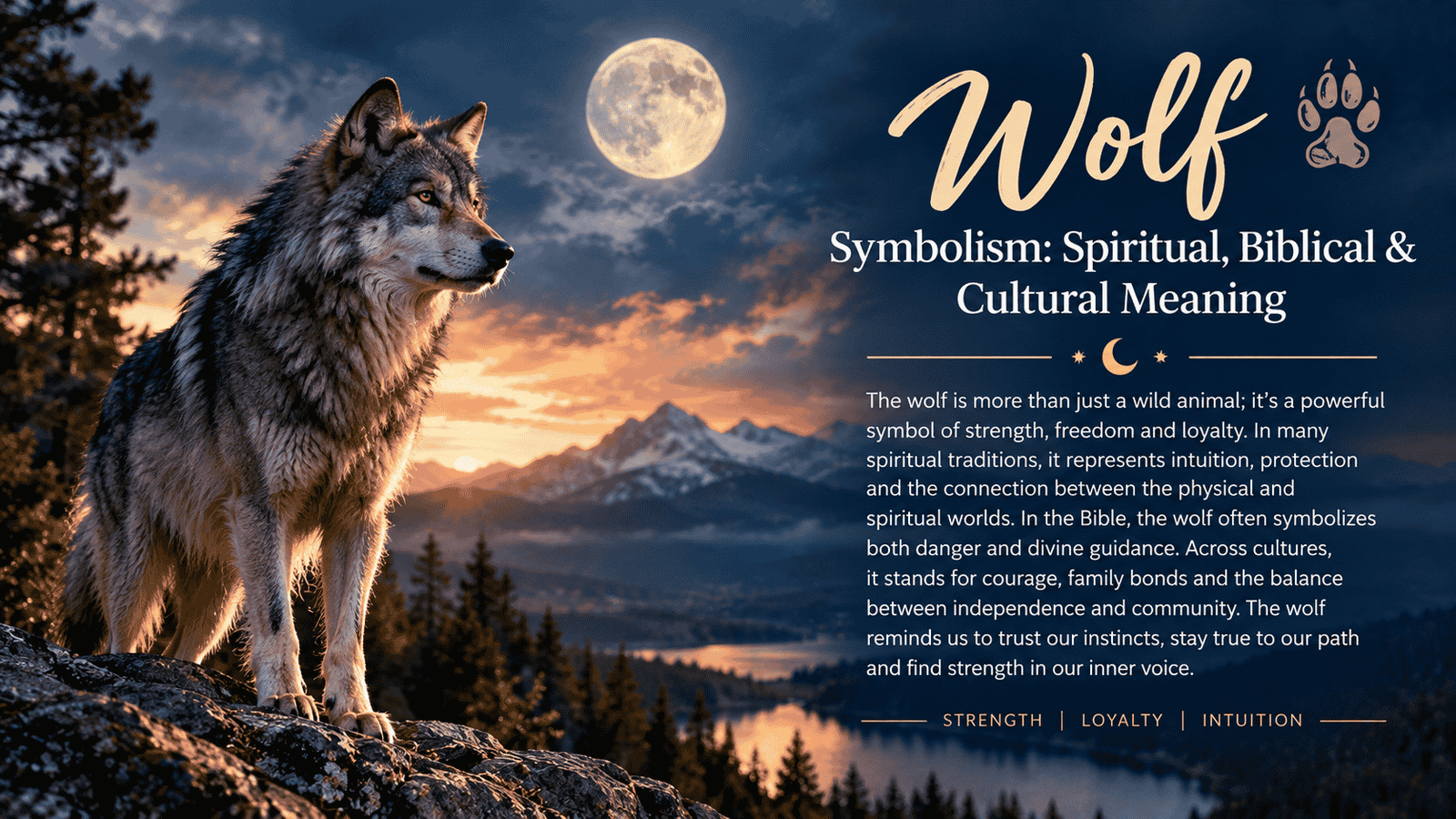
Wolf Symbolism: Spiritual, Biblical & Cultural Meaning
Quick Answer
Wolf symbolism commonly represents strength, loyalty, instinct, independence, protection, courage, community, and transformation. Because wolves live socially while also surviving in challenging natural environments, they can symbolize both the power of belonging and the importance of self-reliance.
The meaning of a wolf changes according to context. In the Bible, wolf imagery is often connected with danger or predatory behavior. In various Indigenous traditions, wolf meanings differ between nations and communities. In modern spirituality, wolves may represent intuition, personal power, protection, and a connection with nature. In dreams and tattoos, the symbolism is often shaped by the wolf’s behavior, appearance, and the emotions surrounding the image.
TL;DR: What Does a Wolf Symbolize?
- Strength: The ability to endure challenges and survive difficult circumstances.
- Loyalty: Strong bonds with family, friends, or a community.
- Independence: Freedom, self-reliance, and following one’s own path.
- Instinct: Trusting awareness, observation, and natural responses.
- Protection: Vigilance and defending people or values that matter.
- Community: Cooperation, social bonds, and shared responsibility.
- Courage: Facing uncertainty without abandoning one’s values.
- Transformation: Adapting to change and developing a stronger identity.
- Mystery: The unknown, wilderness, nighttime, and hidden aspects of life.
Wolf Symbolism
The wolf is one of the most recognizable animal symbols in human storytelling. Its image can inspire admiration, fear, curiosity, or a sense of freedom. Much of this symbolism comes from the wolf’s real characteristics: it is intelligent, highly social, adaptable, territorial, and capable of surviving in demanding environments.
One of the most interesting aspects of wolf symbolism is its duality. A wolf can represent independence, yet wolves also depend heavily on social relationships. This makes the animal a useful symbol for balancing individuality with belonging.
What Does a Wolf Symbolize Spiritually?
In modern spiritual interpretations, the wolf is often associated with intuition, inner strength, protection, independence, and personal transformation. A wolf may be viewed as a symbolic reminder to listen carefully to one’s instincts while remaining connected to people who provide genuine support.
Spiritual wolf symbolism does not have one universal interpretation. Someone who associates wolves with family may see a wolf as a symbol of loyalty, while another person may connect it with freedom and solitude.
Wolf Symbolism and Personal Strength
The wolf’s ability to adapt to changing environments contributes to its association with resilience and strength. As a symbolic image, it can represent the determination to continue through difficult periods without losing one’s sense of identity.
A wolf may therefore appear in artwork or personal symbolism when someone wants to express courage, endurance, confidence, and the ability to overcome obstacles.
Wolf Symbolism of Loyalty and Family
Wolves are social animals, making them natural symbols of connection, cooperation, and loyalty. The idea of the wolf pack has become especially influential in modern symbolism.
A wolf can represent the people who stand beside you during difficult times. For this reason, wolf imagery is sometimes chosen to symbolize family, close friendships, partnership, or a strong sense of belonging.
Wolf Symbolism in the Bible
Wolf symbolism in the Bible is primarily associated with danger, predatory behavior, deception, and threats against vulnerable people or communities. Biblical references often use the wolf as a metaphor rather than presenting the animal as inherently evil.
One well-known example appears in Matthew 7:15, where Jesus warns about false prophets and describes them as coming in sheep’s clothing while being inwardly like ravenous wolves. The contrast between sheep and wolves makes the symbolism particularly powerful: sheep represent vulnerability, while the wolf represents a concealed threat.
Wolf Symbolism Biblical
The biblical meaning of the wolf should be understood within its specific textual context. Unlike some modern spiritual interpretations, biblical wolf imagery generally does not center on independence, personal empowerment, or positive transformation.
Instead, the wolf can symbolize predatory behavior, danger, false appearances, or an individual who threatens others. This imagery reflects the historical understanding of wolves as predators that could endanger livestock and vulnerable animals.
Wolf in the Bible Meaning
Several biblical passages use wolves metaphorically. In Genesis 49:27, Benjamin is compared to a ravenous wolf in language connected with strength and aggressive action. In Ezekiel 22:27, leaders are compared to wolves tearing prey, emphasizing exploitation and wrongdoing.
These examples show why wolf symbolism in biblical passages depends on context. The wolf can communicate aggression or danger, but readers should examine the particular passage rather than assigning one universal biblical meaning.
Wolf Symbolism in Christianity
Christian interpretations frequently connect wolves with false teachers, spiritual danger, deception, and the need for discernment. The image becomes especially meaningful when contrasted with sheep and shepherds.
At the same time, Christianity does not teach that wolves themselves are spiritually evil animals. The wolf functions primarily as a metaphor within particular biblical passages and later religious interpretations.
Wolf Symbolism Native American
There is no single “Native American meaning” of the wolf. Indigenous nations across North America have distinct languages, histories, spiritual traditions, stories, and relationships with animals. Therefore, wolf symbolism should not be reduced to one universal interpretation.
In some Indigenous traditions, wolves have important associations with family, cooperation, hunting knowledge, loyalty, courage, and relationships with the natural world. The precise meaning can vary substantially between communities.
Wolf as a Spiritual Animal in Indigenous Traditions
Animal relationships can hold significant cultural meaning in some Indigenous traditions, but it is important not to combine separate nations into one generalized belief system.
Descriptions of wolves as teachers, relatives, helpers, or important cultural figures should therefore be connected to the specific Indigenous nation or tradition being discussed.
Wolf Clan and Cultural Associations
Some Indigenous communities have clan systems in which animals have important social or cultural associations. However, clan meanings are not identical across Native nations.
When researching wolf-related clan traditions, the most respectful approach is to identify the specific nation and use sources representing that community rather than assuming that one interpretation applies throughout North America.
Respectful Interpretation of Wolf Symbolism
Modern websites sometimes present generalized claims about “Native American wolf symbolism.” Such claims can blur meaningful differences between nations.
A respectful interpretation recognizes that Indigenous cultures are diverse and living traditions, not a single symbolic system. Historical context and community-specific sources matter when discussing this subject.
Wolf Symbolism Spiritual
Modern spirituality often gives the wolf a more positive meaning than some biblical and European folklore traditions do. The animal may symbolize intuition, freedom, courage, protection, personal power, and transformation.
This interpretation is especially common in contemporary spiritual writing, artwork, tattoos, and personal symbolism. These meanings should be understood as modern interpretations rather than automatically attributed to every ancient culture.
Wolf as a Spirit Guide
The phrase “wolf spirit guide” is common in modern spiritual discussions. In this framework, the wolf may symbolize listening to instinct, recognizing personal boundaries, developing courage, and remaining connected to one’s community.
This is a personal or contemporary spiritual interpretation, not a universal religious doctrine. People may understand the symbol differently according to their own beliefs.
Wolf Spiritual Meaning
A wolf may spiritually represent a period when someone is learning to trust themselves while maintaining meaningful relationships with others.
Its symbolism can also relate to self-discovery, protection, resilience, and the courage to enter unfamiliar territory.
Wolf Energy Meaning
“Wolf energy” is often used metaphorically to describe qualities such as alertness, determination, independence, loyalty, and confidence.
Rather than suggesting that an actual supernatural force is present, the phrase can be understood as a symbolic way of describing the characteristics people associate with wolves.
Wolf Symbolism in Dreams
Dream symbolism is highly personal. A wolf appearing in a dream does not have one fixed meaning, and interpretation can depend on the animal’s behavior, the setting, and especially the dreamer’s emotions.
A frightening wolf may represent something very different from a calm wolf. Likewise, a wolf traveling with a pack can communicate a different symbolic theme from a solitary wolf.
Dreaming of a Friendly Wolf
A friendly wolf may symbolize trust, protection, companionship, loyalty, or a growing acceptance of one’s instincts.
If the dream feels peaceful, the wolf may function as an image of confidence or emotional safety. Personal associations with wolves should also be considered.
Dreaming of a Wolf Attacking
An attacking wolf can symbolize fear, conflict, vulnerability, pressure, or a perceived threat. The meaning may relate to a difficult relationship or situation rather than predicting an actual event.
The dreamer’s emotional response is important. Fear, anger, helplessness, or determination can each change the interpretation.
Dreaming of a Wolf Pack
A wolf pack may represent family, friendship, community, teamwork, or group identity. It can symbolize the comfort of belonging or concerns about one’s position within a group.
For someone experiencing social pressure, the same image could represent anxiety about conformity or group expectations.
Dreaming of a Lone Wolf
A lone wolf often symbolizes independence, solitude, self-reliance, and freedom. It can have a positive meaning when solitude is chosen.
However, it may also represent loneliness or emotional distance when the dream carries sadness or isolation.
Wolf Symbolism Negative
Wolves have negative symbolic associations in many stories and traditions. These associations are partly connected with their role as predators and with historical conflicts between humans, livestock, and wild animals.
Negative wolf symbolism can include danger, aggression, deception, fear, predatory behavior, and isolation.
Why Are Wolves Seen as Negative Symbols?
Historical encounters between wolves and human communities influenced folklore. Wolves could threaten livestock, particularly when natural habitats overlapped with agricultural settlements.
Religious and literary traditions also developed symbolic uses of the wolf, reinforcing its association with danger or deception.
Wolf as a Symbol of Danger
A wolf may represent something powerful that feels threatening or difficult to control. This interpretation appears frequently in folklore and modern storytelling.
The symbolism does not mean that real wolves are morally dangerous. It reflects the way humans have used predators as metaphors for perceived threats.
Wolf Symbolism of Deception
The wolf disguised as a harmless figure is a recurring storytelling idea. The most famous examples include stories in which wolves deceive or pursue vulnerable characters.
This makes the wolf a powerful symbol of hidden danger, manipulation, false appearances, and the importance of caution.
Wolf Symbolism in Literature
Literature has used wolves to explore the boundary between human civilization and wilderness. Writers may present the animal as a predator, companion, outsider, spiritual figure, or representation of human instinct.
Because of this flexibility, the wolf can symbolize completely different things in different books.
Wolves as Literary Symbols
In literature, wolves may represent freedom, danger, instinct, loneliness, social identity, violence, survival, or the unknown.
The surrounding story determines which interpretation is most appropriate. A protective wolf character has a different symbolic role from a predatory wolf antagonist.
Wolf Symbolism in Folklore and Fairy Tales
Wolves are especially common in European fairy tales and folklore. Stories such as Little Red Riding Hood helped establish the wolf as a symbol of danger, deception, predation, and the threatening unknown.
These stories also use the wolf to create a contrast between innocence and danger, civilization and wilderness, or safety and uncertainty.
The Lone Wolf in Literature
The “lone wolf” is a powerful literary archetype. It often describes a character who exists outside conventional society.
Depending on the story, this outsider can represent freedom and individuality or loneliness and alienation.
Wolf Symbolism in Fantastic Mr. Fox
In Wes Anderson’s film adaptation of Fantastic Mr. Fox, the wolf appears briefly but carries considerable symbolic weight. The animal represents a world beyond the carefully structured society inhabited by the main characters.
The wolf’s presence creates a quiet contrast with Mr. Fox’s energetic, complicated life. Rather than functioning simply as a villain, the wolf can be interpreted as an image of wildness, mystery, distance, and a life outside human-like social structures.
What Does the Wolf Represent in Fantastic Mr. Fox?
The wolf can be interpreted as representing the untamed natural world. Its quiet presence contrasts with the dialogue, planning, competition, and social relationships that dominate the rest of the story.
The encounter can also suggest a recognition between different forms of animal existence.
Wolf and the Theme of Wildness
The wolf’s appearance emphasizes the boundary between civilization and wilderness. The characters live in a world filled with human-like homes, clothes, meals, businesses, and social rules.
The wolf, by contrast, appears as a creature that belongs naturally to the wild. This makes it a visual symbol of freedom and untamed nature.
Wolf and Mr. Fox
Mr. Fox is clever, ambitious, social, and constantly making plans. The wolf is comparatively silent and distant.
Their contrast allows the wolf to function as a reminder of the natural identity that exists beyond Mr. Fox’s civilized persona.
Wolf Symbolism Tattoo
Wolf tattoos are popular because the image can communicate many different ideas without requiring words. The meaning depends on the wolf’s expression, posture, surrounding symbols, artistic style, and the personal story behind the tattoo.
Common themes include strength, family, loyalty, freedom, courage, protection, individuality, and resilience.
Wolf Tattoo Meaning
A wolf tattoo can symbolize personal strength and independence. For another person, the same tattoo may represent family or loyalty.
The meaning can also be shaped by the design. A realistic wolf may emphasize connection with nature, while a stylized wolf can communicate identity or artistic expression.
Wolf Pack Tattoo Symbolism
A pack of wolves is often used to symbolize family, friendship, teamwork, loyalty, and belonging.
People may choose several wolves to represent parents, children, siblings, close friends, or another meaningful group.
Lone Wolf Tattoo Meaning
The lone wolf tattoo commonly represents independence, individuality, self-reliance, and choosing one’s own path.
Depending on the personal story, it can also symbolize a period of solitude or learning to become comfortable with oneself.
Wolf and Moon Tattoo Symbolism
A wolf beneath or howling toward the moon combines two powerful symbols. The design can represent mystery, intuition, nighttime, nature, freedom, and emotional depth.
The moon can also introduce themes of cycles and change, giving the overall tattoo a more reflective meaning.
Geometric Wolf Tattoo Meaning
Geometric wolf designs combine natural animal imagery with mathematical shapes and structured lines. They may symbolize balance, order, identity, focus, and harmony between instinct and reason.
The geometric style is also popular for its clean, contemporary appearance.
White Wolf Symbolism
White wolf symbolism commonly centers on purity, mystery, resilience, transformation, protection, and individuality. White wolves can appear especially striking because their coloring creates an immediate visual association with snow, winter, light, and rare beauty.
However, the meaning of a white wolf differs across cultural and personal contexts.
White Wolf Spiritual Meaning
In modern spiritual interpretations, the white wolf may symbolize inner clarity, transformation, intuition, protection, and spiritual growth.
Its pale appearance can encourage associations with purity and light, while its wolf identity retains themes of strength and instinct.
White Wolf in Dreams
A white wolf in a dream may symbolize something the dreamer perceives as mysterious, powerful, protective, or transformative.
A calm white wolf may evoke trust or guidance, while an aggressive one may represent fear or uncertainty. The dreamer’s emotional experience remains central to interpretation.
White Wolf Tattoo Meaning
A white wolf tattoo can represent individuality, strength, mystery, resilience, transformation, or personal freedom.
Some people choose the design because it represents a distinctive identity, while others associate the white wolf with a difficult life transition or a new beginning.
Wolf Symbolism Across Cultures
Wolves appear in myths, religious texts, folklore, literature, and oral traditions across many regions. Their meanings are not identical, however.
Some traditions emphasize danger and destruction, while others associate wolves with origins, protection, social bonds, nature, or supernatural forces.
Wolf Symbolism in European Folklore
European folklore frequently presents wolves as dangerous predators. Fairy tales often use the wolf as a threatening character who enters a safe human environment.
At the same time, European mythology contains more complicated wolf imagery, including stories in which wolves possess extraordinary strength or supernatural significance.
Wolf Symbolism in Norse Mythology
Norse mythology contains several important wolf figures. Fenrir, one of the best-known, is associated with immense power and the events of Ragnarök.
Other wolves, including Sköll and Hati in later mythological accounts, are connected with the celestial pursuit of the sun and moon. Norse wolf symbolism therefore includes power, cosmic conflict, fate, destruction, and forces that cannot easily be controlled.
Wolf Symbolism in Roman Mythology
The she-wolf associated with Romulus and Remus has a particularly important place in Roman foundation mythology.
Rather than representing danger alone, this wolf is connected with nurturing, survival, origins, and the legendary beginnings of Rome.
Wolf Symbolism in Japanese Culture
The Japanese wolf, or ōkami, has historical cultural associations that differ from the threatening wolf imagery found in some European stories.
In particular traditions, wolves have been associated with protection and the natural world. Modern representations sometimes combine these historical associations with contemporary spiritual interpretations, so the two should not automatically be treated as identical.
Wolf Symbolism and Personality
Wolf imagery is frequently used as a metaphor for human personality. These comparisons usually focus on traits people associate with wolves rather than making scientific claims about personality.
Wolf Personality Symbolism
Common symbolic traits include:
- Independent
- Loyal
- Observant
- Protective
- Determined
- Social
- Adaptable
- Courageous
- Instinctive
Lone Wolf Personality
The phrase “lone wolf” describes someone who prefers operating independently. It can suggest confidence and self-reliance, but it may also imply social isolation.
Its meaning depends heavily on context and whether solitude is voluntary.
Wolf Pack Personality
The wolf pack metaphor emphasizes cooperation and social connection. It can describe people who value family, teamwork, loyalty, shared goals, and mutual protection.
Wolf Symbolism and Protection
Protection is one of the strongest modern associations with wolf imagery. The idea comes partly from the wolf’s social nature and the common perception of pack members as connected and cooperative.
Wolf as a Protector
A wolf can symbolically represent vigilance, courage, awareness, and defending what matters.
This makes wolf imagery especially suitable for artwork representing family, guardianship, or personal boundaries.
Wolf and Family Symbolism
The pack provides a powerful metaphor for family relationships. A wolf image may represent people who support one another through difficult situations.
A family-oriented wolf design can therefore communicate belonging, loyalty, responsibility, and mutual care.
Wolf Symbolism and Transformation
Wolves can also symbolize transformation because they represent adaptability, survival, and movement between different environments.
Wolf Symbolism for New Beginnings
A wolf can represent leaving behind an old identity and developing greater independence. The symbolism is particularly appropriate when someone views a major life change as an opportunity to become stronger.
Wolf Symbolism for Resilience
The wolf’s reputation for surviving challenging environments makes it a natural metaphor for resilience and endurance.
In personal symbolism, the animal can represent continuing forward despite obstacles.
Wolf Symbolism for Personal Growth
A wolf may symbolize the process of becoming more aware of one’s instincts, boundaries, strengths, and relationships.
The deeper message is not simply “be strong,” but rather understand when to stand alone and when to rely on your community.
Wolf Symbolism in Modern Culture
Modern culture has transformed wolf imagery into a flexible symbol appearing in tattoos, movies, books, fashion, artwork, logos, fantasy stories, and social media.
Today, wolves can communicate everything from rugged independence to family loyalty.
Wolf Symbolism on Social Media
Wolf images are frequently used to express confidence, independence, determination, mystery, motivation, and individuality.
The phrase “lone wolf” is particularly common in motivational and identity-focused content, although its meaning can range from positive self-reliance to social isolation.
Wolf Symbolism in Art
Artists use wolves in realistic, minimalist, geometric, fantasy, and abstract styles.
A realistic wolf may emphasize nature, while a highly stylized wolf may focus more strongly on identity, spirituality, mythology, or personal expression.
What Does It Mean When You Keep Seeing Wolf Imagery?
Repeatedly encountering wolf imagery does not necessarily indicate a supernatural message. There can be several explanations, including personal associations, cultural exposure, coincidence, and selective attention.
If wolves already have emotional significance for you, seeing one repeatedly may encourage reflection on themes such as independence, loyalty, family, courage, or change.
Consider asking yourself what the wolf represents to you, what emotion it creates, and what circumstances surround each encounter. This approach can provide a more meaningful interpretation than applying a universal definition.
Wolf Symbolism and Emotional Meaning
Wolf imagery can evoke very different emotions. One person may feel protected by the image, while another may associate it with danger or loneliness.
Wolf Symbolism for Courage
The wolf can represent the courage to face uncertainty, defend personal boundaries, and continue through difficult circumstances.
Wolf Symbolism for Freedom
Because wolves are strongly associated with wilderness, they often symbolize freedom, independence, and an untamed spirit.
Wolf Symbolism for Loyalty
Pack imagery makes wolves powerful symbols of loyalty, family, friendship, and commitment.
Wolf Symbolism for Independence
The wolf can represent the ability to make decisions independently and trust one’s own judgment.
Wolf Symbolism for Protection
Wolf imagery can symbolize vigilance, guardianship, courage, and protecting people or principles that are important.
Common Wolf Symbolism Meanings at a Glance
| Wolf Image or Context | Common Symbolic Themes |
|---|---|
| Wolf | Strength, instinct, freedom |
| Wolf pack | Family, loyalty, community |
| Lone wolf | Independence, solitude |
| White wolf | Purity, mystery, transformation |
| Wolf in dreams | Instinct, fear, protection, change |
| Wolf tattoo | Strength, identity, loyalty |
| Wolf and moon | Mystery, intuition, nature |
| Wolf attack | Conflict, fear, vulnerability |
| Friendly wolf | Trust, protection, companionship |
| Howling wolf | Communication, longing, connection |
| Wolf in literature | Wildness, danger, freedom |
| Biblical wolf | Threat, predatory behavior, warning |
FAQs About Wolf Symbolism
What does a wolf symbolize?
A wolf commonly symbolizes strength, loyalty, independence, instinct, protection, courage, community, and resilience. Its meaning depends on the cultural, religious, artistic, or personal context.
What is the spiritual meaning of a wolf?
In modern spiritual interpretations, a wolf can represent intuition, personal strength, independence, protection, transformation, and connection with nature.
What does a wolf symbolize in the Bible?
In biblical passages, wolves are generally used as metaphors for danger, predatory behavior, false appearances, or threats to vulnerable people. The precise meaning depends on the passage.
What does a wolf symbolize in Native American cultures?
There is no single Native American wolf meaning. Indigenous nations have distinct traditions, and wolf symbolism can vary significantly. Some traditions associate wolves with themes such as family, cooperation, courage, and relationships with nature.
What does seeing a wolf in a dream mean?
A wolf dream may relate to instinct, fear, independence, protection, social relationships, or transformation. The wolf’s behavior and the dreamer’s emotional response are important for interpretation.
Is wolf symbolism positive or negative?
Wolf symbolism can be both positive and negative. It may represent loyalty, courage, and protection, while other traditions and stories use the wolf to symbolize danger, deception, or predatory behavior.
What does a white wolf symbolize?
A white wolf is commonly interpreted in modern symbolism as representing purity, mystery, resilience, transformation, individuality, and spiritual growth.
What does a lone wolf symbolize?
A lone wolf commonly represents independence, solitude, freedom, and self-reliance. Depending on context, it can also symbolize loneliness or separation from a community.
What does a wolf tattoo symbolize?
A wolf tattoo can symbolize strength, loyalty, family, independence, courage, protection, freedom, or resilience. The design and the personal meaning behind it determine the most relevant interpretation.
What does a wolf pack symbolize?
A wolf pack commonly represents family, loyalty, cooperation, community, teamwork, and belonging.
What does a wolf symbolize in literature?
In literature, wolves can symbolize wildness, danger, freedom, instinct, isolation, survival, transformation, or the conflict between nature and civilization.
What does the wolf symbolize in Fantastic Mr. Fox?
The wolf can be interpreted as a symbol of wildness, mystery, freedom, and the natural world beyond the structured society of the main characters.
What does a wolf symbolize spiritually in Christianity?
Christian interpretations generally connect wolf imagery with spiritual danger, false teaching, deception, and the need for discernment, based on specific biblical passages.
What does a wolf symbolize in different cultures?
Wolf symbolism varies widely. Wolves can represent danger, destruction, protection, origins, loyalty, nature, power, or spiritual significance, depending on the culture and historical context.
Final Thoughts on Wolf Symbolism
Wolf symbolism has no single universal meaning. The wolf can represent strength and vulnerability, independence and community, protection and danger, freedom and isolation.
In biblical imagery, the wolf often serves as a warning about predatory behavior or concealed threats. In modern spirituality, it is frequently connected with intuition, courage, transformation, and personal strength. In dreams, tattoos, literature, and popular culture, its meaning depends strongly on the surrounding imagery and personal context.
Ultimately, the most useful way to understand a wolf symbol is to consider where it appears, how it behaves, what tradition it comes from, and what emotions it creates. The same wolf can tell very different symbolic stories—and that flexibility is one reason wolf imagery continues to hold such a powerful place in human culture.