Owl Symbolism: Spiritual, Biblical & Cultural Meanings
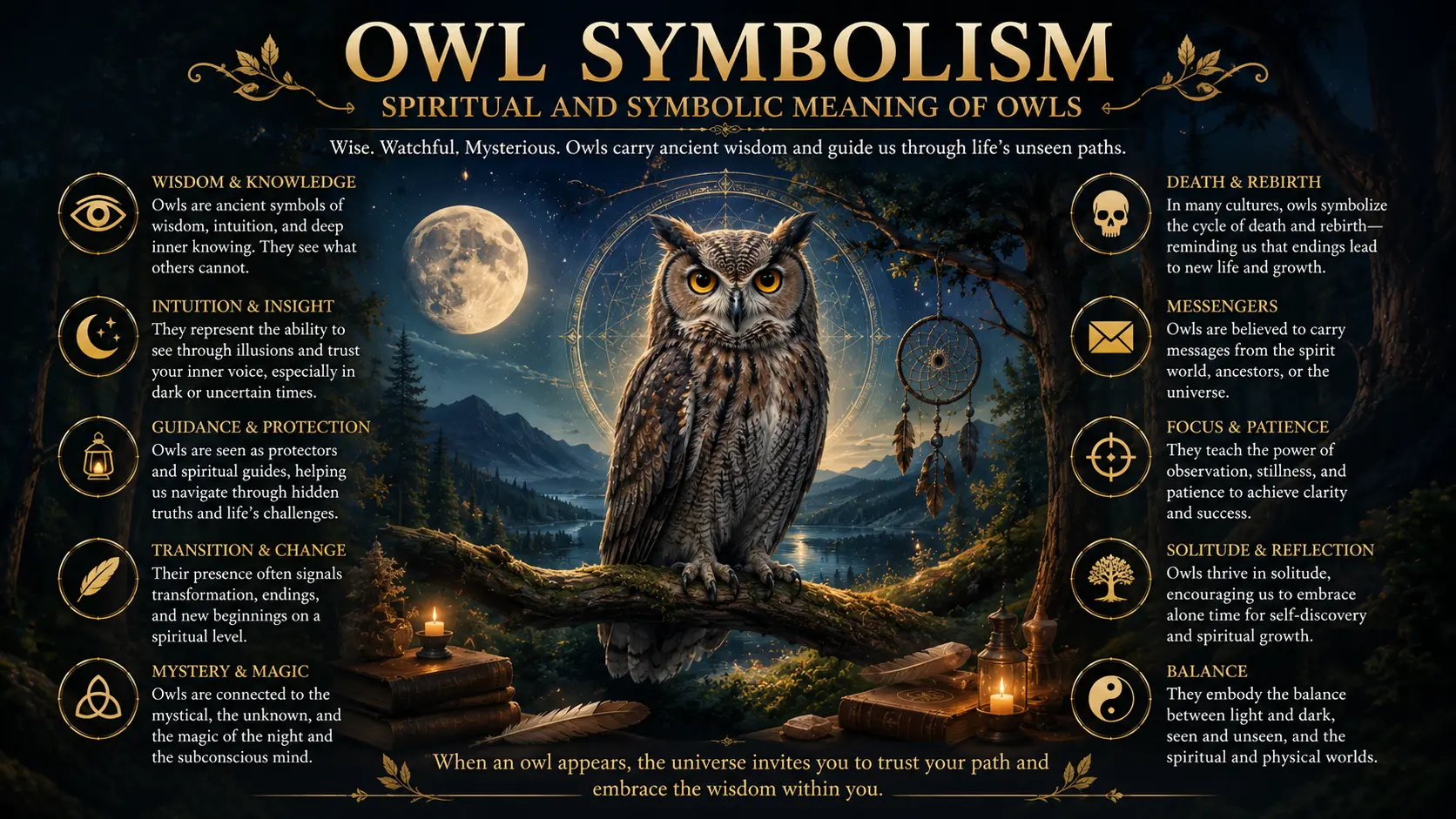
Owl symbolism has fascinated people for centuries because owls are creatures of the night, possess remarkable vision, and move quietly through darkness. Across different traditions, an owl can represent wisdom, intuition, mystery, protection, hidden knowledge, transformation, or death.
The meaning of an owl is not universal. In some cultures, owls are respected as wise and observant creatures, while in others they have been connected with darkness, omens, solitude, or the spirit world. Literature, religion, mythology, art, and modern spirituality have all added different layers to owl symbolism.
This guide explores owl symbolism across cultures, including Native American traditions, the Bible, Christianity, Buddhism, Celtic traditions, Bohemian Grove, Hieronymus Bosch, and Rudolfo Anaya’s Bless Me, Ultima. It also examines spiritual meanings, dreams, colors, tattoos, and modern interpretations.
Owl Symbolism: What Does an Owl Symbolize?
At its broadest level, owl symbolism represents the ability to see what others cannot see. Because owls are active at night and can navigate darkness, they naturally became metaphors for perception, hidden knowledge, and awareness.
An owl may therefore symbolize a person who observes carefully rather than reacting immediately. Its quiet movements can also suggest patience, independence, and thoughtful action.
Wisdom and Knowledge
The association between owls and wisdom is one of the most recognizable forms of owl symbolism. The connection is especially famous because of the owl associated with Athena, the ancient Greek goddess of wisdom.
The owl’s large eyes, attentive behavior, and ability to hunt accurately in darkness have contributed to its image as an intelligent observer. In modern culture, an owl often appears on books, educational logos, libraries, and academic imagery for this reason.
Symbolically, an owl can represent learning, intelligence, knowledge, careful observation, and the search for truth.
Mystery and the Unknown
Owls belong strongly to the nighttime world. Their calls, silent flight, and ability to appear suddenly from darkness have made them mysterious animals in many traditions.
For this reason, owl symbolism can represent secrets, hidden knowledge, uncertainty, and things that remain outside ordinary understanding.
The owl does not necessarily symbolize something frightening. Mystery can also mean curiosity and the willingness to explore what is not immediately visible.
Intuition and Inner Vision
Another important meaning of owl symbolism is intuition. The owl’s ability to function in darkness provides a natural metaphor for seeing beyond obvious circumstances.
In spiritual interpretations, an owl may represent the need to pay closer attention to subtle details, instincts, emotions, or information that is easy to overlook.
The symbolism is particularly powerful during uncertain periods. Instead of suggesting that every owl encounter is a supernatural message, the image can be used as a personal reminder to slow down, observe, and trust thoughtful judgment.
Protection and Awareness
An owl’s hearing, eyesight, and hunting ability make it an exceptionally alert animal. Symbolically, these characteristics can represent vigilance, awareness, protection, and preparedness.
An owl watching from a tree can be imagined as a silent guardian that notices movement before others do. This interpretation has contributed to the owl’s use as a symbol of observation and protection.
Death, Change, and Transformation
Owl symbolism can also have a darker dimension. Because owls are nocturnal and have sometimes been associated with graveyards, wilderness, and the unseen world, some traditions connect them with death, mortality, or transitions between states of existence.
This does not mean an owl literally predicts death. Symbolically, death can represent the end of one chapter and the beginning of another.
An owl may therefore be interpreted as a metaphor for change, transition, letting go, and transformation.
Owl Symbolism Across Cultures
Owl symbolism across cultures demonstrates how the same animal can acquire very different meanings. Geography, religion, mythology, folklore, and local relationships with wildlife all influence interpretation.
In some societies, the owl became a symbol of wisdom. In others, its nighttime habits encouraged associations with death, supernatural forces, or warnings.
Why Owl Meanings Differ Between Cultures
Animal symbolism develops from human observation as well as cultural storytelling. Owls are nocturnal, have exceptional hearing, fly quietly, and are predators. These characteristics can be interpreted positively or negatively depending on the surrounding culture.
A community that emphasizes the owl’s intelligence may view it as a symbol of wisdom. Another tradition may focus on its nighttime calls and associate it with the unknown.
Therefore, there is no single meaning that accurately represents every culture.
Owls as Symbols of Wisdom
The wisdom interpretation became particularly influential through classical Mediterranean traditions. The owl associated with Athena helped establish a long-lasting cultural connection between owls and knowledge.
That symbolism later spread through art, literature, education, and popular culture. Today, the owl is one of the most recognizable visual symbols of wisdom.
Owls as Symbols of Death and Mystery
In some folklore, an owl’s nighttime activity and unusual call have been interpreted as ominous. Such associations can involve death, loneliness, darkness, or the supernatural.
These meanings should be understood within their historical and cultural contexts rather than treated as universal facts about owls.
Owl Symbolism Native American
Owl symbolism Native American traditions requires particular care because Native American cultures are not one single cultural tradition. Hundreds of Indigenous nations have distinct languages, histories, spiritual systems, and relationships with animals.
Consequently, it is inaccurate to claim that all Native American peoples interpret owls in the same way.
Owl Symbolism in Indigenous Traditions
In some Indigenous traditions, owls have been associated with spiritual matters, warnings, nighttime, or death. Other communities may have different relationships with particular owl species or may place different significance on owl behavior.
These beliefs developed within specific cultural environments and should not be generalized to every Indigenous nation.
Owls as Warnings or Spiritual Beings
Some traditional accounts connect owls with warnings or the presence of the spiritual world. In these contexts, the owl can carry a serious meaning rather than simply representing wisdom.
At the same time, contemporary internet discussions sometimes combine unrelated Indigenous beliefs into one simplified “Native American owl meaning.” Such generalizations can erase important cultural differences.
Respectful Interpretation of Native American Owl Symbolism
A respectful approach is to identify the specific nation, community, story, or historical source when discussing Indigenous owl symbolism.
Modern spiritual websites may describe an owl as a universal Native American “spirit animal,” but this language should not automatically be presented as an authentic representation of all Indigenous traditions.
Owl Symbolism Bible
Owl symbolism Bible references are more complicated than the popular idea that “the owl means wisdom.” Biblical passages mentioning owls generally occur in contexts involving wilderness, desolation, ruins, solitude, or unclean animals, depending on the passage and translation.
The exact English word can also vary among Bible translations because ancient Hebrew animal names do not always have a precise one-to-one equivalent in modern English.
Where Owls Appear in the Bible
Owls or owl-like birds appear in several biblical passages, including lists of birds and poetic descriptions of desolate places.
Some passages portray birds associated with abandoned or ruined environments. These descriptions contribute to the biblical imagery surrounding solitude and desolation.
Owls and Desolate Places
Biblical owl imagery can be connected with loneliness, wilderness, ruins, and desolation. This differs from the modern Western symbolism of the owl as simply a wise animal.
The surrounding passage matters. Biblical symbolism should be interpreted within its literary and historical context rather than through modern animal-symbol dictionaries.
What Does an Owl Symbolize in the Bible?
There is no single biblical statement declaring that an owl universally symbolizes wisdom. Depending on the passage, owl-related imagery may contribute to ideas involving desolation, solitude, darkness, wilderness, or judgment.
The familiar wisdom association largely comes from broader cultural history, particularly classical mythology, rather than from a simple biblical definition.
Owl Symbolism Biblical
Owl symbolism biblical interpretations often combine direct biblical references with later Christian traditions and modern spiritual ideas.
Understanding the distinction between those categories is important. A symbolic interpretation found on a modern spiritual website is not automatically a teaching of the Bible.
Biblical Meaning of Seeing an Owl
The Bible does not establish a universal rule that seeing an owl means a particular event will happen.
A person may personally interpret an owl encounter as a reminder of vigilance, reflection, or spiritual awareness, but that personal interpretation should be distinguished from explicit biblical teaching.
Owl Symbolism and Darkness
Darkness is an important element of owl symbolism because the animal is naturally active during the night.
In biblical literature, darkness can have multiple meanings depending on context, including literal nighttime, uncertainty, danger, secrecy, or spiritual imagery. The owl’s association with darkness therefore provides rich symbolic possibilities without creating one fixed interpretation.
Owl Symbolism and Wisdom in Christianity
The modern Christian association between owls and wisdom is partly influenced by the wider cultural symbolism of the owl.
Christianity can use animal imagery for moral and spiritual reflection, but the owl is not given one universal wisdom meaning throughout Christian Scripture.
Owl Symbolism Christianity
Owl symbolism Christianity has developed through biblical imagery, Christian art, medieval traditions, and later cultural associations.
The owl can sometimes be interpreted positively as a symbol of contemplation and observation, while darker interpretations may connect it with desolation, darkness, or mortality.
Owl Symbolism in Christian Art
Christian artists have frequently used animals as visual symbols. However, an animal’s meaning can change according to the artwork, period, surrounding objects, and intended message.
An owl appearing in a religious artwork therefore needs to be interpreted within the particular image rather than assigned a universal meaning.
Owl as a Symbol of Vigilance
Because owls are exceptionally alert animals, they can serve as metaphors for watchfulness and awareness.
This connects naturally with Christian themes encouraging people to remain spiritually attentive and thoughtful.
Positive and Negative Christian Interpretations
Christian interpretations of owls can range from contemplation and knowledge to darkness and desolation.
These different meanings are not necessarily contradictory. Symbols often contain multiple layers, and their interpretation depends on historical context and the particular work or passage.
Owl Symbolism Bohemian Grove
The owl at Bohemian Grove has become one of the most recognizable modern examples of owl symbolism connected with a private organization.
The large owl statue at the California retreat of the Bohemian Club is associated with the organization’s traditions and ceremonial activities. Its imagery has also attracted extensive public speculation.
The Owl at Bohemian Grove
The owl statue is a major visual feature of the Grove. The Bohemian Club has historically used artistic, theatrical, and ceremonial traditions as part of its activities.
The owl has consequently become closely associated with the location in popular culture.
What Does the Owl Symbolize at Bohemian Grove?
Interpretations of the Bohemian Grove owl vary. Discussions commonly connect it with ideas such as wisdom, nature, mystery, and ancient symbolism.
There are also numerous conspiracy theories surrounding the owl and the Grove. Those claims should be distinguished from documented information about the organization and its traditions.
Why the Bohemian Grove Owl Became Famous
The combination of a huge owl statue, private gatherings, ceremonial performances, and limited public access has contributed to the site’s mystique.
Popular media and internet discussions have further expanded interpretations of the owl. Not every claim repeated online has the same evidentiary basis, so documented history and speculation should be kept separate.
Owl Symbolism Buddhism
Owl symbolism Buddhism is not represented by one universal Buddhist doctrine. Buddhist traditions developed across many regions, including South and East Asia, and local folklore can influence how animals are represented.
Are Owls a Major Buddhist Symbol?
Owls are not among the most universally recognized symbols of Buddhism in the way that the lotus, Dharma wheel, or Bodhi tree are.
However, owls can appear in regional stories, artwork, folklore, and cultural traditions associated with Buddhist societies.
Owls in Buddhist Art and Stories
The meaning of an owl in Buddhist-related art depends heavily on location and context. A bird appearing in a painting does not necessarily carry a specifically Buddhist doctrinal meaning.
Regional artistic traditions may assign their own meanings to owls.
Owl Symbolism and Awareness
Modern spiritual interpretations sometimes connect the owl’s alertness with awareness and observation.
These ideas can serve as useful metaphors, but they should not be presented as a universal Buddhist teaching that “the owl symbolizes awareness.”
Owl Symbolism in Bless Me, Ultima
Owl symbolism in Bless Me, Ultima is especially important because the owl is closely connected with Ultima, the central spiritual and mysterious figure in Rudolfo Anaya’s novel.
The owl contributes to the novel’s exploration of spirituality, nature, healing, death, and the complex relationship between different belief systems.
The Owl in Bless Me, Ultima
The owl appears as a recurring and meaningful presence around Ultima. It is not simply an ordinary background animal.
For Antonio, the owl becomes part of the mysterious world surrounding Ultima and contributes to his developing understanding of spirituality and the natural world.
What Does the Owl Represent?
The owl can represent Ultima’s spiritual presence, protection, mystery, nature, and connection to forces beyond ordinary understanding.
Its presence also supports one of the novel’s central ideas: nature and spirituality are deeply connected to human experience.
The Owl and Ultima’s Power
The owl is closely associated with Ultima’s identity and influence. It reinforces her relationship with the natural world and her role as a healer.
Through the owl, Anaya creates an atmosphere in which the boundaries between nature, spirituality, tradition, and human life become less rigid.
The Owl’s Death and Its Symbolism
The owl’s death is a crucial event in the novel. It is connected to Ultima’s vulnerability and foreshadows profound loss.
The event demonstrates how the owl functions as more than a decorative symbol. It represents connection, protection, spiritual power, and ultimately mortality.
Owl Symbolism Bosch
Owl symbolism Bosch refers primarily to the mysterious use of owl imagery in the works of Hieronymus Bosch, the Northern Renaissance artist.
Bosch’s paintings contain numerous animals and symbolic objects. Scholars have debated their meanings for generations because his imagery is often deliberately complex and ambiguous.
Owls in the Art of Hieronymus Bosch
Bosch incorporated owls into several works. Their nocturnal nature made them visually suitable for paintings concerned with mystery, morality, temptation, knowledge, and hidden realities.
However, it is difficult to assign one fixed meaning to every owl in Bosch’s art.
What Does the Owl Represent in Bosch’s Art?
Possible interpretations include wisdom, darkness, observation, secrecy, and ambiguity.
The owl’s symbolism may also depend on where it appears in relation to humans, buildings, landscapes, and other animals.
The Owl in The Garden of Earthly Delights
The owl imagery in The Garden of Earthly Delights has attracted significant scholarly attention.
Rather than treating the owl as having one universally proven meaning, it is more accurate to recognize that Bosch’s animals frequently operate within an elaborate visual language that remains open to interpretation.
Why Bosch Used Ambiguous Animal Symbolism
Bosch lived during a period when animals could carry moral, religious, folkloric, and natural-history meanings.
His art frequently combines recognizable reality with strange and imaginative elements. This ambiguity encourages viewers to look beyond the surface and search for additional meanings.
Owl Symbolism Celtic
Owl symbolism Celtic is another area where modern interpretations sometimes simplify a complex historical tradition.
“Celtic” refers to multiple peoples, languages, and historical regions rather than one unified ancient religion. Therefore, owl beliefs can vary across Celtic-speaking areas.
Owls in Celtic Folklore
Owls appear in folklore associated with darkness, wisdom, mystery, and supernatural themes.
Because the owl is active at night, it naturally became associated with the boundary between ordinary daylight life and the mysterious nighttime world.
Owl as a Symbol of Wisdom and Mystery
Modern Celtic symbolism often describes the owl as a creature of wisdom, hidden knowledge, intuition, and mystery.
Some of these interpretations reflect broader European symbolism rather than one clearly documented ancient Celtic doctrine.
Owl and the Otherworld
Celtic mythology contains rich traditions concerning supernatural realms and beings. Because owls inhabit nighttime environments and are difficult to observe closely, they can easily become symbols associated with liminal or mysterious spaces.
The exact interpretation, however, depends on the specific folklore tradition.
Owl Symbolism and Transformation
The owl’s relationship with darkness can metaphorically represent moving from ignorance toward knowledge.
This makes it a useful modern symbol for transformation, personal growth, change, and deeper understanding.
Spiritual Meaning of Owl Symbolism
In modern spirituality, the owl is frequently interpreted as a symbol of inner knowledge and awareness.
These interpretations are personal or belief-based rather than scientifically established messages from the supernatural world.
Owl as a Spiritual Guide
An owl can symbolize guidance through uncertainty. Its ability to navigate darkness makes it a powerful metaphor for finding direction when circumstances are unclear.
The symbolism encourages patience, observation, and thoughtful decision-making.
Owl as a Sign of Change
An owl may be personally interpreted as a reminder that a period of transformation is taking place.
This can involve leaving behind an old habit, entering a new phase, changing relationships, or developing a different understanding of oneself.
Owl and Hidden Truths
The owl’s night vision creates a strong metaphor for discovering things that are not immediately obvious.
Spiritually, this may represent self-awareness, honesty, intuition, and deeper reflection.
Owl as a Symbol of Protection
An owl watching from above can be interpreted as a guardian-like image.
This symbolism is especially common in modern spirituality, where the owl represents awareness of one’s surroundings and the ability to recognize potential problems before they become larger.
Owl Symbolism in Dreams
Dreams involving owls can have different meanings depending on the dreamer’s emotions, experiences, cultural background, and the owl’s behavior.
There is no scientifically established universal dictionary that assigns one fixed meaning to every owl dream.
Seeing an Owl in a Dream
Seeing an owl may symbolize observation, intuition, knowledge, mystery, or something unknown.
If the dream feels peaceful, the owl may be associated with wisdom or guidance. If the dream feels frightening, it may reflect uncertainty or anxiety surrounding an unfamiliar situation.
White Owl Dream Meaning
A white owl may be interpreted symbolically as clarity, peace, wisdom, purity, or spiritual reflection.
The personal emotional atmosphere of the dream is more important than the color alone.
Black Owl Dream Meaning
A black owl can represent mystery, hidden information, uncertainty, shadow aspects of life, or transformation.
It does not automatically mean something negative. Black symbolism can also represent depth, protection, and the unknown.
Owl Attacking in a Dream
An attacking owl may symbolize feeling challenged by something difficult to understand.
It can represent a confrontation with uncertainty, hidden concerns, or information that the dreamer has been avoiding.
Owl Flying in a Dream
A flying owl can symbolize freedom, perspective, movement, transition, and gaining a broader view.
Because flight changes the owl’s relationship with the landscape below, it can also represent seeing a problem from a different perspective.
Owl Symbolism by Color
Color can add another symbolic layer to an owl image.
White Owl Symbolism
White owl symbolism commonly suggests wisdom, clarity, peace, purity, mystery, and spiritual awareness.
The white owl can represent illumination emerging from darkness.
Black Owl Symbolism
Black owl symbolism is often connected with mystery, the unknown, transformation, protection, and hidden knowledge.
Its meaning can be positive or negative depending on the surrounding symbolism.
Brown Owl Symbolism
Brown owls can symbolize grounding, nature, stability, simplicity, and connection with the earth.
The natural coloring makes this interpretation especially appropriate for themes involving wilderness and balance.
Gray Owl Symbolism
Gray owl symbolism can represent balance, neutrality, transition, patience, and uncertainty.
Gray exists between extremes, making it a useful metaphor for periods when answers are not yet clear.
Golden or Tawny Owl Symbolism
Golden or tawny owl imagery can suggest knowledge, warmth, confidence, illumination, and insight.
These meanings are primarily modern symbolic associations rather than universal cultural definitions.
Owl Symbolism in Different Spiritual Traditions
Owls appear in many cultures, but their meanings are not identical.
Owl Symbolism in Ancient Greece
Ancient Greek owl symbolism is strongly associated with Athena, goddess of wisdom and strategic thought.
The owl became an important representation of wisdom and knowledge, and owl imagery appeared on ancient coins associated with Athens.
Owl Symbolism in Ancient Rome
Roman culture inherited and adapted many Greek ideas. The owl could therefore retain associations with wisdom and supernatural significance.
At the same time, Roman beliefs about omens could give birds—including owls—additional meanings depending on their behavior and circumstances.
Owl Symbolism in Ancient Egypt
Owls had a more complicated place in ancient Egyptian visual culture. Owl hieroglyphic imagery was used in writing, and the bird’s connection with darkness and the night contributed to its distinctive symbolic presence.
Ancient Egyptian animal symbolism should be interpreted within the specific religious and artistic context rather than reduced to one modern spiritual meaning.
Owl Symbolism in African Traditions
African traditions are extraordinarily diverse, so there is no single African meaning of the owl.
In different regions, owls may be connected with nighttime, spirits, warnings, wisdom, or other cultural ideas. Local folklore is essential for understanding a particular interpretation.
Owl Symbolism in Asian Traditions
Across Asia, owl symbolism varies considerably. In some settings, owls can represent wisdom or good fortune, while in others they may have more complicated associations.
Japanese, Chinese, Indian, Tibetan, and other cultural traditions should not be treated as one unified symbolic system.
Positive Owl Symbolism
The owl can represent many positive qualities, including:
- Wisdom
- Knowledge
- Intuition
- Awareness
- Observation
- Protection
- Patience
- Independence
- Transformation
- Spiritual reflection
- Hidden understanding
- Clear perception
These meanings are especially common in contemporary Western culture.
Negative Owl Symbolism
Some traditions associate owls with darker themes such as:
- Death
- Darkness
- Fear
- Isolation
- Bad omens
- Hidden danger
- The supernatural
- Uncertainty
These meanings are culturally specific. Seeing an owl does not scientifically indicate that something bad will happen. An owl may simply be behaving naturally according to its nocturnal lifestyle.
Owl Symbolism in Literature and Popular Culture
Literature has played a major role in making the owl a familiar symbol of wisdom and mystery.
Owls as Wise Characters
Writers frequently use owls as wise characters because readers already recognize the cultural association between owls and intelligence.
This makes the owl an efficient literary symbol for teachers, advisers, scholars, and observers.
Owls as Mysterious Characters
The owl’s nighttime behavior also makes it suitable for fantasy, supernatural fiction, and mysterious stories.
An owl appearing in a scene can immediately create an atmosphere of secrecy or anticipation.
Owls as Messengers
Owls can function as messengers in fictional worlds. Their silent flight and nighttime activity make them believable symbolic carriers of secrets or information.
This literary use builds upon the owl’s broader association with knowledge and hidden worlds.
Owls in Modern Media
Films, novels, fantasy stories, video games, illustrations, and social media have expanded owl symbolism.
Modern audiences may now associate owls simultaneously with wisdom, magic, education, mystery, intelligence, and spirituality.
Owl Symbolism Tattoo
Owl tattoos are popular because the image can communicate several meanings at once.
Owl Tattoo Meaning
An owl tattoo may represent:
- Wisdom
- Independence
- Intelligence
- Intuition
- Mystery
- Protection
- Personal transformation
- Knowledge gained through experience
The meaning ultimately depends on the individual and the other tattoo elements.
Owl and Moon Tattoo
An owl and moon tattoo emphasizes night, mystery, intuition, cycles, and hidden knowledge.
The combination is especially suitable for designs that focus on spirituality or the mysterious side of nature.
Owl and Rose Tattoo
An owl and rose can combine wisdom and beauty.
The design may symbolize the idea that life contains both intellectual depth and emotional complexity.
Owl and Skull Tattoo
An owl and skull design often emphasizes mortality, transformation, impermanence, and acceptance of life’s cycles.
The combination creates a darker aesthetic while maintaining the owl’s traditional association with knowledge.
Owl and Compass Tattoo
An owl and compass can represent guidance, awareness, direction, and thoughtful navigation through life.
It can be particularly meaningful for someone who views knowledge as a way of finding one’s path.
What Does It Mean When You See an Owl?
An owl encounter can have both a natural explanation and a personal symbolic meaning.
Owls may appear because suitable prey, nesting areas, shelter, or environmental conditions are available.
Seeing an Owl at Night
Seeing an owl at night is generally consistent with normal owl behavior because many owl species are nocturnal or crepuscular.
Symbolically, however, nighttime owl encounters can inspire thoughts about intuition, awareness, mystery, and hidden knowledge.
Owl Crossing Your Path
Some spiritual traditions interpret an owl crossing one’s path as a sign of observation or change.
There is no scientific evidence that an owl crossing a path predicts a specific future event. The experience can nevertheless become personally meaningful.
Owl Near Your Home
An owl near your home may simply indicate that the surrounding environment provides food or shelter.
From a symbolic perspective, someone might interpret it as a reminder to become more observant, protective, or reflective.
Repeatedly Seeing Owls
Repeated owl sightings can feel meaningful, particularly when they occur during an important period of life.
A useful interpretation is to treat the owl as a personal symbol for paying attention, while avoiding the assumption that repeated sightings prove a supernatural message.
Owl Symbolism in Modern Spirituality
Modern spirituality has created many new interpretations of owl symbolism.
These ideas can be meaningful to individuals, but they should be distinguished from historical religious teachings.
Owl as a Spirit Animal
In contemporary spiritual language, the owl may be described as a spirit animal representing wisdom, intuition, independence, and perception.
The term does not represent one universal belief shared by every culture.
Owl as a Spirit Guide
An owl spirit guide is commonly imagined as a guide through uncertain circumstances.
The symbolism encourages people to observe carefully, gather information, and avoid rushing into decisions.
Owl as an Angelic Sign
Some modern spiritual communities interpret owl encounters as messages from angels or the spiritual realm.
This is a belief-based interpretation rather than an established scientific fact or universal religious teaching.
Owl Symbolism and Personal Growth
The owl can be a powerful metaphor for personal development because its strongest symbolic characteristic is the ability to perceive in darkness.
Learning to See in the Dark
Life often includes situations where the outcome is uncertain.
Owl symbolism can represent learning to remain calm when answers are incomplete and gradually developing clarity through observation and experience.
Trusting Your Intuition
The owl can symbolize listening to intuition while still considering evidence and practical circumstances.
Healthy intuition does not require ignoring reality. Instead, it can encourage deeper attention to feelings, patterns, and information.
Observing Before Acting
An owl does not symbolize constant movement. Its stillness and patience make it a natural metaphor for thoughtful action.
The message can be simple: observe first, understand the situation, and then respond.
Embracing Change
Because owls are associated with darkness, transitions, and mystery, they can represent periods of personal change.
The symbolism suggests that uncertainty does not necessarily mean failure. Sometimes a new understanding develops gradually.
Frequently Asked Questions About Owl Symbolism
What does an owl symbolize spiritually?
Spiritually, an owl is commonly associated with wisdom, intuition, mystery, awareness, hidden knowledge, and transformation. These meanings vary by spiritual tradition and personal belief.
What does an owl symbolize in the Bible?
Biblical owl references are often associated with wilderness, desolation, solitude, and darkness, depending on the passage and translation. The popular idea that an owl universally symbolizes wisdom comes more strongly from classical and modern cultural traditions.
Are owls a symbol of wisdom?
Yes. The owl is one of the world’s most recognizable symbols of wisdom, particularly because of its association with Athena in ancient Greek culture. Modern education and literature have reinforced this meaning.
What does an owl symbolize in Native American culture?
There is no single Native American owl meaning. Different Indigenous nations have distinct traditions, and some associate owls with warnings, spirituality, death, or other concepts. Specific cultural context is essential.
What does an owl symbolize in Christianity?
Christian owl symbolism varies. Biblical references can involve desolation and wilderness, while later cultural traditions may associate the owl with wisdom, contemplation, or vigilance.
What does the owl symbolize in Buddhism?
Owls are not a single universal symbol across Buddhism. Their meaning can vary according to regional folklore, art, and cultural traditions. Modern interpretations sometimes connect them with observation and awareness.
What does the owl symbolize in Bless Me, Ultima?
In Bless Me, Ultima, the owl is strongly connected with Ultima, spirituality, nature, protection, mystery, and mortality. Its eventual death has important symbolic significance within the novel.
What does the owl symbolize at Bohemian Grove?
The owl at Bohemian Grove is associated with the Bohemian Club’s imagery and ceremonial traditions. Its symbolism has generated many interpretations, including claims found in conspiracy theories, which should be distinguished from documented information.
What does the owl symbolize in Celtic culture?
Modern Celtic symbolism often associates the owl with wisdom, mystery, nighttime, hidden knowledge, and the supernatural. Celtic cultures were diverse, so there is no single interpretation that applies to every Celtic tradition.
What does an owl symbolize in dreams?
An owl in a dream can represent observation, intuition, wisdom, mystery, or uncertainty. The emotional atmosphere of the dream and the dreamer’s personal experiences can influence its meaning.
Is seeing an owl a good or bad sign?
There is no universal answer. Some traditions view owls positively as symbols of wisdom and protection, while others associate them with warnings or death. In practical terms, seeing an owl is normally simply an encounter with a wild animal.
What does a white owl symbolize?
A white owl commonly symbolizes clarity, wisdom, peace, purity, mystery, and spiritual reflection in modern symbolic interpretations.
What does a black owl symbolize?
A black owl can symbolize mystery, the unknown, transformation, hidden knowledge, and protection. It is not automatically a negative symbol.
What does an owl tattoo symbolize?
An owl tattoo can represent wisdom, intelligence, independence, intuition, mystery, protection, or transformation. Additional elements such as moons, roses, skulls, and compasses can change the intended meaning.
Final Thoughts on Owl Symbolism
Owl symbolism is powerful because the owl naturally occupies a space between the familiar and the mysterious. It is visible in the physical world but most active when humans traditionally associate the environment with darkness and uncertainty.
Across cultures, the owl has represented wisdom, knowledge, intuition, protection, mystery, death, solitude, and transformation. Yet these meanings are not interchangeable. The owl in ancient Greek mythology is different from an owl in biblical poetry, Native American traditions, Celtic folklore, Buddhist cultural settings, Bless Me, Ultima, or the paintings of Bosch.
The most meaningful way to understand owl symbolism is therefore to consider context. Ask where the owl appears, which culture or tradition is being discussed, what historical period is involved, and whether the interpretation comes from documented tradition or modern spirituality.
Ultimately, the owl remains a compelling symbol because it represents a universal human experience: trying to understand what lies beyond what we can immediately see.