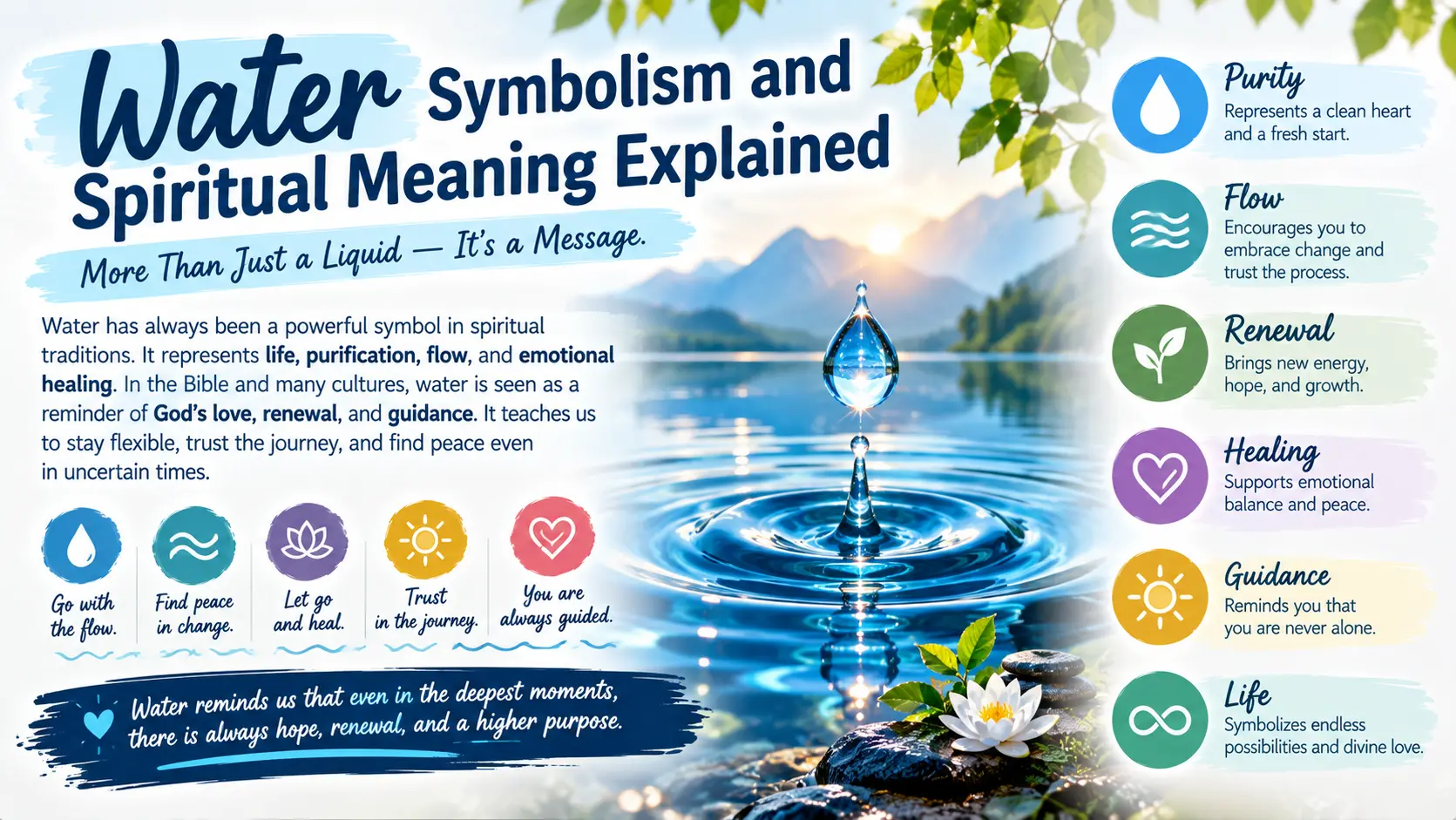
Water Symbolism and Spiritual Meaning Explained
Quick Answer
Water is commonly associated with life, cleansing, renewal, emotional depth, transformation, movement, and spiritual growth. Across American culture and many spiritual traditions, water can represent both peaceful beginnings and powerful change. Its meaning often depends on its form, condition, cultural setting, and the emotions connected to it.
Clear water may suggest peace and clarity, while rain can symbolize renewal. Rivers often represent life’s journey, oceans can suggest mystery and freedom, and turbulent water may represent emotional uncertainty or overwhelming circumstances.
TL;DR
Water symbolizes life, purification, renewal, emotions, transformation, movement, and spiritual connection. Its interpretation is not always positive. Calm water may represent peace, while floods, storms, or muddy water can symbolize uncertainty, emotional pressure, or disruption.
In American life, water symbolism is influenced by religious traditions, Indigenous histories, literature, art, geography, environmental concerns, and everyday experiences with rivers, lakes, rain, and oceans.
What Does Water Symbolize?
Water is one of the most widely recognized symbols in human culture. People depend on it for survival, yet water is also powerful enough to reshape landscapes, carry people across distances, and transform entire ecosystems.
Because of this dual nature, water has developed many symbolic meanings. It can represent life and death, peace and danger, cleansing and destruction, stability and change.
The symbolic meaning of water is rarely fixed. A gentle rain falling on dry ground may feel hopeful, while the same amount of water arriving as a flood can represent loss or disruption. Context is therefore essential when interpreting water symbolism.
Water as a Symbol of Life and Renewal
Water is fundamentally connected with life because plants, animals, and humans require it to survive. This practical reality helps explain why water frequently symbolizes birth, nourishment, fertility, growth, and renewal.
Rain is especially associated with fresh starts because it restores dry landscapes and supports new growth. Symbolically, this can translate into the idea of receiving another opportunity, beginning again, or moving beyond a difficult period.
Why Water Has So Many Meanings
Water constantly changes form. It can be liquid, ice, mist, rain, snow, a stream, or a vast ocean. It can be still or violent, transparent or muddy, shallow or impossibly deep.
These contrasting qualities make water a flexible symbol. Its meaning often comes from what the water is doing and how a person feels when encountering it.
Core Symbolic Meanings of Water at a Glance
Water can carry several meanings simultaneously. The most common symbolic associations include:
| Water Symbolism | Common Meaning |
|---|---|
| Life | Survival, nourishment, existence |
| Cleansing | Purification and release |
| Renewal | Fresh starts and restoration |
| Transformation | Change and personal growth |
| Emotions | Feelings and the subconscious |
| Movement | Progress and life’s journey |
| Peace | Calmness and emotional balance |
| Mystery | The unknown and hidden knowledge |
| Freedom | Openness, movement, and possibility |
| Power | Strength, nature, and uncontrollable forces |
These meanings should be viewed as symbolic interpretations rather than universal rules. The same image can mean something different depending on personal experience, religious background, or cultural context.
Spiritual Meaning of Water
Water has a particularly strong place in spiritual symbolism because it connects physical survival with ideas of purification, renewal, and transformation.
Many traditions use water in ceremonies or stories involving beginnings, cleansing, sacred places, or spiritual transitions. These practices have contributed to water’s enduring association with the movement from one state of being to another.
Water as a Symbol of Cleansing
One of the most common spiritual meanings of water is cleansing. Washing with water can represent removing something unwanted, whether physically, emotionally, or symbolically.
This idea appears in many traditions through ritual washing, immersion, bathing, or sprinkling. Symbolically, cleansing can suggest releasing old burdens and preparing for a new stage.
Water, Renewal, and New Beginnings
Water can symbolize the possibility of starting over. Rain after drought, a flowing stream after winter, or water used in a ceremonial ritual can all evoke restoration.
For someone going through a period of change, water symbolism may therefore feel connected to hope, recovery, forgiveness, and a fresh beginning.
Water and Spiritual Transformation
Water can also represent transformation because it is constantly moving and changing. A person may interpret water as a reminder that life is not permanently fixed.
From a symbolic perspective, flowing water can encourage adaptability. Instead of remaining in one place, it continues forward, responding to the shape of the landscape around it.
Ancient Roots of Water Symbolism
Water symbolism predates modern religions and cultures. Ancient societies depended heavily on rivers, rainfall, springs, and seas, making water central to both survival and mythology.
Communities often settled near dependable sources of water, while unpredictable floods and droughts demonstrated the element’s enormous power. These experiences naturally contributed to spiritual and symbolic interpretations.
Water in Ancient Myths and Rituals
Ancient myths from different regions frequently describe water as a source of creation, destruction, fertility, or transformation. Flood stories, sacred rivers, sea deities, and creation narratives demonstrate the importance of water in early worldviews.
Rituals involving water could also mark transitions, purification, fertility, healing, or religious devotion. Although the meanings differed among cultures, the recurring theme was the special role water played between ordinary life and the sacred.
Sacred Springs, Rivers, and Oceans
Natural bodies of water have often been treated as special places. Springs may have been valued because water emerged from the earth, while rivers represented movement and continuity.
Oceans, meanwhile, could inspire both reverence and fear because of their immense size and unpredictable nature. Symbolically, the ocean became associated with mystery, power, distance, and the unknown.
Water in Religious and Spiritual Traditions
Water appears throughout religious history as a symbol and ritual element. Its meanings vary widely, so it is important not to treat every tradition as though it interprets water in exactly the same way.
In many cases, water represents some combination of purification, sacred transition, life, rebirth, or divine blessing.
Judeo-Christian Influence in the United States
Judeo-Christian traditions have strongly influenced American cultural symbolism. Within Christianity, water is particularly significant in baptism, where it is connected with spiritual renewal and entry into a life of faith.
Biblical stories also give water symbolic importance through themes involving creation, floods, rivers, wilderness, thirst, healing, and spiritual nourishment.
Baptism and Spiritual Rebirth
Baptism is one of the most recognizable examples of water symbolism in American religious life. Water can represent washing away an old identity and entering a renewed spiritual life.
The specific practice varies among Christian denominations. Some traditions use immersion, while others use pouring or sprinkling. The symbolic emphasis may likewise differ, but cleansing and spiritual renewal remain important themes.
Water in Prayer, Purification, and Ritual
Water can also appear in religious practices involving blessing, purification, remembrance, or preparation. These practices demonstrate how an ordinary physical substance can acquire deeper meaning through ritual.
The symbolism does not necessarily mean that water itself possesses supernatural power. Instead, it can serve as a visible representation of an invisible spiritual idea.
Water Symbolism in American Culture
Water has a distinctive role in American culture because of the country’s enormous geographic diversity. Oceans, rivers, lakes, wetlands, deserts, waterfalls, and rain patterns all shape how communities experience water.
Water can therefore symbolize both beauty and survival. It appears in national landscapes, regional identities, stories, songs, paintings, films, and environmental discussions.
Rivers, Lakes, Oceans, and National Identity
Major rivers have historically been associated with exploration, transportation, settlement, agriculture, commerce, and regional identity. Oceans can represent travel, immigration, military power, trade, or freedom.
Lakes and coastal areas often carry a different emotional association, connected with recreation, family memories, relaxation, and seasonal traditions.
Water symbolism in the United States is therefore partly geographical. A person raised near an ocean may associate water with the horizon and freedom, while someone from a landlocked region may associate it more strongly with lakes, rivers, storms, or seasonal weather.
Water in American Art, Music, and Literature
American creative traditions frequently use water as a metaphor for change, memory, freedom, isolation, or emotional depth.
A river may represent a journey, while an ocean can represent an enormous unknown. Rain can create a mood of sadness or reflection, but it can also symbolize hope after hardship.
Because water is familiar to nearly everyone, it provides artists and writers with a powerful way to communicate abstract emotions through recognizable images.
Emotional and Psychological Meaning of Water
Water is often connected with emotions because its changing appearance can resemble changing inner states.
Calm water may evoke peace, while waves, storms, or floods can create feelings of anxiety or instability. These associations are common in storytelling and personal symbolism, although they do not constitute a universal psychological code.
Water and the Inner Emotional World
Still water can be used symbolically to represent reflection, calmness, self-awareness, and emotional balance.
Deep water may suggest feelings that are difficult to understand or fully express. Flowing water can represent emotional movement, while blocked or stagnant water may be used metaphorically for feelings that seem stuck.
Calm Water vs. Rough Water Symbolism
Calm water is commonly interpreted as a sign of peace or stability. Its smooth surface can create an image of emotional control and quiet reflection.
Rough water often carries a contrasting meaning. Waves, whirlpools, storms, and flooding may symbolize stress, conflict, uncertainty, or emotions that feel difficult to control.
Spiritual Meaning of Different Types of Water
The type and condition of water can significantly change its symbolic interpretation. Water is not one universal symbol; its appearance often provides important clues.
Ocean Water
Ocean water commonly symbolizes vastness, mystery, freedom, emotional depth, and the unknown.
Because the ocean extends beyond the visible horizon, it can represent possibilities that cannot yet be fully understood. It may also symbolize a person’s relationship with something larger than themselves.
River Water
Rivers are strongly associated with movement, progress, journeys, and the passage of time.
A flowing river can represent moving forward despite obstacles. Its path may change, but the water continues toward another destination, making it a natural metaphor for life’s ongoing journey.
Rainwater
Rain often symbolizes renewal, cleansing, nourishment, and hope.
However, rain can also represent sadness or emotional release depending on the context. A gentle spring rain and a destructive storm naturally produce very different symbolic impressions.
Still or Clear Water
Clear, still water commonly represents peace, clarity, emotional balance, and understanding.
Its transparency can symbolize seeing a situation honestly or gaining a clearer perspective. Still water may also encourage reflection and quietness.
Muddy or Dirty Water
Muddy water often represents confusion, uncertainty, hidden issues, or emotional disturbance.
It does not automatically mean something negative is happening. Symbolically, muddy water can simply suggest that a situation has not yet become clear or that more information is needed.
What Water Can Represent in Dreams
Water is one of the most frequently discussed dream symbols. However, dreams do not have a single universal dictionary, and the meaning of water in a dream can depend heavily on the dreamer’s emotions and personal experiences.
Rather than assuming a particular image always has one meaning, it can be more useful to consider what happened, how the water looked, and how you felt.
Clear Water in Dreams
Clear water in a dream may be interpreted symbolically as clarity, peace, emotional openness, or a desire for renewal.
If the dream feels calm and comfortable, the water may reinforce those positive associations. If the dreamer feels afraid despite the water being clear, the emotional context becomes more important.
Floods, Waves, and Stormy Water
Flooding and violent waves can symbolize feeling overwhelmed by circumstances or emotions.
Such imagery may also represent major changes that feel beyond personal control. The interpretation should remain personal rather than being treated as a prediction of future events.
Swimming or Walking Through Water
Swimming may symbolize navigating emotions, challenges, or unfamiliar situations.
Walking through water can suggest moving through a difficult period or confronting something that requires effort. Again, the emotional experience of the dream can be more informative than the water itself.
Water Symbolism Across Cultures
Water symbolism appears across cultures, but the meanings are not identical. Different communities have developed their own relationships with particular rivers, seas, rainfall patterns, religious practices, and natural environments.
Some symbolic associations are widespread because humans share similar physical experiences with water. Others are shaped by local history, belief systems, geography, and tradition.
Shared Meanings Across Traditions
Common themes include life, cleansing, renewal, fertility, transformation, movement, and spiritual transition.
These similarities make sense because water is essential to human existence. People across different societies have experienced thirst, rain, rivers, storms, oceans, and the importance of clean water.
Why Interpretations Can Differ
The same water image can have opposite meanings in different circumstances. A flood might symbolize destruction in one context and transformation in another.
Personal experience also matters. Someone who associates the ocean with peaceful vacations may interpret it differently from someone whose life has been shaped by coastal storms.
Modern Uses of Water Symbolism in the USA
Water symbolism continues to appear in modern American life. It has moved beyond traditional myths and religious rituals into personal expression, design, entertainment, wellness culture, and digital communication.
People may choose water imagery because they associate it with personal growth, freedom, peace, resilience, or a connection with nature.
Tattoos, Home Decor, and Jewelry
Water-related tattoos may feature waves, rivers, raindrops, koi, oceans, or symbolic water patterns. These designs can represent personal memories, change, strength, travel, or emotional identity.
In home decor, water imagery may create associations with calmness and relaxation. Ocean artwork, fountains, blue-toned designs, and aquatic motifs are often used to establish a peaceful atmosphere.
Social Media and Digital Expression
Water imagery is also common in digital culture. Ocean photographs, rain videos, waterfalls, and sunset reflections can communicate moods without requiring words.
The symbolism is often simple: calm water can express peace, waves can suggest energy, and rain can create a reflective mood.
Water Symbolism in Common American Contexts
| Context | Common Symbolic Meaning |
|---|---|
| Rain | Renewal, cleansing, change |
| River | Journey, movement, life |
| Ocean | Mystery, depth, freedom |
| Clear water | Peace, clarity, healing |
| Stormy water | Emotional turmoil, uncertainty |
| Flood | Overwhelm, major change |
| Baptism | Rebirth, purification, faith |
These are common symbolic associations rather than fixed meanings. The surrounding situation should always be considered.
Is Water Symbolism Always Positive?
Water is not always a positive symbol. Its power to sustain life is matched by its ability to destroy, overwhelm, isolate, and reshape landscapes.
This contrast is one reason water remains such a powerful symbolic element. It can represent both creation and destruction.
Destructive and Warning-Related Meanings
Floods, hurricanes, dangerous currents, drowning imagery, and violent storms can symbolize fear, loss, instability, or circumstances beyond human control.
In storytelling, destructive water can represent a major turning point. It may destroy an existing structure while creating the conditions for something new.
Why Context Matters
The same water can have completely different meanings depending on the situation.
A river crossing during a peaceful journey may symbolize progress. A river that becomes impossible to cross may instead symbolize an obstacle. A rainstorm after months of drought can feel like a blessing, while the same storm during a flood can be frightening.
How Water Symbolism Has Changed Over Time
Water symbolism has evolved alongside human society. Ancient communities often understood water through survival, agriculture, mythology, and sacred practice. Modern societies add new meanings connected with environmental protection, recreation, infrastructure, and climate concerns.
The symbolic importance of water has therefore not disappeared. Instead, it has expanded.
From Sacred Element to Cultural Symbol
Water remains important in religious rituals, but it is also a powerful cultural image independent of religion.
It can represent travel, freedom, personal identity, relaxation, adventure, nostalgia, and emotional expression. Modern storytelling continues to use water because its physical characteristics provide such rich metaphors.
From Natural Resource to Environmental Responsibility
Today, water can also symbolize stewardship and responsibility. Concerns about clean drinking water, drought, pollution, flooding, and ecosystem protection have made water an important environmental symbol.
In this context, water represents more than personal renewal. It can symbolize humanity’s responsibility to protect the natural systems that support life.
How to Interpret a Personal Water Symbol
If water keeps appearing in your thoughts, dreams, artwork, or personal experiences, it can be useful to consider the surrounding circumstances instead of relying on a single universal interpretation.
Symbolism works best as a tool for reflection rather than a guaranteed prediction.
Consider the Type and Condition of the Water
Ask yourself what kind of water you encountered. Was it an ocean, river, lake, rainstorm, puddle, waterfall, or flood?
Then consider its condition. Was it clear, muddy, frozen, calm, flowing, or violent? These details can dramatically change the symbolic interpretation.
Consider Your Emotions and Life Circumstances
Your emotional reaction may be just as important as the water itself.
If the water made you feel peaceful, it may connect with your desire for rest or emotional balance. If it caused fear, it may reflect uncertainty or a situation that currently feels overwhelming.
FAQs About Water Symbolism and Spiritual Meaning
What does water symbolize spiritually?
Water commonly symbolizes cleansing, renewal, life, transformation, emotional depth, and spiritual growth. Its exact meaning depends on the tradition and context.
Why is water associated with emotions?
Water changes constantly and can be calm, turbulent, deep, or flowing. These qualities provide natural metaphors for changing emotional states and inner experiences.
What does clear water symbolize?
Clear water commonly represents clarity, peace, emotional balance, purity, and understanding. The personal context can influence the interpretation.
What does dirty or muddy water symbolize?
Muddy water may symbolize confusion, uncertainty, emotional disturbance, or unresolved issues. It does not automatically indicate something bad.
What does water mean in dreams?
Water in dreams can symbolize emotions, change, uncertainty, renewal, or personal transformation. The type of water and the dreamer’s feelings are important when interpreting it.
Is water always a positive spiritual symbol?
No. Water can represent positive ideas such as life and renewal, but it can also symbolize danger, loss, emotional overwhelm, destruction, or uncertainty.
Does water symbolism differ across cultures?
Yes. Some meanings, such as life and cleansing, appear across many traditions, while other interpretations are strongly influenced by religion, geography, history, and cultural experience.
What does water symbolize in American culture?
In American culture, water can symbolize freedom, travel, nature, renewal, emotional depth, regional identity, and environmental responsibility. Rivers, lakes, oceans, and rain can each carry different associations.
Conclusion
Water is one of the most versatile symbols in human culture. Its connection with life makes it a natural representation of nourishment, renewal, growth, and survival, while its changing and sometimes destructive nature gives it deeper associations with transformation, uncertainty, and emotional intensity.
In American life, water symbolism is shaped by religion, geography, history, literature, art, personal experience, and modern environmental concerns. A river may represent life’s journey, an ocean may evoke mystery and freedom, rain may suggest renewal, and turbulent water may reflect emotional challenges.
Ultimately, water does not have one universal spiritual meaning. Its symbolism becomes more meaningful when you consider the type of water, its condition, the surrounding circumstances, and the feelings it creates.