Poseidon Symbolism: Meaning, History and Spirituality
Poseidon is one of the most powerful and recognizable gods in ancient Greek mythology. Known as the god of the sea, earthquakes, and horses, he represents the immense strength, beauty, and unpredictability of nature. His most famous symbol is the trident, a three-pronged weapon that reflects his divine authority over the ocean.
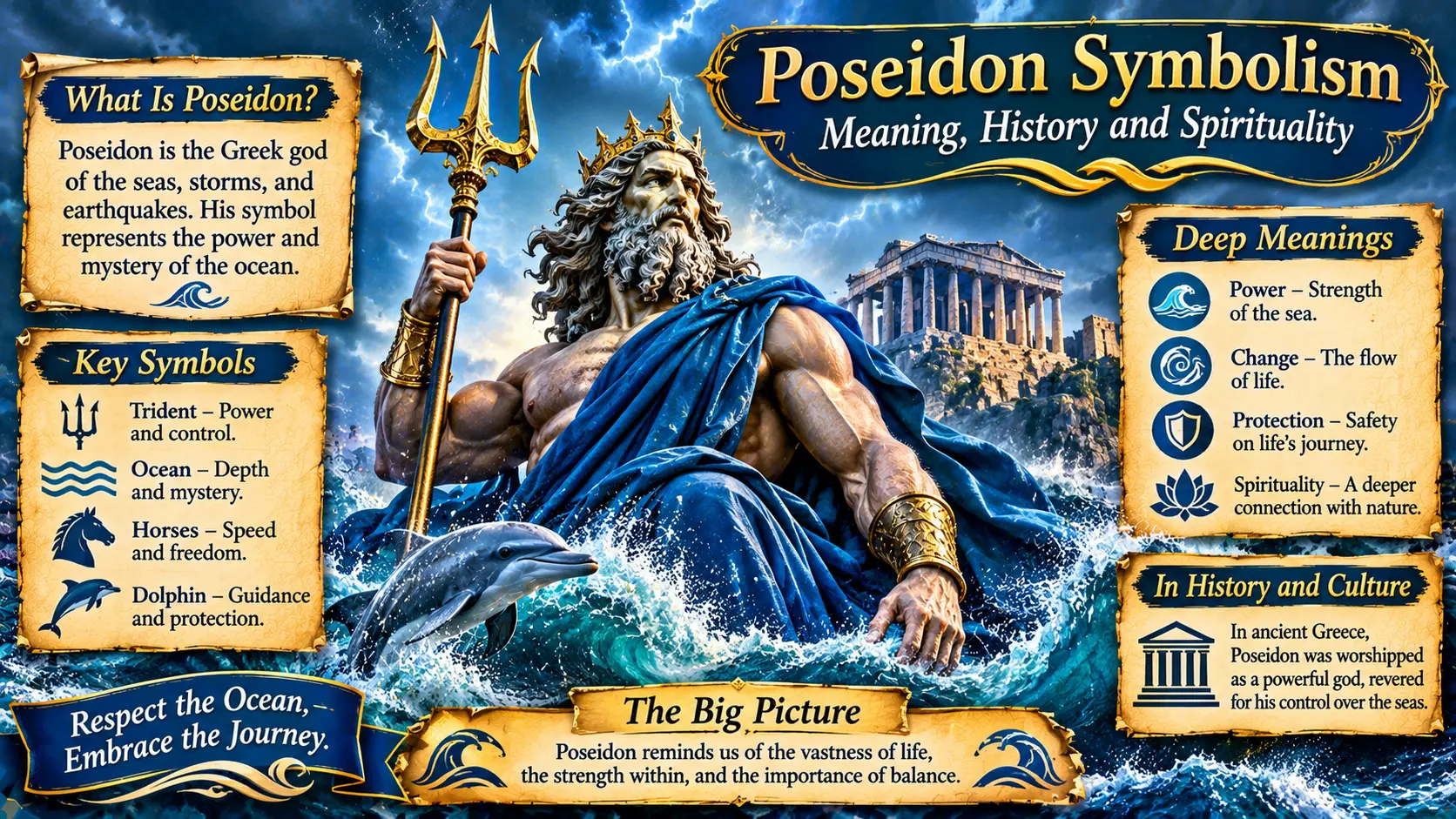
The Poseidon symbol meaning is associated with power, strength, protection, transformation, water, and natural forces. Other symbols connected with him include horses, dolphins, bulls, and mythical sea creatures. Each represents a different aspect of his mythology and his connection with the natural world.
As one of the twelve Olympian gods, Poseidon was the brother of Zeus and Hades. His myths explore the relationship between humans and nature, the dangers of the ocean, and the importance of respecting powerful natural forces. Understanding his symbols reveals why Poseidon remains an enduring figure in Greek mythology, art, and modern culture.
What Is the Poseidon Symbol?
The Poseidon symbol refers to the objects and animals traditionally associated with Poseidon, one of the principal gods of ancient Greek mythology. Although he is primarily known as the ruler of the sea, his divine influence also extends to earthquakes and horses.
His most recognizable symbol is the trident, a three-pronged spear that represents his authority over the ocean. In mythology, Poseidon uses this powerful weapon to stir the waters, create waves, and demonstrate his divine strength.
Other symbols associated with Poseidon include:
- Trident: Divine authority and control over the sea.
- Horse: Strength, speed, and movement.
- Dolphin: Marine life and connection with the ocean.
- Bull: Physical power and force.
- Sea creatures: His dominion over the underwater world.
- Hippocampus: Mythical marine power and movement.
Poseidon was one of the three powerful brothers who divided the universe after defeating the Titans. Zeus received the sky, Hades ruled the underworld, and Poseidon became the ruler of the sea.
Today, his symbols appear in sculptures, paintings, mythology-inspired tattoos, jewelry, literature, and popular culture.
What Does the Poseidon Symbol Mean?
The Poseidon symbol meaning is primarily connected with power, authority, ocean energy, strength, and the forces of nature. His symbols reflect both his protective qualities and his unpredictable personality.
The most common symbolic meanings include:
- Power: The trident represents Poseidon’s divine strength and authority.
- Ocean: His connection with the sea reflects water, marine life, and the mysteries of the deep.
- Strength: Horses and bulls symbolize physical power and determination.
- Protection: Poseidon was worshipped by sailors who sought favorable conditions and safe sea journeys.
- Transformation: The constantly changing ocean can represent life’s transitions and personal growth.
- Earthquakes: His title as the Earth-Shaker reflects the immense power of natural forces.
- Movement: Waves, horses, and marine creatures symbolize energy and motion.
- Authority: His position among the Olympian gods represents leadership and divine influence.
Together, these meanings portray Poseidon as a powerful figure who represents both the beauty and destructive potential of nature.
Poseidon Symbol Meaning: The Main Symbols
Poseidon is associated with several important objects and animals in Greek mythology. Each symbol reveals a different part of his divine identity.
1. The Trident
The trident is Poseidon’s most famous symbol and the clearest representation of his authority over the sea. Its three-pronged design makes it instantly recognizable in ancient Greek artwork and modern mythology-inspired designs.
According to Greek mythology, Poseidon uses his trident to control the waters, create powerful waves, and demonstrate his strength. His weapon is also connected with earthquakes and disturbances in the natural world.
Its common symbolic associations include:
- Authority and leadership.
- Strength and divine power.
- Control over the ocean.
- Natural forces and unpredictability.
- The mystery and depth of the sea.
The trident remains the most recognizable visual representation of Poseidon.
2. The Horse
The horse is another important animal associated with Poseidon. In ancient Greek mythology, he was known as Poseidon Hippios, emphasizing his connection with horses.
Some traditions describe Poseidon as the creator or divine father of extraordinary mythological horses. He is also associated with Pegasus, although ancient accounts differ regarding the circumstances of Pegasus’s birth.
The horse represents strength, speed, freedom, movement, and energy. Its connection with Poseidon demonstrates that his influence extended beyond the ocean.
3. The Dolphin
Dolphins represent Poseidon’s relationship with marine life and the underwater world. As intelligent and graceful ocean creatures, they are frequently associated with the sea god in mythology-inspired artwork.
In ancient Greek traditions, dolphins could also symbolize guidance, rescue, and safe passage across the water.
Their presence in Poseidon’s imagery highlights his connection with the living ocean and its creatures.
4. The Bull
The bull is another animal connected with Poseidon. It symbolizes physical strength, power, fertility, and force.
In several Greek myths, bulls appear in stories involving Poseidon’s divine influence and religious offerings. Their impressive physical strength reflects the god’s association with powerful and sometimes unpredictable natural forces.
5. Sea Creatures
Poseidon is frequently depicted alongside fish, marine animals, and mythical sea creatures. These represent his authority over the ocean and its mysterious underwater world.
One notable creature is the hippocampus, traditionally portrayed with the upper body of a horse and the tail of a fish. These mythical beings are often shown pulling Poseidon’s chariot through the sea.
| Poseidon’s Symbol | Common Symbolic Meaning |
|---|---|
| Trident | Authority, power, and control over the sea |
| Horse | Strength, speed, and movement |
| Dolphin | Marine life and connection with the ocean |
| Bull | Physical power and force |
| Sea creatures | Ocean life and divine authority |
| Hippocampus | Mythical sea power and movement |
Poseidon Trident Meaning
The Poseidon trident is more than a recognizable weapon. It represents his position as the ruler of the sea and his influence over powerful natural forces.
In Greek mythology, Poseidon uses his trident to stir the ocean, create storms, and cause earthquakes. It reflects the different sides of his personality, from protective authority to overwhelming power.
Power and Authority
The trident represents Poseidon’s divine authority. As the god of the sea, he controls an environment essential to ancient Greek transportation, fishing, and trade.
Control Over Water
Water is central to Poseidon’s identity. His trident symbolizes his dominion over the ocean, including its waves, currents, and unpredictable conditions.
Natural Forces
The trident also represents the immense power of nature. The ocean can be peaceful and welcoming one moment and dangerous the next, reflecting Poseidon’s powerful character.
Strength and Leadership
As one of the principal Olympian gods, Poseidon holds an important position in Greek mythology. His trident communicates his strength, status, and divine influence.
Although modern spiritual interpretations sometimes associate its three points with balance or mind, body, and spirit, these are modern interpretations rather than established ancient Greek meanings.
Poseidon Spiritual Meaning
The Poseidon spiritual meaning is commonly interpreted through themes of emotional depth, personal strength, transformation, and respect for nature.
In modern spiritual symbolism, Poseidon can represent the importance of understanding powerful emotions, accepting change, and using personal strength responsibly. These interpretations are inspired by his mythology rather than one fixed ancient religious teaching.
Emotional Depth
The ocean is often used as a metaphor for human emotions. Poseidon’s connection with the sea can represent feelings that are deep, complex, and sometimes difficult to express.
Strength and Confidence
Poseidon represents tremendous power in Greek mythology. His image can inspire courage, confidence, determination, and the ability to face difficult situations.
Change and Transformation
The sea is constantly moving and changing. Its connection with Poseidon can symbolize life’s transitions and the importance of adapting to unfamiliar circumstances.
Respect for Nature
Poseidon’s myths demonstrate that natural forces cannot always be controlled. His symbolism encourages respect for the ocean, the environment, and the power of the natural world.
Personal Responsibility
Poseidon can also inspire reflection on how strength and authority are used. His mythology reminds us that true strength should be guided by wisdom, awareness, and responsibility.
Poseidon Symbolism in Love and Relationships
Poseidon’s mythology includes stories about marriage, relationships, family, and conflict. His wife was Amphitrite, a sea goddess, and their relationship forms an important part of his mythological identity.
In modern symbolic interpretations, Poseidon’s connection with the ocean can represent emotional depth, passion, loyalty, and the changing nature of relationships.
Emotional Depth
The ocean can symbolize feelings that are powerful and difficult to communicate. Poseidon’s symbolism may encourage emotional honesty and deeper understanding between partners.
Strength and Commitment
Poseidon and Amphitrite represent a mythological connection between two sea deities. Their story can inspire reflection on commitment, partnership, and shared responsibilities.
Change in Relationships
Like the changing sea, relationships experience different stages. Poseidon’s symbolism can remind people that patience, understanding, and flexibility are important during difficult periods.
Respect and Responsibility
Some of Poseidon’s myths involve conflict and complicated relationships. These stories also offer an opportunity to reflect on the importance of respect, fairness, and responsible behavior.
Poseidon Meaning for Twin Flames
In modern twin flame interpretations, Poseidon’s symbolism may represent emotional depth, personal transformation, strength, and spiritual growth.
Twin flame beliefs describe an intense spiritual connection between two people, although interpretations differ across spiritual communities. Poseidon is not traditionally recognized as a specific twin flame deity in ancient Greek religion.
People who connect his imagery with twin flame symbolism may interpret it through several themes:
- Emotional understanding: The ocean represents deep feelings and the importance of communication.
- Personal strength: Poseidon symbolizes confidence and inner power.
- Transformation: The changing sea reflects personal development and new experiences.
- Balance: His powerful nature encourages responsible use of emotions and strength.
- Adaptability: The movement of water represents the ability to grow through change.
However, seeing Poseidon’s symbol does not prove that two people are destined to be together or predict a reunion. Healthy relationships depend on mutual respect, communication, trust, and care.
Poseidon Symbolism in Greek Mythology and Religion
Poseidon was one of the most important deities in ancient Greek religion. His influence extended beyond the ocean to include earthquakes, horses, and the protection of sailors.
Poseidon as the God of the Sea
Poseidon was primarily worshipped as the god of the sea. Ancient Greek communities depended on the ocean for fishing, transportation, trade, and communication.
Because sea journeys were often dangerous, sailors prayed to Poseidon for favorable weather and safe passage. His worship reflected both the opportunities and risks associated with maritime life.
Poseidon as the Earth-Shaker
Poseidon was also known as the Earth-Shaker, a title connected with his association with earthquakes.
Ancient Greeks believed his divine power could cause the ground to shake and buildings to collapse. This aspect of his mythology demonstrates that his influence extended beyond water.
Poseidon and Horses
Poseidon was closely associated with horses and was sometimes worshipped as Poseidon Hippios.
His connection with horses was especially important in ancient Greek religious traditions, where horses represented strength, speed, and physical power.
Poseidon and His Family
Poseidon was the brother of Zeus and Hades. He was married to Amphitrite, and their son Triton was a sea deity commonly depicted with a human upper body and a fish-like lower body.
His family connections helped establish his place among the most influential gods of ancient Greece.
Poseidon Symbolism in Dreams
Dreaming about Poseidon may encourage reflection on emotions, strength, change, and your relationship with the natural world.
Dream interpretations are subjective and depend on personal experiences, cultural background, and the details of the dream. The following meanings are possible symbolic associations rather than predictions.
| Poseidon Dream | Possible Symbolic Meaning |
|---|---|
| Poseidon holding a trident | Authority, strength, or confidence |
| Calm ocean | Peace and emotional reflection |
| Rough waves | Uncertainty or challenging circumstances |
| Seeing a dolphin | Connection with nature or guidance |
| Seeing a horse | Energy, determination, or movement |
| Poseidon statue | Interest in mythology or personal strength |
| Ship at sea | A journey or new experience |
| Storm over the ocean | Powerful emotions or uncertainty |
Dreaming of Poseidon’s Trident
Seeing a trident in a dream may symbolize authority, confidence, or the need to make an important decision. It can also reflect an interest in ancient Greek mythology.
Dreaming of Poseidon in the Ocean
Seeing Poseidon near the sea may encourage reflection on your emotions, personal changes, or connection with nature.
Dreaming of Rough Waves
Rough water may represent uncertainty, emotional pressure, or a challenging period. It can serve as a reminder to remain patient during difficult circumstances.
Dreaming of a Calm Sea
A peaceful ocean may symbolize a desire for stability, emotional clarity, and inner peace.
Dreams about Poseidon do not have one universal meaning and should be understood as personal experiences rather than certain signs of future events.
Poseidon Symbolism in Art, Tattoos, and Jewelry
Poseidon has appeared in Greek sculptures, paintings, decorative objects, and modern creative designs for centuries. His distinctive appearance and recognizable trident make him a popular subject in mythology-inspired artwork.
Poseidon in Ancient Art
Ancient Greek artists frequently portrayed Poseidon as a powerful, mature figure holding a trident. He often appears alongside horses, dolphins, and other symbols associated with his divine role.
Sculptures, pottery, and other artworks helped communicate his importance in ancient Greek religious and cultural life.
Poseidon Tattoos
A Poseidon tattoo can represent several personal ideas, including:
- Strength and confidence.
- Connection with the ocean.
- Respect for nature.
- Transformation and personal growth.
- Interest in Greek mythology.
- Leadership and authority.
- Emotional depth and resilience.
The trident tattoo is particularly popular because it directly represents Poseidon’s identity and divine power.
Poseidon Jewelry
Trident pendants, rings, bracelets, and other mythology-inspired accessories often represent an appreciation for ancient Greek culture or a personal connection with the sea.
Some people also choose Poseidon jewelry as a reminder of strength, courage, and adaptability.
Poseidon in Modern Design
Poseidon’s image continues to appear in books, films, video games, decorative artwork, and mythology-inspired fashion. Modern representations often emphasize his commanding presence and authority over the ocean.
What Does It Mean When You See the Poseidon Symbol?
Seeing Poseidon’s trident or image may inspire reflection on strength, transformation, nature, and emotional understanding.
There is no established universal spiritual message associated with encountering this symbol. However, its traditional mythological associations offer several meaningful interpretations.
A Reminder of Strength
Poseidon’s trident represents divine authority and power. It can inspire confidence, courage, and responsible leadership.
A Connection With the Ocean
The symbol may reflect an interest in marine life, ocean conservation, or the natural environment.
An Invitation to Adapt
The ocean is constantly changing. Poseidon’s connection with water can remind us that flexibility and patience are valuable when facing unfamiliar situations.
Respect for Natural Forces
Poseidon’s mythology highlights the immense power of nature. His symbol can encourage greater respect for oceans, weather, and the environment.
Interest in Ancient Mythology
Sometimes seeing a mythological symbol simply reflects curiosity about ancient Greek history, literature, art, or culture.
Poseidon and Other Greek Mythology Symbols
Greek mythology includes many powerful gods, each associated with distinctive symbols and areas of influence.
Although these deities sometimes share similar themes, their symbols represent different aspects of the ancient Greek worldview.
| Greek God | Main Symbol | Common Association |
|---|---|---|
| Poseidon | Trident | Sea, earthquakes, and horses |
| Zeus | Thunderbolt | Sky, thunder, and authority |
| Hades | Helm of Darkness | Underworld and the dead |
| Athena | Owl | Wisdom and strategic warfare |
| Apollo | Lyre | Music, prophecy, and healing |
| Hermes | Caduceus | Communication, travel, and trade |
| Artemis | Bow and arrow | Hunting and wilderness |
Poseidon’s trident distinguishes him from the other Olympian gods. While Zeus represents the sky and thunder, Poseidon symbolizes the ocean and its powerful natural forces.
Common Misconceptions About the Poseidon Symbol
Poseidon is a familiar figure in Greek mythology, but some explanations of his symbols can be misleading. Understanding their historical context helps separate traditional beliefs from modern interpretations.
Misconception 1: Poseidon Is Only the God of the Sea
Poseidon is best known as the god of the sea, but his mythological responsibilities also include earthquakes and horses.
Misconception 2: The Trident Is His Only Symbol
The trident is his most recognizable symbol, but horses, dolphins, bulls, and mythical sea creatures are also associated with him.
Misconception 3: Poseidon and Zeus Are the Same God
Poseidon and Zeus are brothers, but they have different divine responsibilities. Zeus rules the sky, while Poseidon rules the sea.
Misconception 4: Poseidon Represents Only Peaceful Water
Poseidon symbolizes both the beauty and danger of the ocean. His mythology includes calm waters, storms, earthquakes, and destructive natural forces.
Misconception 5: The Trident Has One Universal Spiritual Meaning
The trident’s established mythological meaning is connected with Poseidon’s authority and power. Modern interpretations may associate it with balance or personal growth, but these are not universal ancient Greek beliefs.
Misconception 6: Poseidon Was a Minor Greek God
Poseidon was one of the principal Olympian gods and held an important position in ancient Greek mythology and religious practices.
What Can the Poseidon Symbol Teach Us About Life?
Poseidon’s mythology offers several ideas that can inspire personal reflection and a deeper understanding of the natural world.
1. Understand the Power of Nature
The ocean is beautiful but powerful. Poseidon’s stories remind us to respect nature and recognize that humans cannot control every natural force.
2. Use Strength Responsibly
Poseidon represents tremendous power and authority. His mythology encourages reflection on how strength and leadership should be guided by responsibility.
3. Accept Change
The sea is always moving. Its connection with Poseidon can symbolize the importance of adapting to new circumstances and remaining resilient.
4. Develop Confidence
The trident represents divine authority. It can serve as a reminder to develop confidence, courage, and the ability to take responsibility.
5. Value Knowledge
Learning about Poseidon reveals how ancient Greeks used mythology to understand natural events, human experiences, and the world around them.
6. Respect the Ocean
Poseidon’s identity is deeply connected with the sea. His symbolism can inspire greater awareness of marine environments and the importance of protecting ocean life.
Frequently Asked Questions About Poseidon Symbol Meaning
What does the Poseidon symbol mean?
The Poseidon symbol represents power, authority, the ocean, strength, and natural forces. His trident is the most recognizable symbol of his divine role.
What is Poseidon’s main symbol?
Poseidon’s main symbol is the trident, a three-pronged weapon associated with his authority and power over the sea.
What does Poseidon’s trident represent?
The trident represents Poseidon’s divine authority, strength, and control over the ocean. It is also associated with his connection to earthquakes and natural forces.
What animals are associated with Poseidon?
Poseidon is associated with horses, dolphins, bulls, and various sea creatures. These animals represent different aspects of his mythology and divine identity.
What is the spiritual meaning of Poseidon?
In modern spiritual interpretations, Poseidon can represent emotional depth, strength, transformation, adaptability, and respect for nature. These are symbolic interpretations rather than one fixed ancient religious teaching.
What does Poseidon represent in Greek mythology?
Poseidon is the god of the sea, earthquakes, and horses. He is one of the principal Olympian gods and the brother of Zeus and Hades.
What does a Poseidon tattoo symbolize?
A Poseidon tattoo may represent strength, confidence, connection with the ocean, transformation, leadership, or an interest in ancient Greek mythology.
What does Poseidon symbolize in dreams?
Poseidon in a dream may inspire reflection on emotions, strength, personal challenges, and change. Its interpretation depends on the dreamer’s individual experiences.
Who is Poseidon’s wife?
Poseidon’s wife in Greek mythology is Amphitrite, a sea goddess. Their son Triton is also associated with the ocean.
Why is Poseidon associated with horses?
Poseidon has a strong connection with horses in ancient Greek mythology and was sometimes called Poseidon Hippios. Horses represent strength, speed, movement, and physical power.
Final Thoughts
The Poseidon symbol meaning reflects power, authority, the ocean, and the immense forces of nature. His trident remains his most recognizable symbol, while horses, dolphins, bulls, and mythical sea creatures reveal other aspects of his divine identity.
As the Greek god of the sea, earthquakes, and horses, Poseidon represents both the beauty and unpredictability of the natural world. His mythology also offers lasting themes of strength, adaptability, and respect for nature. Whether appearing in ancient sculptures, modern tattoos, or popular culture, Poseidon’s symbols continue to capture the mystery and extraordinary power of the ocean.