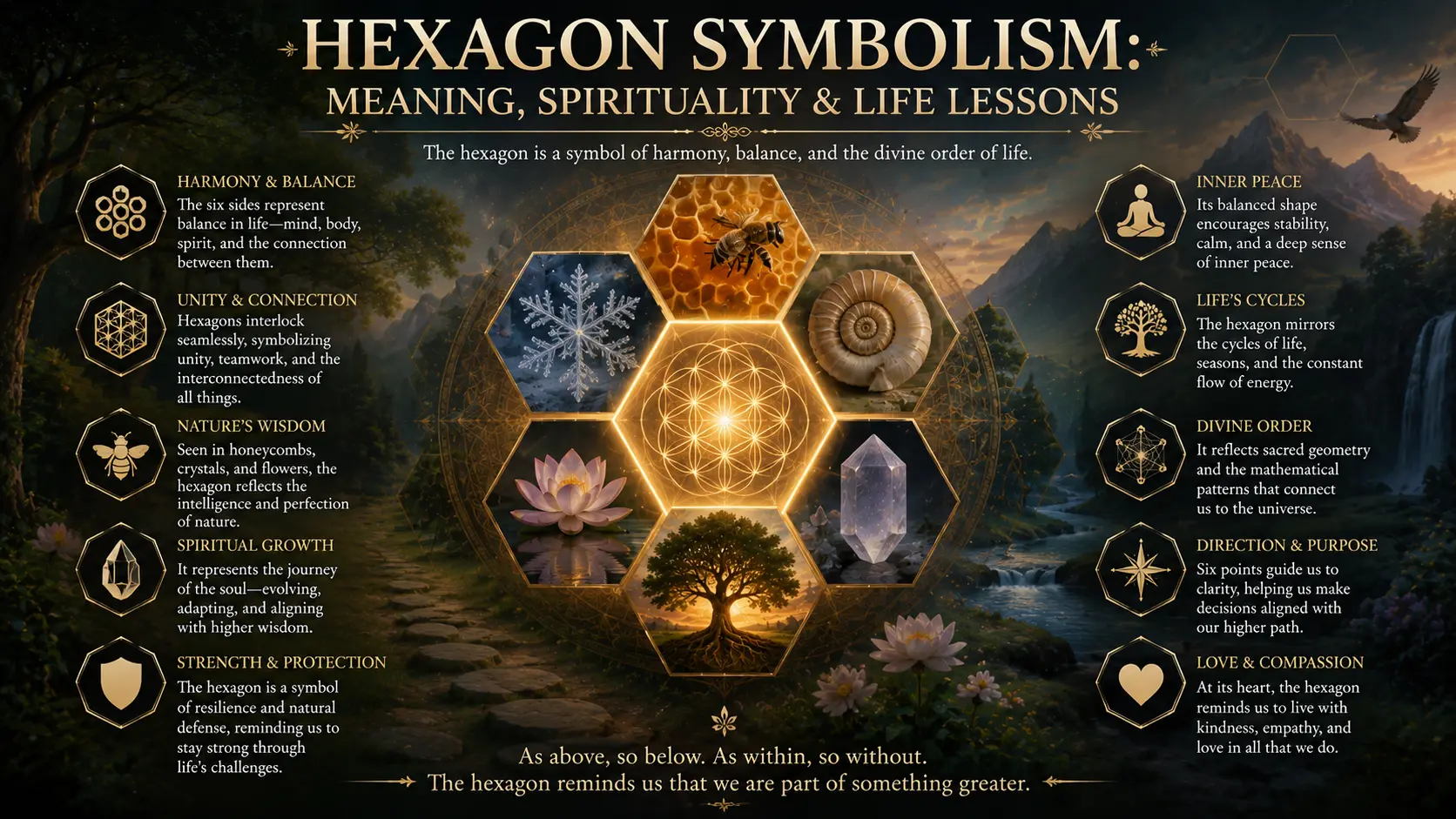
Hexagon Symbolism: Meaning, Spirituality & Life Lessons
A hexagon is more than a six-sided geometric shape. Across nature, mathematics, architecture, spirituality, and art, the hexagon is often associated with balance, structure, cooperation, harmony, and efficient use of space. Its distinctive form can appear both highly organized and naturally beautiful, which makes it an appealing symbol for people exploring deeper meanings.
From the honeycomb created by bees to the geometric patterns found in snowflakes and sacred designs, hexagons frequently represent the relationship between individual parts and a larger whole. Spiritually, they may be interpreted as symbols of stability, connection, protection, transformation, and harmony.
It is important to remember that symbolic meanings are interpretive rather than universal rules. A hexagon can mean different things depending on its cultural, religious, artistic, or personal context.
What Does a Hexagon Symbolize?
The Core Meaning of the Hexagon
At its simplest, a hexagon represents sixness, structure, symmetry, and interconnectedness. Six equal sides can create a visually balanced form, while multiple hexagons can fit together without leaving gaps.
This quality gives the hexagon a strong association with organization and cooperation. One hexagon may stand alone, but repeating hexagons demonstrate how individual units can become part of a larger system.
Balance, Harmony, and Stability
The symmetry of a regular hexagon naturally suggests balance. Its six sides distribute the shape’s structure around a central point, creating an appearance of stability.
Symbolically, this can inspire ideas about maintaining equilibrium between different parts of life—such as work and rest, individuality and community, or ambition and patience.
Unity and Connection
Hexagons can connect seamlessly into larger patterns. This makes them useful metaphors for relationships, communities, networks, and collective strength.
The symbolism suggests that strength does not always come from standing alone. Sometimes, stability comes from understanding how individual parts support one another.
Historical and Cultural Meaning of the Hexagon
Hexagons in Ancient Civilizations
Geometric forms have appeared throughout ancient art, architecture, decoration, and mathematical traditions. While not every historical hexagon carried a specific symbolic meaning, geometric patterns were frequently used to communicate order, symmetry, proportion, and cosmic organization.
Ancient builders and artists recognized that repeating geometric shapes could create visually powerful designs. The hexagon’s symmetry made it particularly useful in decorative patterns and structured compositions.
Hexagons in Eastern Traditions
In several Eastern philosophical and artistic traditions, geometric forms have been incorporated into diagrams, mandalas, architectural motifs, and symbolic systems. Six-sided or interlocking forms can sometimes be connected with concepts involving balance, opposing forces, and the relationship between different dimensions of existence.
The exact meaning varies considerably between traditions, so it is better to view the hexagon as a geometric framework that can acquire symbolic meaning within a particular system, rather than assigning one universal Eastern interpretation.
Hexagons in Modern Culture
Today, the hexagon appears everywhere from architecture and branding to technology and interior design. Modern interpretations often emphasize efficiency, innovation, intelligence, organization, and connectivity.
Because hexagonal patterns can communicate both natural beauty and technical precision, they have become popular in contemporary visual language.
Spiritual Meaning of the Hexagon
Balance Between Opposing Forces
The hexagon can symbolize the need to bring different forces into equilibrium. Its symmetrical structure provides a visual reminder that opposing qualities do not always need to compete.
Spiritually, this may represent finding harmony between strength and gentleness, action and reflection, independence and cooperation.
Protection and Inner Strength
A strong geometric boundary can also be interpreted as a symbol of protection. The six-sided structure creates a defined interior space while remaining connected to surrounding forms.
For personal reflection, the hexagon can therefore represent healthy boundaries, emotional stability, and the strength to protect what matters without becoming isolated.
Harmony and Spiritual Growth
Because hexagons can repeat and expand into larger patterns, they may also symbolize gradual growth. One stable unit can become part of a much more complex design.
This creates a useful spiritual metaphor: personal development does not always happen through dramatic transformation. Sometimes it happens through small, balanced improvements that eventually create a larger pattern of growth.
Hexagon Symbolism in Nature
Honeycombs and the Symbolism of Bees
The honeycomb is one of the most recognizable examples of hexagonal geometry in nature. Bees construct hexagonal cells to store honey, pollen, and support their colony.
Because of this association, hexagons are often linked symbolically with hard work, cooperation, productivity, community, and resourcefulness.
The honeycomb also demonstrates how individual spaces can form a highly organized collective structure. As a metaphor, it suggests that cooperation can produce results that are difficult to achieve individually.
Snowflakes and Natural Geometry
Many snowflakes display sixfold symmetry, making them another powerful natural association with the hexagon.
Snowflakes can symbolize uniqueness within structure. Although they follow underlying physical principles, individual snowflakes develop distinctive forms.
This provides a meaningful reminder that having structure does not mean losing individuality.
Basalt Columns and Geological Patterns
Certain volcanic landscapes contain striking hexagonal column patterns formed through natural cooling and contraction processes.
These formations demonstrate that geometric order can emerge from natural physical processes. Symbolically, they can represent patience, transformation, resilience, and hidden order within apparent chaos.
Hexagon Symbolism in Religion and Spiritual Traditions
Christianity and Sacred Geometry
The hexagon itself is not a universal Christian symbol with one fixed meaning. However, sixfold geometric patterns can appear in Christian art, architecture, decoration, and discussions of sacred geometry.
In some symbolic interpretations, the number six can be connected with creation and human existence, particularly through biblical associations with the six days of creation.
However, interpretations differ, so the specific artistic or theological context matters.
Hinduism and Eastern Spirituality
Geometric diagrams play an important role in several Indian spiritual traditions. Interlocking triangular forms, for example, can create six-pointed or hexagonal centers within sacred designs.
These patterns can represent the interaction of complementary forces, such as masculine and feminine principles or different aspects of cosmic balance, depending on the specific tradition.
Indigenous and Traditional Symbolism
Geometric patterns appear in the visual traditions of many Indigenous and traditional cultures around the world. However, their meanings are highly specific to individual communities, histories, and ceremonial contexts.
Therefore, a hexagon should not automatically be assigned a single “Indigenous meaning.” Its interpretation should be understood within the culture where the symbol appears.
Hexagon Symbolism in Sacred Geometry
The Hexagon and the Flower of Life
The hexagon is closely related to patterns found within the Flower of Life, a geometric design made from overlapping circles.
When circles are arranged around a central circle at equal distances, recognizable hexagonal relationships emerge. This connection has made the hexagon important in modern discussions of sacred geometry.
Symbolically, such patterns are often associated with unity, interconnectedness, balance, and the underlying order of creation.
Six-Pointed Geometric Forms
Interlocking triangles can create a six-pointed star-like structure containing hexagonal relationships. Such designs have been interpreted in different religious and cultural contexts.
The important point is that the meaning belongs to the specific symbol and tradition, not simply to the fact that six sides are present.
The Meaning of Six Sides
The number six can contribute another layer of symbolic interpretation. In numerological and spiritual traditions, six is sometimes associated with harmony, responsibility, nurturing, balance, and relationships.
When combined with geometric symmetry, these associations can make the hexagon feel like a visual representation of balanced interconnectedness.
Hexagon Symbolism in Art, Architecture, and Design
Hexagonal Patterns in Art
Artists use hexagons to create repetition, symmetry, rhythm, and visual movement. A single hexagon can act as a focal point, while repeating hexagons can create intricate patterns.
The form can therefore symbolize both individual identity and collective structure.
Hexagons in Architecture
Hexagonal forms can be used in floors, windows, facades, tiles, roofs, and structural patterns. Their ability to tessellate makes them visually attractive and practically useful.
In architectural symbolism, the hexagon can suggest precision, stability, efficiency, and connection.
Modern Design and Visual Symbolism
Contemporary designers frequently use hexagonal shapes in logos, interfaces, packaging, furniture, and decorative patterns.
Because the shape feels simultaneously organic and technical, it can communicate ideas such as innovation, intelligence, technology, natural systems, and organized complexity.
Hexagon Symbolism in Dreams
Seeing a Hexagon in a Dream
Dream symbolism is highly personal, so seeing a hexagon does not have one predetermined meaning.
It may represent a desire for order, stability, balance, boundaries, or connection. The emotional atmosphere of the dream is often more important than the shape alone.
A Broken or Distorted Hexagon
A damaged or incomplete hexagon could metaphorically reflect feelings of instability, conflict, separation, or something unfinished.
For example, if the dream feels stressful, the broken shape might represent a disrupted sense of balance. If the dream feels peaceful, it could instead symbolize transformation or the process of rebuilding.
Repeated Hexagon Dreams
Repeated geometric imagery may indicate that your mind is focusing on patterns, organization, or something that feels structured in your waking life.
Rather than treating the dream as a prediction, consider asking what the hexagon represents to you personally and what was happening around it.
Hexagon Symbolism in Science and Technology
Mathematics and Geometric Perfection
A regular hexagon has six equal sides and six equal internal angles. Its symmetry makes it an important shape in geometry.
Its ability to tessellate efficiently also explains why hexagonal patterns appear in mathematics, design, and natural systems.
Chemistry and Molecular Structures
Hexagonal arrangements occur in chemistry and materials science. One famous example is the hexagonal arrangement associated with carbon atoms in graphene.
This scientific association can contribute modern symbolic ideas of strength, connectivity, innovation, and advanced structure.
Engineering and Technology
Engineers use hexagonal forms because they can provide practical advantages in construction, manufacturing, fastening, materials, and spatial organization.
The common hexagonal nut is a simple everyday example. Its shape demonstrates how geometry can combine function, stability, and efficiency.
Symbolism Ideas | Meaning, Inspiration & Modern Applications
Hexagon Symbolism in Literature and Metaphor
Hexagons as Symbols of Order
In literature and creative writing, geometric shapes can become metaphors for systems and structured thinking.
A hexagon may represent a life that has clearly defined boundaries or a world where seemingly separate elements follow an underlying pattern.
Transformation and Personal Growth
Because hexagonal patterns can expand through repetition, the shape can become a metaphor for gradual development.
One small improvement may appear insignificant by itself, but repeated improvements can create a strong and recognizable structure.
Connection, Community, and Relationships
The interlocking nature of hexagonal patterns makes them especially useful metaphors for relationships.
A person may be independent like a single cell, yet still depend on connections with family, friends, colleagues, or a wider community.
Hexagon Symbolism in Everyday Life
Hexagonal Objects and Their Meanings
Hexagons appear in everyday objects such as tiles, nuts and bolts, decorative mirrors, tables, shelving, jewelry, artwork, and packaging.
Their presence can be purely practical, but people may also find symbolic value in their appearance. A hexagonal object can remind someone of organization, balance, cooperation, or strength.
Why Hexagonal Patterns Feel Meaningful
Humans naturally recognize symmetry and repeating patterns. When a shape appears repeatedly in nature or design, it can feel orderly and significant.
This does not necessarily mean the pattern carries a supernatural message. Sometimes its appeal comes from the way our minds respond to symmetry, repetition, and visual harmony.
Using Hexagon Symbolism for Personal Reflection
You can use the hexagon as a personal reflection symbol without believing that it has a fixed spiritual power.
Ask yourself where you need more balance, which relationships provide support, and whether your daily habits are creating a stable foundation for your goals.
Life Lessons From Hexagon Symbolism
Finding Balance
The symmetrical hexagon can remind us that a balanced life requires attention to multiple areas.
Success in one area does not necessarily compensate for complete neglect elsewhere. Balance can mean creating enough space for work, relationships, rest, learning, and personal development.
Building Strong Foundations
A stable structure begins with strong individual components. The hexagon provides a visual metaphor for building life gradually rather than expecting instant results.
Small habits, consistent decisions, and clear boundaries can eventually create significant stability.
Embracing Cooperation and Connection
The honeycomb demonstrates how individual units can contribute to a much larger system.
Likewise, personal strength does not always mean doing everything alone. Healthy cooperation can multiply individual effort and create stronger communities.
Creating Order From Complexity
Hexagonal patterns show how a simple shape can become remarkably complex when repeated.
This can inspire a practical life lesson: when life feels overwhelming, focus on one manageable part at a time. Order can emerge gradually from consistent small actions.
Hexagon Symbolism in Popular Culture
Logos and Branding
Brands often use hexagons because they can communicate modernity, precision, technology, efficiency, and organization.
The shape can feel less rigid than a square while appearing more structured than a circle, giving designers a versatile middle ground.
Film, Games, and Visual Media
Hexagonal patterns frequently appear in futuristic interfaces, science-fiction environments, game maps, energy shields, technology displays, and fantasy artwork.
In these settings, the shape often reinforces ideas of technology, systems, intelligence, networks, and advanced civilization.
Contemporary Symbolic Uses
Modern culture has expanded the hexagon’s symbolic range. It may represent environmental systems, digital networks, scientific discovery, architecture, teamwork, or mathematical beauty.
Its meaning depends heavily on how it is presented and what surrounding imagery communicates.
Common Hexagon Symbolism Meanings at a Glance
| Hexagon Symbolism | Common Interpretation |
|---|---|
| Balance | Harmony between different forces |
| Stability | Strong foundations and structure |
| Unity | Individual parts working together |
| Cooperation | Collective effort and community |
| Protection | Boundaries and security |
| Growth | Expansion through connected stages |
| Efficiency | Smart use of space and resources |
| Nature | Honeycombs, snowflakes, and natural geometry |
| Sacred geometry | Interconnection and geometric order |
| Technology | Precision, networks, and innovation |
| Creativity | Pattern, symmetry, and visual design |
| Transformation | Order developing from complexity |
Frequently Asked Questions About Hexagon Symbolism
What Is the Spiritual Meaning of a Hexagon?
A hexagon can spiritually symbolize balance, harmony, stability, protection, interconnectedness, and growth. Its meaning depends on the spiritual tradition and personal circumstances in which it appears.
What Does a Hexagon Represent in Sacred Geometry?
In sacred geometry, the hexagon is often associated with symmetry, unity, interconnectedness, and natural order. Its relationship to circles and other geometric forms makes it a recurring component of sacred geometric patterns.
What Does Seeing a Hexagon Mean Spiritually?
Seeing a hexagon may personally inspire thoughts about balance, organization, boundaries, or connection. There is no universally established spiritual rule stating that seeing one guarantees a particular message or event.
Why Are Hexagons So Common in Nature?
Hexagonal arrangements can emerge because they efficiently organize space and can result from physical processes. Honeycombs are a famous example, while sixfold symmetry appears in snowflakes and other natural structures.
Is a Hexagon a Symbol of Balance and Harmony?
Yes, balance and harmony are common modern interpretations of the hexagon, largely because of its symmetry and interconnected structure. However, the exact meaning varies according to context.
Final Thoughts on Hexagon Symbolism
Hexagon symbolism brings together nature, geometry, spirituality, science, art, and everyday life. Its six-sided structure can represent balance and stability, while its ability to connect with other hexagons suggests cooperation and unity.
From bee-created honeycombs to snowflakes, architecture, sacred geometry, and modern technology, the hexagon demonstrates how simple structures can become part of complex systems. That makes it a powerful metaphor for personal development: strong foundations, balanced relationships, consistent effort, and meaningful connections can create something greater than any single part.
Ultimately, the meaning of a hexagon depends on context. Whether you encounter one in a dream, artwork, spiritual practice, scientific setting, or ordinary object, the most useful interpretation is often the one that encourages thoughtful reflection rather than rigid certainty.